




About this worksheet
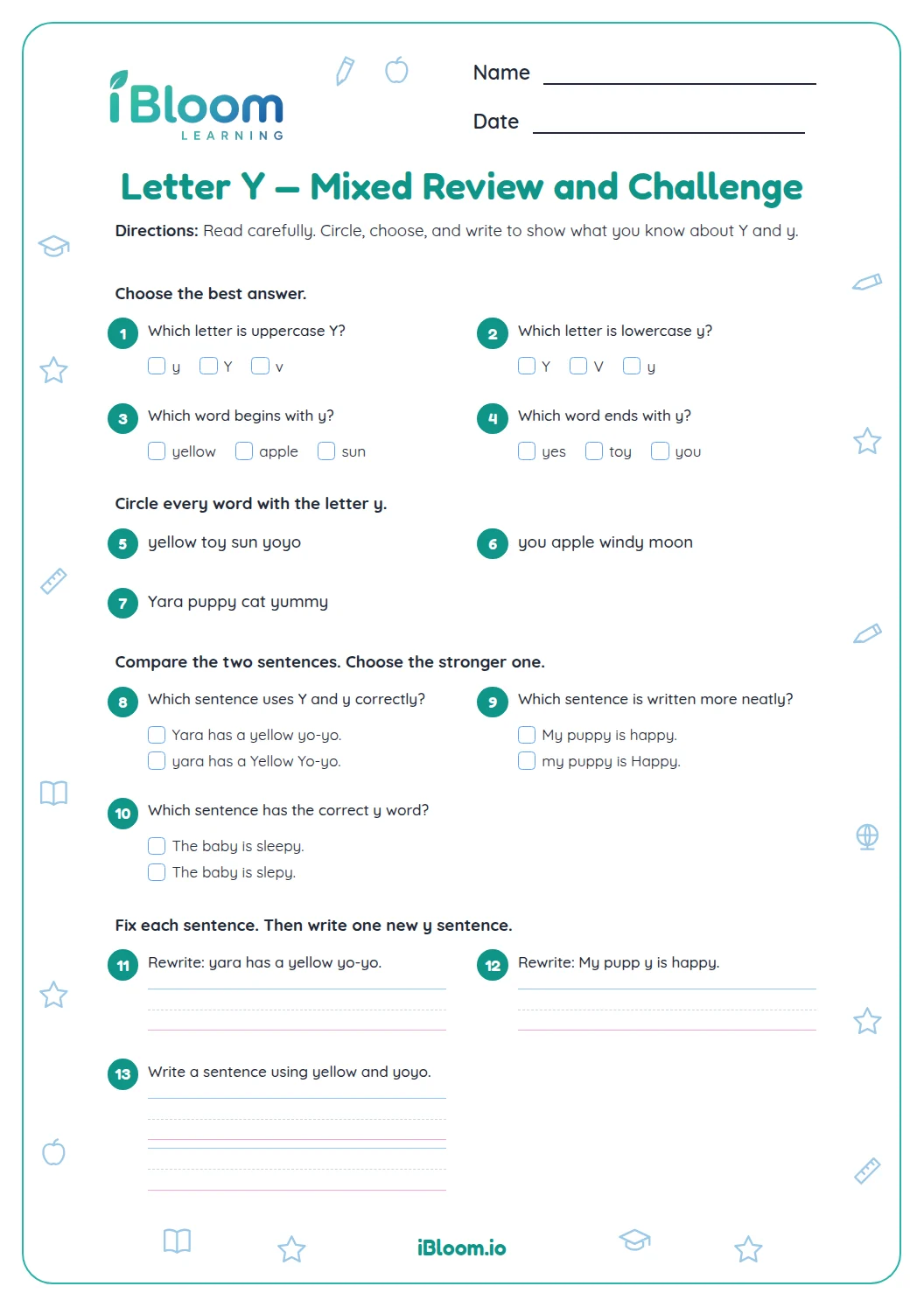
This free printable worksheet gives Grade 1 children a full round of practice with the letter Y, from the first pencil stroke to a finished sentence. In Part A, they trace the capital and small letters together, then the word yo-yo. In Part B, they choose the y word that completes four short sentences. In Part C, they pick the sentence with a capital letter and an end mark. In Part D, they write sentences of their own with yellow and you. It supports Common Core L.1.1a and L.1.2b, and a two-page answer key shows every answer and sample sentences.
Aligned to L.1.1a and L.1.2b
What is on this letter Y worksheet?
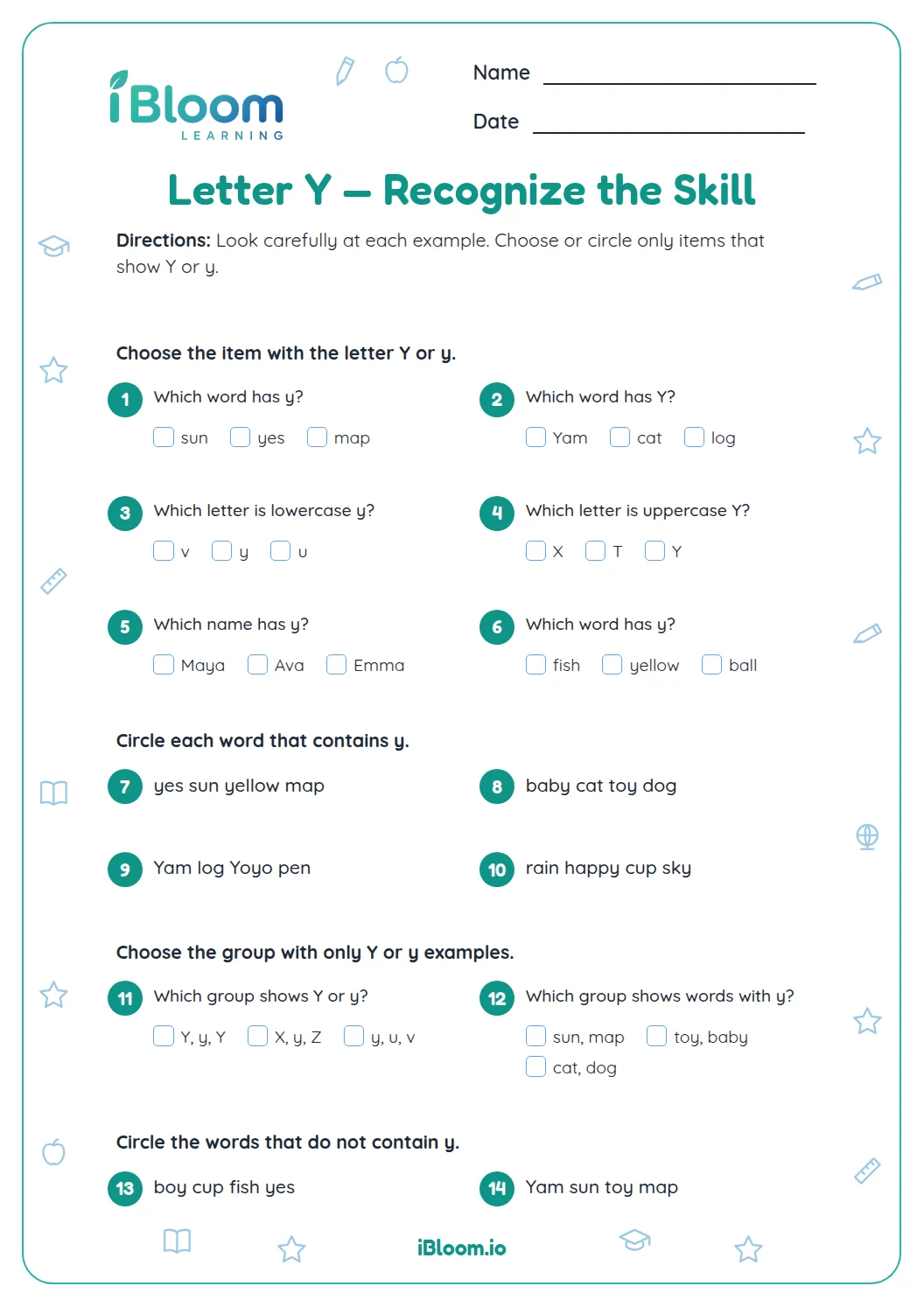
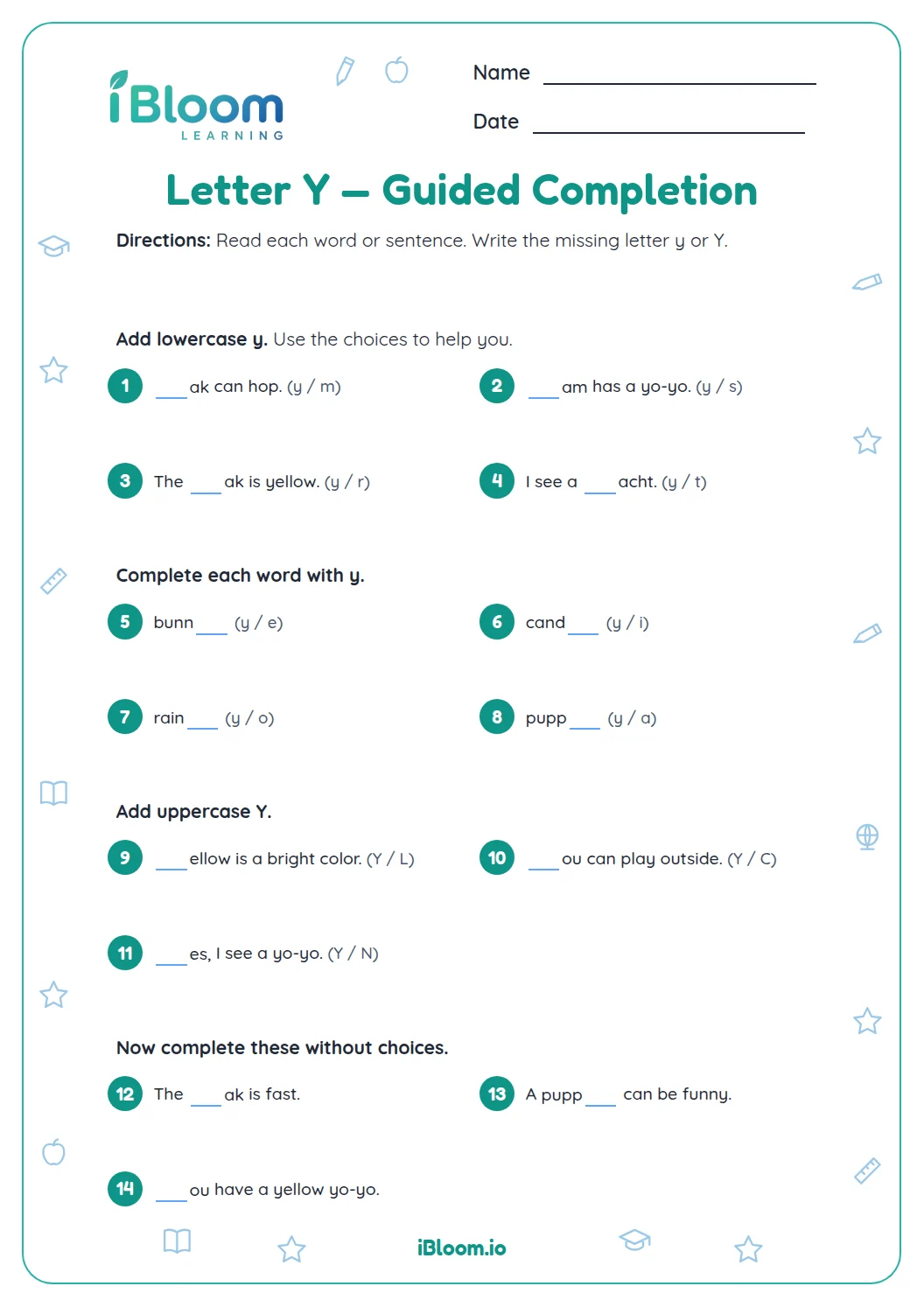
Ten questions in four parts move children from tracing to choosing to writing. The y words are short and familiar: yes, yarn, yo-yo, yellow, yummy and you.
Part A has two tracing lines, and the gray letters show the shape to follow. Parts B and C are quick multiple-choice questions. Part D has two writing lines, each with room for a full sentence.
- Part A: trace Yy and yo-yo (questions 1 and 2)
- Part B: pick the y word that fits the sentence (questions 3 to 6)
- Part C: pick the sentence with a capital and an end mark (questions 7 and 8)
- Part D: write a sentence with yellow and one with you (questions 9 and 10)
How do you write a capital Y and a small y?
The capital Y is made of two short slanted lines that meet in the middle, followed by one straight line down. The small y looks similar but is shorter, and its tail drops below the writing line. That tail is the part children forget most often.
Before your child traces, trace the letter once in the air with two fingers. Then let them follow the gray letters on the page, saying the word as they go. On the second line they trace the word yo-yo, which has a small y at the start of each half.
Does the letter Y always make the same sound?
At the start of a word, Y makes the sound you hear in yes, yarn, yo-yo, yellow and you. At the end of a word like yummy, it makes a long e sound instead. Part B puts both kinds of y word in front of your child, so read each sentence aloud and listen for which word fits.
If a choice sounds funny, say the sentence with each word. “A ripe banana is purple” does not sound right, but “A ripe banana is yellow” does.
- 14) Mom knits a hat with ___. sand milk yarn
- 2Read it with each word: a hat with sand? a hat with milk? a hat with yarn?
- 3Only yarn makes sense, and it starts with y.
- 4Answer: yarn
Why check for a capital letter and an end mark?
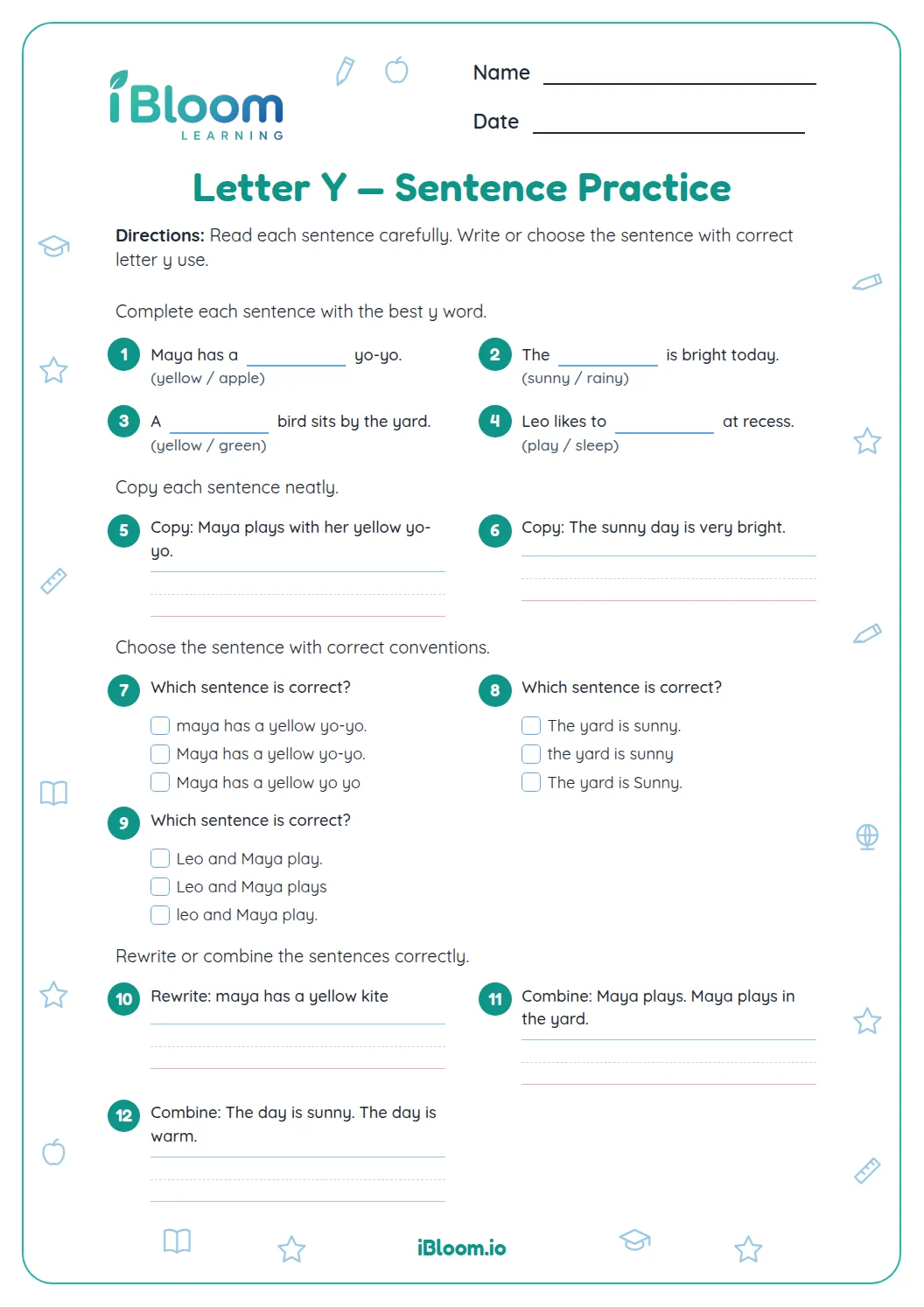
Writing a letter well is only the first step. First graders also need to remember that a sentence begins with a capital letter and ends with a mark such as a period. Part C shows three versions of one sentence and asks which is written correctly, so children practice proofreading before they write.
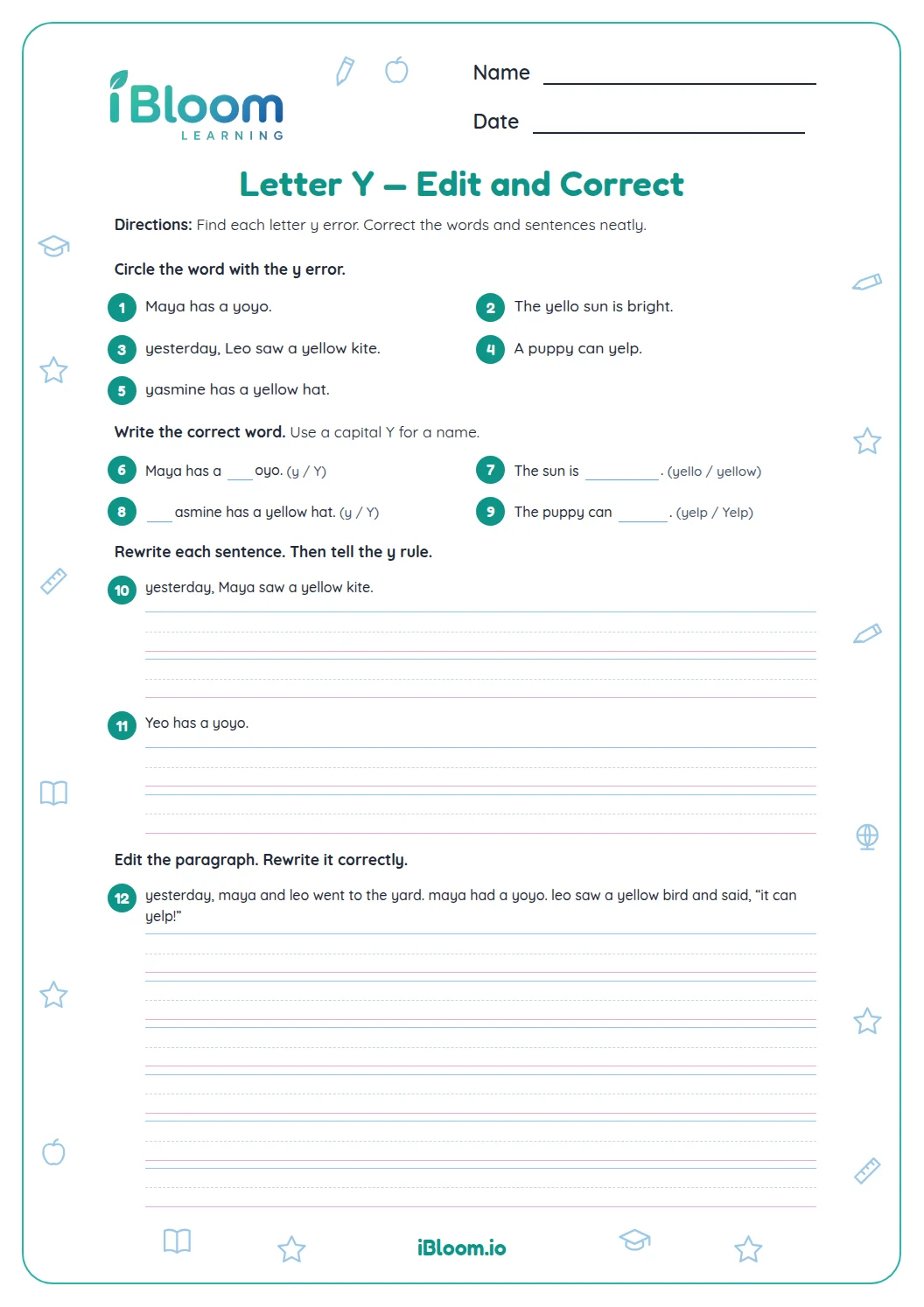
In Part D, they apply the same checks to their own sentences. Reading each sentence aloud once more, then pointing to the first letter and the last mark, takes only a few seconds.
How to use this worksheet at home or in class
- 1Say the sound of y together and name two words that begin with it, such as yes and yellow.
- 2Trace Y and y in the air, then let your child trace the gray letters in Part A, saying each word aloud.
- 3Read the Part B sentences to your child if needed, and let them say each choice before marking one.
- 4In Part C, have your child point to the first letter and then to the end of each sentence before choosing.
- 5For Part D, let your child say the sentence out loud first, then write it with a capital letter and a period.
- 6Check with the answer key and ask your child to read one finished sentence to you.
Common mistakes and quick fixes
The mistake
Writing the small y so the tail sits on the line, which makes it look like a v.
The fix
Draw a clear baseline and show that the tail of y goes down through it. Trace the long diagonal stroke again, slowly, past the line.
The mistake
Choosing “i like yarn.” in question 7 because it ends with a period, without noticing the small i.
The fix
Teach two checks in order: look at the first letter, then look at the end. Both must be right, and only “I like yarn.” passes.
The mistake
Writing a capital Y in the middle of a sentence, as in “I like to play with You.”, because the sheet is all about Y.
The fix
Remind your child that the capital letter belongs at the start. The word you stays small in the middle of a sentence.
Common Core alignment
These two Grade 1 language standards cover the letter work and the sentence marks on this page.
Print the capital Y and the small y, and words that use them, such as yo-yo.
On this sheet: Part A traces Yy and yo-yo, and Part D has children print their own y words in sentences.
Show the official wordingHide the official wording
Print all upper- and lowercase letters.
End each sentence with a period or other mark, as in Parts C and D.
On this sheet: Part C asks which sentence ends correctly, and Part D asks children to end their own sentences.
Show the official wordingHide the official wording
Use end punctuation for sentences.
What to practice next
Make more practice
Further reading
Questions parents and teachers ask
Why does this letter Y worksheet use words like yo-yo and yarn?
These are short, familiar words that begin with the y sound, so children hear the letter clearly. Yo-yo is also a good tracing word because it has two small y letters, one at the start of each half, which gives two chances to form the letter's tail below the line.
Is yummy a y word if the y sounds like e?
Yes, it is a y word because it contains the letter. In yummy, the first y says its usual sound, /y/, and the last y says a long e. Part B uses it on purpose so children see that the same letter can sound different depending on where it sits.
How long should the sentences in Part D be?
One short sentence is enough, such as “I see a yellow bird.” The goal is a capital letter at the start, the y word spelled correctly and an end mark. If your child wants to write more, that is fine, but a single complete sentence meets the goal.
My child cannot read the Part B sentences yet. What should I do?
Read each sentence aloud and let your child say each choice in the blank. Hearing the sentence usually makes the right word clear. As they get more confident, point to the words while you read so they begin to match the spoken words to the print.
What does the answer key show for Part D?
The key shows a sample sentence for each prompt, such as “I see a yellow bird.” and “I like to play with you.” Many different sentences are correct. Check that your child's sentence uses the word, starts with a capital letter, ends with a period and makes sense when read aloud.
What should we practice after the letter Y?
Move on to Letter Z to finish the alphabet, then try the Print Letters worksheets, which mix all the letters together. Letter X and Letter W are good review if a slanted line still wobbles. The trace letters generator can make a custom sheet for any letter that still needs work.