

About this worksheet
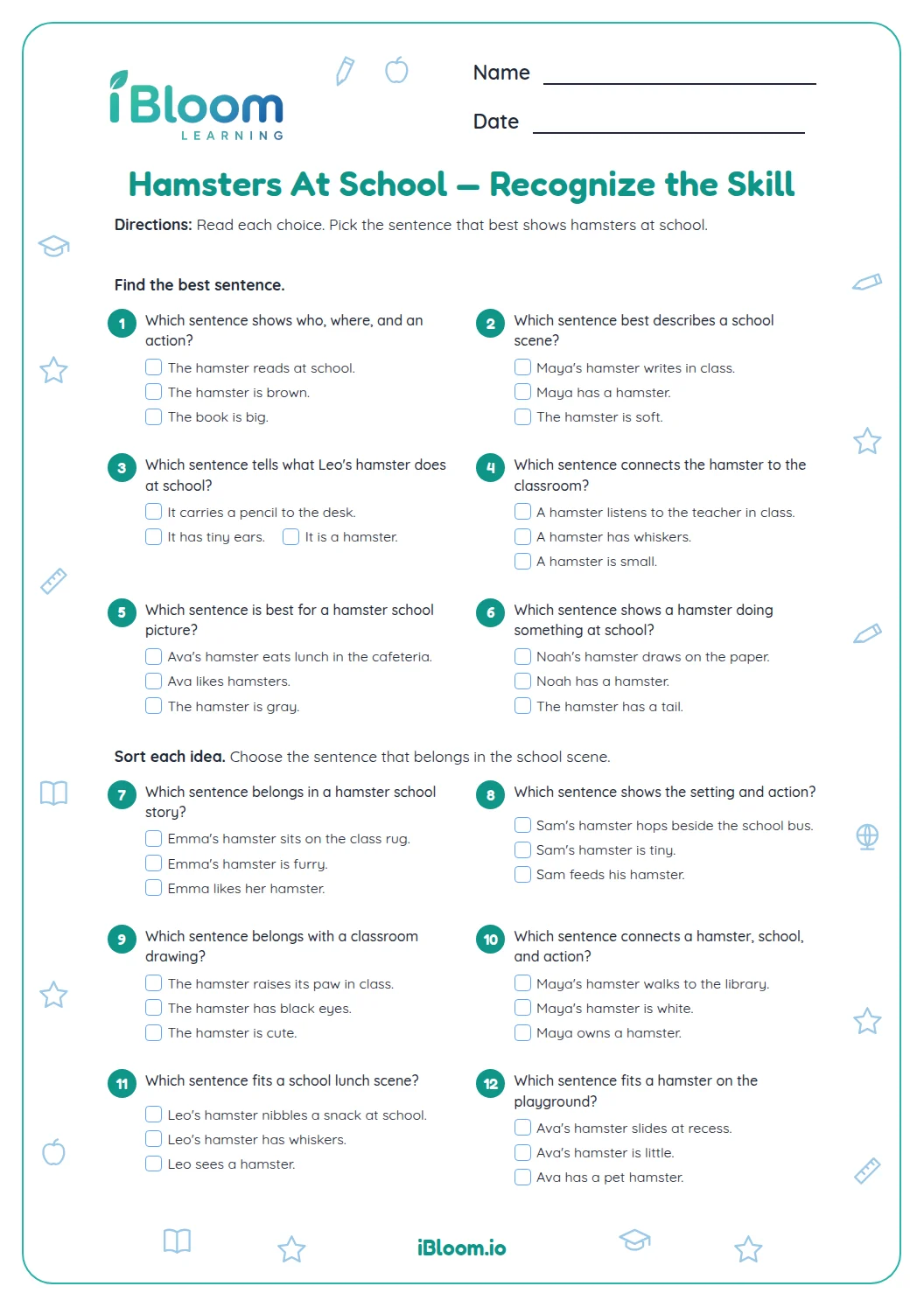
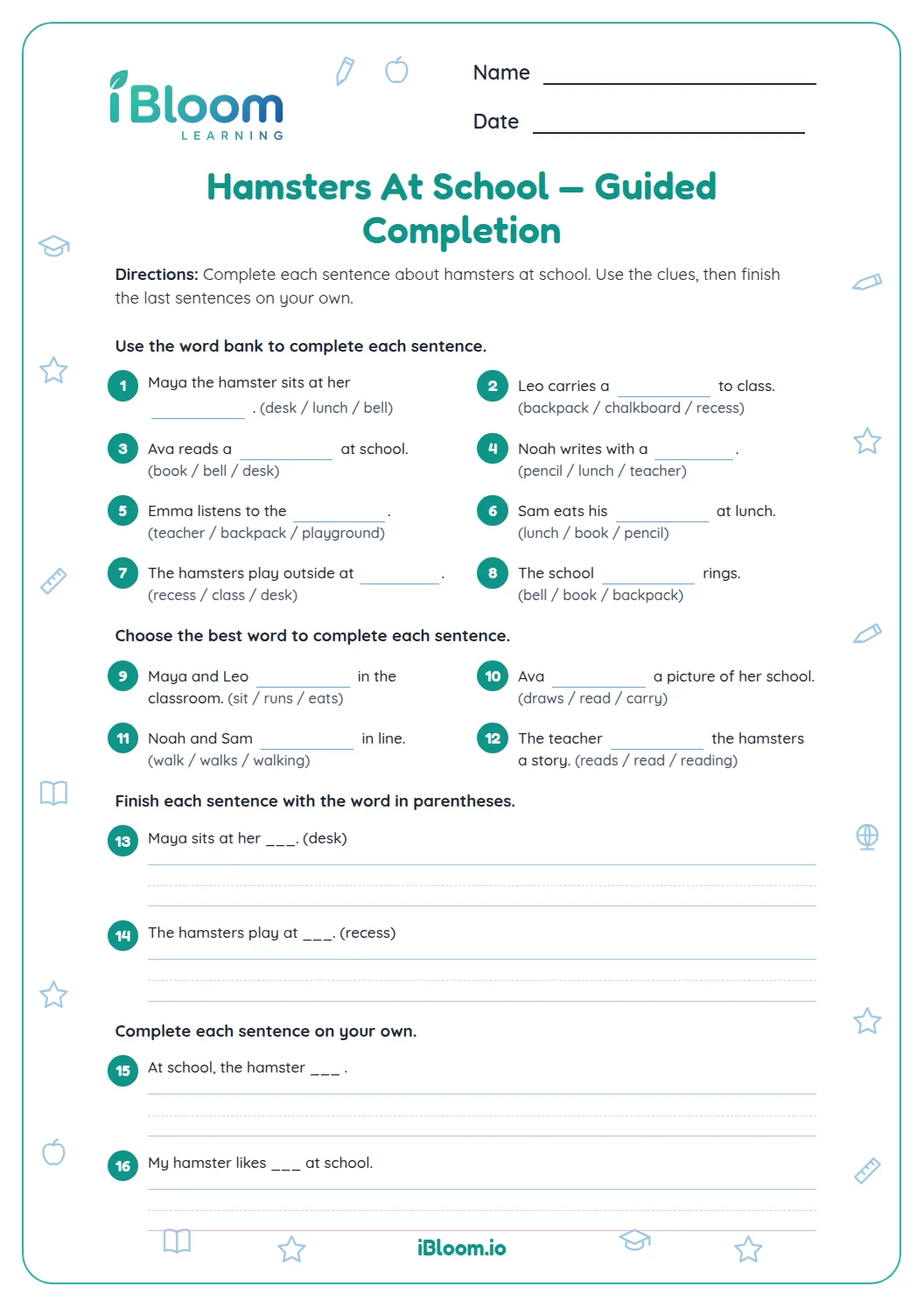
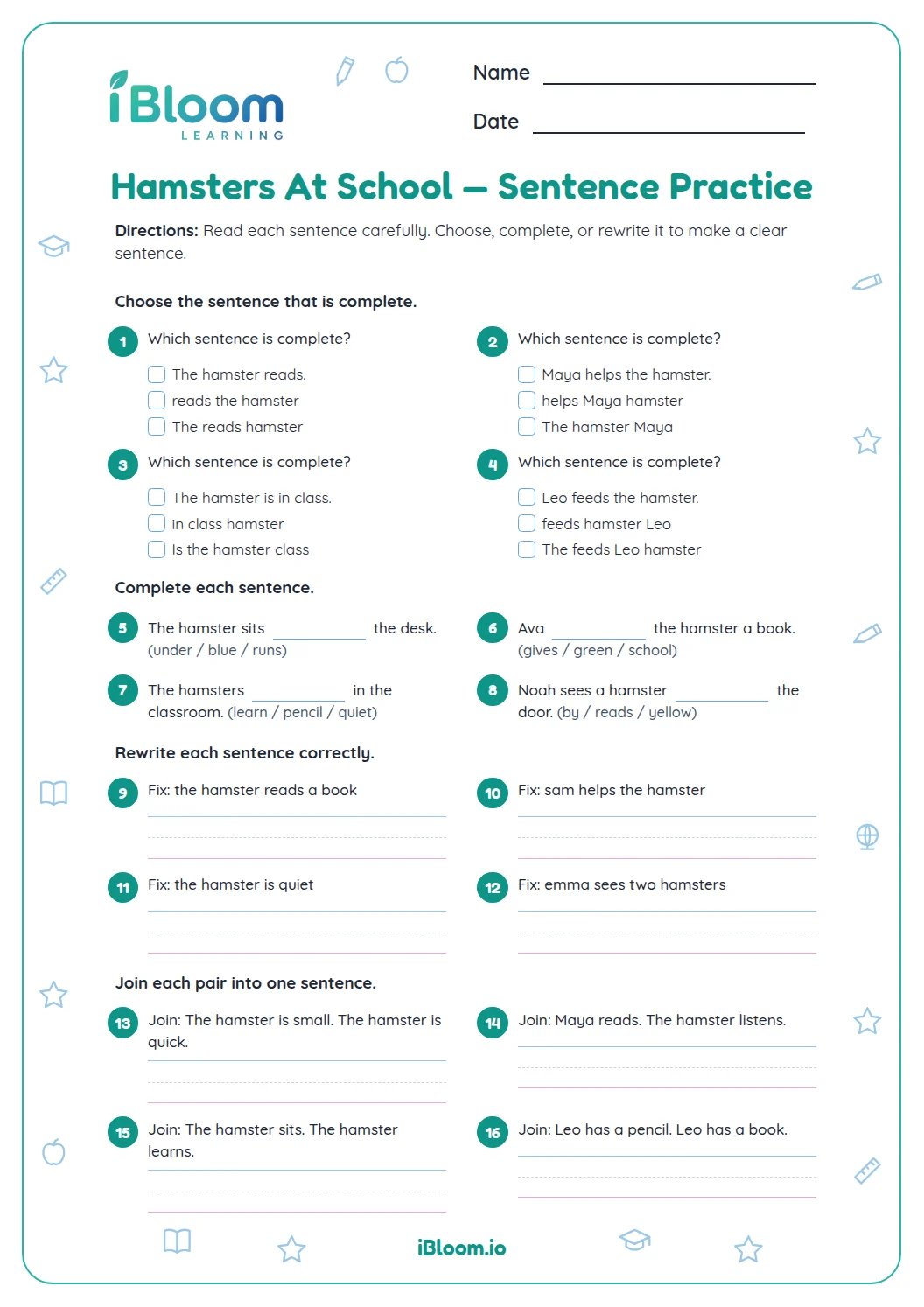
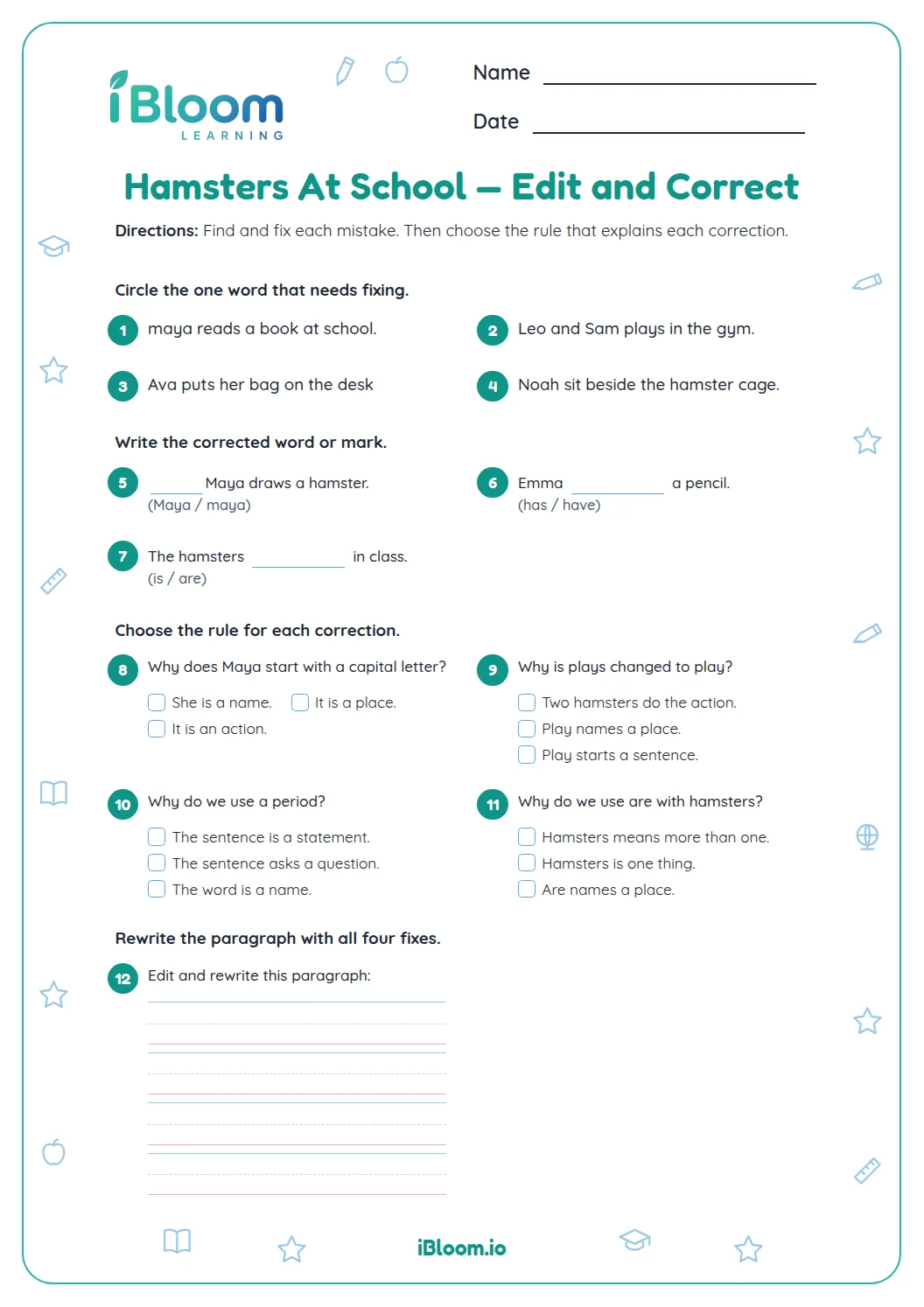
This Grade 1 printable uses a hamster-at-school theme to practice sentence writing and short narratives. Children complete sentences, fix capitals and end marks, spot details, and choose clear story events. The final draw-and-write prompt asks them to sequence two school events, add a detail, and finish the story. A separate answer key gives answers and a sample story goal.
Aligned to W.1.3 and L.1.2
How does the sheet build from sentence choices to stories?
Part A completes school sentences with a capital letter, a time word, or an end mark. For example, question 1 changes “___ip reads a book” to “Pip reads a book.”
Part B asks children to notice details in a short sentence; question 7 asks them to circle “desk.” Part C chooses a strong complete sentence or story event.
How can a child turn a prompt into a short story?
Question 11 asks which event happened first. “First, Pip hung up his coat” gives the opening action, while “Then Pip opened his bag” belongs later. In question 14, children use that sequence in a two-event school story with a detail and an ending.
What does the answer key show for open responses?
The key is a guide, not a script. For sentence prompts, it gives a sample; for the draw prompt, it lists the main scene details to look for. Accept a different response when it is complete, understandable, and fits the prompt.
How to use the worksheet
- 1Read each prompt aloud if that helps your child get started.
- 2For sentence choices, ask which option has a subject and tells a complete thought.
- 3When editing, check the first letter and the mark at the end.
- 4For story prompts, say the events in order before writing.
- 5Use one specific detail, such as a red book or a quiet room.
- 6Compare each open answer with the key’s idea, not only its exact words.
Common slips and quick fixes
The mistake
Starting a sentence with a lowercase letter.
The fix
Point to the first word and check whether it needs a capital.
The mistake
Writing an event list with no order words.
The fix
Add first, next, or then to show what happens when.
The mistake
Drawing a scene that does not match the story.
The fix
Reread the prompt and make the picture show the same school event.
Common Core alignment
This sheet practices the following Common Core skill.
Sequence story events, add details, use time words and give the story an ending.
On this sheet: The story prompts ask children to sequence events, add details, and bring a school-day story to a close.
Show the official wordingHide the official wording
Write narratives in which they recount two or more appropriately sequenced events, include some details regarding what happened, use temporal words to signal event order, and provide some sense of closure.
Use standard capitalization and punctuation while writing.
On this sheet: The editing prompts practice capitals at sentence starts and names, plus end punctuation.
Show the official wordingHide the official wording
Demonstrate command of the conventions of standard English capitalization, punctuation, and spelling when writing.
What to practice next
Make more practice
Further reading
Questions parents and teachers ask
What does this hamster worksheet ask a first grader to do?
It has 14 hamster-themed questions: five sentence completions, four word-circling sentences, four choices, and one draw-and-write narrative. A separate answer key gives the missing words, correct choices, and story criteria. Children finish by drawing two events and writing a short, ordered story.
How many questions and pages are included?
There are 14 questions in four parts, plus a separate answer key. The page moves from sentence completions to detail spotting, sentence choices, and one draw-and-write narrative about Bean at school. The final prompt asks for two ordered events, a detail, and an ending in both the picture and the sentences.
What should a child include in the story prompts?
A short story can name what happened first and next, add a concrete detail, and finish the idea. For example, a child might say Pip hangs up his coat, joins reading time, and feels ready to learn. A small action or object can serve as the detail, such as a coat, pencil, or book.
Does the answer key require one exact story?
No. The final draw-and-write prompt allows many sensible school stories. The key gives a sample idea and names what to look for: two events in order, a detail, and an ending. A child may choose another school event as long as the sentences and picture fit the prompt.
How can an adult support the drawing and writing?
Ask the child to tell the two events aloud before writing. Prompt with “What happens first?” and “What detail can you add?” Then have the child draw the same events and write a sentence for each. Let the child explain how the picture and words show the story in order.