







About this worksheet
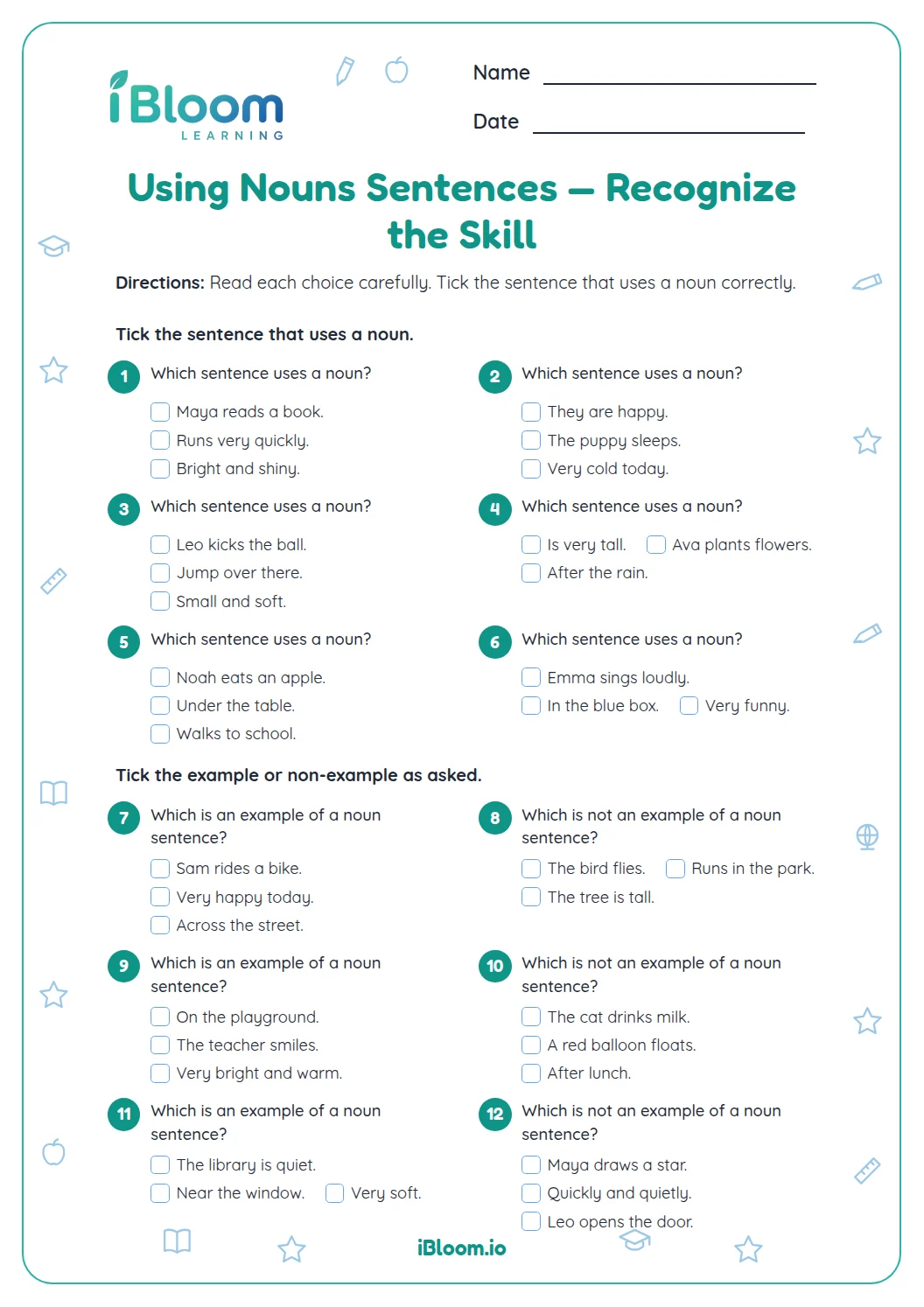
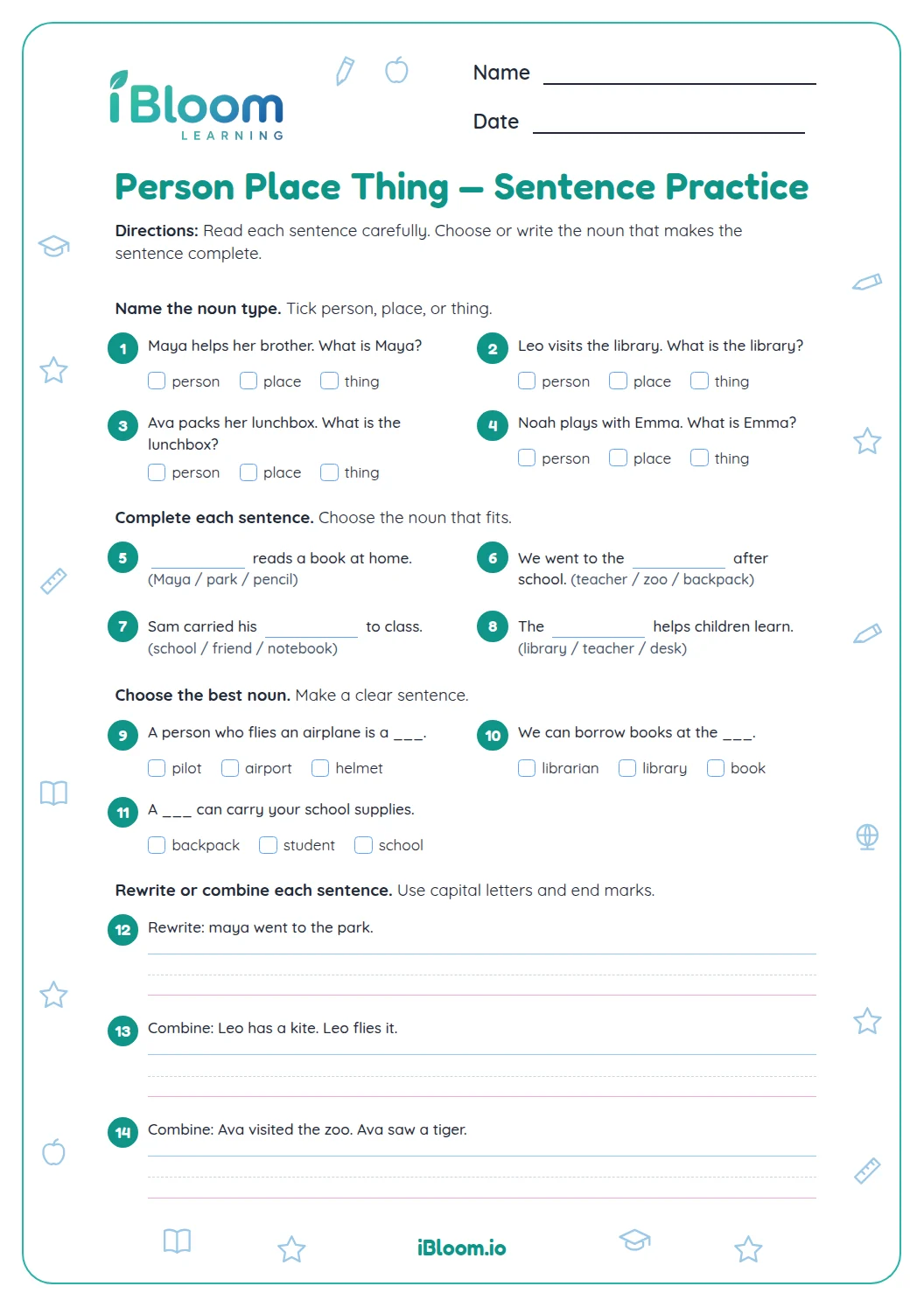
This printable keeps practice centered on nouns in sentences. Children name person, animal, place, and thing nouns, choose a noun to complete a sentence, compare sentence examples, and fix capitals. The last items ask for a place or animal noun and one short sentence. The key includes answers and a sample sentence.
How can children spot a noun?
Ask who or what the sentence is about, then look for a naming word. A sentence may include more than one noun: “Maya carried a basket” has Maya (person) and basket (thing).
Question 1 asks for the person noun in “Maya carried a basket.” The answer is Maya.
- 1Sentence: Maya carried a basket.
- 2Who carried it? Maya (person)
- 3What was carried? basket (thing)
How can a noun help make a complete sentence?
A noun can be the subject or another important part of a sentence. Add a word that fits the meaning, then reread the whole sentence. “A flower blooms in the garden” names a thing and a place.
What should writers check when editing nouns?
Names of specific people begin with capital letters. Every sentence begins with a capital and ends with punctuation. Read the whole sentence to make sure the noun fits the action.
How can I use this sheet?
- 1Read the whole sentence once.
- 2Ask who or what is named.
- 3Sort the noun as person, place, animal, or thing if helpful.
- 4For blanks, choose a naming word that makes sense.
- 5Reread your own sentence for capitals and an end mark.
What errors should I watch for?
The mistake
Calling an action word a noun.
The fix
Ask who or what does the action; the naming word is the noun.
The mistake
Forgetting to capitalize a person’s name.
The fix
Capitalize names such as Maya and Mia.
The mistake
Writing a noun without a complete thought.
The fix
Add an action or describing idea and end punctuation.
What to practice next
Make more practice
Questions parents and teachers ask
What kinds of words are nouns?
Nouns name people, places, animals, or things. In “The rabbit rests,” rabbit names the animal; in “We visited the library,” library names a place. On this worksheet, children identify nouns doing different jobs in complete sentences and use them to make their own sentences.
Can a sentence have more than one noun?
Yes. “Maya carried a basket” has two nouns: Maya names a person, and basket names a thing. Find every word that names someone or something. The worksheet includes both single-noun prompts and sentences with several nouns, so students practice noticing nouns in context.
Are there different correct answers for the blank prompts?
Yes. The blank prompts accept different nouns when each makes a sensible sentence. The answer key gives one sample, not the only possible choice. A response should fit the sentence and name a person, place, animal, or thing.
Why does Mia need a capital letter?
Mia is a specific person’s name, so it begins with a capital letter. The corrected sentence also starts with a capital and ends with punctuation. Rereading aloud can help children hear where the sentence begins and ends, then check that names are capitalized.
How many questions are on the worksheet?
There are 16 questions: noun identification, sentence completion, choices, editing, and original writing. The key provides sample sentences for open responses. Students can compare their own complete, sensible sentences with those examples and check that the requested noun type is included.