




About this worksheet
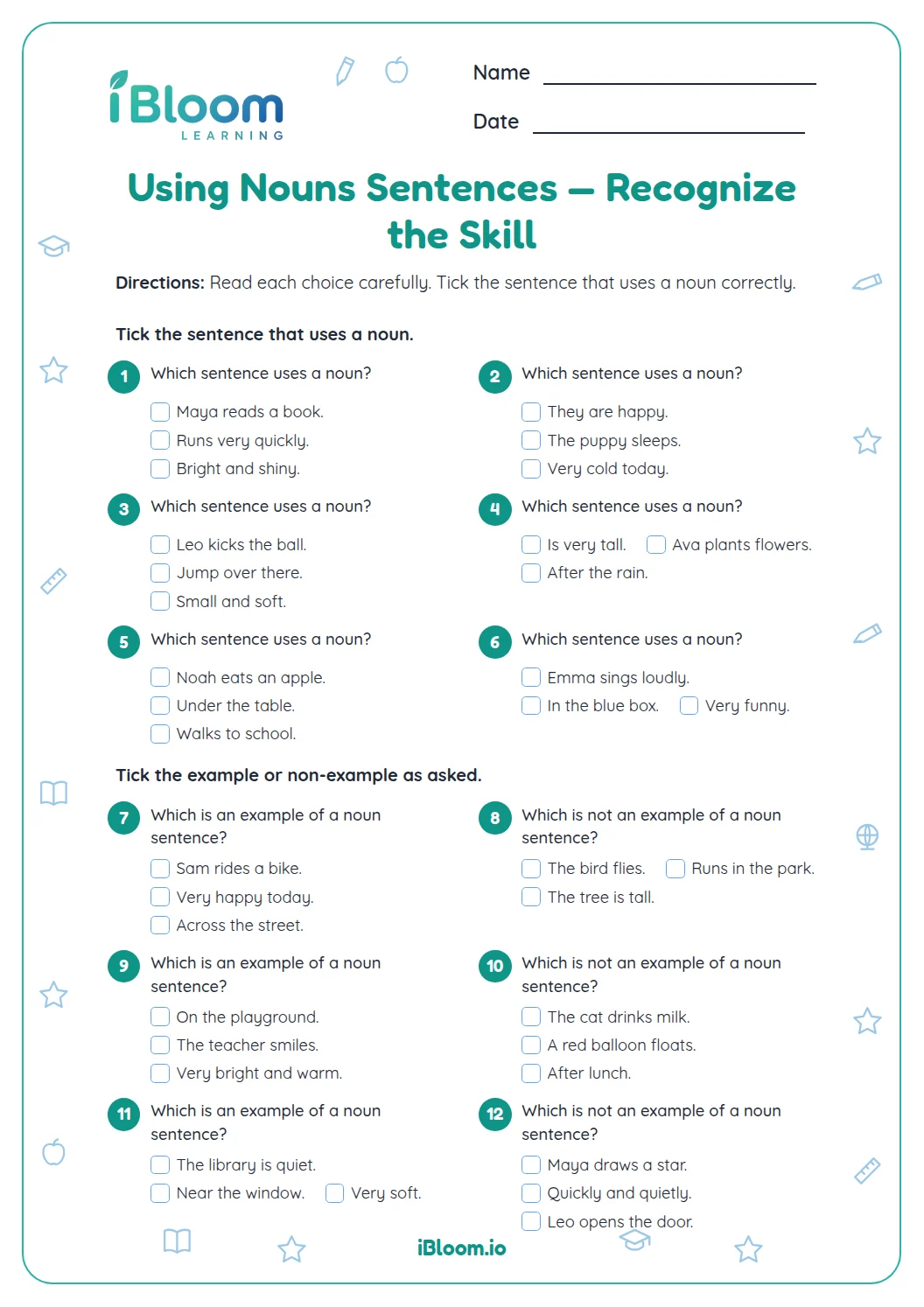
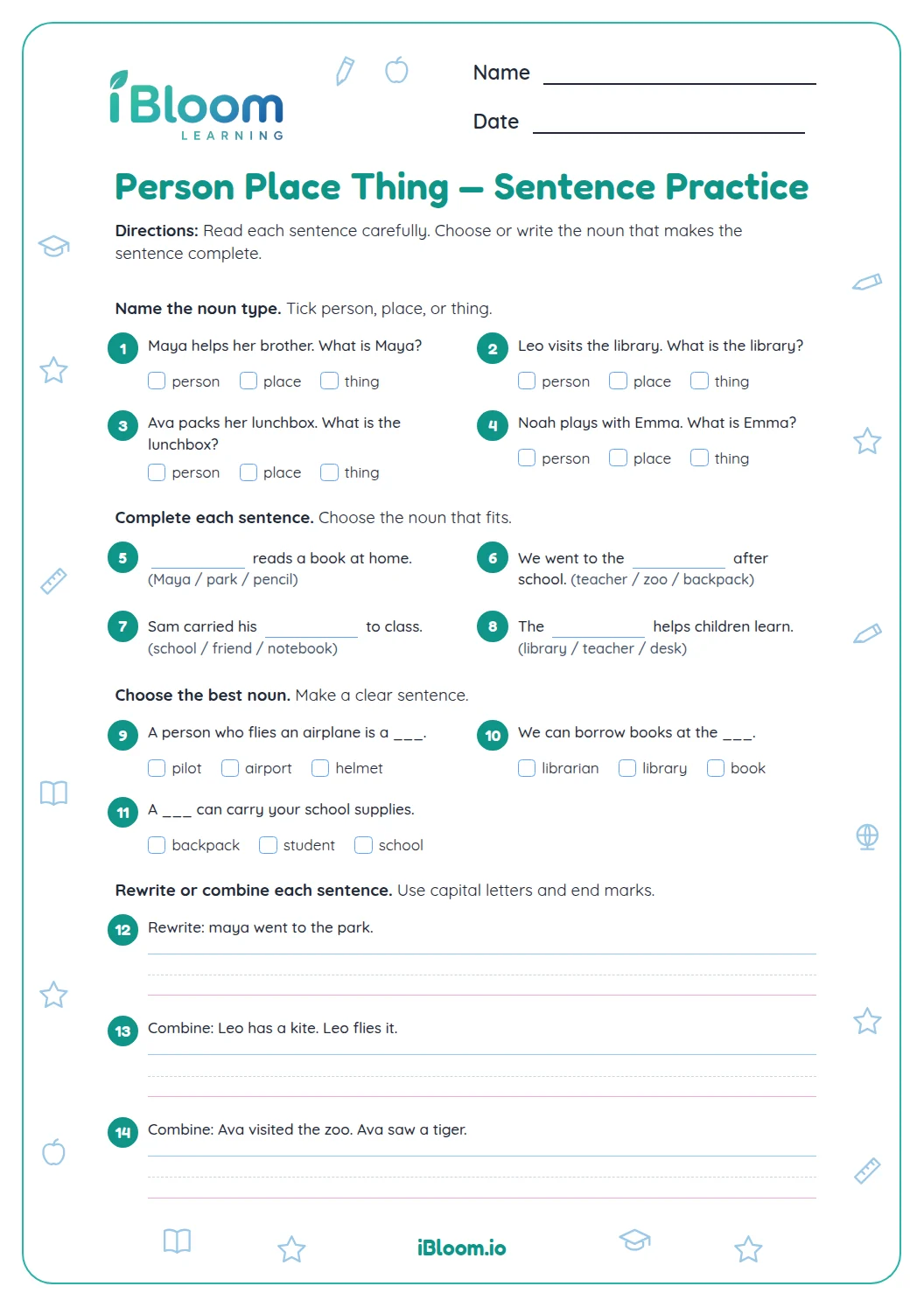
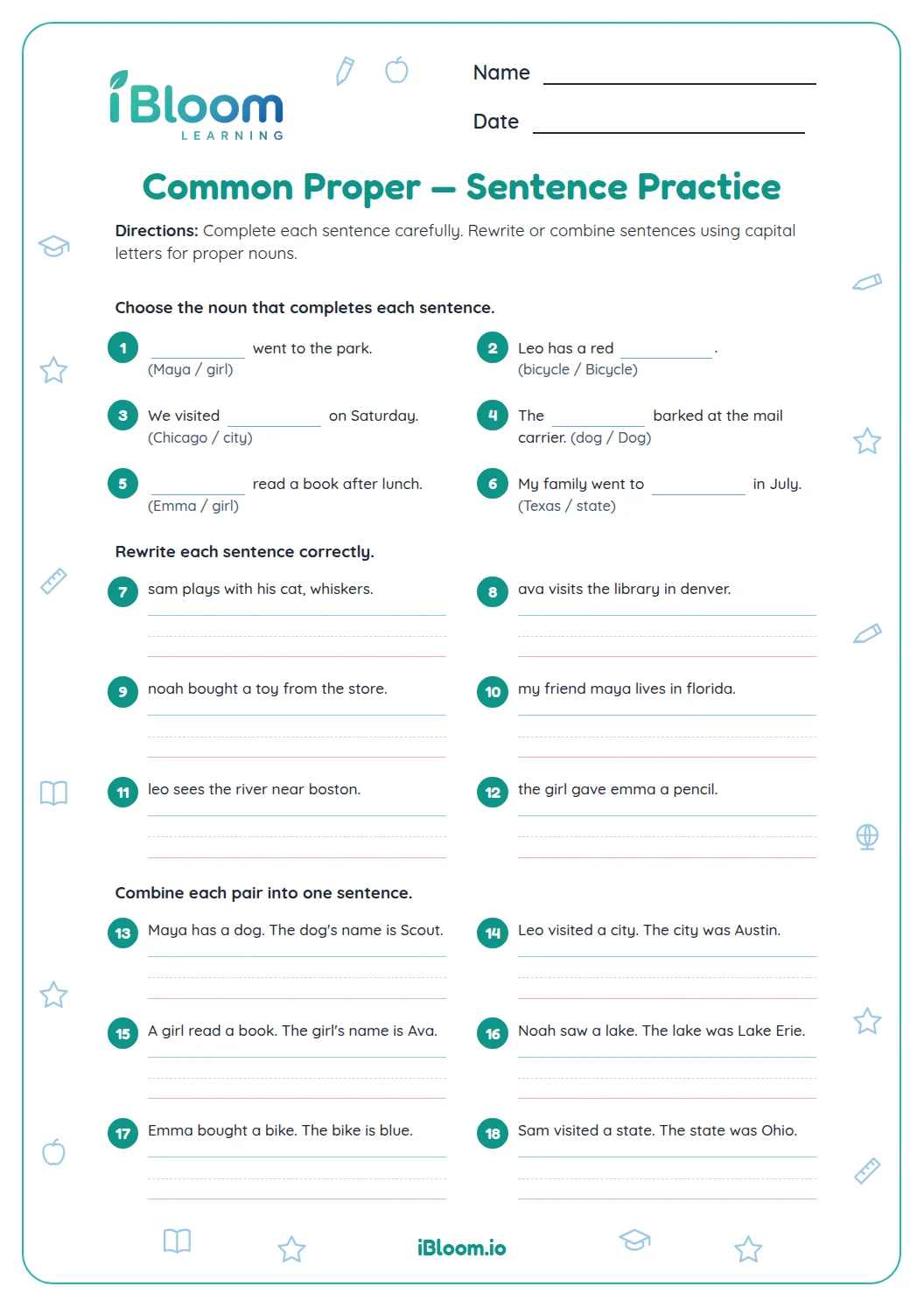
This free Grade 2 worksheet helps children turn nouns into complete sentences. Four short blanks establish that nouns name people, places, animals or things. Next, children build three sentences from supplied words and expand “The bird sings” with a detail. The last two prompts ask for original sentences about a school and a park. These 10 tasks practice Common Core L.2.1f by producing and expanding complete sentences. The answer key supplies exact words for the blanks and sample sentences for the writing tasks, so adults can check meaning and sentence structure while accepting a child’s own ideas.
Aligned to L.2.1f
What job does a noun do in a sentence?
A noun names a person, place, animal or thing. A sentence can contain more than one noun: “The teacher reads a book” names both a person and a thing. The action reads connects them in a complete thought.
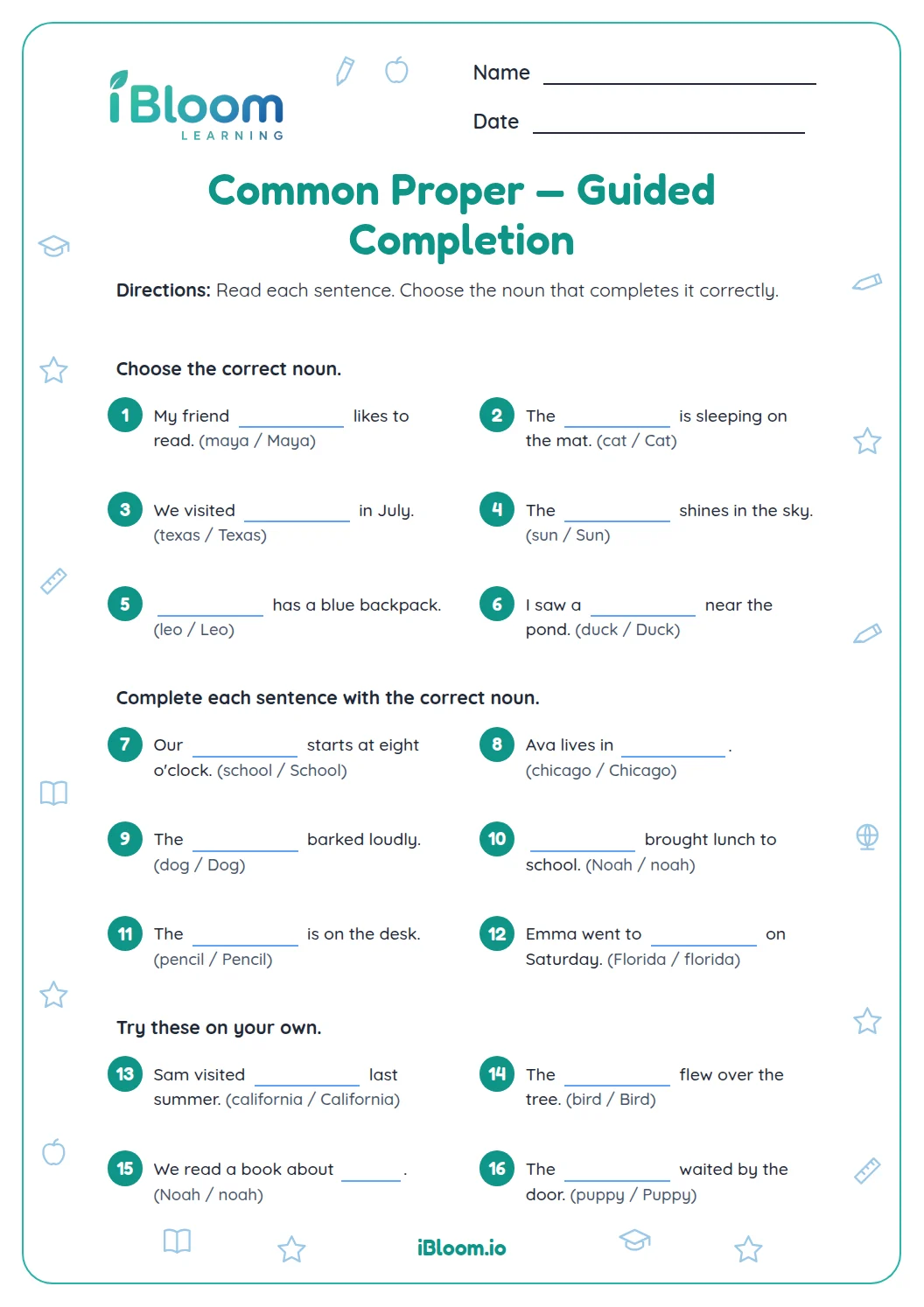
Part A lets children choose a noun from a pair in each prompt. The pair keeps the blank focused: “The ___ barks” calls for dog rather than desk.
How do children build a complete sentence?
Use both supplied words and add the small words needed to make a complete thought. In question 5, teacher and reads need a sentence around them. A child may write about reading a book, a note or a poem.
- 1Words: teacher, reads
- 2Start with who: The teacher
- 3Add the action and a detail: reads a book
- 4Complete sentence: The teacher reads a book.
What should adults check in the original sentences?
Part B has four prompts: build with teacher and reads, use rabbit and garden, expand “The bird sings,” and use children and play. Part C asks for one school sentence with a person noun and one park sentence with an animal noun.
Check that the required noun is present, the action agrees with it, and the sentence has a capital letter and end punctuation. Accept different details when the sentence meets the prompt.
How to use this worksheet
- 1Say a person noun and an action together, such as “teacher reads.”
- 2Let your child choose and write each noun in Part A.
- 3For each Part B prompt, ask your child to say a whole sentence before writing.
- 4In Part C, have your child choose a person or animal before adding an action and place.
- 5Read the sentences aloud and compare them with the key’s sample answers.
Mistakes to notice and ways to help
The mistake
Writing only “The teacher” when a sentence is requested.
The fix
Ask what the teacher does, then add that action to complete the thought.
The mistake
Using “The children plays” in question 8.
The fix
Read “children play” aloud; the plural noun children takes play here.
The mistake
Copying the original bird sentence without adding a detail.
The fix
Add a word or phrase that tells more, such as “little” or “in the tree.”
Common Core alignment
Produce and expand complete sentences using nouns for people, places, animals and things.
On this sheet: Parts B and C ask children to produce complete sentences and expand a supplied sentence with a detail.
Show the official wordingHide the official wording
Produce, expand, and rearrange complete simple and compound sentences (e.g., The boy watched the movie; The little boy watched the movie; The action movie was watched by the little boy).
What to practice next
Make more practice
Further reading
Questions parents and teachers ask
What nouns does Part A practice?
Part A uses dog, park, teacher and pencil. Each question includes two possible words, and only one makes sense in the sentence. These choices give children a clear starting point before they use nouns in longer responses. The answer key lists the four missing words.
Must my child copy the sentences in the answer key?
No. The six writing answers are examples, so other complete sentences can be correct. Check the required words or noun category in the prompt, then read for meaning. For teacher and reads, “The teacher reads a poem” works just as well as the sample about a book.
How should my child expand “The bird sings”?
Add a detail while keeping the original idea. “The little bird sings in the tree” is one possible answer. Your child might instead add when the bird sings or describe its song. Ask them to read the new sentence and point to the information they added.
Should spelling mistakes make a sentence wrong?
Judge the noun and the complete thought first, then help with spelling. A recognizable attempt at a longer noun can still show the intended grammar skill. Have your child reread the sentence, correct one useful spelling, and check the opening capital and ending mark before moving on.
Can an adult help a reluctant writer?
Yes. Let your child rehearse each sentence aloud before writing it. Ask a short prompt such as “Who is at the park?” or “What does the teacher read?” Once the child has a complete idea, repeat it slowly together and let the child record their own sentence.