




About this worksheet
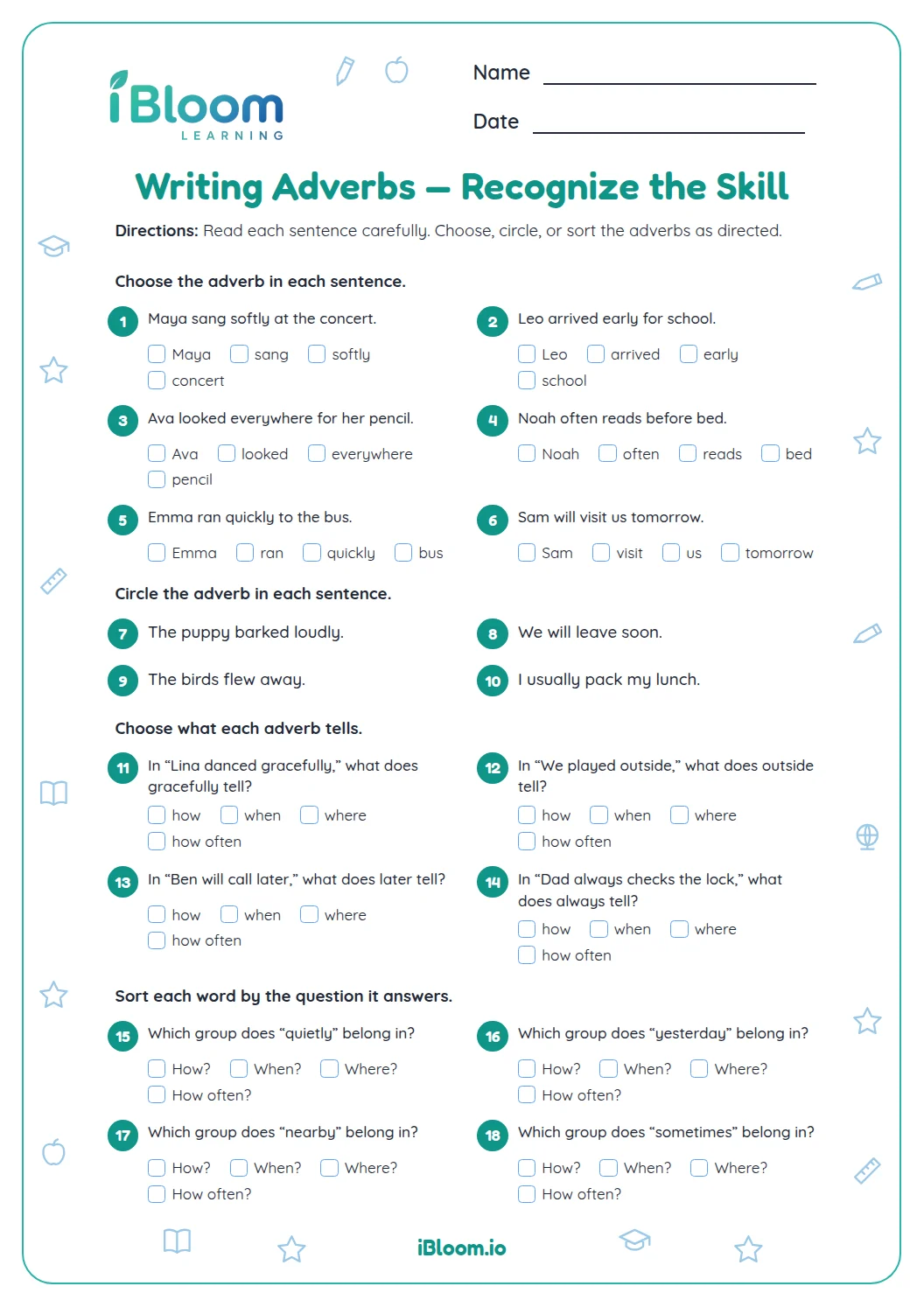
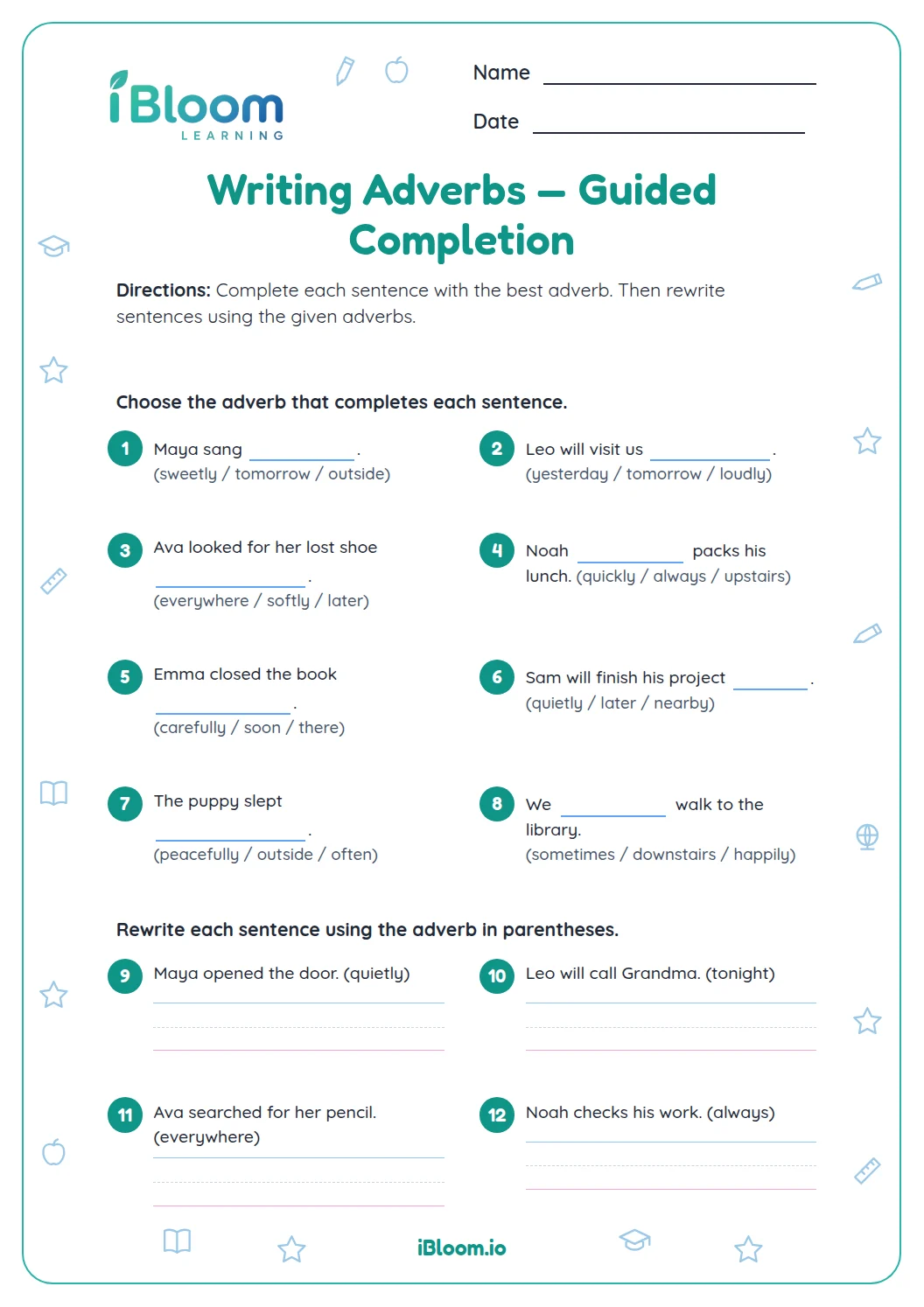
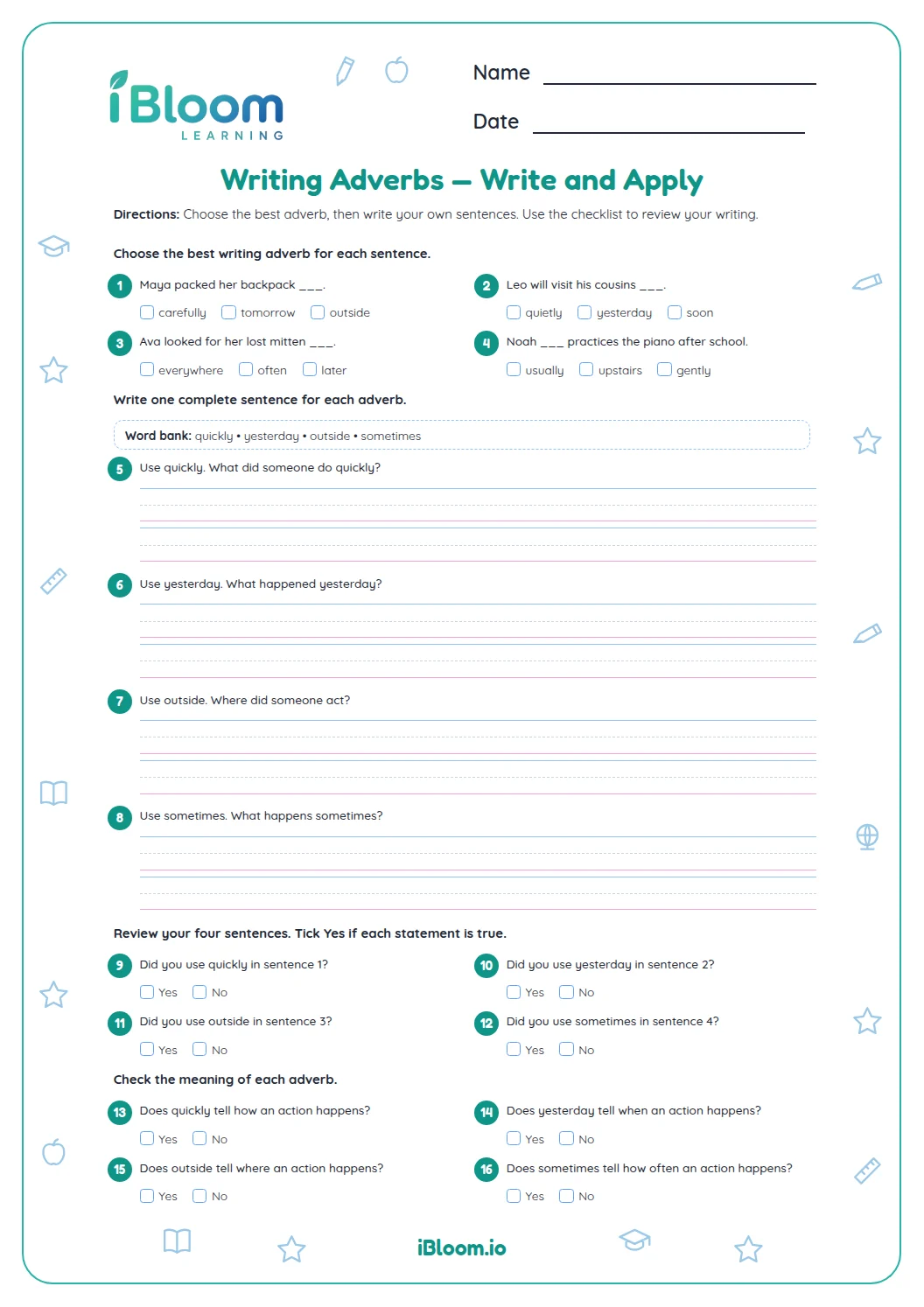
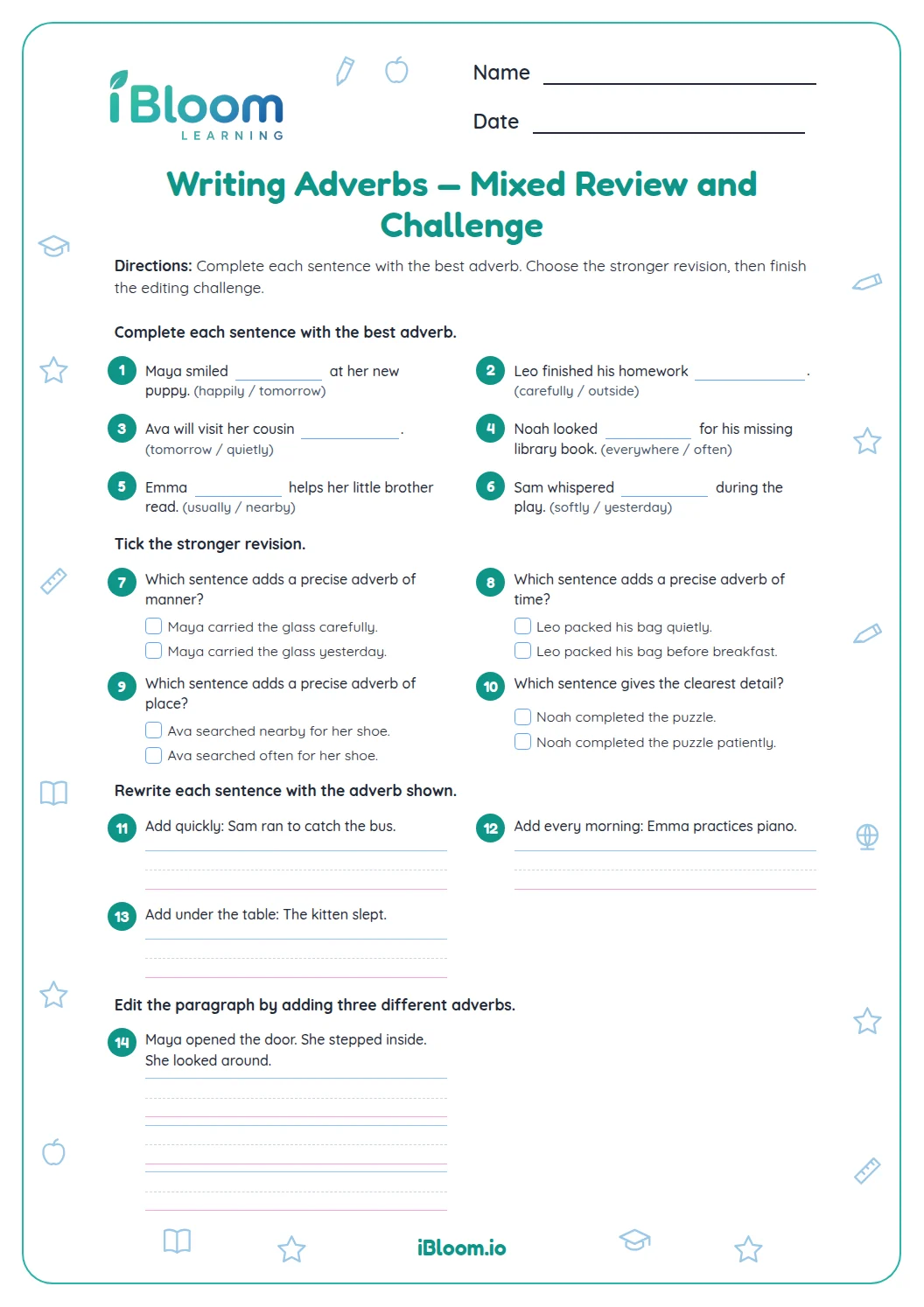
This free Grade 3 worksheet helps children edit words that tell how an action happens. Part A offers four choices, including carefully, well, eagerly, and fast. Part B asks for the adverb forms of four capitalized adjectives. Part C moves into two sentence corrections, a short paragraph edit, and an explanation of what silently tells about crept. The twelve tasks connect forming useful adverbs with understanding their job beside verbs, supporting Common Core L.3.1.a. A separate answer key gives the corrected forms, complete sentences, and a sample explanation.
Aligned to L.3.1.a
How do children choose between careful and carefully?
First find the verb: carried. The blank tells how the child carried the bowl, so carefully fits. Compare that with “a careful child,” where careful describes the child.
Part A also includes well and fast. These examples keep the child’s attention on a word’s job instead of treating ly as a rule for every adverb.
- 1Question 1: The child carried the bowl ___.
- 2Action: carried. Ask: How did the child carry it?
- 3Answer: carefully. It tells how the carrying happened.
How do the word corrections change in Part B?
The capitalized word is an adjective, and the direction asks for its adverb form. Excited becomes excitedly, careful becomes carefully, and patient becomes patiently. Happy changes to happily: replace the y with i before adding ly.
Say each corrected sentence aloud and ask what the new word describes. In “The puppy waited patiently,” patiently tells how the puppy waited.
What should children notice when they rewrite a sentence?
In Part C, keep the person and action while correcting the describing word. “Ava closed the door GENTLE” becomes “Ava closed the door gently.” The change keeps the meaning while making the modifier fit its action.
Question 11 puts three corrections together in a short paragraph about Nia putting away a towel. Children change NEAT, HAPPY, and CAREFUL to neatly, happily, and carefully while keeping the events in order.
The final question asks for an explanation: silently describes crept and tells how the fox moved. Naming both the verb and the information the adverb adds makes the editing choice easier to explain.
How to use this worksheet
- 1Read the first sentence and identify carried as the action.
- 2Choose the Part A words by asking how each action happens.
- 3Write only the corrected adverb in Part B; check the spelling of happily.
- 4Rewrite the two sentences and the short paragraph in Part C. Check every capitalized adjective.
- 5Explain the connection between silently and crept, then check the key.
Mistakes to notice and fix
The mistake
Choosing careful to describe carried.
The fix
Ask how the action happened; carefully describes carried.
The mistake
Writing good after sang.
The fix
Use well to tell how Mia sang.
The mistake
Writing happyly or gentlely.
The fix
Use happily for happy and gently for gentle; read the corrected sentence aloud.
Common Core alignment
Explain how an adverb describes an action in a particular sentence.
On this sheet: Children choose and correct action modifiers, then explain what silently tells about crept.
Show the official wordingHide the official wording
Explain the function of nouns, pronouns, verbs, adjectives, and adverbs in general and their functions in particular sentences.
What to practice next
Make more practice
Further reading
Questions parents and teachers ask
What kinds of adverb errors will children correct?
Children choose adverbs that describe actions, replace incorrect adjective forms, and rewrite sentences with the corrected words. Examples include changing “careful” to “carefully” after “carried” and changing “good” to “well” after “sang.” The last task asks children to explain what an adverb tells about a particular verb.
Does every adverb on the sheet end in ly?
No, the sheet includes well and fast as well as adverbs ending in ly. In “The runner moved fast,” fast already describes the action correctly. In “Mia sang well,” well tells how Mia sang. Encourage children to ask what the word does in the sentence before changing its ending.
Why is carefully correct in the bowl sentence?
Carefully tells how the child carried the bowl, so it describes the action carried. Careful would describe a person or thing, as in “a careful child.” Ask your child to name the action first, then read both choices aloud to hear how the adverb fits that action.
Should children copy the whole sentence for every correction?
Part C asks for two sentence rewrites, a short paragraph edit, and an explanation. Part A uses choices, and Part B asks for just the corrected word. Children first practice individual forms, then apply three corrections together in the paragraph about Nia putting away a towel.
How do I check the final explanation?
A correct explanation names crept as the action and says silently tells how the fox crept. The child may explain that the fox made no sound. Accept clear wording that makes this connection, even when it differs from the sample explanation printed on the answer key.