






About this worksheet
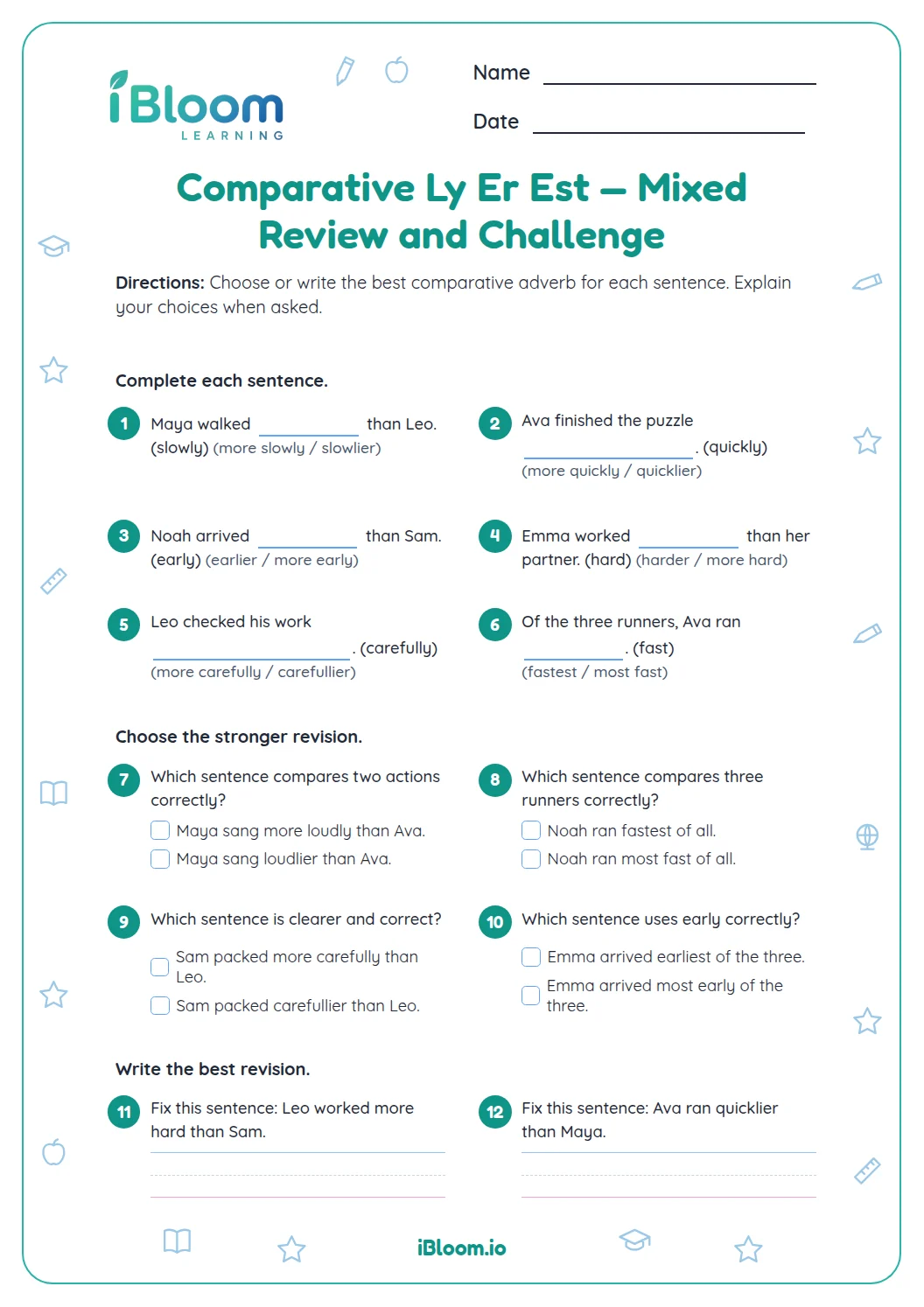
This Grade 3 grammar worksheet practices choosing comparative and superlative adverbs in sentences. Part A compares two actions or selects the strongest of three; Part B applies the forms in fresh contexts. Learners distinguish shorter forms such as faster and fastest from more or most + adverb forms such as more quietly and most gracefully. An answer key is included. The practice aligns with CCSS L.3.1.g.
Aligned to L.3.1.g
When do we use more or most with an adverb?
Many adverbs ending in -ly use more to compare two actions and most to compare three or more. Short adverbs often take -er or -est.
- 1Question 1 compares Maya’s reading with yesterday’s: more quietly fits before than.
How does the sentence tell you which form to choose?
Look for than when comparing two actions. Look for a group of three or more or a word like all when choosing a superlative.
- 1Question 10 compares Ava with all the dancers, so most gracefully fits.
How to use this worksheet
- 1Read the full sentence and notice whether it compares two actions or a group.
- 2Look for than or a phrase such as of all.
- 3Check whether the adverb ends in -ly.
- 4Choose -er/-est for short forms or more/most for many -ly forms.
- 5Reread the sentence with your choice.
Common mistakes and quick fixes
The mistake
Using most when only two actions are compared.
The fix
Use than as a clue for a two-item comparison, usually with -er or more.
The mistake
Adding -er to an -ly adverb.
The fix
Keep the -ly word and place more before it.
The mistake
Choosing the superlative without a group.
The fix
Use -est or most when comparing one action with a group of three or more.
Curriculum alignment
This Grade 3 practice connects each activity to the skill named in CCSS L.3.1.g.
Choosing comparative and superlative adverbs in sentences
On this sheet: Choosing comparative and superlative adverbs in sentences
Show the official wordingHide the official wording
Form and use comparative and superlative adjectives and adverbs, and choose between them depending on what is to be modified.
What to practice next
Further reading
Questions parents and teachers ask
Which skill does this page practice?
This page practices choosing comparative and superlative adverbs in complete sentences. Learners use clues such as than and of all to decide whether to use -er, -est, more, or most. The answer key shows the selected form for every item.
How should a learner use the answer key?
Complete a group of sentences before checking the key. For a missed item, reread the comparison words and identify whether the sentence compares two actions or a whole group. Then check which adverb form fits that comparison. The included key makes a later review quick and clear.
Can this worksheet be used at home?
Yes. Read each sentence aloud and pause at the blank. A student can choose an answer, then explain whether the clue points to two actions or to the strongest action in a group. The key supports a quick review afterward.
What should I do when an answer is incorrect?
Ask what is being compared and look for words such as than or all. Next, check whether the adverb ends in -ly. These clues help distinguish a short -er or -est form from more or most plus an -ly word.
How long will the practice take?
About 15 minutes is a reasonable starting point for these sentence choices. Take more time to discuss a confusing pair, especially when a learner needs to hear how the comparison changes the meaning of the sentence. The included key makes a later review quick and clear.