





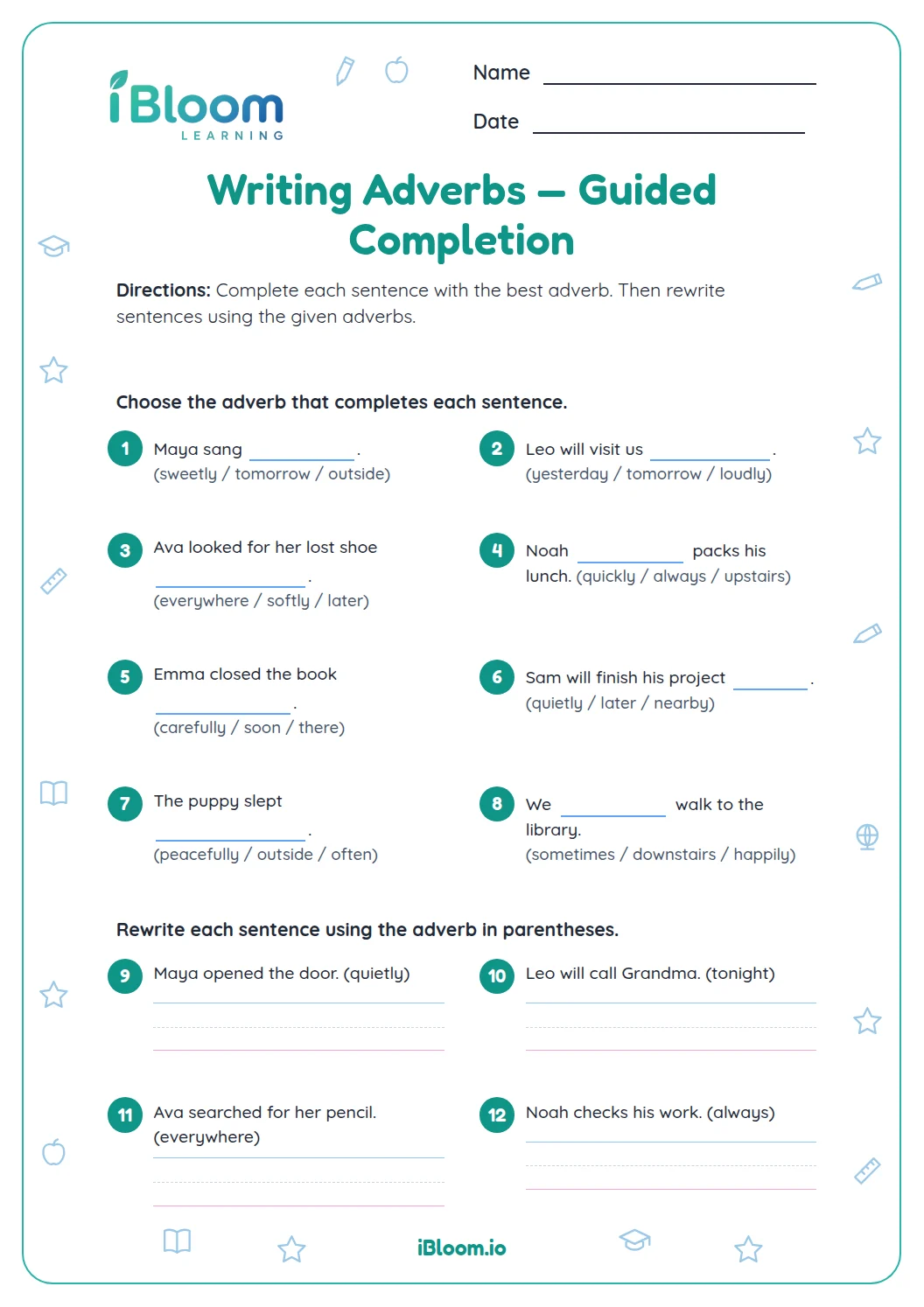

About this worksheet
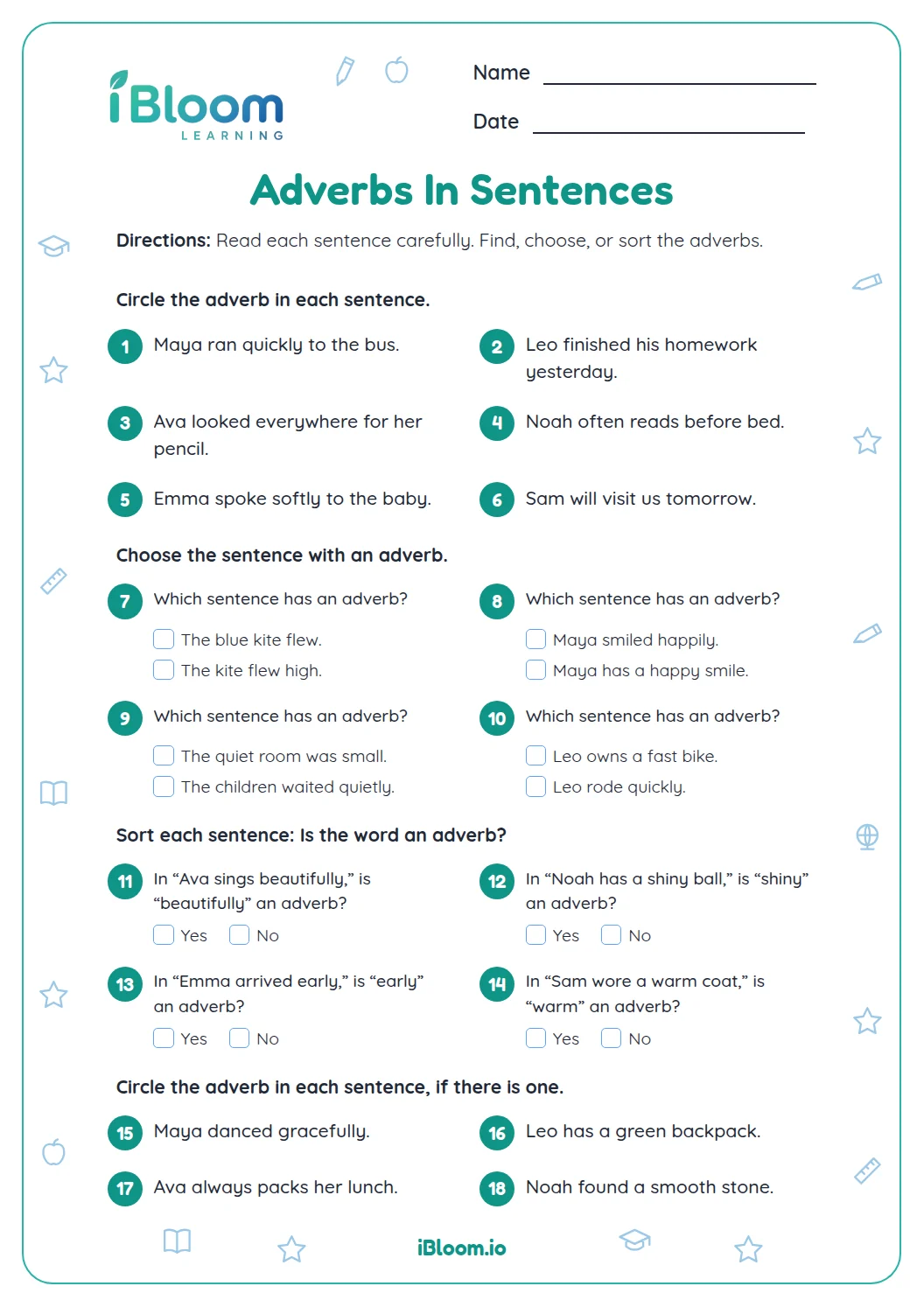
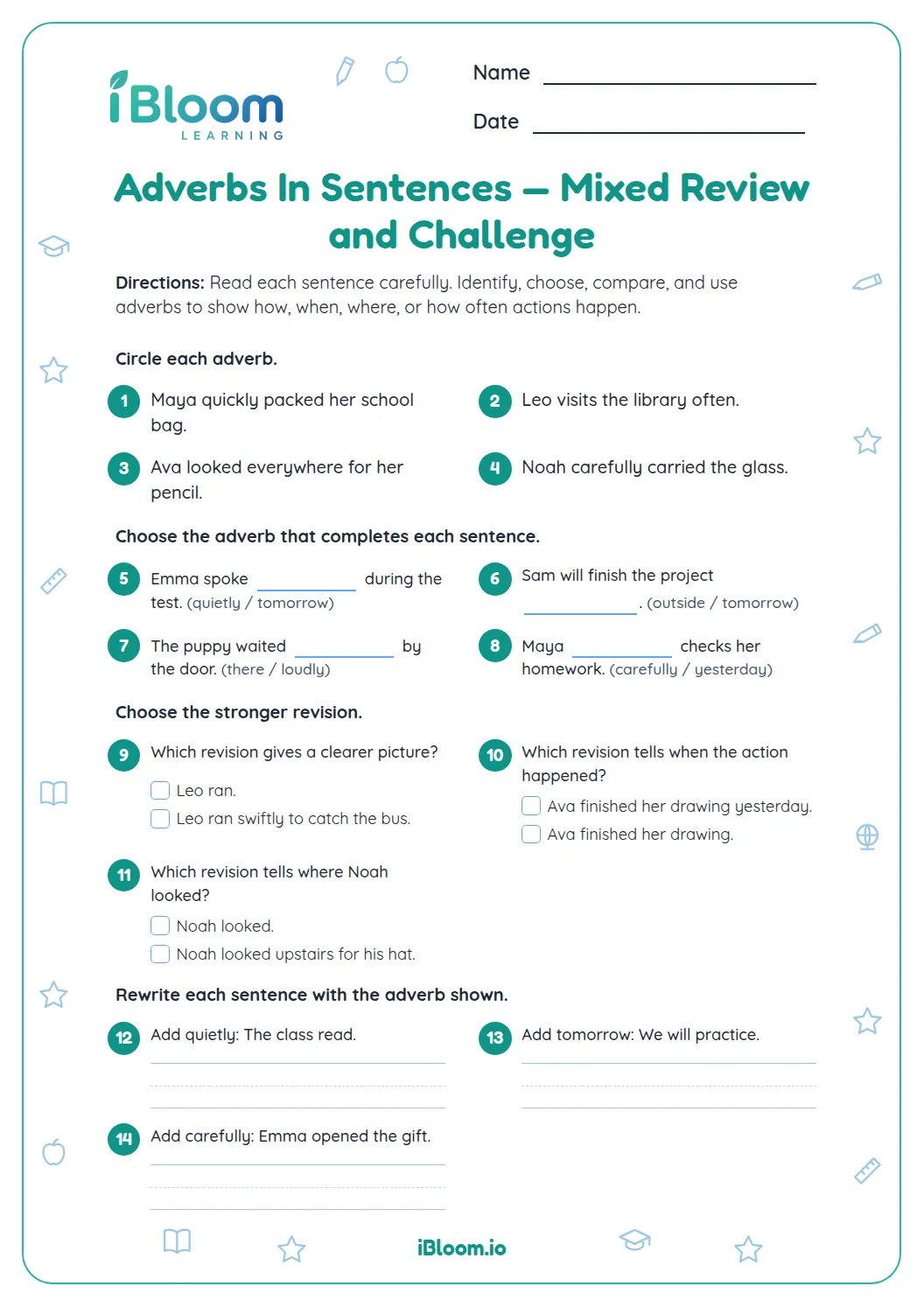
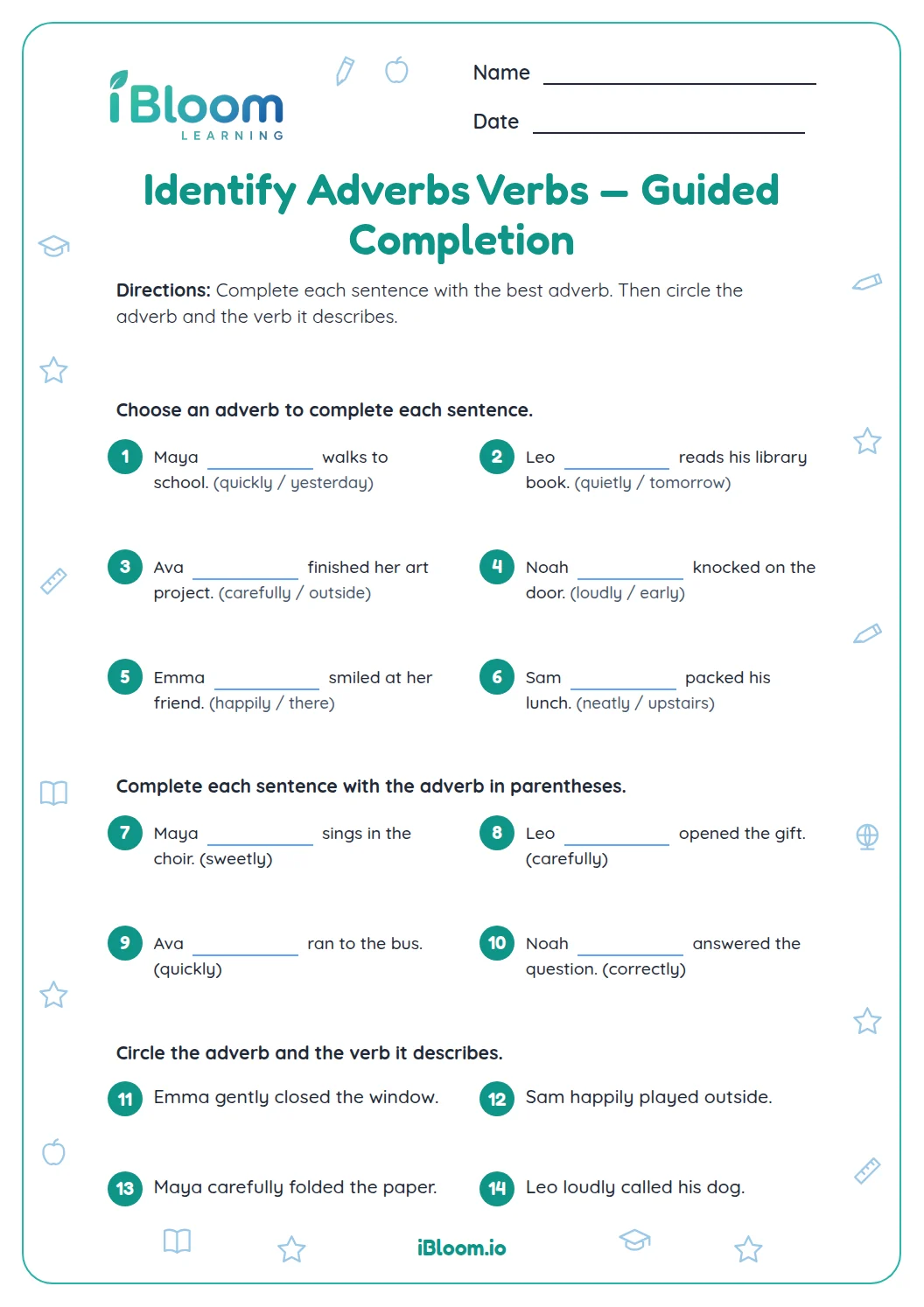
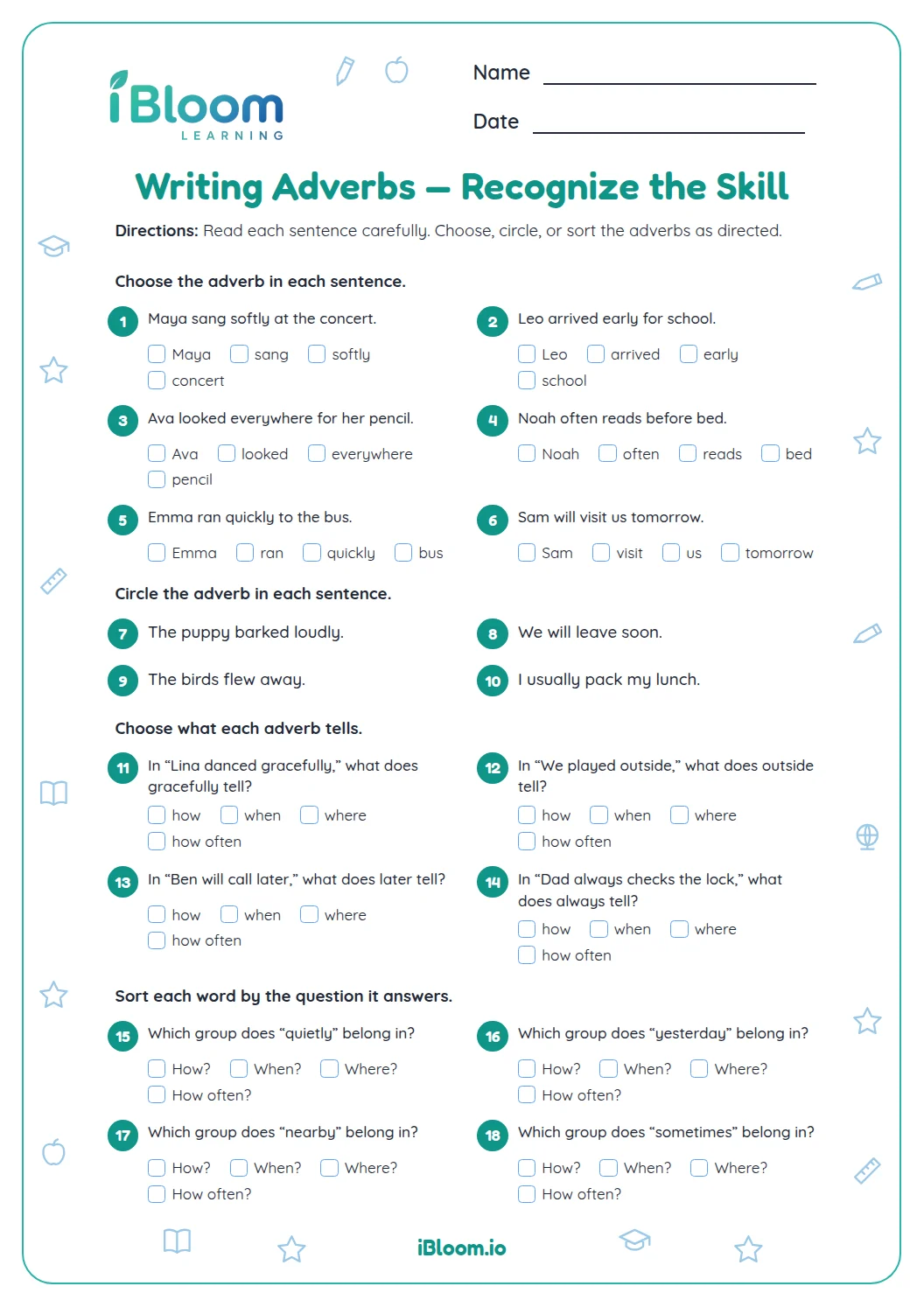
This Grade 3 worksheet gives children 16 sentences to complete with adverbs. They choose words that tell how, when or where an action happens, then reread each sentence to check its meaning. The answer key lists the intended word for every item.
Aligned to L.3.1.a
What job does an adverb do in a sentence?
An adverb can tell how, when or where an action happens. It often describes a verb. In “The turtle moved slowly,” slowly tells how the turtle moved.
- 1Question 1: The turtle moved ___ across the path.
- 2“Slowly” tells how the turtle moved.
- 3Read the whole sentence again: The turtle moved slowly across the path.
How do you choose an adverb that fits?
Read the whole sentence, not just the blank. The surrounding words help you hear whether the sentence needs a way of moving, a time, or a place. Check that the word form makes sense: “carefully” describes how Maya packed, while “careful” describes a person or thing.
Why reread the completed sentence?
Rereading checks both grammar and meaning. A choice may look related to the verb but still be an adjective or noun. Hearing the complete sentence helps confirm that the chosen word adds the intended detail.
How to use this worksheet
- 1Read the entire sentence once.
- 2Ask whether the blank tells how, when or where.
- 3Compare the choices by their meaning and word form.
- 4Insert the best choice and reread aloud.
- 5Use the key to revisit any sentence that sounds awkward.
Common mistakes and quick fixes
The mistake
Choosing an adjective because it has a similar meaning.
The fix
Ask whether the word describes the action; “quietly” describes how someone speaks.
The mistake
Looking only at the blank.
The fix
Use the other words in the sentence to decide what detail is needed.
The mistake
Assuming every adverb ends in -ly.
The fix
Check the word’s job in context; words such as “soon” and “often” can also be adverbs.
Common Core alignment
This page practices identifying how adverbs function in particular sentences.
Use context to identify adverbs and the actions they describe.
On this sheet: Children select adverbs that complete sentences and add information about an action.
Show the official wordingHide the official wording
Explain the function of nouns, pronouns, verbs, adjectives, and adverbs in general and their functions in particular sentences.
What to practice next
Make more practice
Further reading
Questions parents and teachers ask
What is an adverb?
An adverb is a word that can describe an action by telling how, when or where it happens. In question 1, “slowly” tells how the turtle moved across the path. Notice the action word first, then ask what extra detail the selected adverb adds to that action.
Do all adverbs end in -ly?
No. Many adverbs use -ly, but words such as “soon,” “often” and “here” can also be adverbs. Look at what the word does in its sentence. The choices include related word forms so children practice identifying a word by its sentence function.
How many questions are included?
There are 16 sentence-completion questions. Each has three choices, and the answer key lists the word that best completes each sentence. Reading the completed sentence aloud can reveal whether the word makes sense with the action. The action word gives the reader a useful place to start.
Why compare adverbs with adjectives?
Related forms can look similar. “Quiet” describes a person or place, while “quietly” tells how someone speaks. Comparing forms makes the word’s job clearer. An adverb can add a detail about manner, time, or place, depending on the sentence. The action word gives the reader a useful place to start.
What should we do after checking the key?
Ask the learner to name the action and explain what detail the adverb adds. That short explanation reinforces the connection between the adverb and the verb. The answer key identifies the intended choice for each context so children can revisit one item at a time.