








About this worksheet
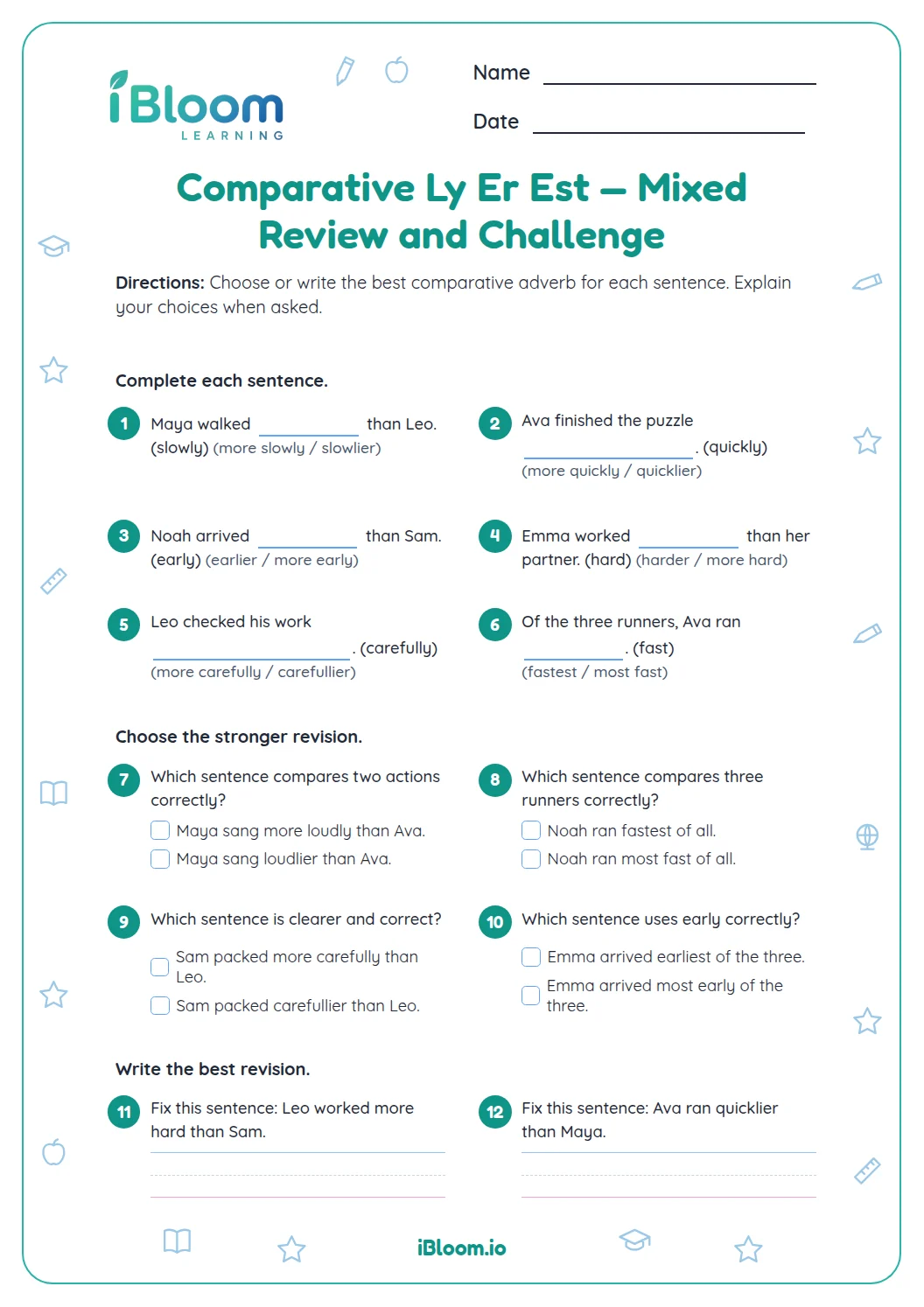
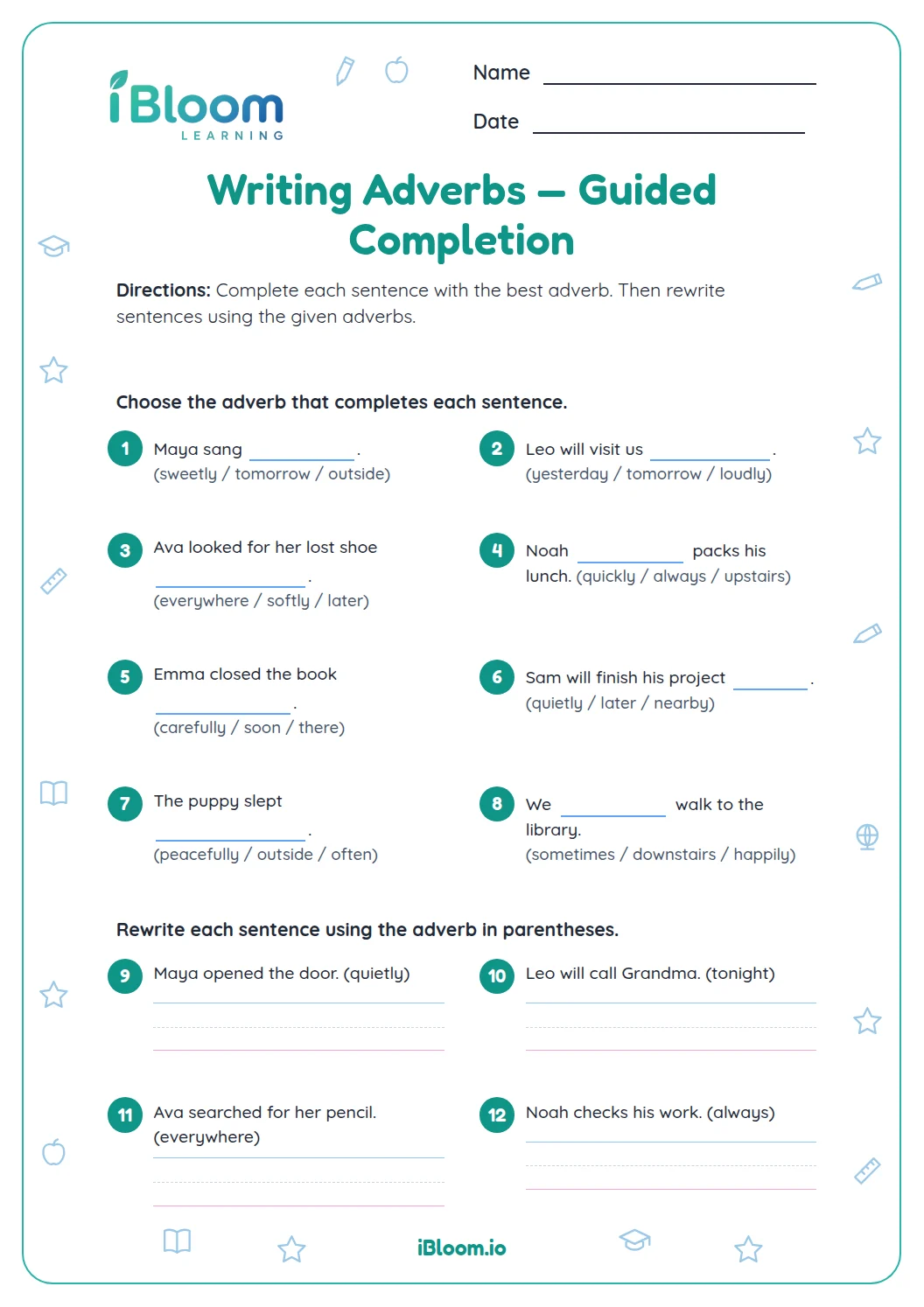
This free printable worksheet helps Grade 3 children compare actions with adverbs. Leo runs faster than Sam, Noah arrived earliest, Ava sang most beautifully: each sentence asks which form fits. Children start by picking from choices, then change a plain adverb in parentheses into its -er or more form, or its -est or most form, and finish by writing one sentence of their own. The sheet practices Common Core L.3.1.g, forming and using comparative and superlative adverbs. A two-page answer key is included.
Aligned to L.3.1.g
What is on this adverb worksheet?
Every sentence is about children doing something: running, working, singing, painting, finishing lunch. Part A gives three choices for four sentences, such as fast, faster and fastest. Part B shows a plain adverb in parentheses and asks children to write the form that fits, and Part C does the same with less support. Part D asks for one sentence that uses the word earlier.
The adverbs cover both patterns children meet in Grade 3. Short adverbs like hard, late and early take -er and -est (harder, latest, earlier). Longer adverbs ending in -ly, like quietly, quickly and carefully, take more and most.
- Part A: pick the right form, 4 multiple-choice sentences
- Part B: write the form from the word in parentheses, 4 sentences
- Part C: finish on your own, 2 sentences
- Part D: use earlier in a sentence of your own, 1 writing question
When do you use -er, -est, more and most?
Start with the clue words. A sentence with than compares two actions, so the adverb takes -er or more. A sentence with of all, or one that names a whole group such as the runners or the team, takes -est or most.
Then look at the adverb. If it is short, add the ending. If it ends in -ly, put more or most in front and leave the adverb alone: quietly becomes more quietly and most quietly, never quietlier.
- 1Sam speaks ___ than Leo.
- 2The word than compares two people, so we need the -er or more form.
- 3Quietly ends in -ly, so we say more quietly.
- 4Answer: more quietly
Why does early turn into earlier and earliest?
When an adverb ends in a consonant plus y, the y changes to i before -er or -est. Early becomes earlier and earliest, just as happy becomes happier. Question 2 asks for earliest because Noah is compared with all the runners, and question 11 invites children to try earlier in a sentence about two people.
Hard and long simply add -er or -est (harder, longest). Late already ends in e, so it adds only -r or -st: later, latest. Question 8 uses late, so Ava stayed the latest of all the students.
What should a good sentence for question 11 look like?
A strong answer names two people or things and uses than: "Noah got to school earlier than Emma." It shows the child understands that earlier compares two. If a child writes "Noah came earlier" with no comparison, ask who he came earlier than.
How to use this worksheet at home or in class
- 1Read the first sentence aloud and ask, "How many people are we comparing, two or more than two?"
- 2Have your child circle than or of all in each Part A sentence before choosing.
- 3In Part B, say the plain adverb in parentheses and let your child decide whether it needs -er, -est, more or most.
- 4Let your child complete Part C alone, then read each finished sentence out loud to hear if it sounds right.
- 5Check with the answer key, and for any miss ask which clue word the sentence contained.
Common mistakes and quick fixes
The mistake
Choosing most quietly for question 3 because most sounds like the quietest way to speak.
The fix
Point to than. It compares only Sam and Leo, so the answer is more quietly. Most quietly belongs with of all.
The mistake
Adding -er to an -ly adverb, such as politelier for question 9.
The fix
Adverbs that end in -ly use more or most in front, so the answer is more politely.
The mistake
Leaving the plain adverb unchanged, such as writing hard for question 5 or fast for question 1.
The fix
Read the sentence with than in it. Hard than Ava does not sound right, but harder than Ava does.
Common Core alignment
Grade 3 children form comparative and superlative adverbs and choose between them depending on what is being compared.
Use comparative and superlative adverbs and choose between them, as in faster and fastest.
On this sheet: Parts A to C ask children to choose or write the -er, -est, more or most form depending on whether two actions or a whole group are compared.
Show the official wordingHide the official wording
Form and use comparative and superlative adjectives and adverbs, and choose between them depending on what is to be modified.
What to practice next
Make more practice
Further reading
Questions parents and teachers ask
What does this adverb worksheet cover?
It has 11 questions about comparing actions with adverbs. Part A offers three choices per sentence, Parts B and C ask children to change a plain adverb such as hard, late or carefully into its comparing form, and Part D asks for one sentence using earlier. The key shows every answer on two pages.
What is a comparative adverb and what is a superlative adverb?
A comparative adverb compares two actions, like faster in "Leo runs faster than Sam." A superlative adverb compares one action with all the others in a group, like earliest in "Noah arrived earliest of all the runners." Children choose between them using clue words such as than and of all.
When do adverbs use more and most instead of -er and -est?
Adverbs that end in -ly, such as quietly, quickly and carefully, use more and most in front of the word. Short adverbs such as hard, late and early take -er and -est at the end. This sheet includes both kinds so children practice telling them apart.
What are the answers?
Part A: faster, earliest, more quietly, most beautifully. Part B: harder, most gracefully, more quickly, latest. Part C: more politely, most carefully. Part D has a sample sentence: "Noah got to school earlier than Emma." Other sentences that compare two things with earlier and than are also correct.
Is this worksheet suitable for second graders or fourth graders?
It is written for Grade 3, where L.3.1.g places comparing adverbs. A strong second grader who knows what an adverb is can try Part A with help. Fourth graders can use it as a quick review before moving to sentences they write themselves.
How can I make the practice more fun?
Turn it into a race. Have two children run, hop or read the same page, then ask who did it faster and who did it the fastest when a third child joins. Saying the sentences out loud helps children hear which form sounds right.