








About this worksheet
This free printable worksheet gives Grade 3 students practice with adverbs that tell how, when or where something happens. Children circle the adverb in four sentences, decide whether six more adverbs tell how, when or where, choose the adverb that fits four sentences, and finish by adding an adverb of their own to two short sentences. It supports Common Core L.3.1.a, explaining the function of adverbs in particular sentences. An answer key shows the adverb or label for every question, with sample sentences for the writing part.
Aligned to L.3.1.a
What is on this adverbs worksheet?
Four short parts that build from spotting to sorting to using. Part A asks children to circle the one adverb in each of four sentences. Part B names an adverb and asks whether it tells how, when or where. Part C gives a label in parentheses and three choices, so only one adverb fits. Part D asks children to add an adverb of their own.
The sentences are short, with familiar names and actions, so the work stays on the adverb itself.
- Part A: circle the adverb (questions 1 to 4)
- Part B: how, when or where (questions 5 to 10)
- Part C: pick the adverb that fits the label (questions 11 to 14)
- Part D: write an adverb of your own (questions 15 and 16)
How can you tell if an adverb tells how, when or where?
Ask the verb a question. Slept how? Slept peacefully. Leave when? Leave tomorrow. Parked where? Parked nearby. The word that answers the question is the adverb, and the question you asked tells you which kind it is.
Many how-adverbs end in -ly, such as softly and carefully, but time and place adverbs often do not. Tonight, here and everywhere do not end in -ly, so Part B mixes them in on purpose.
- 1The bird sang sweetly. → Sang how? Sweetly. It tells how.
- 2My aunt arrives tonight. → Arrives when? Tonight. It tells when.
- 3Please put the box here. → Put where? Here. It tells where.
Why does Part C give a label before the choices?
Several adverbs could fit a sentence in a grammatical way, but only one answers the question in parentheses. “The bus will arrive ___. (when)” has three choices, and only soon tells when. The label makes children think about what job the word is doing, not just which word sounds nice.
Children who can say “I need a time word here” are starting to explain the function of adverbs, which is exactly what the standard asks.
What should a child write in Part D?
Any adverb of the right kind that makes sense. “The turtle walked slowly” and “The turtle walked carefully” both tell how. For “The children played,” outside, indoors, nearby and everywhere all tell where. The key shows one sample, and the sheet is quick to check by asking, “Does your word answer how, or where?”
How to use this worksheet at home or in class
- 1Read the Part A directions aloud and do question 1 together. Ask: slept how?
- 2Let your child circle the adverbs in Part A alone, then check them against the key.
- 3In Part B, have your child say the question out loud (“sang how?”) before choosing how, when or where.
- 4In Part C, cover the choices first and ask your child to think of a word that fits the label, then compare.
- 5Read the Part D sentences back together to hear whether the new word fits.
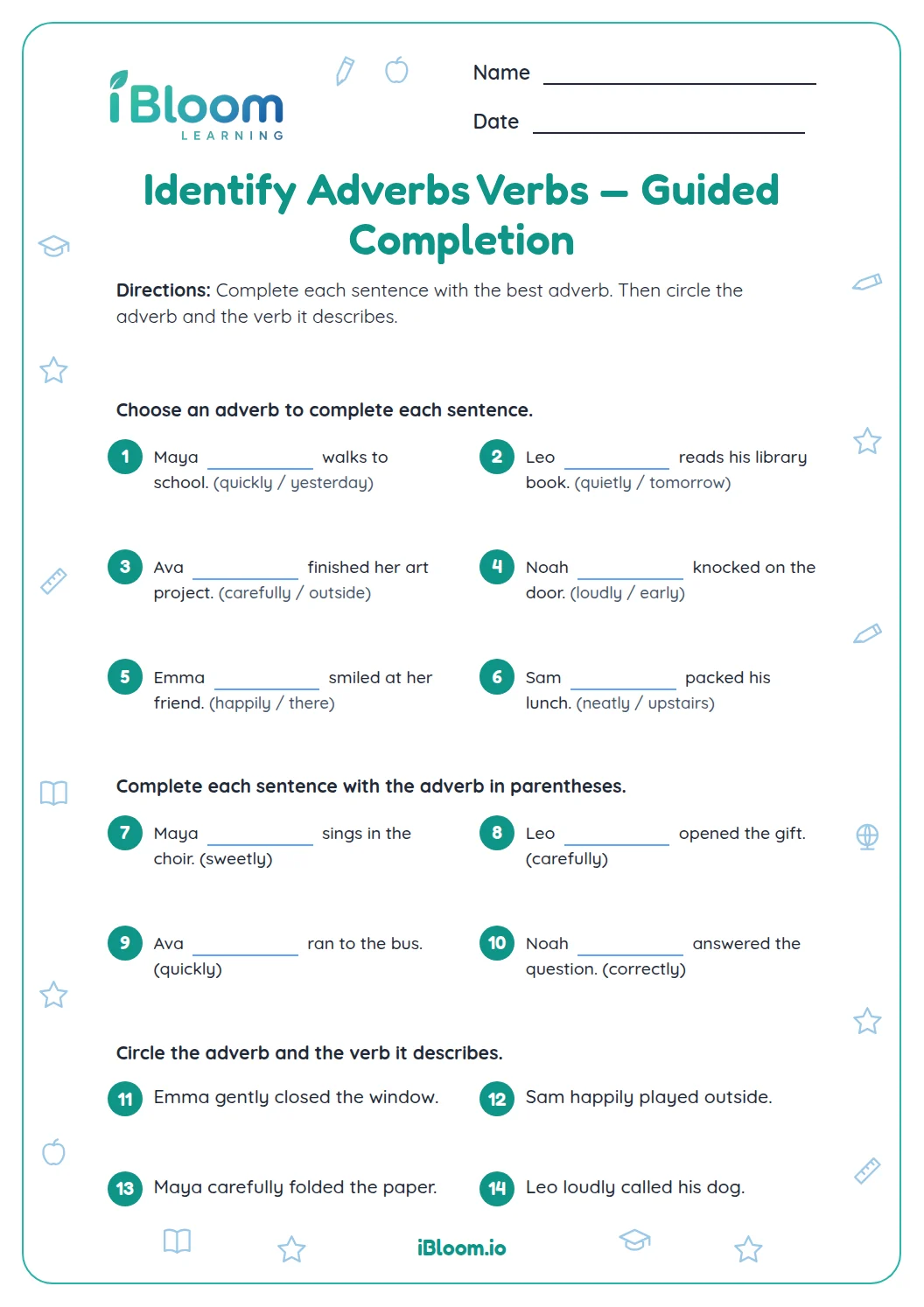
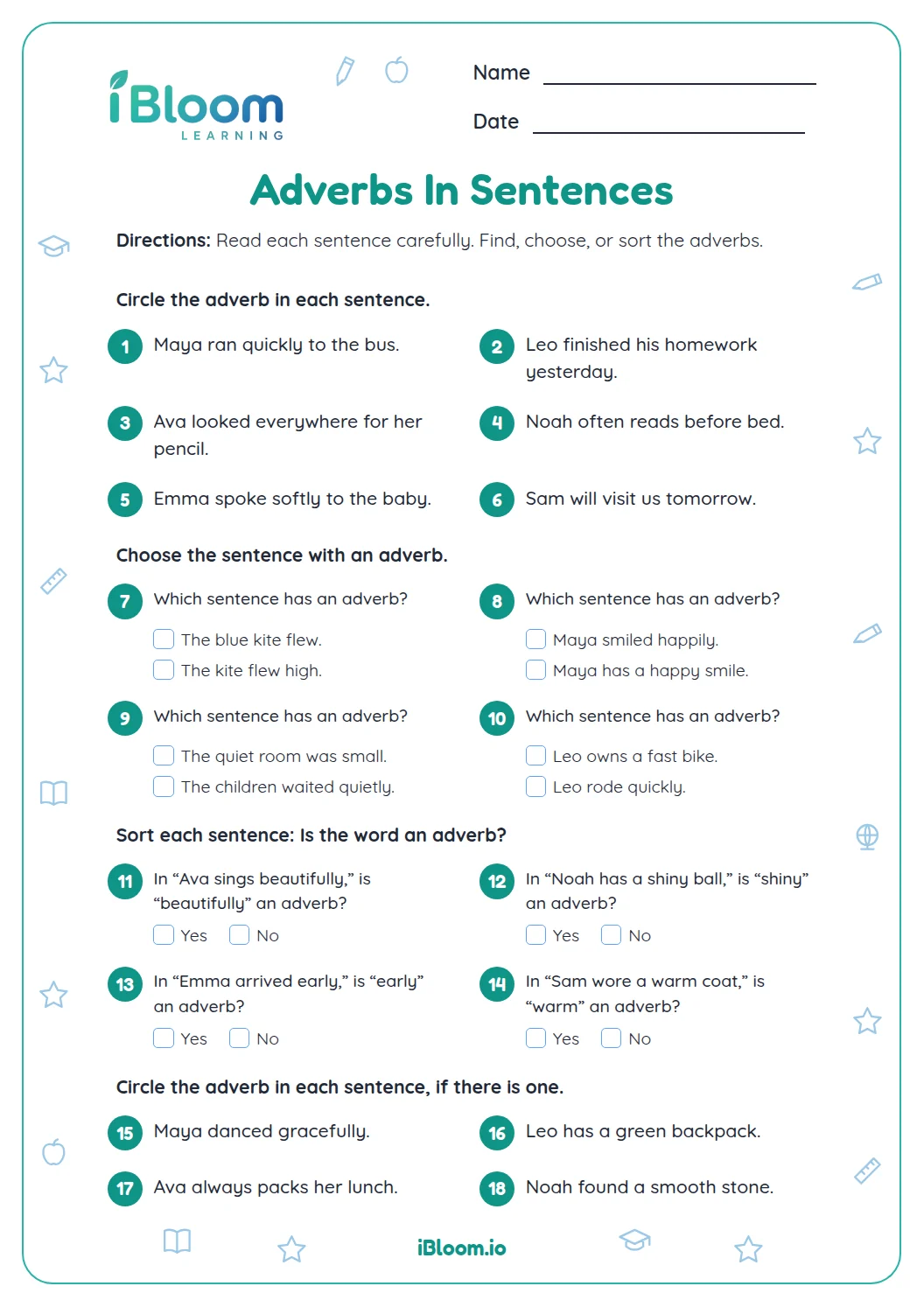
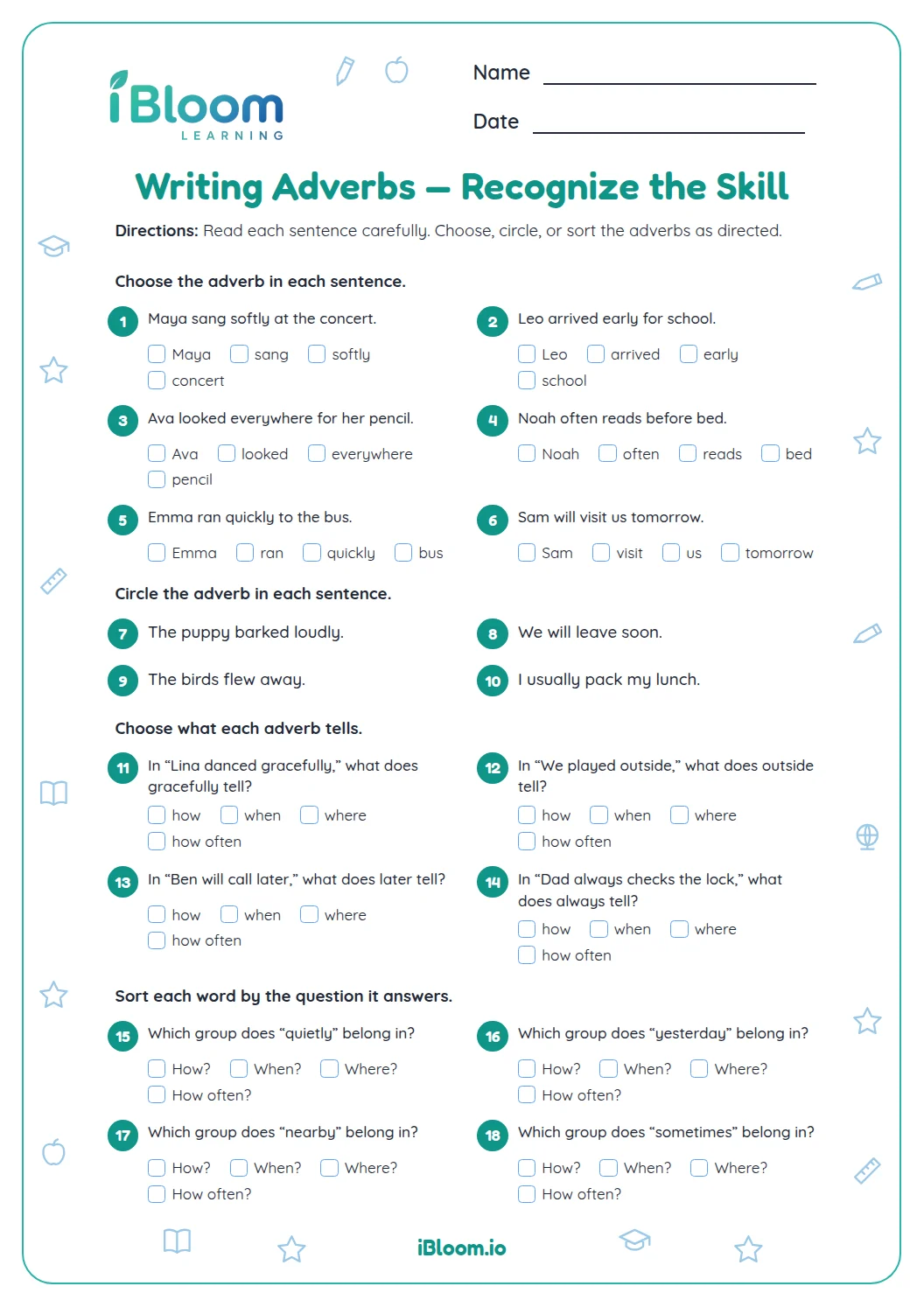
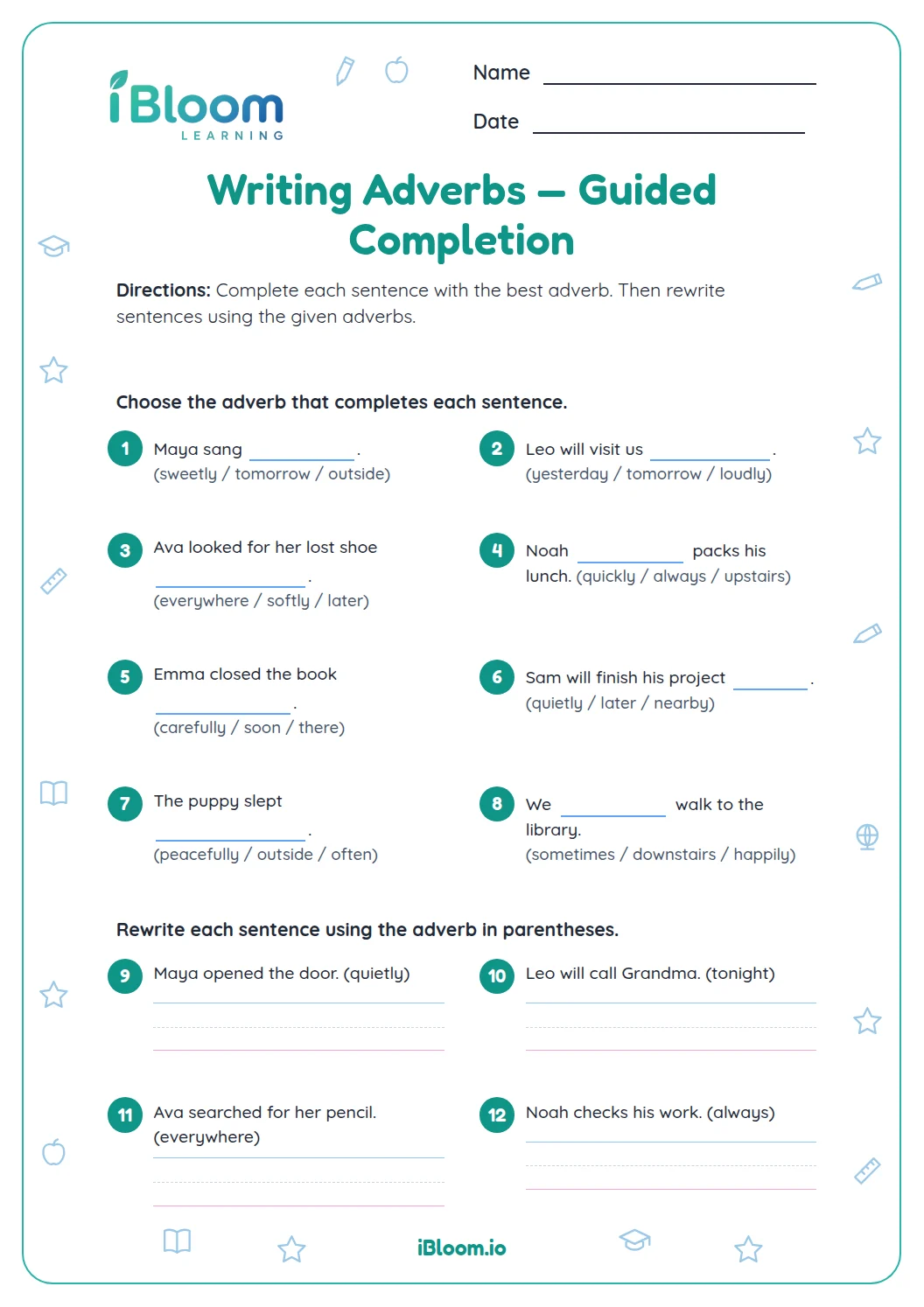
- 6Move on to the Writing Adverbs or Adverbs In Sentences worksheets when sorting feels easy.
Common mistakes and quick fixes
The mistake
Circling a verb or noun instead of the adverb, such as circling “slept” in “The kitten slept peacefully.”
The fix
Ask “Slept how?” The answer, peacefully, is the adverb. The verb is the action the adverb describes.
The mistake
Marking every word that ends in -ly as how, and everything else as where (for example calling tonight a where word).
The fix
Ask the question, not the ending. “Arrives where?” makes no sense, but “arrives when?” does: tonight tells when.
The mistake
Picking a how-adverb for a when blank, such as quietly for “The bus will arrive ___. (when)”.
The fix
Read the label first. Then try each choice with the question: arrive when? Soon answers it, and quietly answers arrive how.
Common Core alignment
Grade 3 students learn to name what each part of speech does in a sentence. These sentences show adverbs at work.
Explain what an adverb does in a sentence: it tells how, when or where.
On this sheet: Parts A to C ask children to find, sort and choose adverbs by what they tell about the verb, and Part D uses them in sentences.
Show the official wordingHide the official wording
Explain the function of nouns, pronouns, verbs, adjectives, and adverbs in general and their functions in particular sentences.
What to practice next
Make more practice
Further reading
Questions parents and teachers ask
What is an adverb that tells how, when or where?
It is a word that describes a verb by answering how, when or where the action happens. In “Maya called yesterday,” yesterday tells when. In “The ducks swam outside,” outside tells where. In “Mia hugged her puppy gently,” gently tells how. Each one adds detail to the verb.
Do all adverbs end in -ly?
No. Many how-adverbs end in -ly, like softly and carefully, but adverbs of time and place usually do not. Tonight, soon, here, nearby and everywhere appear on this worksheet and have no -ly ending. That is why Part B asks children to think about what the word tells, not how it ends.
Why does Part A have only one adverb in each sentence?
Each sentence is built around a single adverb so a child can find it by asking one question about the verb. Part A comes first because finding the word is the easiest step. Parts B and C then ask children to decide what kind it is and which one fits.
Can my child use a different adverb in Part D?
Yes. Any adverb that answers the question and makes sense is correct. For “The turtle walked,” slowly, carefully and quietly all tell how. The key shows one sample. If a word does not answer how or where, ask your child to read the sentence aloud and listen.
Is this worksheet suitable for Grade 2 or Grade 4?
It is written for Grade 3, with short sentences and familiar names. Grade 2 students may need help with the vocabulary in Part B, and Grade 4 students may find it quick. Use it as a warm-up before longer sentence work, or as a check that adverbs are secure.
What comes after how, when and where adverbs?
The next step is using adverbs in longer sentences and writing with them. The Identify Adverbs and Verbs and Adverbs In Sentences worksheets help children find adverbs in fuller sentences, Writing Adverbs asks them to add their own, and the comparative worksheet shows how adverbs change to compare.