

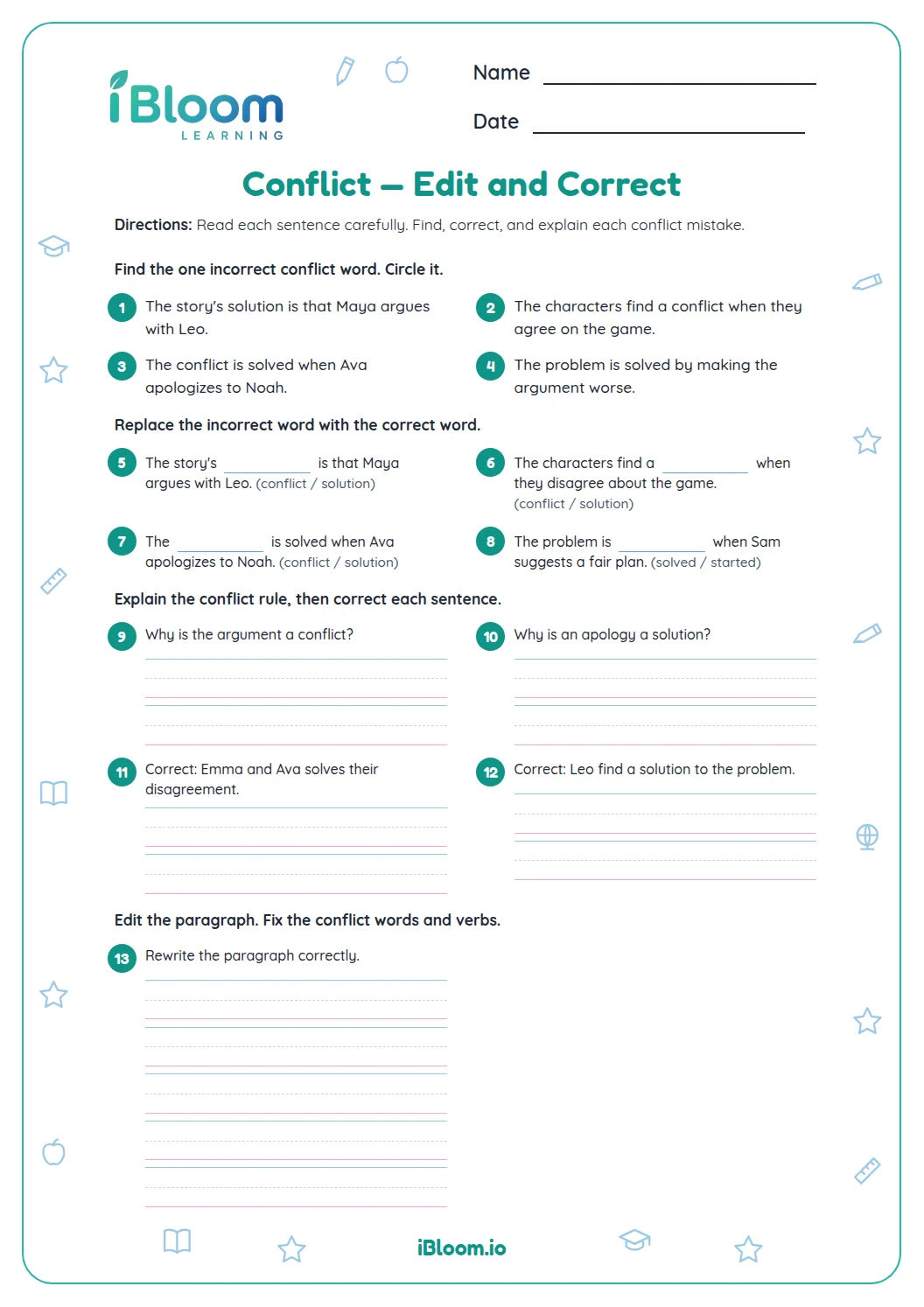
About this worksheet
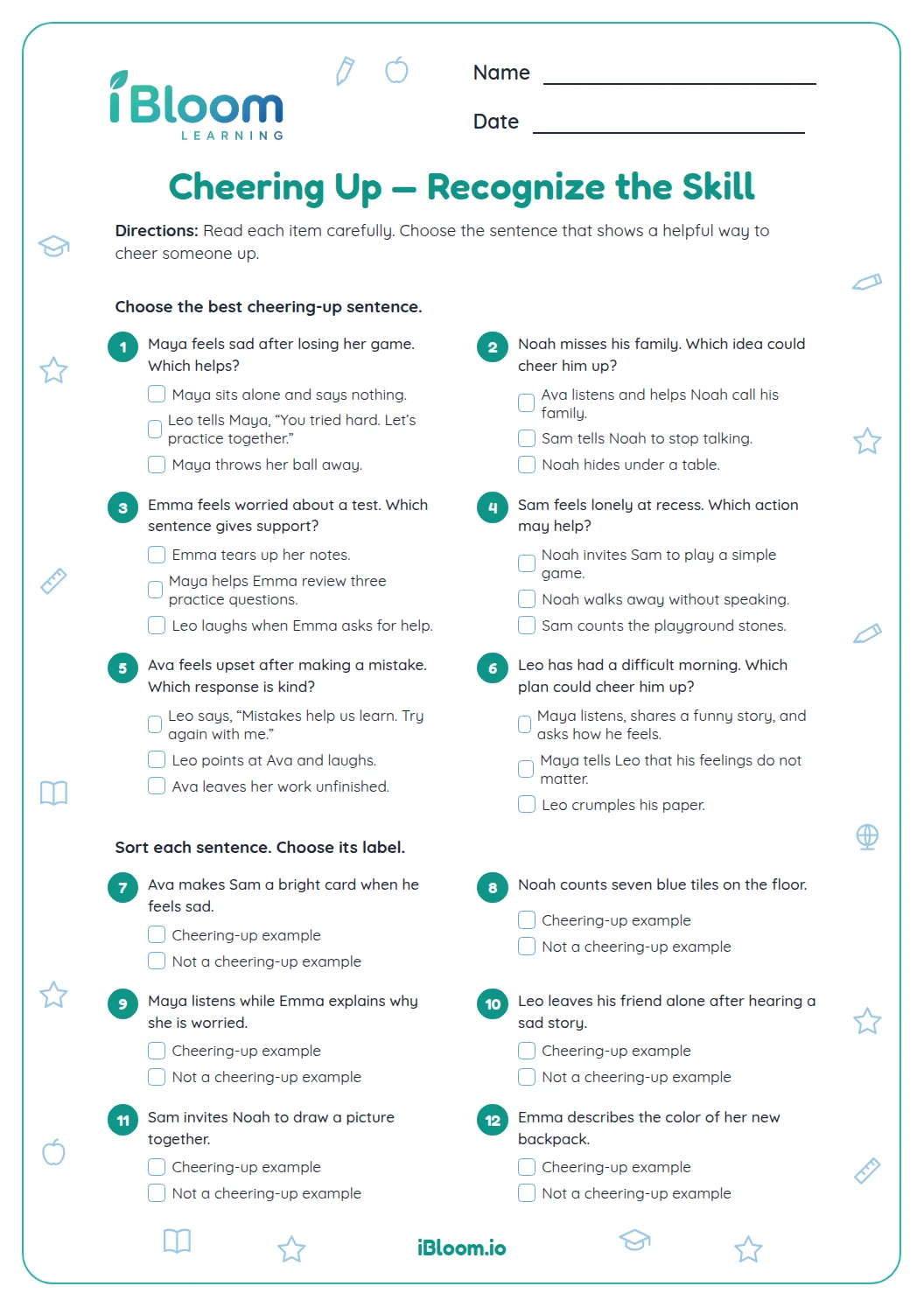
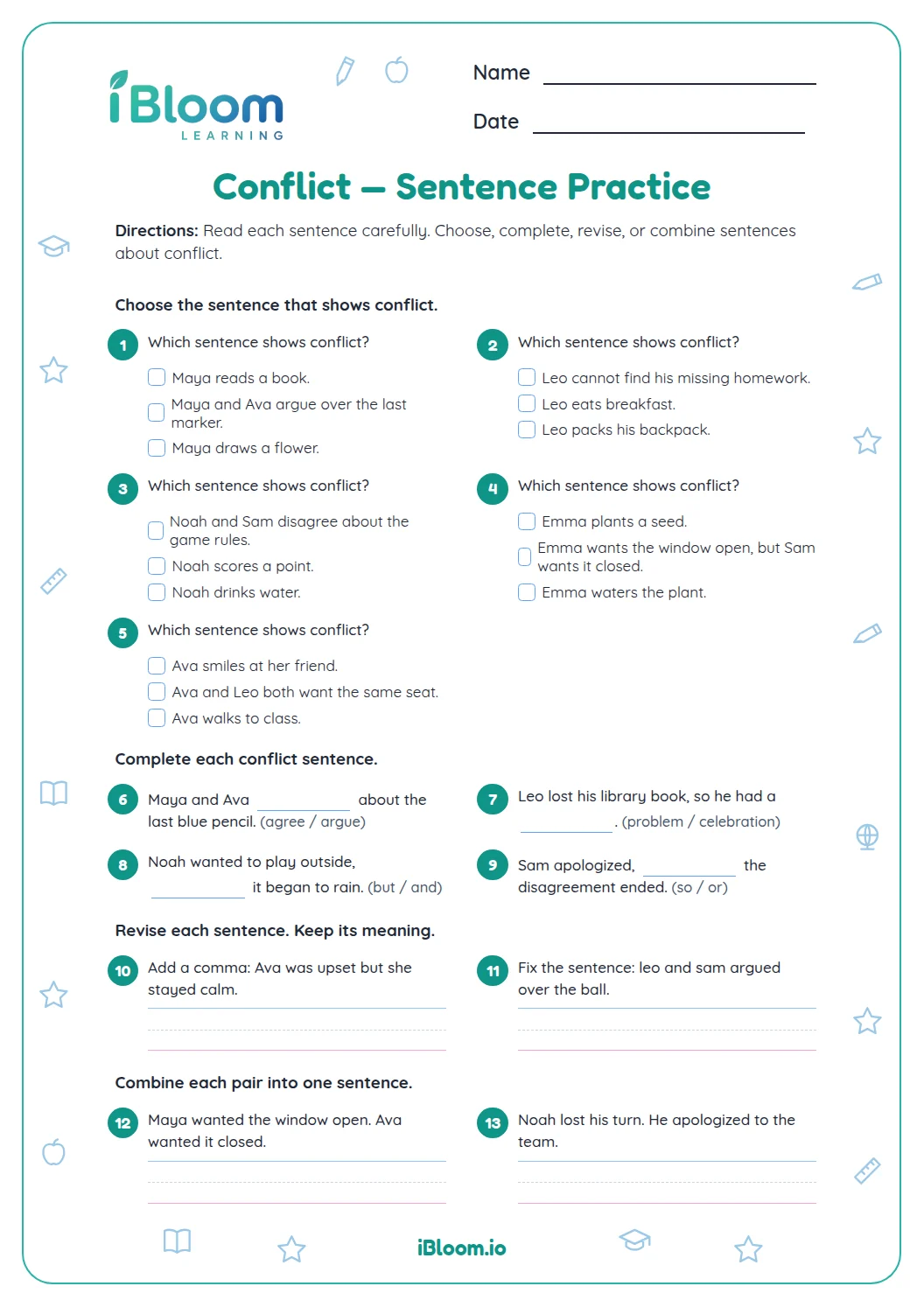
This Grade 3 printable combines sentence editing with a short informative response about cheering up a friend. Learners fix capitalization and punctuation, choose useful details, and write about a helpful action and why it may help. A separate answer key provides corrected sentences and sample responses. The practice aligns with CCSS 3.L.2 and 3.W.2.
Aligned to 3.W.2 and 3.L.2
What makes an edited sentence clear?
A sentence begins with a capital letter and ends with punctuation. Names also begin with capitals. Quotation marks show the words a person says.
For example, “sam said, ‘you can do it’” needs capitals for Sam and You, plus punctuation inside the quotation marks.
How can a detail explain an idea?
A specific action helps the reader picture what happened. A reason connects that action to the idea of cheering up a friend. Parts A and B move from editing and choosing useful details to a short written explanation.
- Part A: select correct edits and relevant details
- Part B: rewrite sentences with capitals and punctuation
- Part C: add detail and write an informative response
How to use this worksheet
- 1Read the sentence aloud to hear where it ends.
- 2Check the first word and names for capital letters.
- 3Add end punctuation and punctuate quoted words.
- 4For the writing prompts, name one action and explain how it may help.
- 5Compare fixed sentences with the separate answer key.
Common mistakes and quick fixes
The mistake
Leaving a name lowercase.
The fix
Capitalize each person’s name.
The mistake
Forgetting punctuation inside a quotation.
The fix
Place the spoken sentence’s end mark before the closing quotation mark.
The mistake
Adding a detail that does not explain the idea.
The fix
Choose a detail that tells what someone did or why it helped.
Curriculum alignment
The editing and informative-writing tasks practice these Grade 3 standards.
Develop an informative response with a clear topic and relevant details.
On this sheet: Children add specific details and explain why an action can help.
Show the official wordingHide the official wording
Write informative/explanatory texts to examine a topic and convey ideas and information clearly.
Use capitalization and punctuation while editing sentences.
On this sheet: Editing tasks correct capitals, sentence endings, commas, and quotation marks.
Show the official wordingHide the official wording
Demonstrate command of the conventions of standard English capitalization, punctuation, and spelling when writing.
What to practice next
Make more practice
Further reading
Questions parents and teachers ask
Does the worksheet ask for a full essay?
No. The final prompt asks for two sentences about one way to cheer up a friend and why it may help. Earlier items focus on editing and choosing details, so learners build toward a short, focused response rather than a long essay.
What should children check while editing?
Check that the first word and names begin with capitals, that sentences have end punctuation, and that spoken words use quotation marks correctly. The worksheet includes examples for rewriting and correcting these conventions. Read the corrected sentence once more to check that its meaning stays clear.
Is there an answer key?
Yes. A separate answer key gives corrected versions for the sentence-editing items and sample responses for prompts that allow different answers. Learners can compare their meaning and details with the samples. Read the corrected sentence once more to check that its meaning stays clear.
What makes a detail useful here?
A useful detail names a specific action or explains how that action could help a friend. “I made a card with a funny drawing” gives the reader a clearer picture than “I did something nice.” Read the corrected sentence once more to check that its meaning stays clear.
Can children give different answers to the writing prompts?
Yes. The open responses can use different actions and wording. A strong response stays on the topic, names a helpful action, and explains why it may cheer up a friend. Read the corrected sentence once more to check that its meaning stays clear.