




About this worksheet
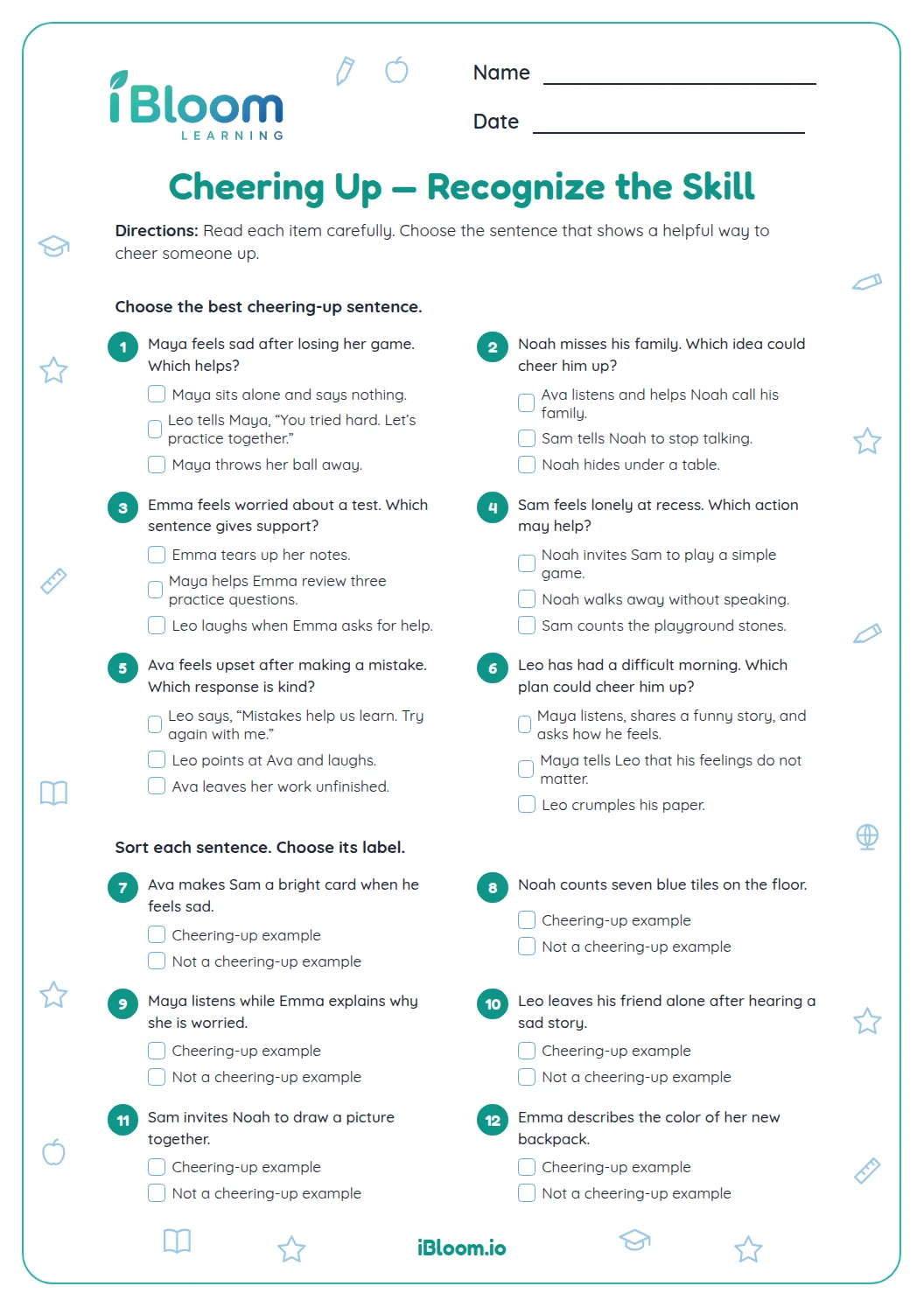
This Grade 3 printable uses the topic of cheering up a friend to practice informative writing. Students choose a focused topic sentence, select a relevant detail and conclusion, add a linking word, and write a few original lines. The 14 questions are arranged in four parts across two worksheet pages; a separate two-page key gives answers and sample responses. It aligns with CCSS W.3.2 through choosing and organizing information about a topic.
Aligned to W.3.2
What will students write about cheering up a friend?
The sheet starts with five choices about kind notes, listening, linking ideas, and conclusions. Students then supply words and ideas, before writing their own topic sentence, explanatory detail, and focused sentence. The last prompt asks for a concluding sentence.
Questions 1–14 appear across four parts. Students choose relevant ideas and explain why the choices support the topic.
How can a student tell whether a detail fits?
A useful informative detail explains the topic sentence. It gives a reason or a specific action instead of changing to an unrelated fact.
- 1Question 1: A kind note may help because it ___.
- 2Answer: shows someone cares
- 3Why it fits: It explains how the note might help.
How do linking words help connect ideas?
In Question 4, “You can listen. ___, you can offer help,” Also adds another related action. “Instead” would suggest replacing listening, which changes the relationship between the ideas.
What makes a complete written response?
Keep each response on the topic of supporting a friend. A topic sentence names the main idea, a detail explains how an action helps, and a conclusion brings the idea to a close. Adults can accept other clear, relevant wording for open questions.
How to use this worksheet
- 1Read the prompt and underline the topic: cheering up a friend.
- 2For choice questions, check that each idea relates to the topic.
- 3Use a linking word that matches the relationship between ideas.
- 4For written answers, state one clear idea and add a reason or detail.
- 5Compare open answers with the key examples and keep other relevant wording.
Common mistakes and quick fixes
The mistake
Choosing a true sentence that does not explain the topic.
The fix
Ask whether the detail tells how a kind action can support a friend.
The mistake
Using a linking word that changes the meaning between sentences.
The fix
Decide whether the next idea adds on, contrasts, or replaces the first.
The mistake
Writing a detail that repeats the topic sentence without explaining it.
The fix
Add a specific action or a reason that supports the main idea.
Curriculum alignment
This page practices informative writing prompts through grade-appropriate examples.
Group related information, explain a topic with facts and details, and conclude.
On this sheet: Questions ask students to choose details, link ideas and draft a focused informative response.
Show the official wordingHide the official wording
Write informative/explanatory texts to examine a topic and convey ideas and information clearly.
What to practice next
Make more practice
Further reading
Questions parents and teachers ask
How many questions are on the printable?
There are 14 questions in four parts, spread across two worksheet pages. The tasks begin with choosing ideas and move toward writing original sentences and a conclusion. A separate two-page answer key includes answers and examples for open responses. This gives children a concrete chance to practice the idea and explain their choices.
What is the topic of the writing prompts?
Every prompt centers on kind ways to cheer up or support a friend. Students consider listening, offering help, inviting someone to join an activity, and explaining why those actions may help. This gives children a concrete chance to practice the idea and explain their choices.
Does the worksheet ask children to write a paragraph?
It practices pieces of informative writing rather than asking for a full paragraph. Children choose and write topic sentences, details, a linking word, and a concluding sentence, which adults can discuss as parts of a paragraph. This gives children a concrete chance to practice the idea and explain their choices.
Are there several acceptable answers?
Yes. Some short prompts have many sensible answers, and the key supplies examples. A response should stay on the topic and clearly answer what the prompt asks; it does not need to copy the sample word for word. This gives children a concrete chance to practice the idea and explain their choices.
Which writing standard does the page practice?
The page aligns with CCSS W.3.2 by asking students to choose related information, explain a topic with details, connect ideas, and write a conclusion. The prompts keep that practice focused on helping a friend. This gives children a concrete chance to practice the idea and explain their choices.