




About this worksheet
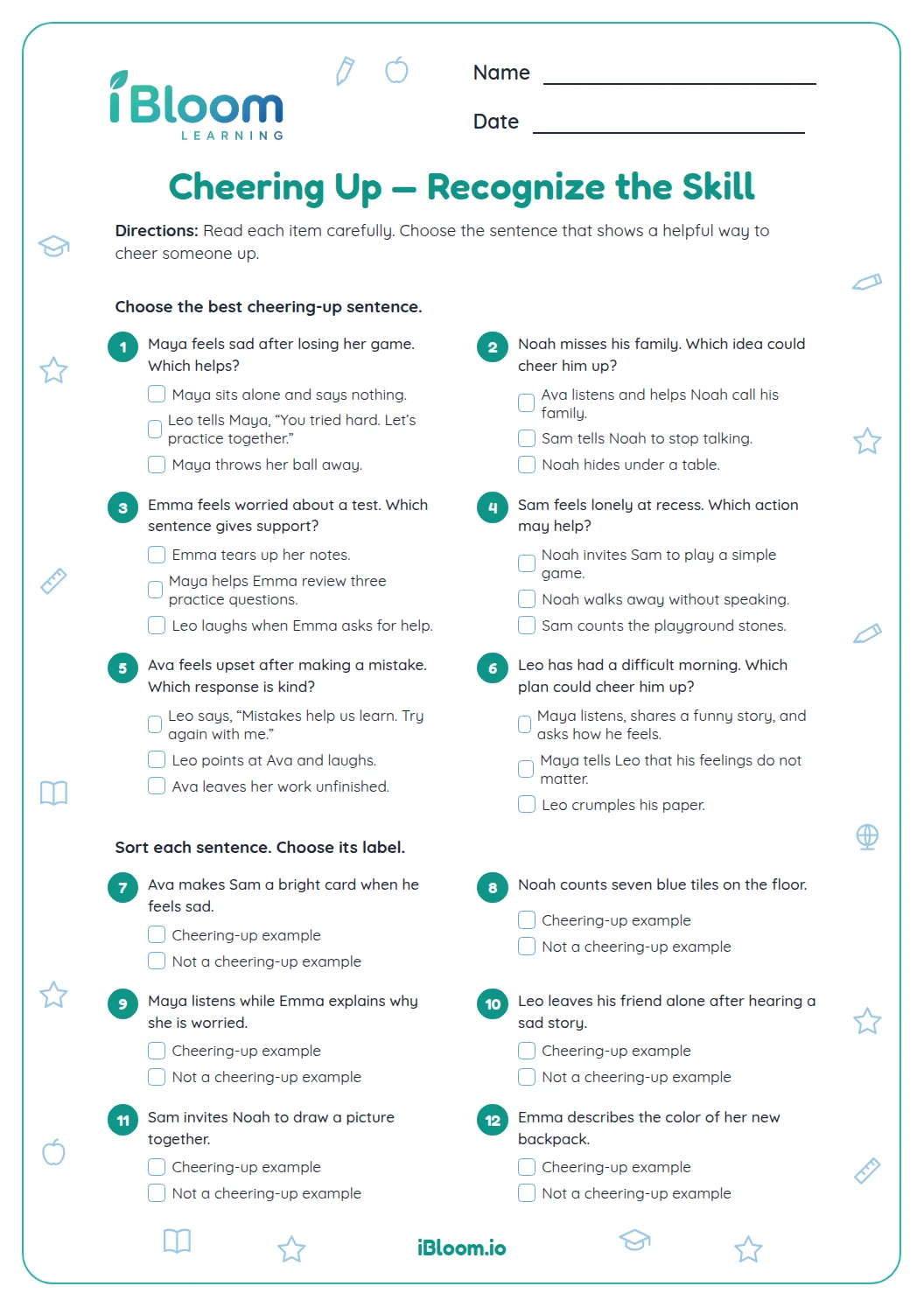
This Grade 3 printable builds informative writing by completing clear ideas and choosing relevant details about cheering up a friend. Ten items focus on useful words and details; four more ask learners to choose the response that best fits a situation. The examples emphasize listening, kind invitations, and respecting a friend’s request for space. The worksheet supports CCSS W.3.2 and includes a separate answer key.
Aligned to W.3.2
How do sentence completions make an idea clearer?
A useful completion makes the sentence specific and keeps its meaning. In question 1, asking how a friend feels invites them to share what is going on.
Questions 1–10 add a word or helpful detail. Questions 11–14 ask learners to select a response that fits a short situation.
- 1A helpful first step is to ask your friend how they ___.
- 2Choose “feel.”
- 3The complete idea is: Ask how your friend feels.
What makes a detail helpful and respectful?
Part A practices sentence-level choices about listening and encouragement. Part B applies those ideas to situations, including a friend who feels left out, a nervous classmate, and someone asking for quiet time.
A strong choice is relevant to the situation and treats the friend respectfully.
How can families use the sample answers?
The answer key gives sample responses for the four written items. A child's wording can differ and still work if it stays on topic, uses complete sentences, and explains a kind action. Invite the child to read the response aloud and check that each sentence makes sense.
How to complete the guided writing
- 1Read the whole sentence before choosing a completion.
- 2Check that the word fits both the grammar and the meaning.
- 3For a situation, identify what the friend may need.
- 4Choose a response that is kind and respects the friend’s choice.
- 5Reread the completed idea to check that it is clear.
Guided writing mistakes to catch
The mistake
Choosing a word that fits the grammar but not the situation, such as “ignore” when a friend wants to talk.
The fix
Read the whole prompt and ask which choice shows care in that specific moment.
The mistake
Writing only “I would help” without naming an action.
The fix
Add a concrete detail such as listening, inviting the friend to walk, or offering to play.
The mistake
Assuming every friend wants the same kind of support.
The fix
Ask what the friend prefers and respect a request for quiet or space.
Common Core alignment
This worksheet practices informative writing with a focused topic and relevant details.
Complete guided informative sentences that explain helpful ways to cheer someone up.
On this sheet: Students complete and write informative sentences that explain actions and details about cheering someone up.
Show the official wordingHide the official wording
Write informative/explanatory texts to examine a topic and convey ideas and information clearly.
What to practice next
Make more practice
Further reading
Questions parents and teachers ask
Are there single correct answers for the writing prompts?
The answer key lists the best choice for all 14 questions. The first ten complete sentences or add a helpful detail; the last four apply the ideas to a situation. Learners can discuss other kind responses, while the selected answer should fit the prompt most closely.
How does the worksheet move from guided to independent writing?
Questions 1–10 guide learners through word and phrase choices in complete sentences. Questions 11–14 use short situations and ask for the most relevant supportive response. Together, they move from completing a clear idea to applying it in context.
What should a strong response include?
A strong choice is specific, kind, and connected to what the friend needs. It might offer to listen or invite someone to join a game. It should not pressure a friend to talk or share private information with others.
How many questions are included?
There are 14 questions across two worksheet pages: ten selected sentence completions and four short written responses. The answer key is separate and includes sample answers for the open-ended prompts, so families can focus on whether the idea is clear and relevant.
Can a child use a different helpful idea from the sample?
The worksheet uses multiple-choice questions, so the key identifies the best response for every item. If a child suggests another helpful idea, discuss whether it fits the situation, respects privacy, and gives the friend a choice. The child can explain why that action would help.