




About this worksheet
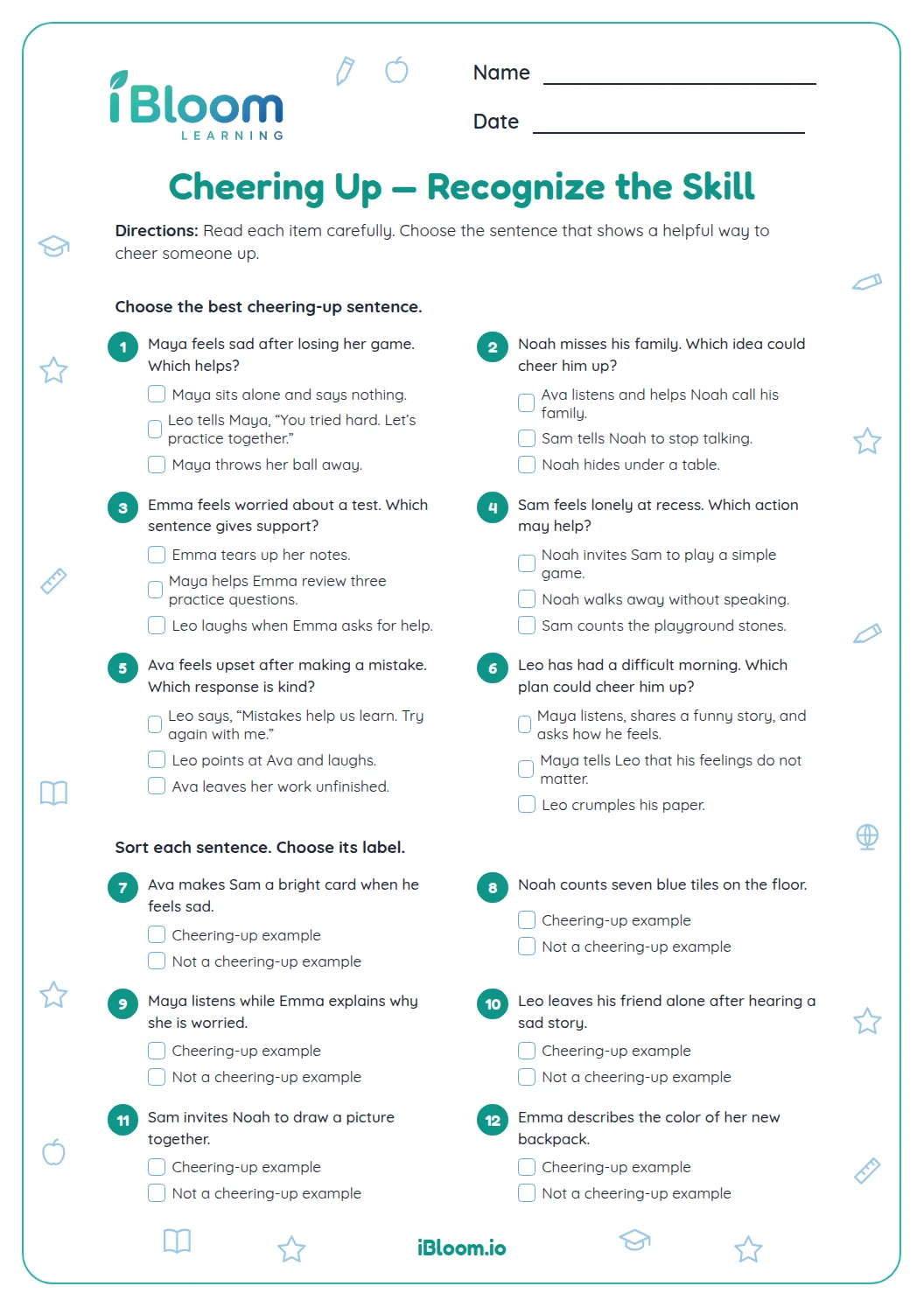
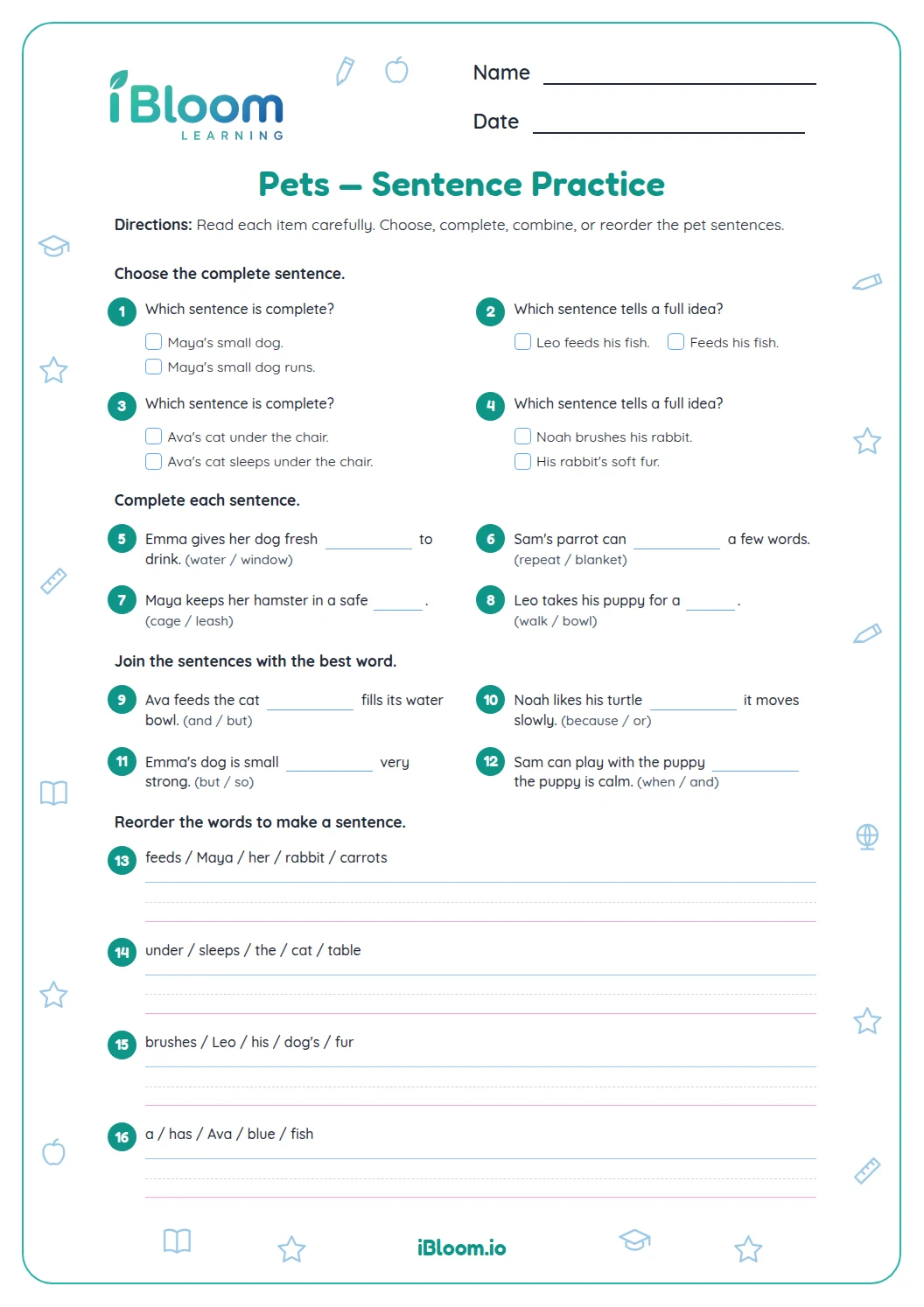
This free Grade 3 worksheet builds informative sentence skills around ways to cheer up a friend. Twelve questions move from choosing a complete sentence and a specific helpful detail to using linking words, revising sentences, and combining ideas. Children correct capitals and punctuation, remove repetition, make a sentence more supportive, and join two related thoughts. The practice supports developing a topic with details and producing varied sentences. A sample answer key gives models for the open-ended revisions and combination.
Aligned to W.3.2b and L.3.1i
What sentence skills does the worksheet practice?
The three parts move from recognizing a complete, specific sentence to linking ideas, revising sentences, and combining them. Children work with and, because, but, and so while writing about helpful actions between friends.
Part A has four choices, Part B has four linking-word blanks, and Part C has four short written revisions or combinations. The answer key gives sample wording for responses that can vary.
How can a detail make a sentence more informative?
A broad sentence can tell the reader that help is offered without saying what the helper will do. Adding an action gives useful information: “I can help my friend pick up the crayons.”
In Part A, children choose a specific helpful action and a reason someone might listen. In Part C, they revise a line to make it more supportive and remove an unnecessary repeated word.
- 1Question 10: Leo smiled and Leo laughed.
- 2The name Leo repeats, but the second subject is still clear.
- 3Revised: Leo smiled and laughed.
Which linking word shows how two ideas fit?
And adds a related action, because gives a reason, but shows a contrast, so introduces a result, and when tells when something happens. Read both parts of the sentence before choosing a connector.
Part B practices four links in short sentences. Part C asks children to revise three sentences and combine a pair of ideas with and.
How can a child check a revised sentence?
Read the sentence aloud and check that it still says what the prompt asks. Look for a capital at the beginning, punctuation at the end, and a joining word that makes the relationship between ideas clear.
The key supplies sample wording for responses that can vary. A different sentence is also correct when it keeps the original meaning and follows the requested revision or connector.
How to use the worksheet
- 1Read each Part A sentence choice and look for a complete thought or a useful detail.
- 2For each Part B blank, read both sides before choosing a linking word.
- 3In Part C, edit for capitals and punctuation, remove repetition, and make a sentence more supportive.
- 4Join the final pair of ideas with and, keeping both actions clear.
- 5Read each revised sentence aloud to check that it sounds clear and keeps the intended meaning.
- 6Compare open-ended responses with the sample key; accept another clear version that meets the prompt.
Mistakes to check together
The mistake
Leaving a name lowercase in “maya listened to ava.”
The fix
Capitalize the first word and each person’s name, then add end punctuation.
The mistake
Repeating the subject in “Leo smiled and Leo laughed.”
The fix
Keep the second action and remove the repeated name: “Leo smiled and laughed.”
The mistake
Using so when the second idea gives a reason, or because when it gives a result.
The fix
Ask how the ideas relate. A reason follows because; a result can follow so.
Common Core alignment
Develop the topic of helping a friend with specific actions and details.
On this sheet: Children write explanatory sentences about listening, helping, and including a friend.
Show the official wordingHide the official wording
Develop the topic with facts, definitions, and details.
Write complete simple, compound, and complex sentences.
On this sheet: Part C asks children to write a simple sentence, join two independent clauses, and explain with because.
Show the official wordingHide the official wording
Produce simple, compound, and complex sentences.
What to practice next
Make more practice
Further reading
Questions parents and teachers ask
Is this a story-writing or informative sentence worksheet?
It is informative sentence practice about ways to help a friend. Children choose specific actions, revise sentences for clarity, and connect related ideas. The sentences can later serve as details in a short informative paragraph about cheering someone up.
What kinds of revisions are on the sheet?
Three prompts ask children to revise sentences: capitalize names and add punctuation, remove a repeated subject, and make a line more supportive. A fourth written prompt combines two ideas with and. Four earlier blanks practice linking words in context.
Can more than one written answer be correct?
Yes. The answer key gives sample wording for all four written revisions and combinations. Another response can be correct if it follows the requested revision or named connector, keeps the important meaning, and reads as a clear sentence. A clear alternate sentence can still earn credit.
Which linking words does the sheet practice?
The four sentence blanks use and, because, but, and so. The final prompt asks children to combine ideas with and. Talk about whether the word adds an action, gives a reason, shows a contrast, or introduces a result before checking the sentence.
How long does this worksheet take, and is there an answer key?
Plan for about 20 minutes for the 12 questions, including four short written revisions and a combination. The separate two-page answer key marks selected answers and offers sample sentences. A child’s wording may differ while still meeting the prompt.
How can I help a child revise without taking over?
Ask what the sentence needs: a capital, less repetition, or a kinder tone. For the dropped-crayons example, invite the child to say exactly what help looks like. Then have the child reread the revision and decide whether it keeps the intended meaning.