







About this worksheet
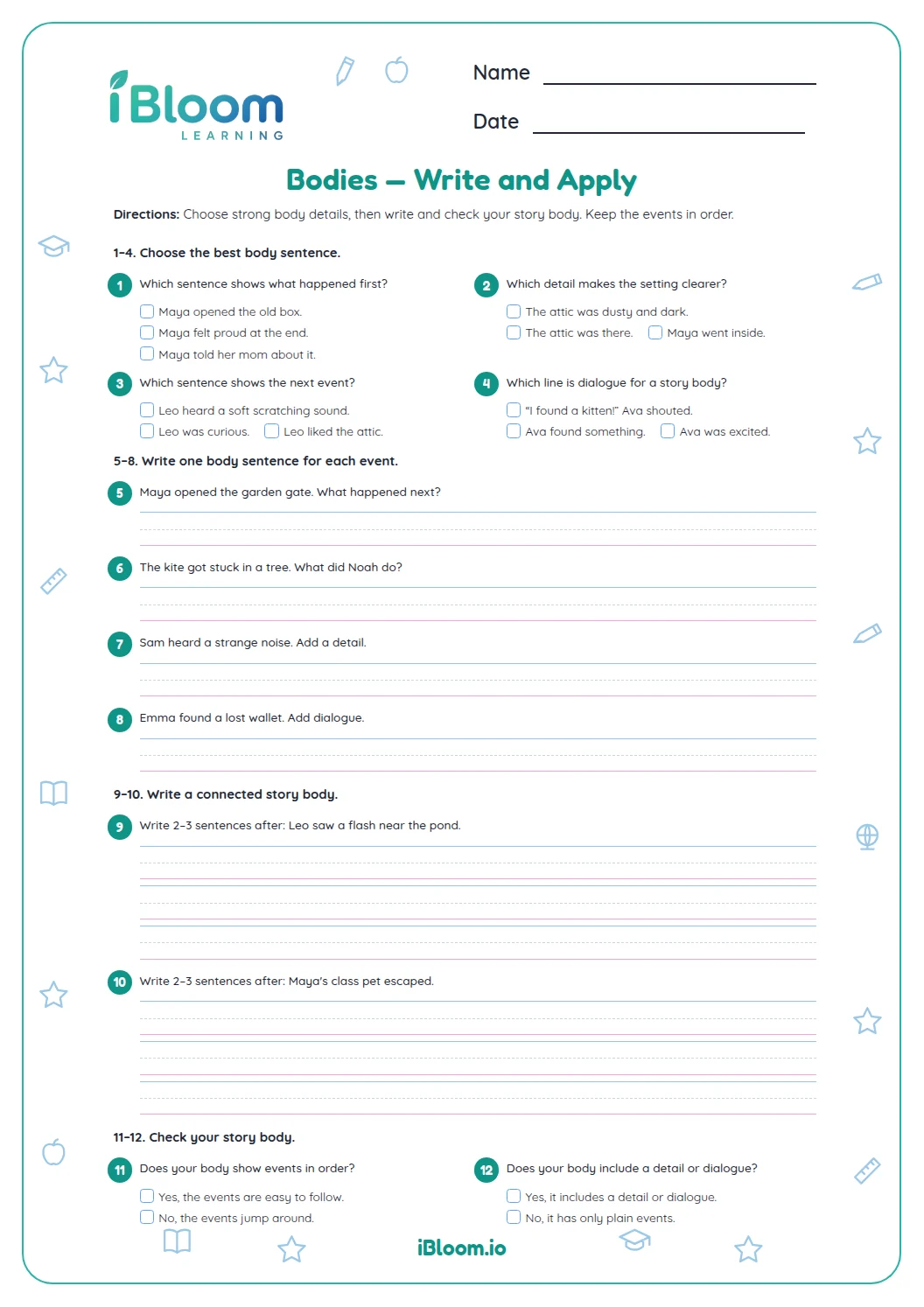
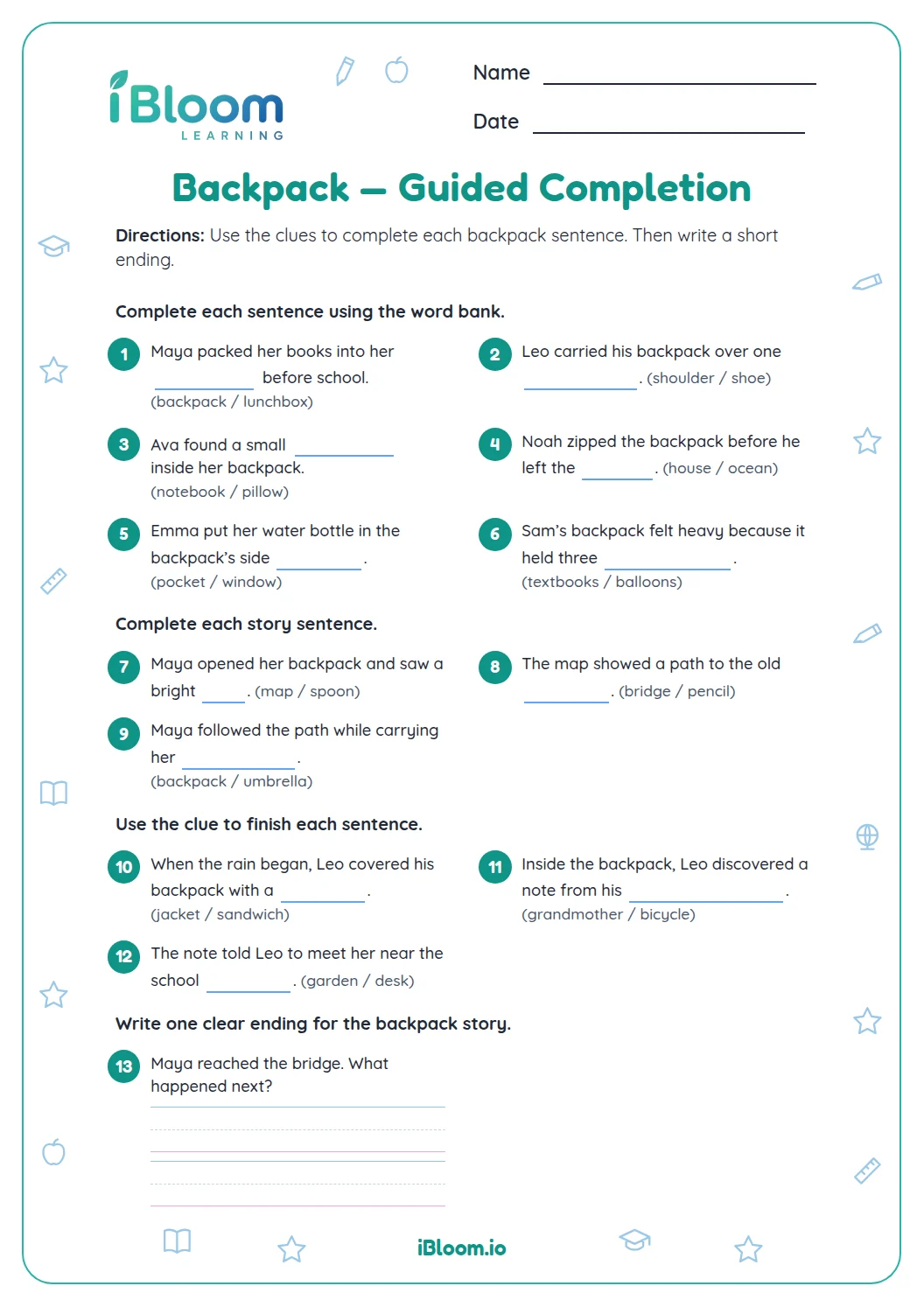
This free Grade 3 narrative worksheet helps children choose details that develop a story body. Fourteen choices use the page’s own scene types: Maya’s cave map, a lost puppy, a storm, a drifting boat, and Sam’s kite. Children identify dialogue, actions, thoughts, and feelings, then choose revisions that move an event forward. The answer key marks each choice.
Aligned to W.3.3b
Which details develop a story body?
Actions, thoughts, feelings, and dialogue add different information. “Her hands trembled” shows Maya is nervous, while “Rain slapped the glass” makes the storm feel forceful. The scenes stay close to those used in the original sheet.
How can a revision make an event clearer?
Replace a vague action with one readers can picture. “Ava gripped the swaying rope” gives a clearer image than “Ava crossed a bridge.”
- 1Plain action: Ava crossed a bridge.
- 2Clearer revision: Ava gripped the swaying rope.
- 3The revision shows what Ava does.
What makes a story event move forward?
A next action should follow what just happened. When Sam spots his kite, pulling it from a tree continues the event; a color detail alone does not tell what happens next.
How to use this worksheet
- 1Notice the event in the prompt.
- 2Decide whether it asks for an action, thought, feeling, or dialogue.
- 3Choose a detail that matches that job.
- 4Keep connected answers in the school-play scene.
- 5Reread to see whether each detail moves or clarifies the moment.
Common mistakes and quick fixes
The mistake
Using a feeling when the prompt asks for an action.
The fix
Show what the character physically does.
The mistake
Writing spoken words without quotation marks.
The fix
Put quotation marks around dialogue.
The mistake
Changing scenes between connected answers.
The fix
Keep the glowing-hands school play as the shared moment.
Common Core alignment
Develop story events with dialogue, actions, thoughts, and feelings.
On this sheet: Children select useful narrative details, revise flat sentences, and write connected events about an imaginary body change.
Show the official wordingHide the official wording
Use dialogue and descriptions of actions, thoughts, and feelings to develop experiences and events or show the response of characters to situations.
What to practice next
Make more practice
Further reading
Questions parents and teachers ask
What kinds of story scenes are on this worksheet?
The questions use brief scenes about Maya’s cave map, a lost puppy, a storm, a drifting boat, and Sam’s kite. They ask children to recognize details that develop a moment, such as a clear action, a thought, a feeling, or dialogue.
What counts as a story action?
An action tells what a character does, such as gripping a rope or pulling a kite from a tree. A feeling names an emotion, while a thought gives an idea in the character’s mind. The choices distinguish those detail types.
How many questions require writing?
All 14 questions are multiple choice, so children select details rather than write extended responses. The prompts still ask them to reason about actions, thoughts, feelings, dialogue, and event order in specific story scenes. Ask the child to point to the clue that makes the choice fit.
How can dialogue be identified?
A character’s spoken words are dialogue and appear inside quotation marks. A thought stays in the character’s mind, even if it is phrased as a question. Check whether someone says the words aloud in the scene. Ask the child to point to the clue that makes the choice fit.
Why choose a specific action instead of a vague one?
A specific action helps readers picture what happens. “Sam pulled the paddle back” gives a clearer event than “Sam did something.” The answer choices let children compare a vague line with a detail that advances the story. Ask the child to point to the clue that makes the choice fit.