


About this worksheet
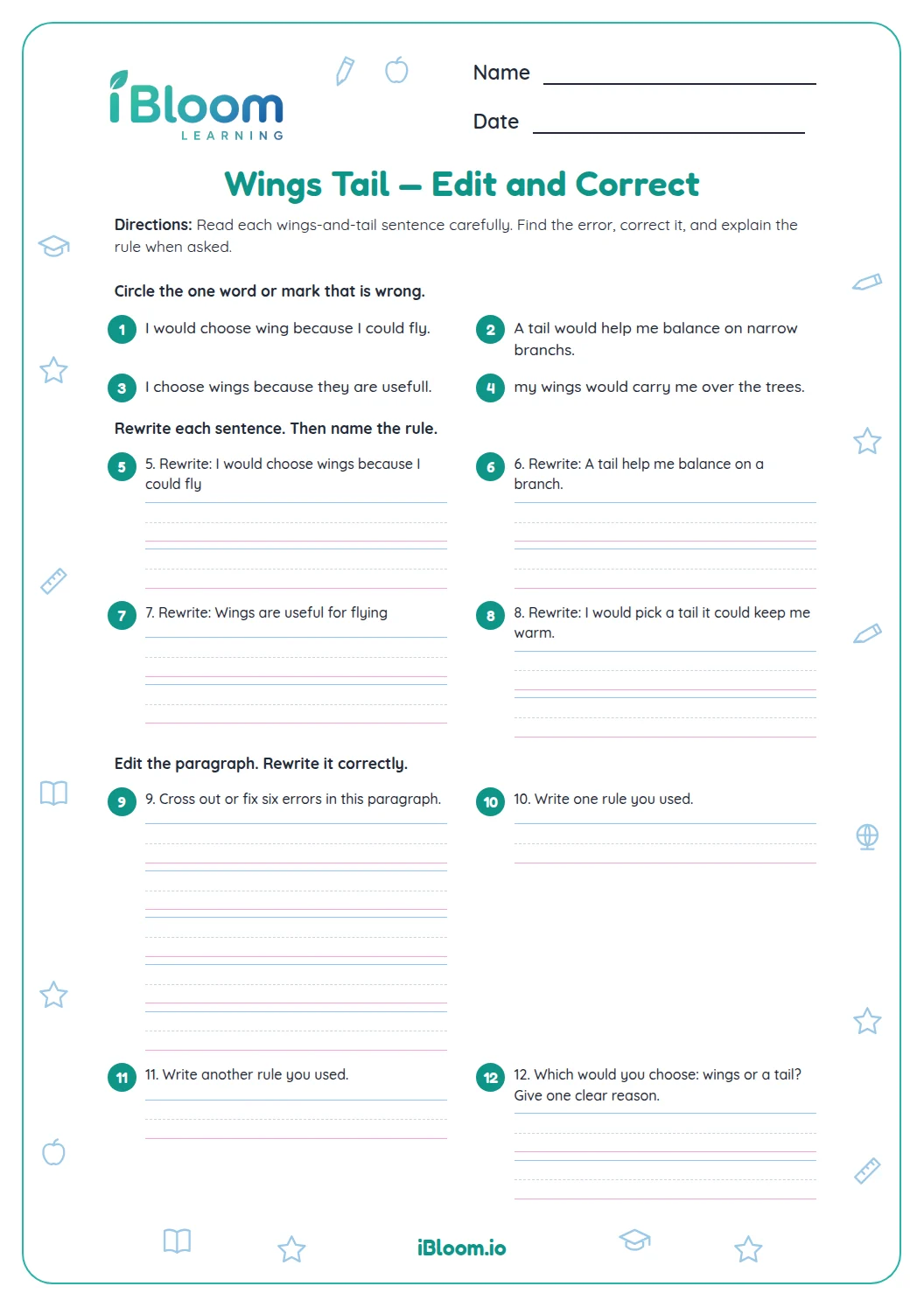
This free Grade 3 opinion-writing worksheet turns an imaginary choice into a supported opinion: would you rather have wings or a tail? Children complete four model sentences about flying, balancing, gliding, and swishing flies away. Six guided responses then build their own opinion with two reasons, an example, a closing, and a revised reason. This practices Common Core W.3.1, supporting a point of view with reasons. The separate answer key gives fixed answers for the word choices and samples for the writing, so either imaginary feature can lead to a successful piece.
Aligned to W.3.1
How do children turn a choice into an opinion?
The choice is imaginary, so children may invent useful wings or a tail. Ask what the feature would let them do. Flying over a forest supports wings; balancing on a narrow branch could support a tail. The important connection is between the chosen feature and the reason.
Part A contains four guided completions about flying, balancing, gliding, and swishing flies away. Children choose between two words or phrases to connect each feature with a useful action before writing their own reasons.
What makes a reason stronger than a repeated choice?
A reason adds information. “I want wings because I want wings” repeats the preference. “I want wings because I could visit high places” tells the reader why. In Part B, children state their choice and supply two different reasons.
- 1Starter: One reason is...
- 2Sample: One reason is that wings would help me reach high places.
- 3Why it works: Reaching high places explains the appeal of wings.
How do the last three questions help finish the writing?
Part C asks for an example, a closing, and an improved reason. The example should explain one reason already given. A child who wants wings to reach high places might describe landing beside a tree house.
The closing returns to wings or a tail without changing the topic. For the final revision, children choose one of their reasons and add a useful detail. Read the responses in order, using the revised reason in place of its earlier version.
How to work through this worksheet
- 1Ask your child to imagine using wings or a tail for one day and talk about what each could do.
- 2Complete the four model sentences in Part A and discuss how each action matches wings or a tail.
- 3Have your child keep one choice through all three sentence starters in Part B.
- 4For question 8, choose one reason to explain with a specific example.
- 5Complete the closing, improve one reason, and read the finished ideas aloud in order.
Mistakes to notice and ways to help
The mistake
Repeating “I want wings” as the reason.
The fix
Ask what wings would make possible, then add that action after “One reason is.”
The mistake
Writing two reasons that both mean “I could fly.”
The fix
Help the child name two different benefits, such as reaching high places and crossing a lake.
The mistake
Switching to a tail in the closing after supporting wings.
The fix
Reread question 5 and make sure the closing returns to that same preference.
Common Core alignment
State a preference for wings or a tail and support it with reasons.
On this sheet: The guided responses build one opinion with two reasons, an example, and a closing.
Show the official wordingHide the official wording
Write opinion pieces on topics or texts, supporting a point of view with reasons.
What to practice next
Make more practice
Further reading
Questions parents and teachers ask
Is there a right choice between wings and a tail?
Either choice works for the guided writing. The key shows a sample about wings, but a child can support a tail with clear reasons and examples. Check whether the reasons explain that choice and whether the closing keeps it. The four word-choice completions have fixed answers.
How much should my child write for each starter?
One complete sentence is enough for each starter. Encourage your child to include the starter when writing, so the result reads smoothly aloud. Questions 5 through 9 build the opinion a sentence at a time; question 10 asks for a more detailed version of one reason.
Can the reasons include pretend abilities?
Yes, pretend abilities fit this imaginary choice. A child might invent wings for traveling or a tail for balancing. Ask for a clear connection between the feature and its use. The reason still needs to make sense within the child’s idea, and the example should explain that same reason.
What should I check in the final revision?
Check that the rewritten reason adds useful information. Compare question 10 with the earlier reason and ask what the reader learns now. Naming a place, an action, or a purpose can help. Simply adding “really” or repeating the choice does not explain why the feature would be useful.
How should I use the sample answer key?
Use the samples to judge the structure of a response, rather than requiring the same words. Look for a clear preference, two different reasons, a related example, and a closing. Discuss any unclear connection aloud, then let your child revise the sentence using their own ideas.