


About this worksheet
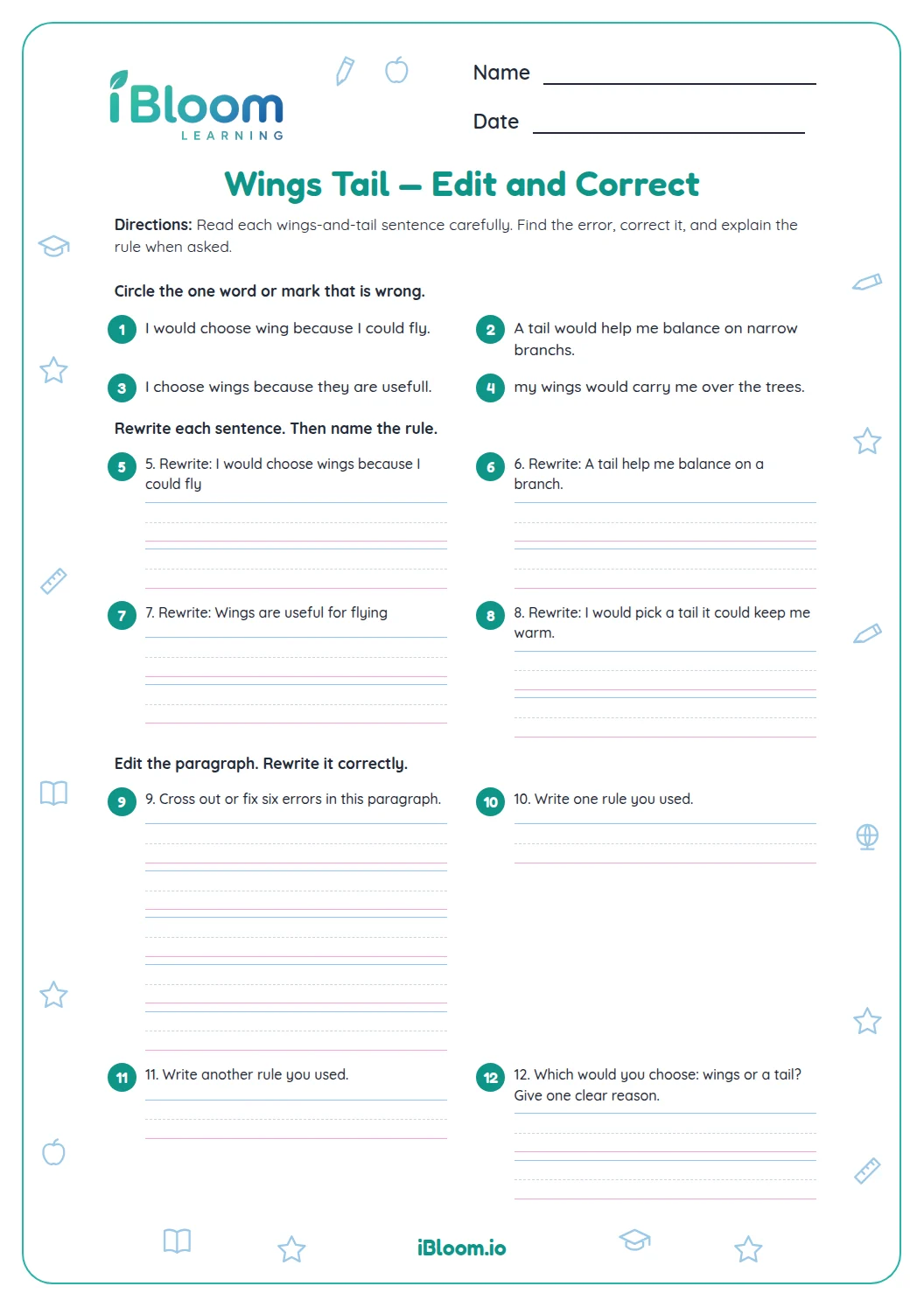
This printable gives Grade 3 writers a playful choice: would wings or a tail be more useful? Children first identify opinions and supporting details, then write their own view, reason, detail and closing sentence. The final prompts ask them to develop and revise an opinion using linking words. The work practices the opinion writing structure in CCSS W.3.1, with a separate answer key for the selected responses and sample writing.
Aligned to W.3.1
What does this opinion writing about wings and tails worksheet practice?
Children first identify an opinion and select details that fit it. They then write a preference, add reasons and details, and revise one response with a linking word.
The answer key identifies the selected choices and provides sample responses for the open-ended prompts.
How can a child work through opinion writing about wings and tails?
Check whether a sentence states a view, then ask if the detail supports that view. In the writing prompts, state a preference and connect it to reasons or examples.
- 1“Wings are better than tails” states a view; “A fish steers with its tail” is a detail that can support a claim about tails.
- 2Pick the detail that directly proves the idea, rather than one that is merely true.
How can an adult help without giving the answer?
Ask the writer to point to the sentence that states the opinion and underline a reason that supports it. A different choice of wings or tail is fine when the reasons fit.
How to use this worksheet
- 1Read each opinion or reason in Part A before choosing a response.
- 2Ask whether the detail directly supports the idea or only describes the animal.
- 3In Part B, state a clear preference in one sentence.
- 4Add a reason and a specific example that supports that reason.
- 5Use a linking word in the revision prompt to connect ideas.
- 6Compare selected answers with the key; accept other sensible written responses.
Opinion writing mistakes and quick fixes
The mistake
Giving a fact instead of a personal view.
The fix
Try “I think,” “I prefer,” or “In my opinion” to make the position clear.
The mistake
Adding a detail that is true but does not support the claim.
The fix
Ask how the detail proves the reason. “A fish steers with its tail” fits a claim that tails are useful.
The mistake
Repeating the opinion as the only reason.
The fix
Add a because statement with a specific example, then restate the view in a closing sentence.
Common Core alignment
The writing prompts ask children to state an opinion, support it with reasons and information, and use linking words.
Write an opinion with reasons, supporting details, linking words and a closing.
On this sheet: Part B asks writers to give an opinion, support it with reasons and details, and close or revise it.
Show the official wordingHide the official wording
Write opinion pieces on topics or texts, supporting a point of view with reasons.
What to practice next
Make more practice
Further reading
Questions parents and teachers ask
What counts as an opinion?
An opinion tells what a writer thinks or prefers, such as “I believe wings are more helpful.” A fact can be checked, such as “Birds have wings.” This worksheet asks children to spot opinions and then write one of their own.
How many reasons should a Grade 3 opinion include?
The writing prompts build from one reason to two different reasons. A clear reason explains why the writer holds the opinion; a detail or example helps the reader understand that reason. The answer key offers sample responses, while other well-supported views can also work.
Do children have to prefer wings?
No. The topic invites a child to choose wings or a tail. The multiple-choice questions have keyed answers about which detail best supports a stated idea, but the personal writing prompts allow either preference when a reason supports it.
What is a supporting detail?
A supporting detail gives a concrete example or fact that helps prove a reason. “A dog wags its tail when happy” supports the idea that tails can communicate. “A dog has four legs” is true, but it does not show how a tail communicates.
What linking words can a child use?
Words such as also, because, another reason, and for example can show how ideas connect. In the final revision item, a child adds a linking word to connect a second reason to the opinion rather than simply listing ideas.
How should I check the written answers?
Use the key’s samples as models, not the only acceptable wording. Look for a clear opinion and a reason that fits it; for the detail prompt, check that the example supports the stated idea. A child can read the response aloud to hear whether the connection makes sense.