





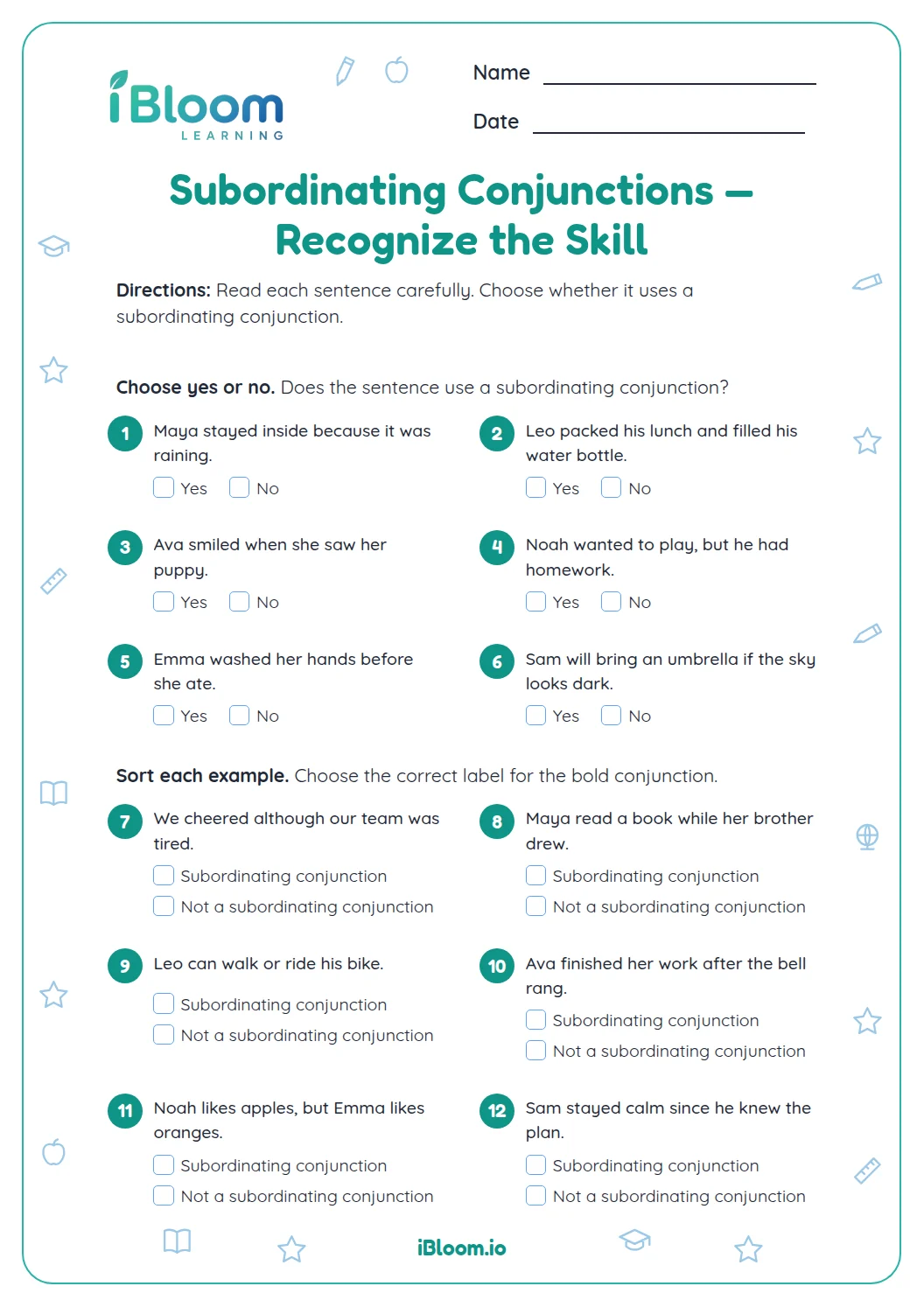
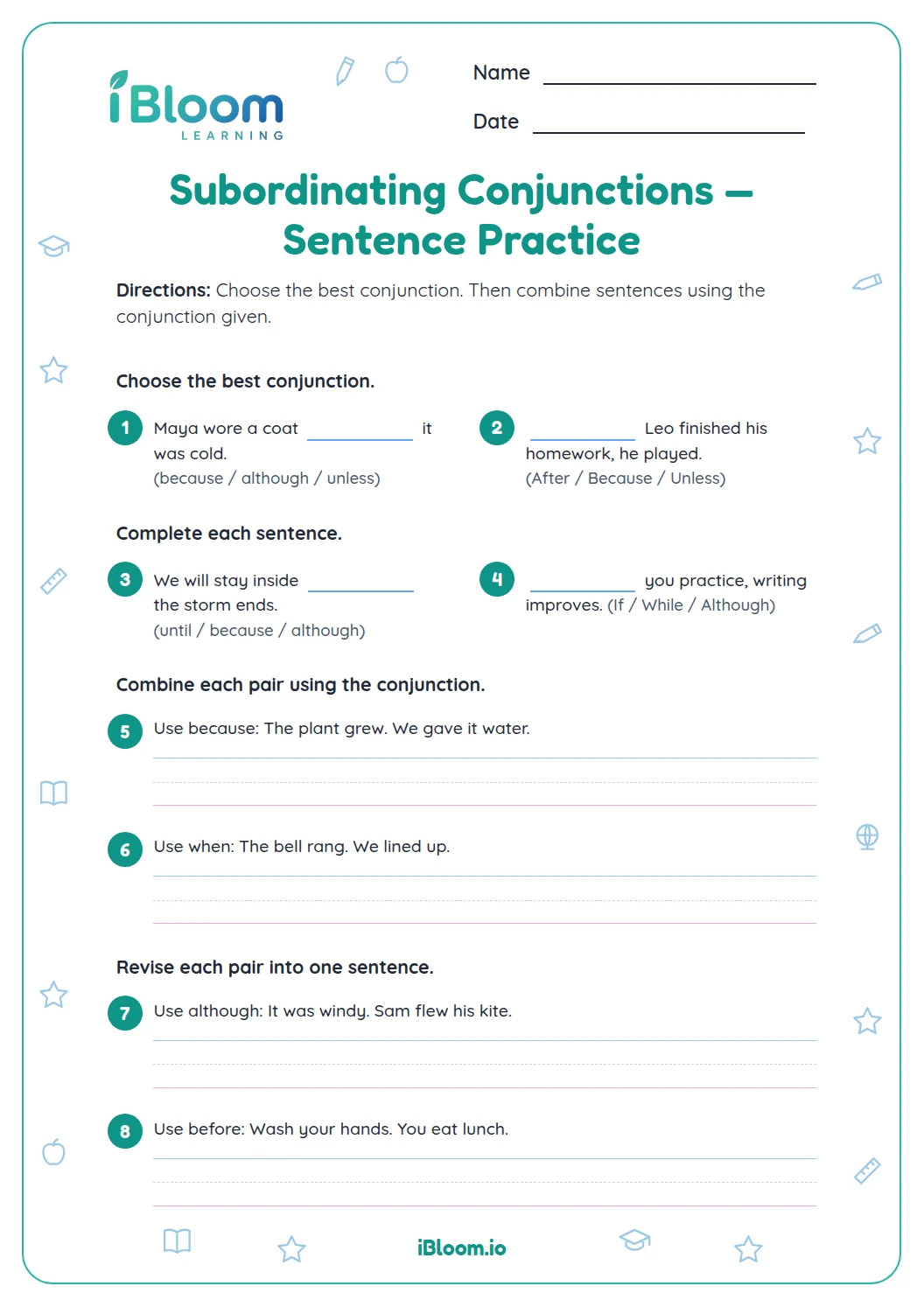
About this worksheet
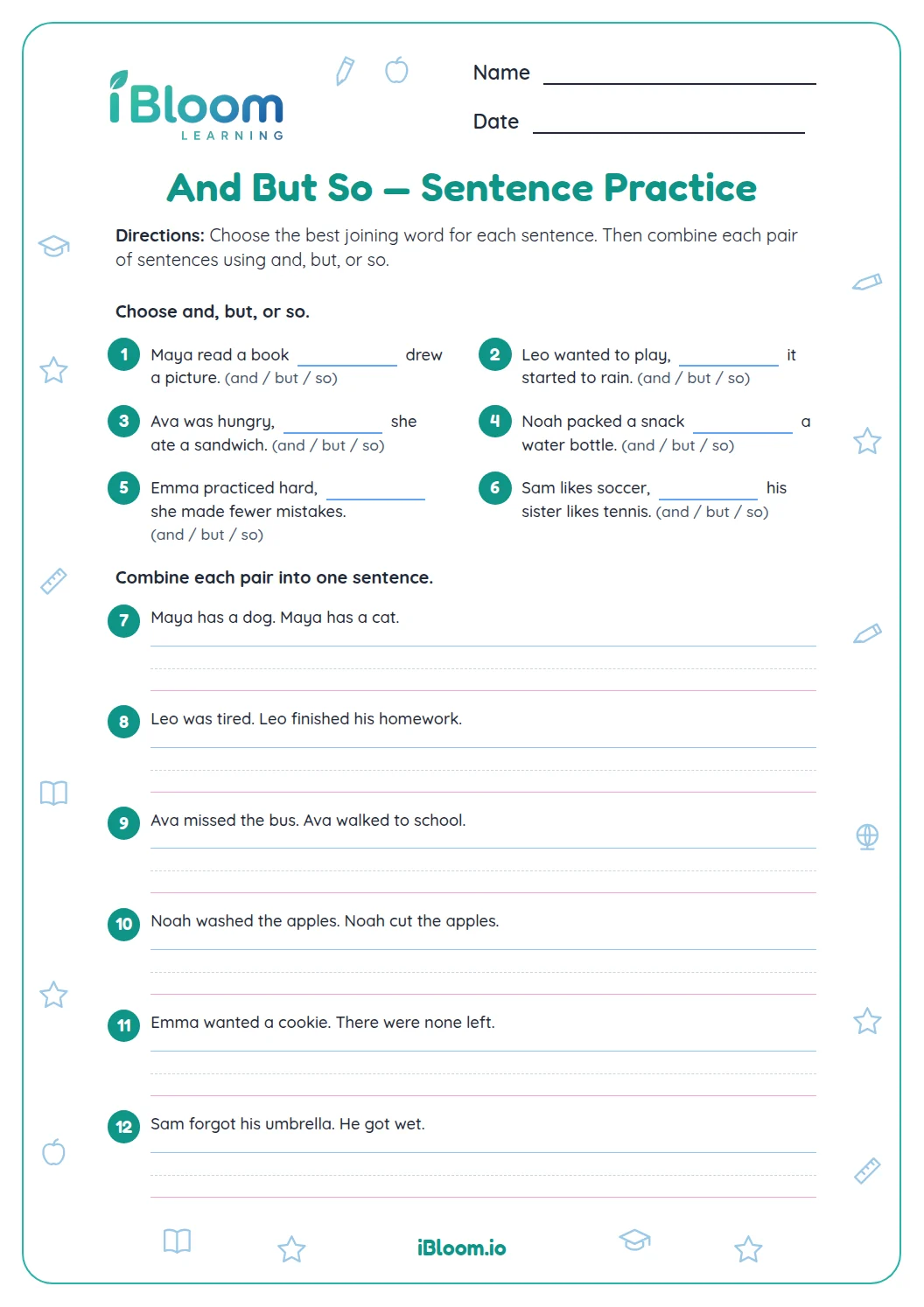
This free printable Grade 3 worksheet helps children choose and, but, or so according to the connection between two ideas. Twelve sentence blanks come with meaning clues: add information, show a contrast, or tell a result. Three final tasks ask children to join a pair of sentences using a given conjunction. The familiar situations include packing a bag, waiting after rain, and noticing a change. This supports Common Core L.3.1h through using conjunctions to connect ideas. A separate answer key gives all twelve missing words and complete models for the three joined sentences.
Aligned to L.3.1h
What do and, but, and so tell a reader?
And adds another piece of information. But points to a contrast, such as wanting to play outside when it is raining. So connects a cause with its result: the bus left, so the children walked.
Each blank includes a meaning clue in parentheses. The clue matters because more than one conjunction can sometimes make a grammatical sentence, while only one expresses the connection requested here.
How do the clues guide each blank?
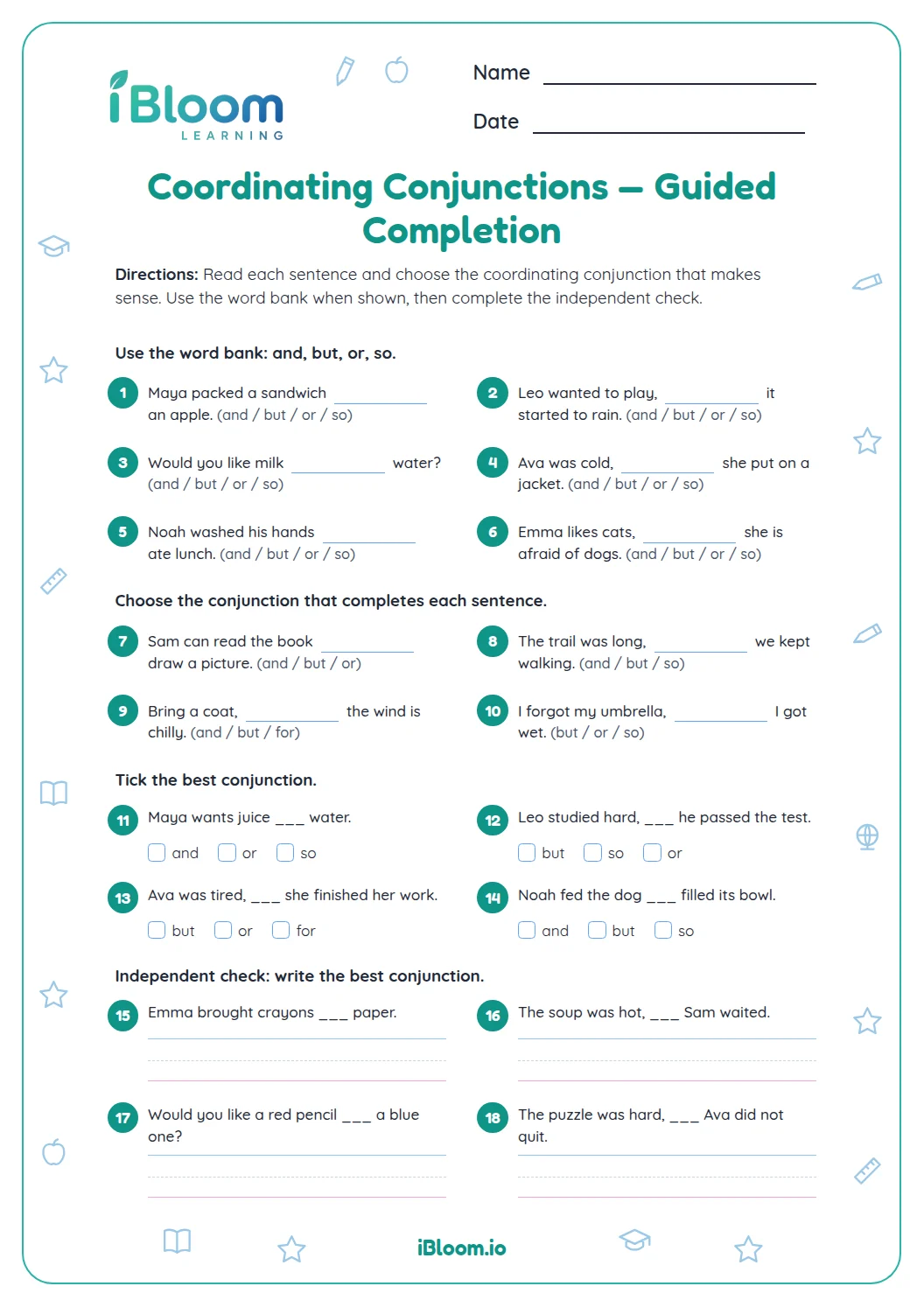
Part A practices each connection twice. Part B mixes six more examples so children have to switch between adding, contrast, and result. Ask children to read the clue first and explain how the two ideas fit it.
- 1The bus left, ___ we walked. (result)
- 2The bus leaving is the cause.
- 3Walking is the result.
- 4Answer: The bus left, so we walked.
How are the final three questions different?
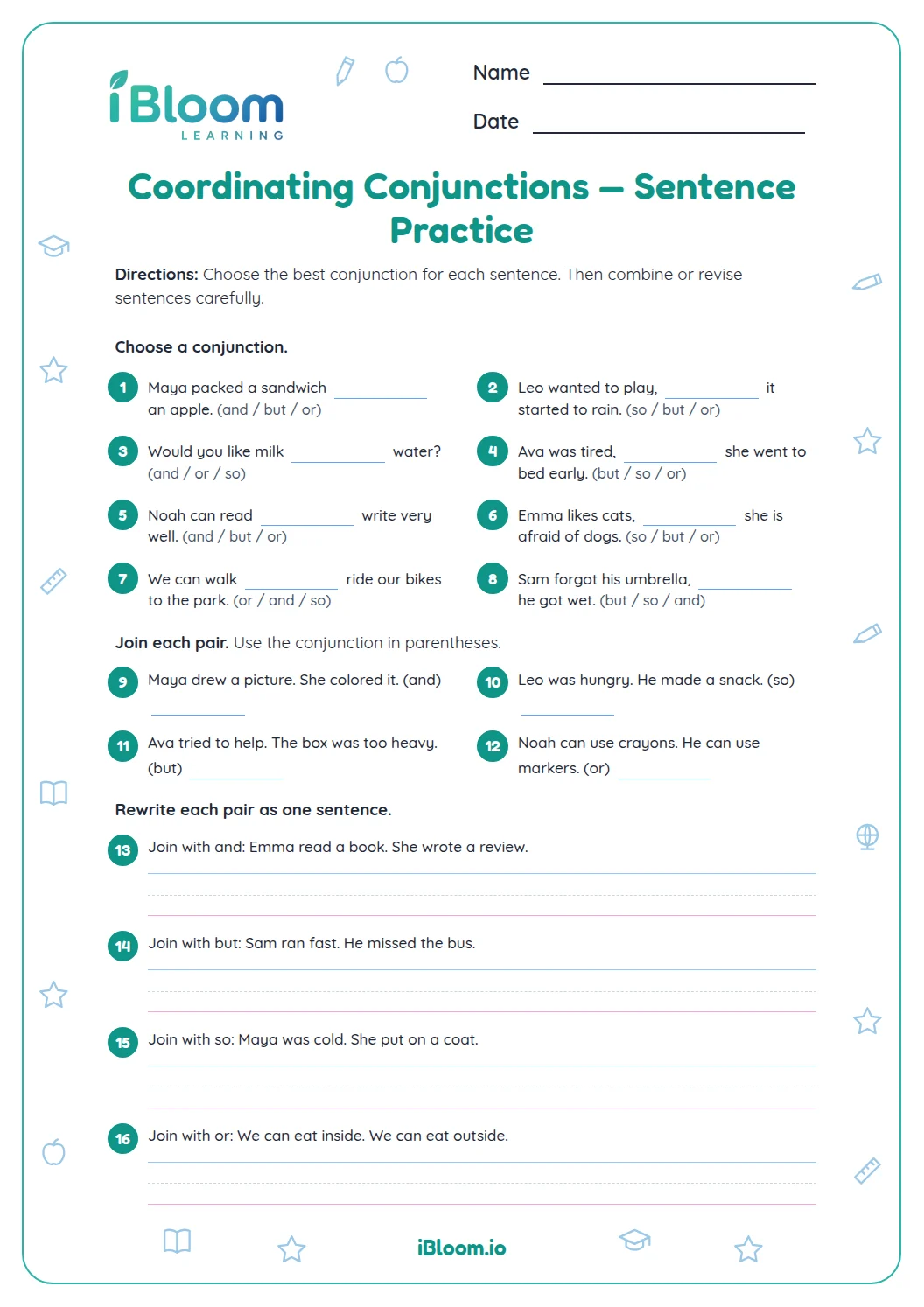
Part C supplies the conjunction and asks children to combine two short sentences. They use and for two things Mina packs, but for a shop that was open yesterday and is closed today, and so for turning on a lamp because a room is dark.
Keep all the words from both sentences in their original order. Put a comma before the conjunction, change the second starting capital to lowercase when needed, and keep one period at the end. The pronoun I stays uppercase in question 15.
How to use this worksheet
- 1Read the Part A meaning guide together: and adds, but contrasts, so gives a result.
- 2Have the child point to each clue in parentheses before filling the blank.
- 3Read each finished sentence aloud and name the connection it expresses.
- 4Complete Part B with the same meaning checks in a mixed order.
- 5Join the Part C sentence pairs and compare them with the answer key.
Mistakes to check together
The mistake
Using and when the clue asks for a result.
The fix
Name the cause and result, then use so to make that connection explicit.
The mistake
Using so for “I wanted to play outside, ___ it rained” with a contrast clue.
The fix
Ask whether wanting to play caused rain. Use but to show the conflict between the ideas.
The mistake
Leaving a period before the conjunction when joining two sentences.
The fix
Replace that first period with a comma, add the conjunction, and keep one final period.
Common Core alignment
Use and, but, and so to connect ideas with the intended meaning.
On this sheet: Children supply coordinating conjunctions and use them to join complete sentences.
Show the official wordingHide the official wording
Use coordinating and subordinating conjunctions.
What to practice next
Make more practice
Further reading
Questions parents and teachers ask
Why are meaning clues printed beside the blanks?
The clues specify the connection children should express. Two conjunctions can sometimes produce sensible sentences with different meanings, so each blank names adding, contrast, or result. Children use that stated purpose to choose one answer and can explain why it fits the sentence on the sheet.
What is the difference between and and so?
And adds information, while so presents a result. In the bus sentence, walking happens because the bus has left, and the clue asks for that result. So makes the cause-and-result connection clear. And would simply place the two events beside each other without naming that relationship.
How does but change a sentence?
But tells the reader to notice a contrast between two ideas. In question 14, the shop was open yesterday, but it is closed today. Open and closed describe opposite conditions. Read both parts aloud and ask what has changed; but makes that difference clear.
Do children write whole sentences on this sheet?
Yes, the last three tasks ask children to join two complete sentences using a supplied conjunction. The first twelve tasks require only a missing word. This sequence gives children practice with the meaning of each conjunction before they manage both the connection and the punctuation in writing.
How should I check the sentence-joining answers?
Check that every word from the two original sentences stays in order and the required conjunction connects them. Each pair contains two complete thoughts, so add a comma before the conjunction and keep one final period. Lowercase She or It after the comma; keep the pronoun I uppercase.