




About this worksheet
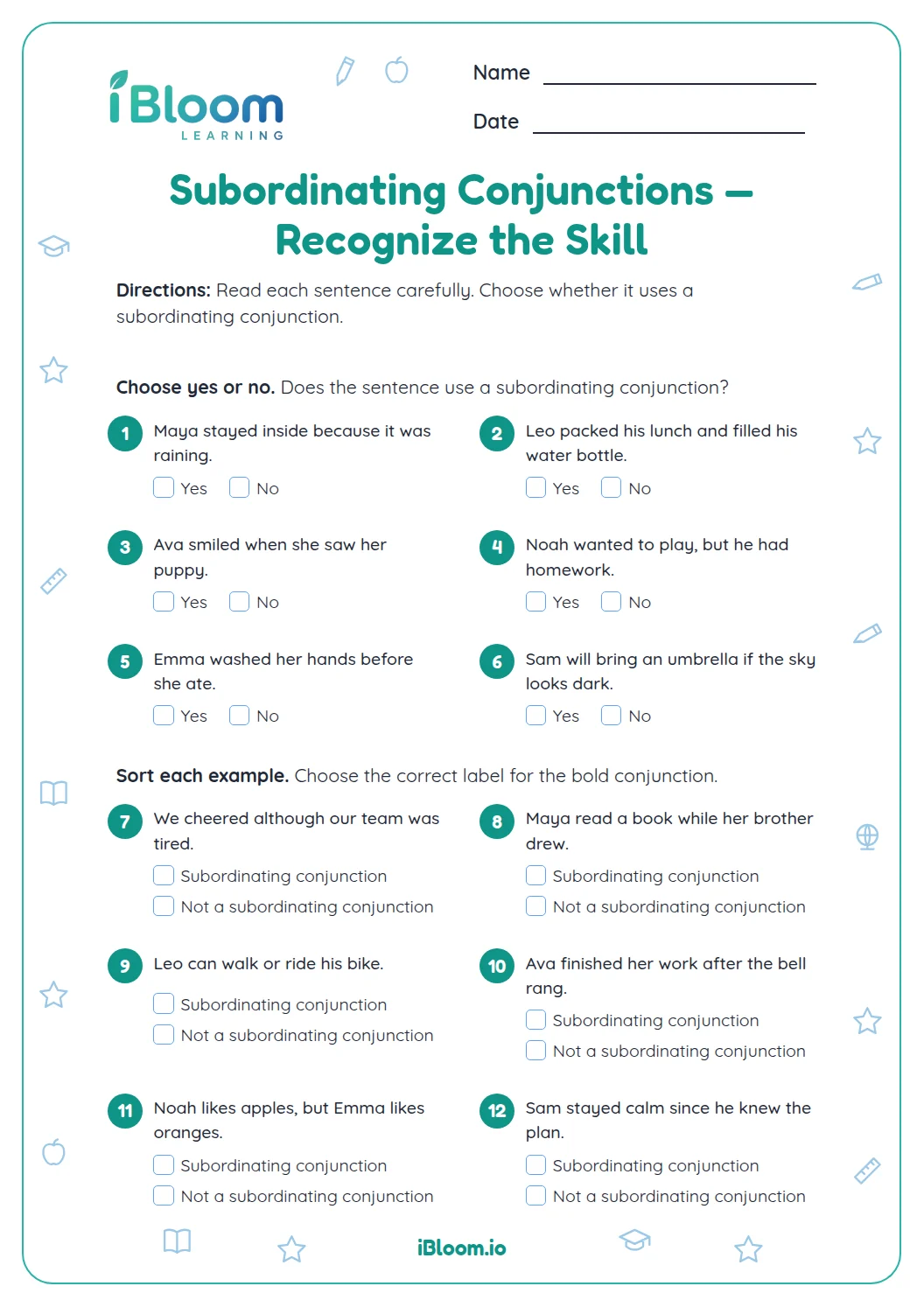
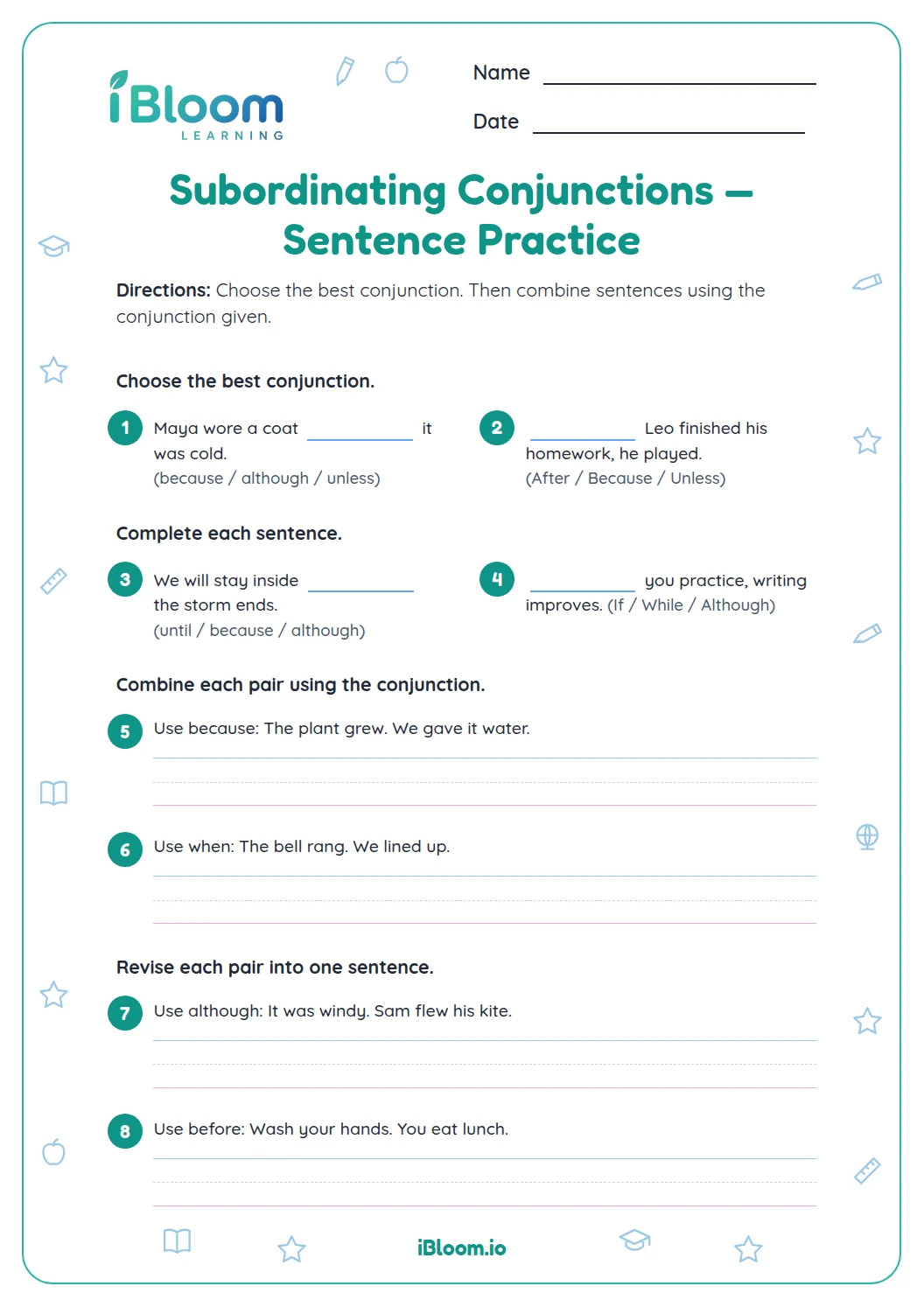
This free printable gives Grade 3 students 16 multiple-choice questions on subordinating conjunctions. Students choose words such as because, when, although, if, and until to show reason, time, contrast, and condition in complete sentences. The page practices CCSS L.3.1.h by using coordinating and subordinating conjunctions. A separate key marks each correct choice.
Aligned to L.3.1.h
How can you choose a subordinating conjunction?
First decide how the ideas are related. A reason may call for because; a time relationship may call for when, after, or until; a contrast may call for although; and a condition may call for if. Read the whole sentence after choosing to check that the meaning is clear.
Question 1 uses “after” to show that the students lined up once the bell rang. The other choices would change or blur that time relationship.
- 1The bell rang. The students lined up.
- 2The second event follows the first.
- 3After the bell rang, the students lined up at the door.
How do you join two ideas into one sentence?
Keep both ideas, then place the subordinating conjunction before the idea it introduces. In question 11, “Although the day was chilly” is the dependent idea; the complete idea is “the children played outside.” The sentence begins with a capital letter and uses a comma after the opening dependent clause.
The conjunction should preserve the relationship named in the prompt. A time word does not show a reason, and a contrast word does not show a condition.
What do the worksheet questions practice?
The 16 multiple-choice sentences cover time, cause, contrast, and conditions. Students use context to choose a subordinating conjunction, then reread the whole sentence to check that the relationship is clear. The answer key marks one best choice for each item.
Read each result aloud. If it sounds incomplete, check whether the sentence includes both the dependent idea and the main idea.
A routine for conjunction practice
- 1Read both ideas before selecting or writing a conjunction.
- 2Name the relationship: time, reason, contrast, or condition.
- 3Place the dependent idea next to its conjunction.
- 4When that idea comes first, put a comma after it.
- 5Read the full sentence to check that it is complete and sensible.
Common conjunction mistakes
The mistake
Choosing a conjunction because it fits grammatically but changes the meaning.
The fix
Decide whether the ideas show time, cause, contrast, or a condition first.
The mistake
Writing only the dependent idea after using a word such as although.
The fix
Add the complete main idea so the sentence can stand on its own.
The mistake
Leaving out the comma after an opening dependent clause.
The fix
Place a comma before the main idea when the dependent clause comes first.
Common Core alignment
The practice focuses on choosing and using subordinating conjunctions in connected sentences.
Use subordinating conjunctions to connect ideas and show their relationship.
On this sheet: Students choose subordinating conjunctions by meaning and use them to join related ideas.
Show the official wordingHide the official wording
Use coordinating and subordinating conjunctions.
What to practice next
Make more practice
Further reading
Questions parents and teachers ask
How many conjunction questions are on the page?
There are 16 questions in two parts. Students answer eight multiple-choice items by choosing a conjunction that fits the sentence, then join eight pairs of ideas in their own sentences. The answer key gives the correct choices and one sample response for each open-ended item.
What is the answer to question 1?
The best answer is “After”: “After the bell rang, the students lined up at the door.” It shows that the students lined up following the bell. The other choices, “unless” and “although,” do not express that event order in this sentence.
Can a child write a different sentence from the answer key?
Yes. The eight sentence-joining questions allow different word orders and conjunction placements. A response should be a complete sentence, use a subordinating conjunction, connect both ideas, and preserve the relationship named in the prompt. The key supplies a sample rather than the only acceptable wording.
When does a sentence need a comma after a conjunction clause?
When the dependent clause comes first, place a comma before the main clause: “Although the day was chilly, the children played outside.” If the main idea comes first, the comma is often unnecessary, as in “The children played outside although the day was chilly.”
Which conjunctions appear in the practice?
The choice questions include after, because, if, until, when, and although. The writing prompts ask students to use conjunctions to express a reason, time, contrast, condition, or two actions happening together, so students focus on how the ideas relate in complete sentences.