




About this worksheet
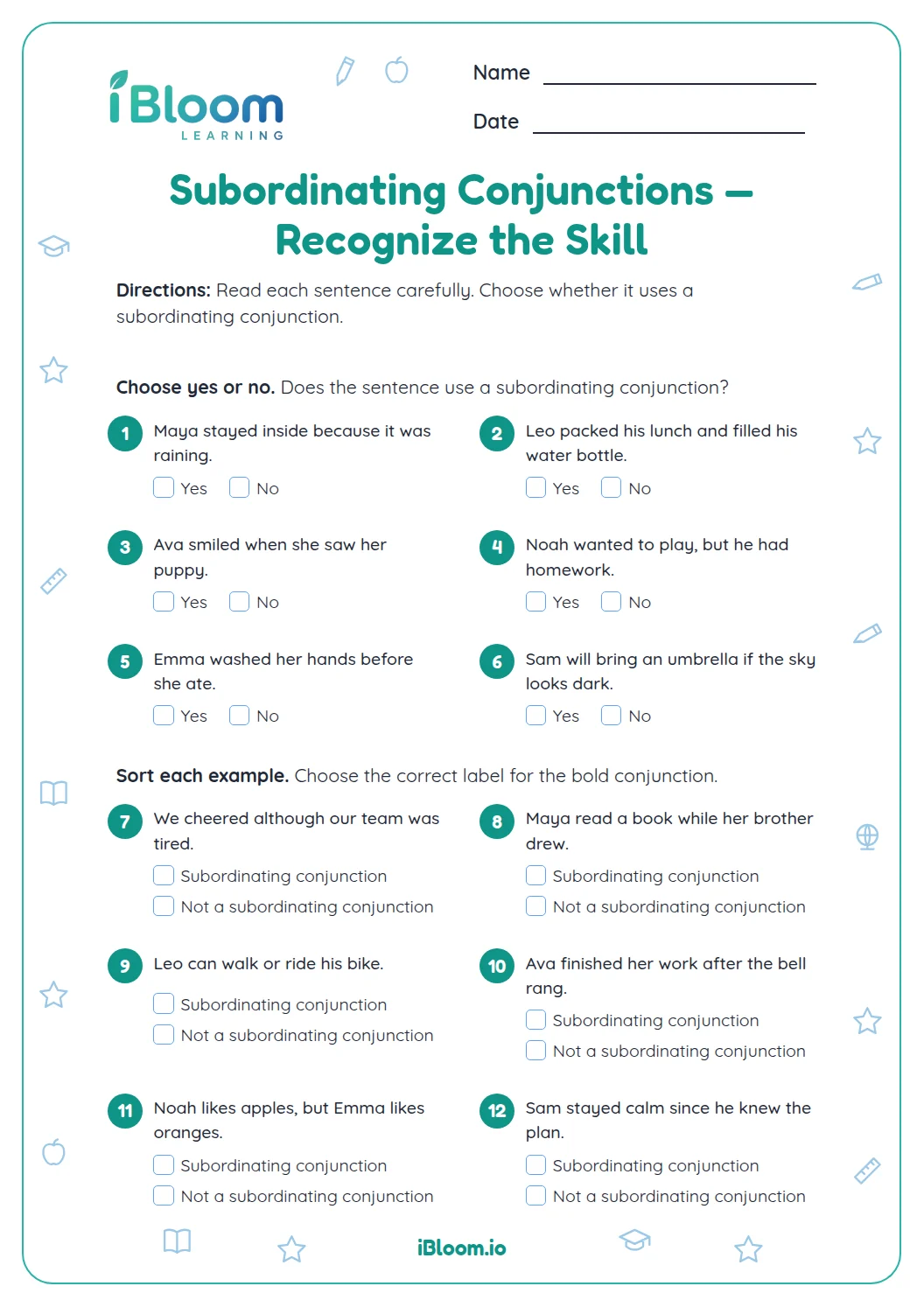
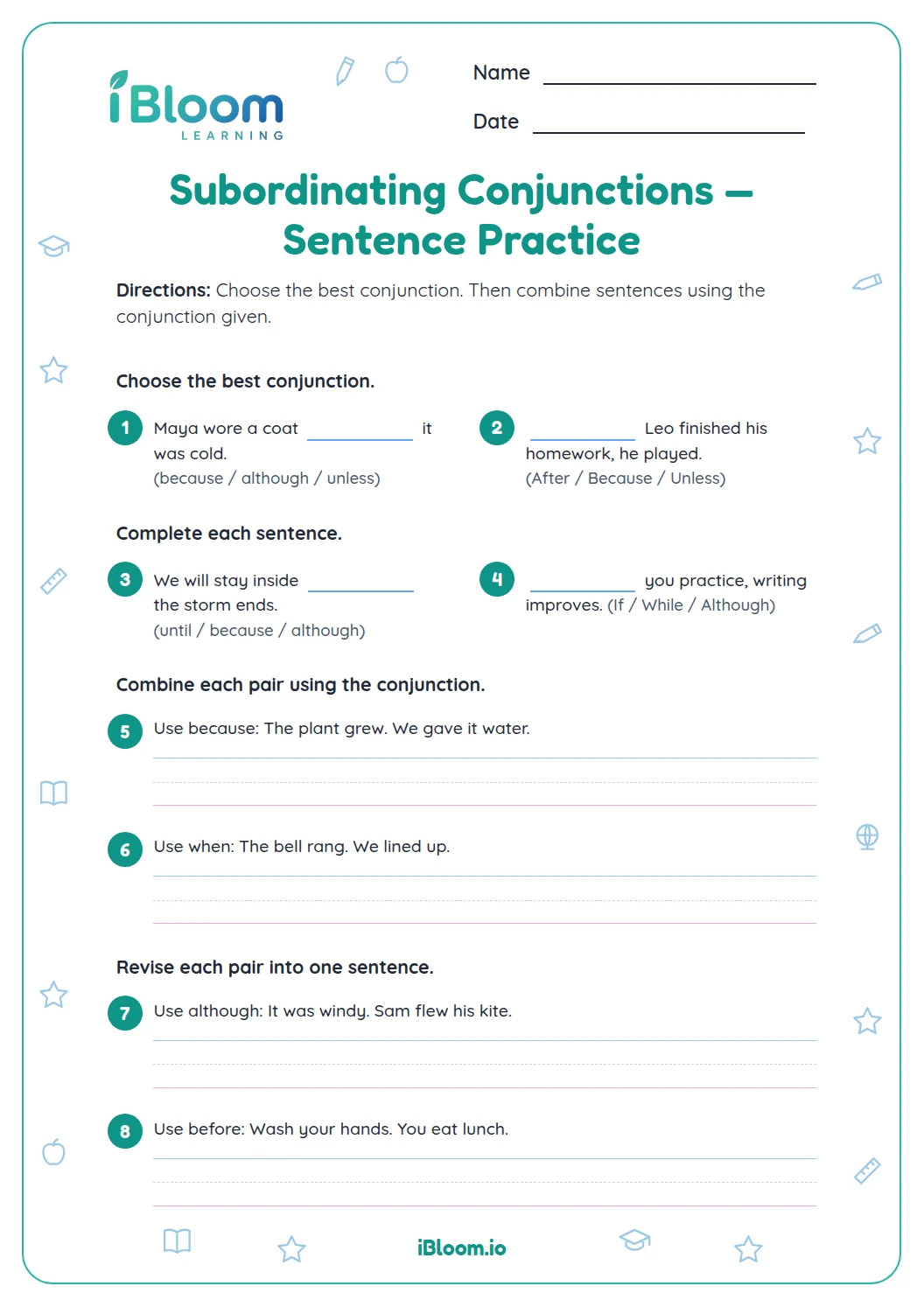
This free Grade 3 worksheet puts subordinating conjunctions to work in sentences. Part A gives four choices tied to a named relationship: reason, contrast, time or condition. Part B asks students to join four pairs of ideas using because, although, after and if. Part C includes a sentence starter, a fragment to repair and an original sentence and a two-sentence paragraph. These 12 questions practice Common Core L.3.1.h and L.3.1.i. The separate answer key supplies the four missing words and sample responses that show complete ideas and sensible connections.
Aligned to L.3.1.h and L.3.1.i
Which connection does each conjunction make?
Because introduces a reason. Although introduces a contrast that may be surprising. Before, after and when tell about time. If introduces a condition. Part A names the intended connection so students can choose between the two printed words.
Read the completed sentence aloud to check its meaning. In question 4, going depends on the other person going too, so if fits the named condition.
How can two ideas become one complete sentence?
Keep both ideas and use the required conjunction to connect them. Question 5 gives Mia’s boots and the muddy path. Because shows why she wears the boots.
For question 6, although introduces the difficulty, and the main clause gives the surprising result: the group reaches the top. When the sentence opens with that introductory clause, place a comma after it.
- 1Mia wore boots. The path was muddy.
- 2Reason word: because
- 3Mia wore boots because the path was muddy.
Why is “Because I lost my pencil” unfinished?
Because tells a reader to expect a result or main idea. The fragment provides the reason but leaves that main idea out. Adding “I borrowed one” makes the connection complete.
Questions 9 and 10 help students complete an idea before questions 11 and 12 ask for original sentences. Check the named relationship as well as the presence of a conjunction.
How to use this worksheet
- 1Name the four connections printed in Part A before filling its blanks.
- 2Join question 5 aloud, keeping both original ideas.
- 3Complete Part B and check the order of events in question 7.
- 4Read the fragment in question 10 and ask what happened because of the lost pencil.
- 5Write the pet sentence and game paragraph; check that although shows contrast, before orders events and if gives a condition.
- 6Compare with the key, accepting other complete sentences with the requested meaning.
Mistakes to notice and fix
The mistake
Writing “Because I lost my pencil” as a complete sentence.
The fix
Add a main idea such as “I borrowed one” to finish the thought.
The mistake
Using although to connect two ordinary events with no contrast.
The fix
Choose ideas that create a surprise, such as a small cat making a loud noise.
The mistake
Reversing the bell and book actions when using after.
The fix
Reread the pair: the bell rings first, then the books are put away.
Common Core alignment
Use because, although, if and time conjunctions to connect ideas.
On this sheet: Students supply subordinating conjunctions and use them in complete sentences.
Show the official wordingHide the official wording
Use coordinating and subordinating conjunctions.
Combine clauses and write complete complex sentences.
On this sheet: Students join two clauses, repair a fragment and write complex sentences of their own.
Show the official wordingHide the official wording
Produce simple, compound, and complex sentences.
What to practice next
Make more practice
Further reading
Questions parents and teachers ask
Which conjunctions does the worksheet practice?
The worksheet uses because, although, before, if, after and when. The first part names the relationship students need to express, and later parts require specific words in complete sentences. Students use the conjunctions to explain reasons, show contrasts, state conditions and connect events in time.
Can students combine the ideas in more than one way?
Yes; several combinations are correct if they preserve the intended meaning and use the requested conjunction. For question 5, students may put the muddy path first or the boots first. The answer key provides one sample, and adults can accept another complete sentence with the same causal relationship.
Should students use commas after introductory clauses?
Yes; model a comma when the sentence starts with the clause introduced by the conjunction. In “Although the hill was steep, we reached the top,” the comma marks the end of the introductory clause. Have students read both ideas aloud before checking that punctuation in their writing.
What should a corrected answer to question 10 include?
It should keep the reason about losing a pencil and add a main idea that makes sense. “Because I lost my pencil, I borrowed one” is one possibility. A different result can work too, as long as the whole sentence is complete and the connection is logical.
How do I check the original writing?
For question 11, look for a pet sentence in which although introduces a surprising contrast. For question 12, check for two connected sentences about a game using before and if. Each sentence needs a complete main idea, a capital letter and ending punctuation; students can use their own examples.