




About this worksheet
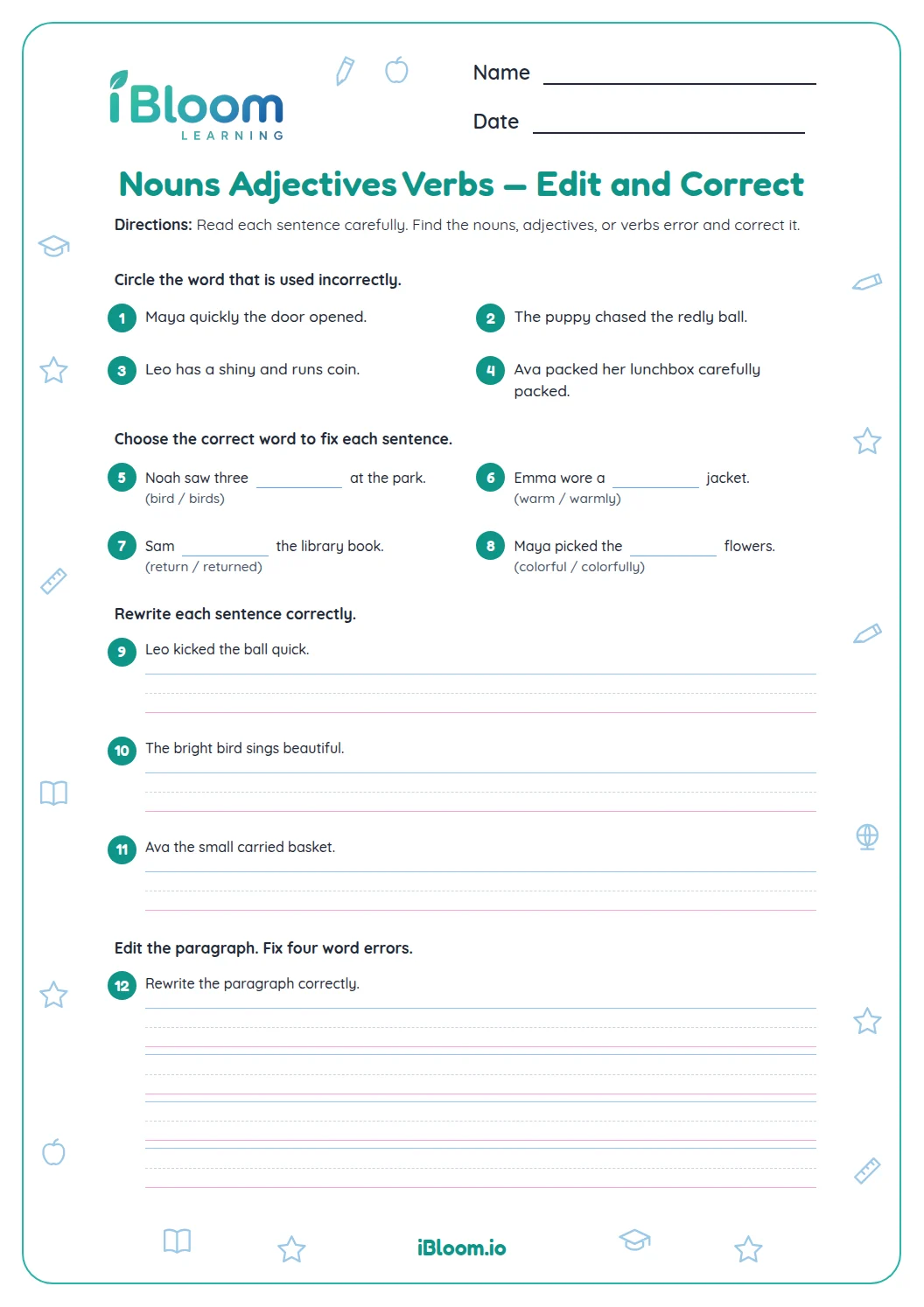
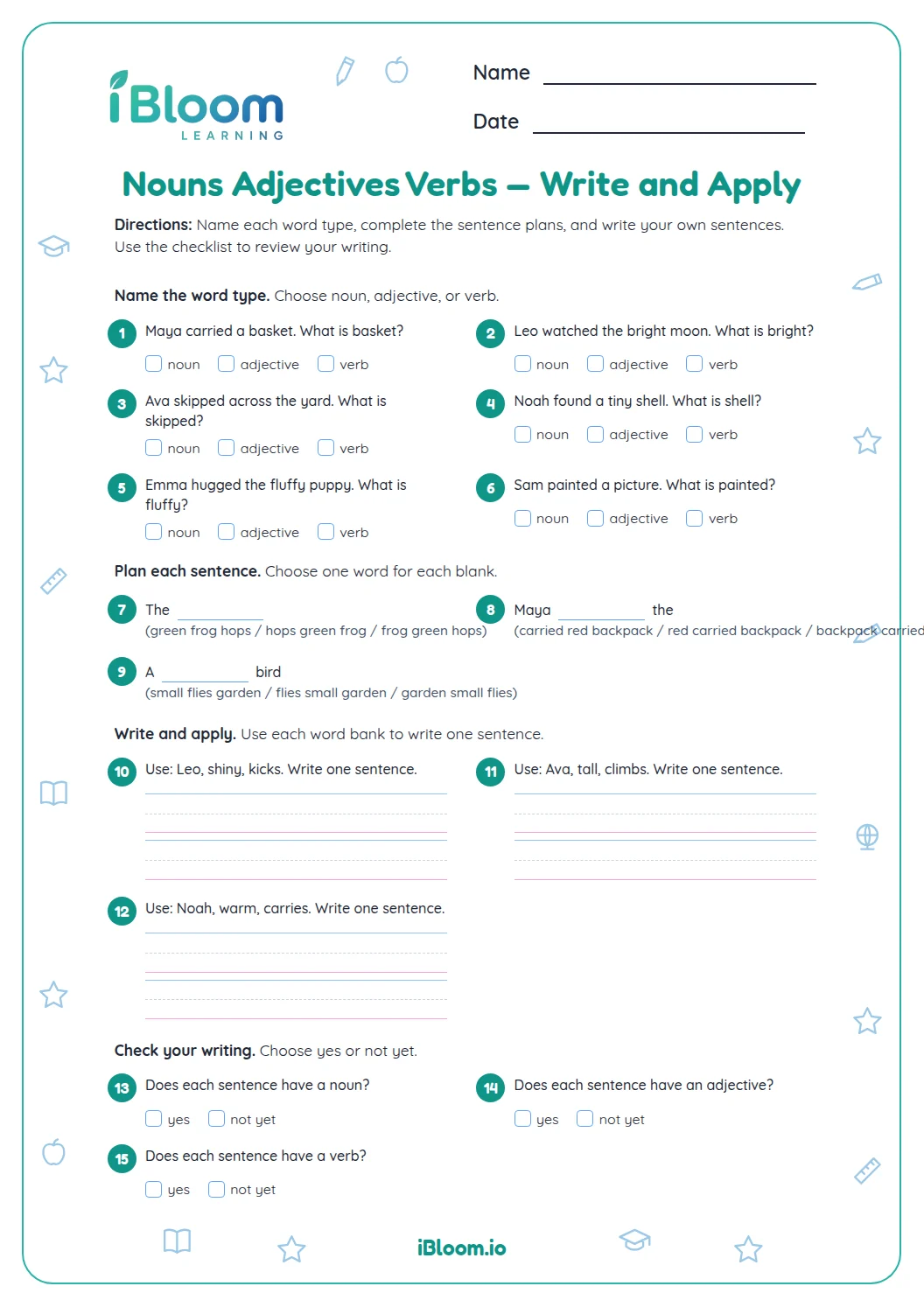
This Grade 3 grammar worksheet reviews nouns, adjectives and verbs in sentences. Children circle a named word in each sentence, then choose examples by their job. The practice aligns with CCSS L.3.1.a, which asks students to explain how parts of speech function in sentences. There are 14 questions over worksheet pages and a separate answer key.
Aligned to L.3.1.a
What do nouns, adjectives and verbs do?
Part A asks children to circle a noun, adjective, and verb in each sentence. Part B completes sentences with the right word choices. Part C compares revisions, explains a stronger choice, and checks word jobs.
- 1In “The bright kite soared above Maya,” circle bright, kite, and soared.
Why read the whole sentence?
Context shows how a word is being used. A word can have different jobs in different sentences, so check what it connects to or tells the reader.
How does the mixed review work?
The first parts focus on one job at a time. The last part asks children to identify a word by its meaning and function.
How to use this worksheet
- 1Read the part heading before each group.
- 2Read the whole sentence once.
- 3Ask what the target word names, describes or does.
- 4Circle one word only in each sentence.
- 5Check your choices with the answer key and explain one choice aloud.
Common mistakes and quick fixes
The mistake
Circling an action word when asked for a noun.
The fix
Ask who or what does the action; that name is often the noun.
The mistake
Calling every word before a noun an adjective.
The fix
Check whether the word describes the noun.
The mistake
Choosing a word by its meaning alone.
The fix
Read the whole sentence and identify the word’s function there.
Common Core alignment
This page asks students to identify how nouns, adjectives and verbs work in sentences.
Explain how nouns, verbs and adjectives function in particular sentences.
On this sheet: Children identify nouns, adjectives and verbs in sentence context.
Show the official wordingHide the official wording
Explain the function of nouns, pronouns, verbs, adjectives, and adverbs in general and their functions in particular sentences.
What to practice next
Make more practice
Questions parents and teachers ask
What is the difference between a noun, adjective and verb?
A noun names a person, place or thing. An adjective describes a noun, and a verb tells an action or state. On this sheet, children circle all three word jobs in each of four sentences, then use the same ideas in completion and revision questions.
Why does the sentence matter when naming a part of speech?
A word’s role depends on how it works in context. In “The bright kite rose,” bright describes kite, while rose tells what the kite did. Read all the words before choosing. For instance, in “Maya opened the window,” window names a thing, while opened tells what Maya did.
How can an adult support the practice?
Ask the child to explain the choice: “What does this word name, describe or do?” That explanation makes it easier to distinguish word meaning from the word’s job in the sentence. An adult can invite the child to point to the noun that an adjective describes or to the action named by a verb.
What does the answer key include?
The key gives the target word for every sentence and choice. Use it after the child finishes each group, then revisit a sentence and discuss the clues that show the word’s function. The last questions revisit all three word jobs and help students apply the same thinking without a sentence to mark.
How many words should a child circle in each sentence?
Circle three words: one noun, one adjective, and one verb. For example, in “The bright kite soared above Maya,” kite is the noun, bright describes it, and soared tells what it did. The key marks all three target words for each sentence.