




About this worksheet
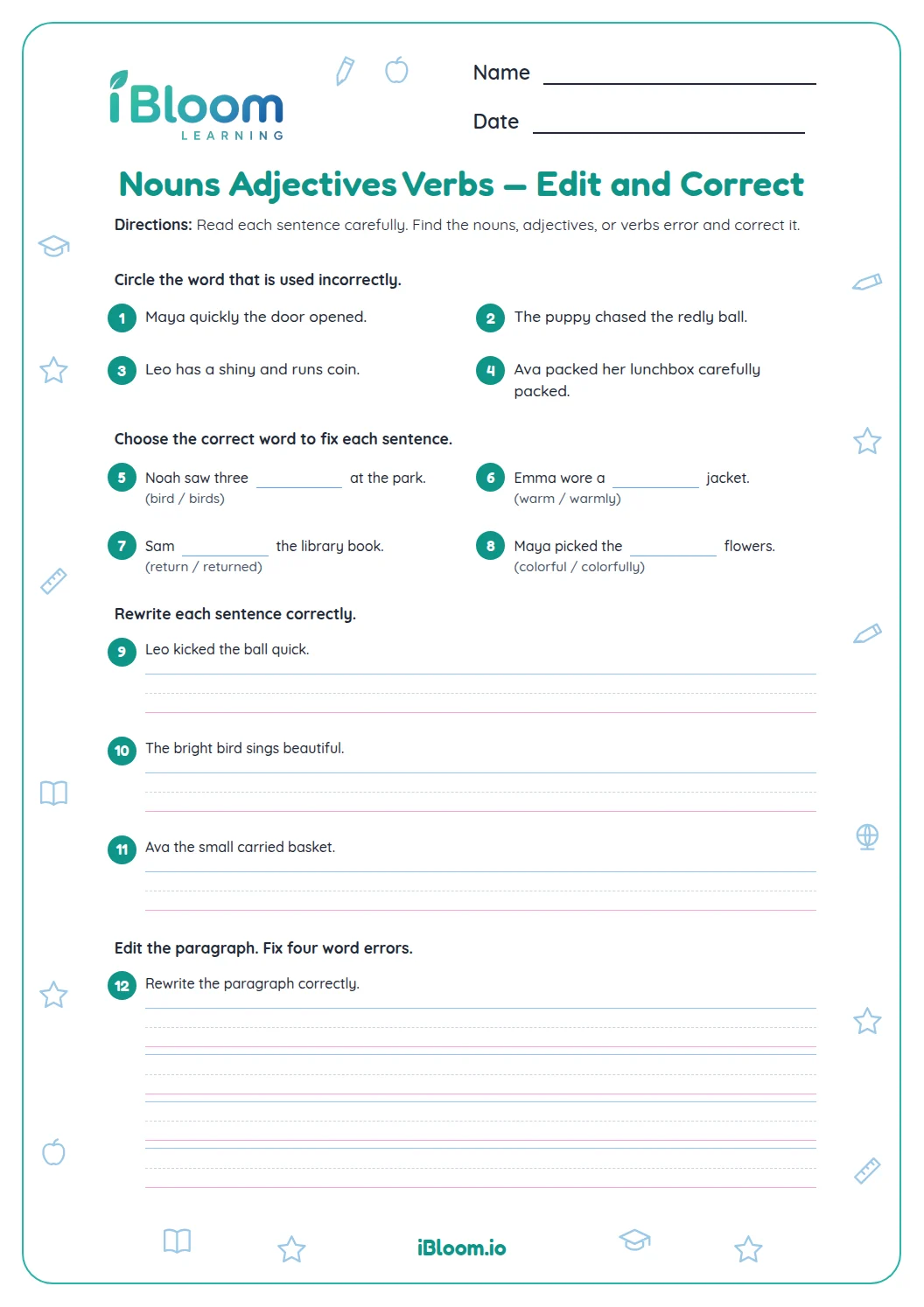
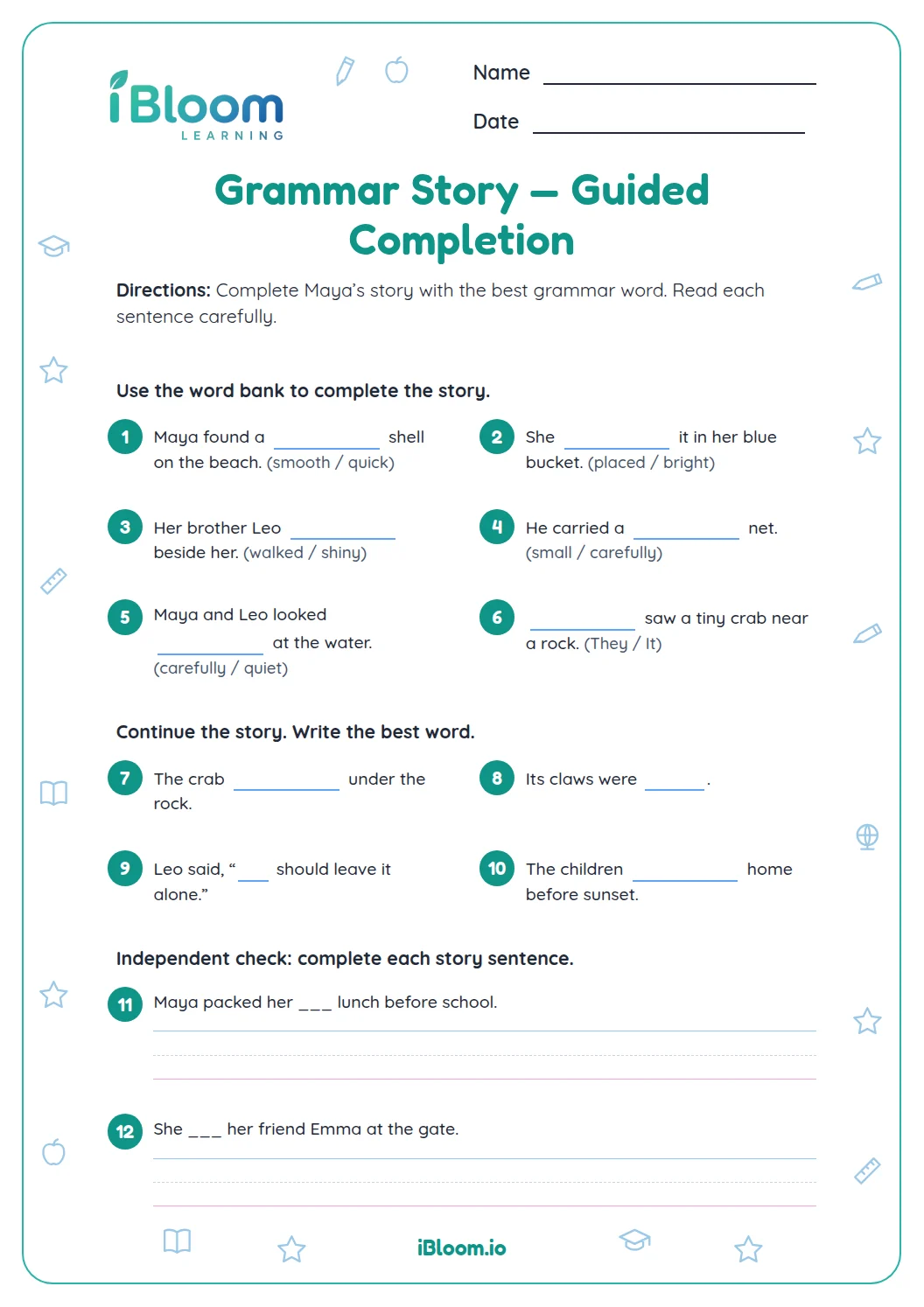
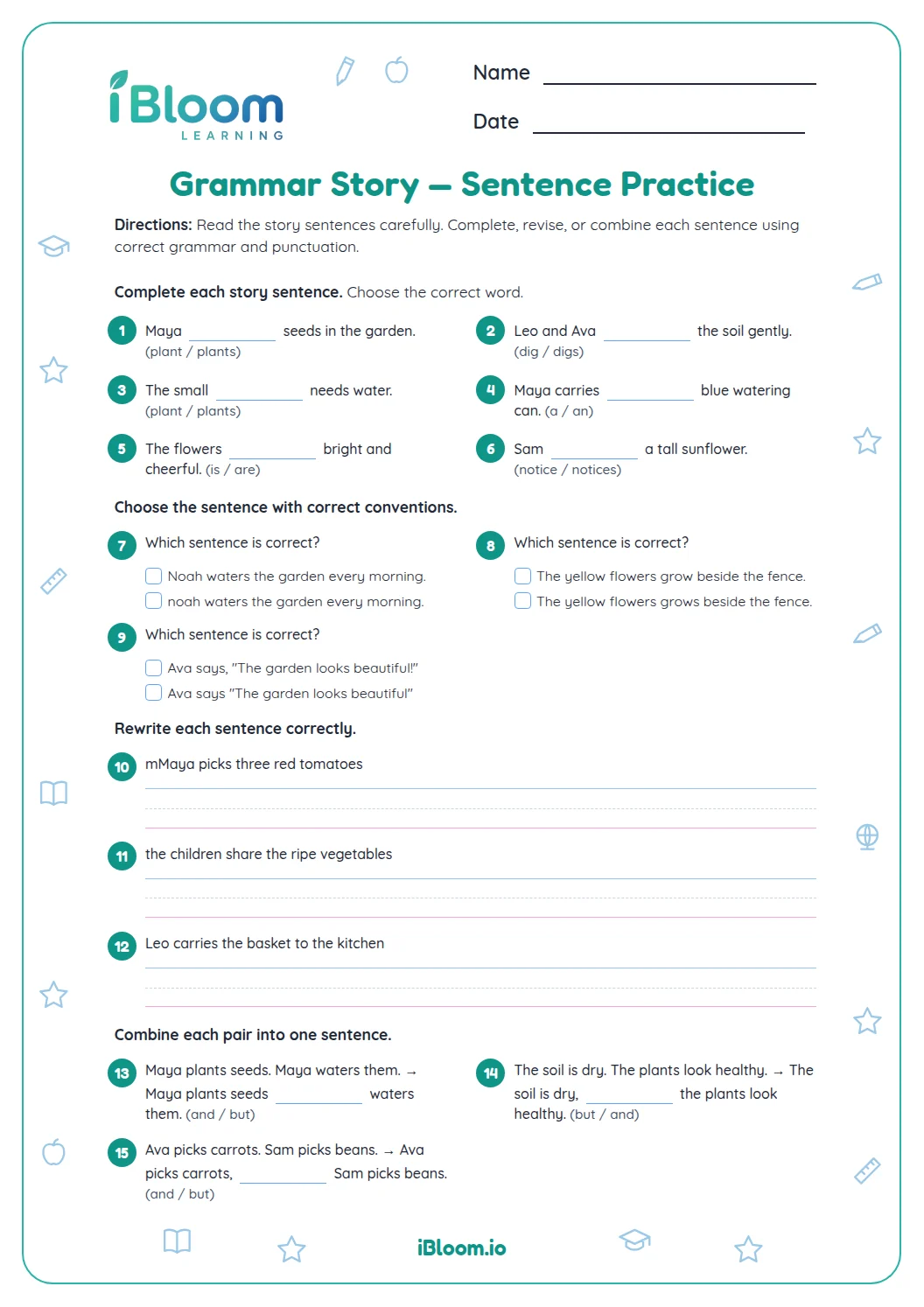
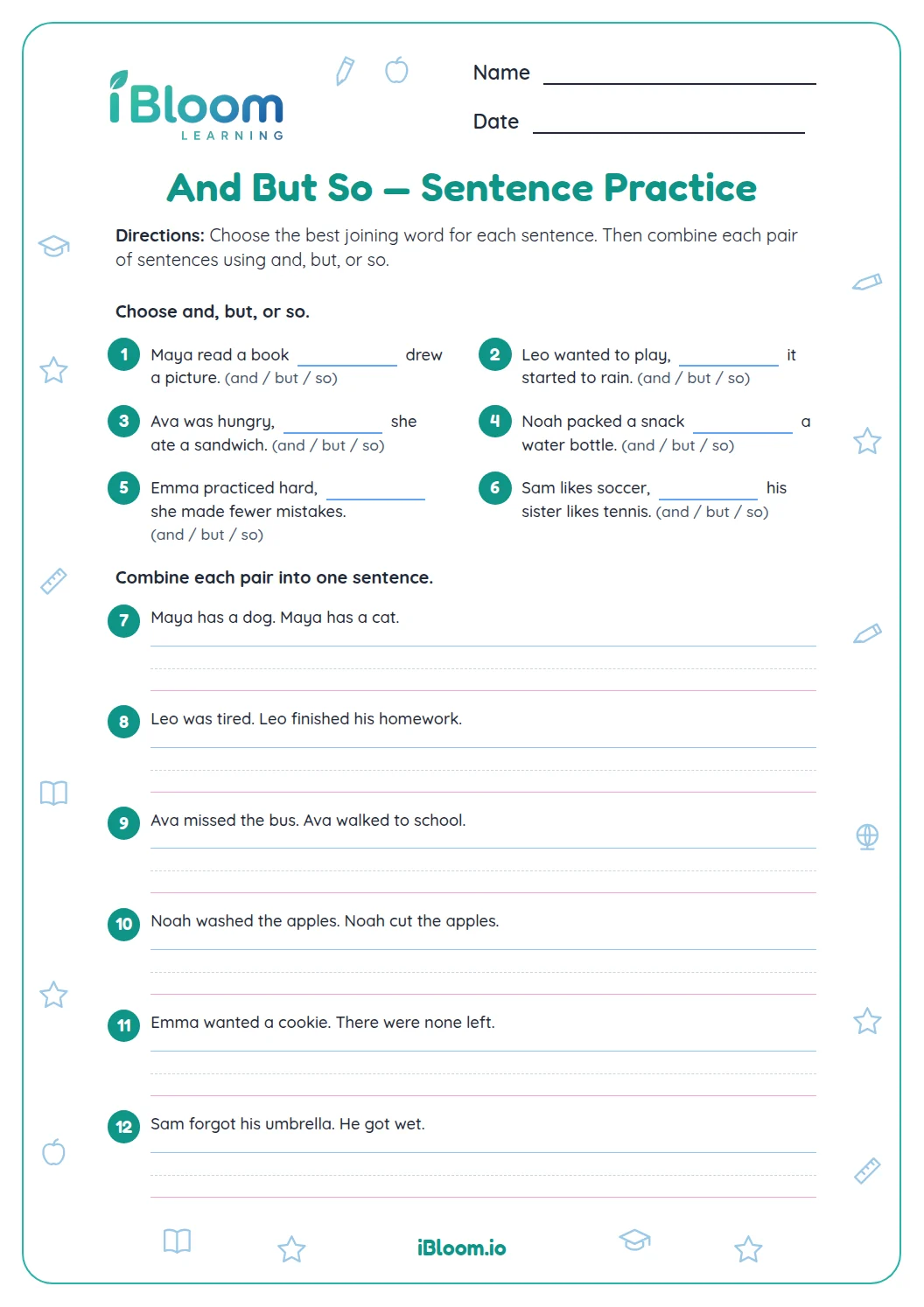
This Grade 3 worksheet gives students 16 sentence blanks to complete with nouns and verbs that fit. Early items identify and use word jobs in context; later items practice plural nouns and subject-verb agreement. The separate answer key lists the missing word for each sentence. The work connects to Common Core L.3.1.a and L.3.1.f.
Aligned to L.3.1a and L.3.1f
How do nouns and verbs work in a sentence?
A noun names a person, place, thing, or idea. A verb tells what the subject does or is. In “Maya ___ seeds,” students use the sentence to supply an action word; the answer key shows “planted.”
How do you correct a verb for a plural subject?
Find the subject first. In “The dogs ___ fast,” dogs is plural, so the verb needs to match: “run.” For one dog, the sentence would use runs.
- 1The dogs ___ fast.
- 2Subject: dogs (plural)
- 3Verb: run
What edits does the worksheet ask learners to make?
Part A asks students to complete eight sentences with a noun or verb. Part B continues with nouns and verbs whose forms depend on sentence clues, including singular and plural subjects. The answer key gives all 16 words.
How to use this worksheet
- 1Read the whole sentence before choosing a word.
- 2Find who or what the sentence is about.
- 3Identify the noun or the action word named in the prompt.
- 4For an edit, check whether the subject is singular or plural.
- 5Write the corrected form and compare it with the key.
Common mistakes and quick fixes
The mistake
Naming the action instead of the person or thing
The fix
Ask who or what the sentence is about to locate a noun.
The mistake
Using a singular verb with a plural subject
The fix
Match the verb to the subject: dogs run, while a dog runs.
The mistake
Changing the noun when the verb is the error
The fix
Follow the prompt and check which word form makes the sentence correct.
Common Core alignment
The questions practice word functions and agreement in sentences.
Identify nouns and verbs and explain their jobs in sentences.
On this sheet: Name nouns and verbs in complete sentences.
Show the official wordingHide the official wording
Explain the function of nouns, pronouns, verbs, adjectives, and adverbs in general and their functions in particular sentences.
Use subject–verb agreement when correcting sentence errors.
On this sheet: Correct singular and plural subject–verb agreement errors.
Show the official wordingHide the official wording
Ensure subject-verb and pronoun-antecedent agreement.
What to practice next
Make more practice
Further reading
Questions parents and teachers ask
What is the difference between a noun and a verb?
A noun names a person, place, thing, or idea. A verb tells what the subject does or is. In “Maya planted seeds,” Maya and seeds are nouns, while planted is the verb. The worksheet asks learners to identify both word jobs in sentences.
How many questions are included?
There are 16 sentence blanks across two worksheet pages, followed by a separate two-page key. The first eight items use nouns and verbs in short contexts. The last eight focus on forms that fit number clues and subject-verb agreement.
How do singular and plural subjects affect verbs?
A singular subject usually takes a verb ending in s in the present tense: a dog runs. A plural subject uses the base form: dogs run. Several sentence edits on this sheet ask learners to make the verb match its subject.
Why does one question ask to correct a noun?
A noun may need a singular or plural form to fit its sentence. For example, “Three bird sit nearby” needs birds because three refers to more than one. Learners should change the word named in the prompt and reread the sentence to check it.
What should a learner do after correcting a sentence?
Reread the entire sentence with the new form. Check that the noun makes sense with words such as a, two, or three, and that the verb matches its subject. Then compare the response with the answer key and explain any correction.