


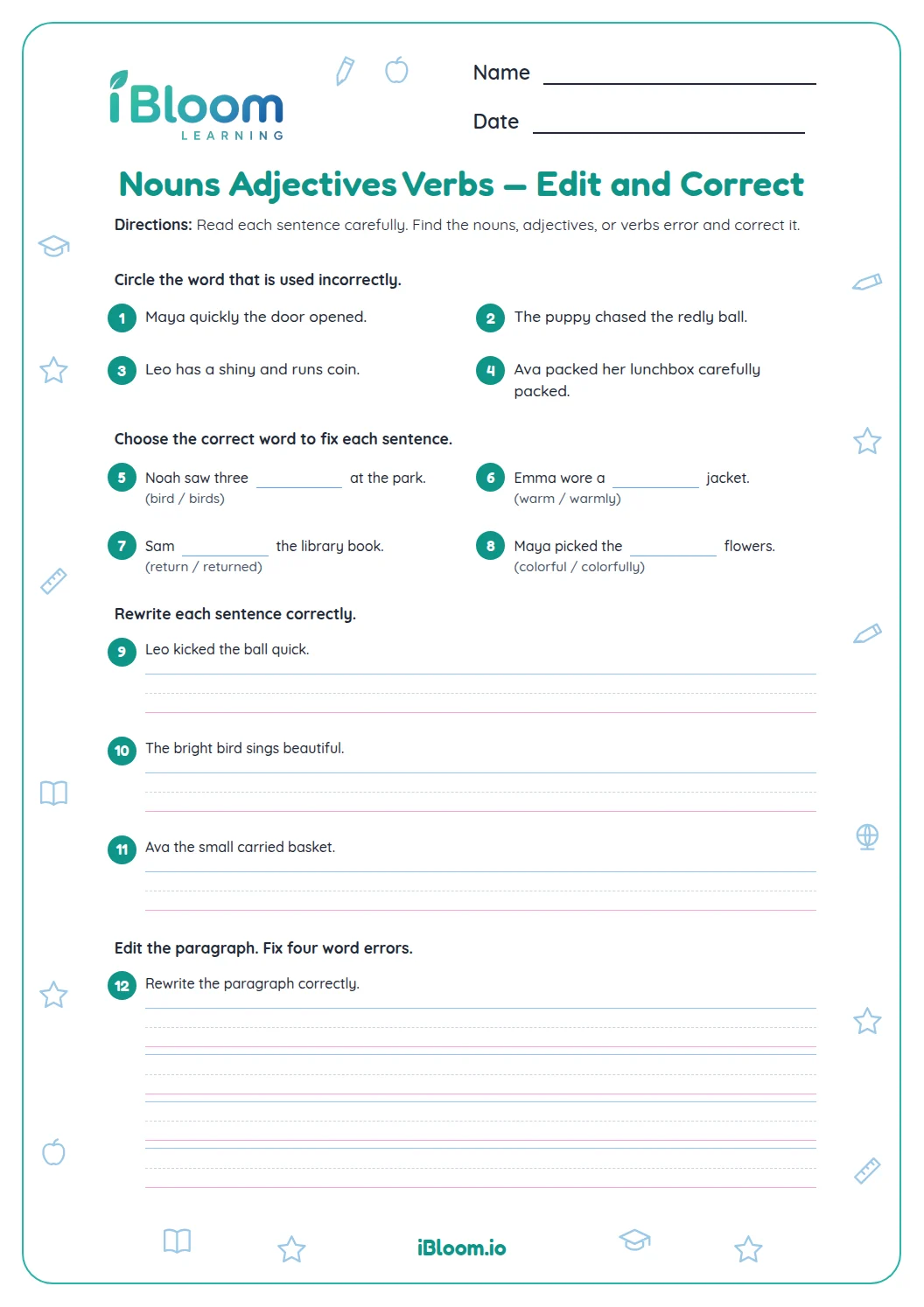


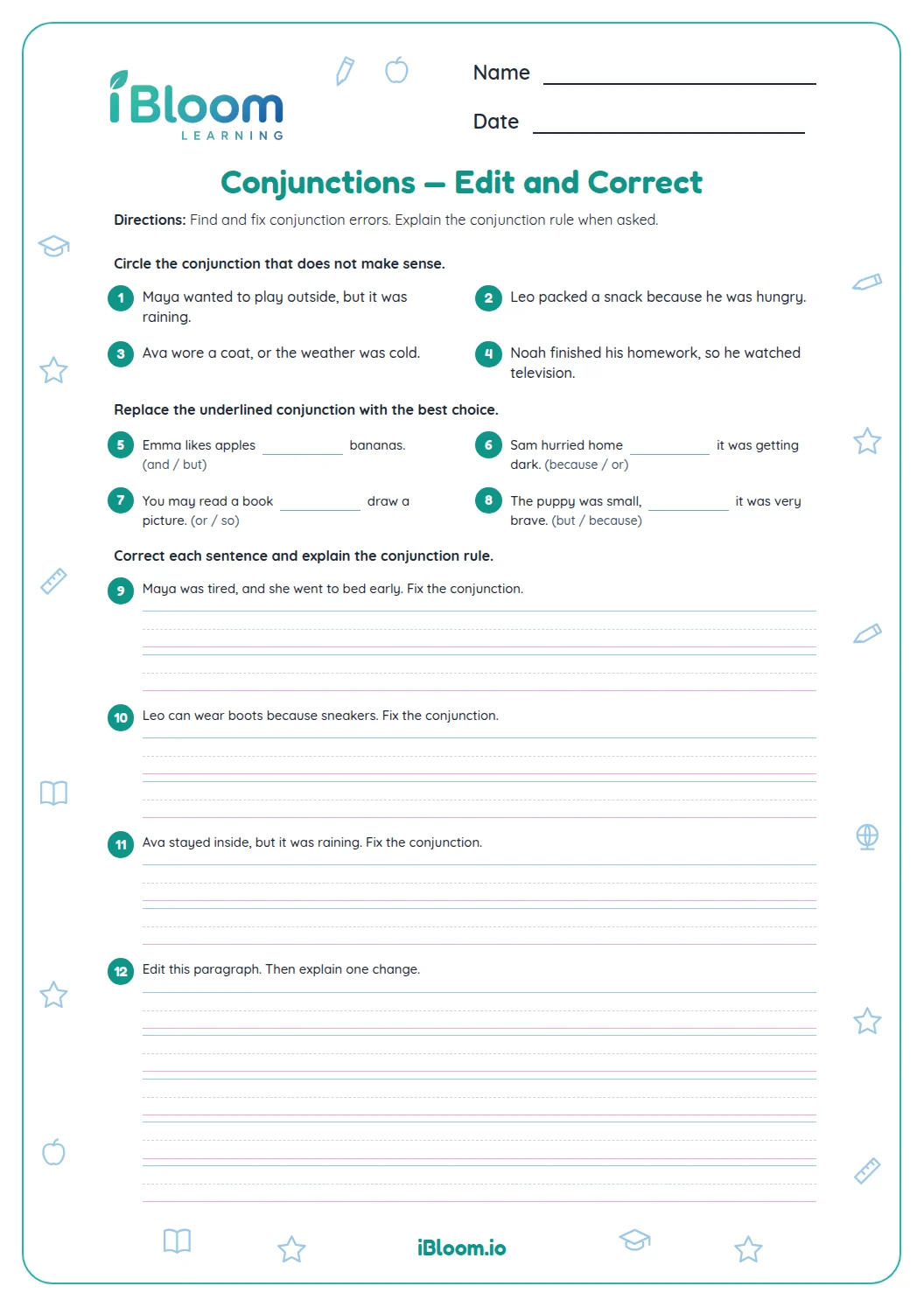
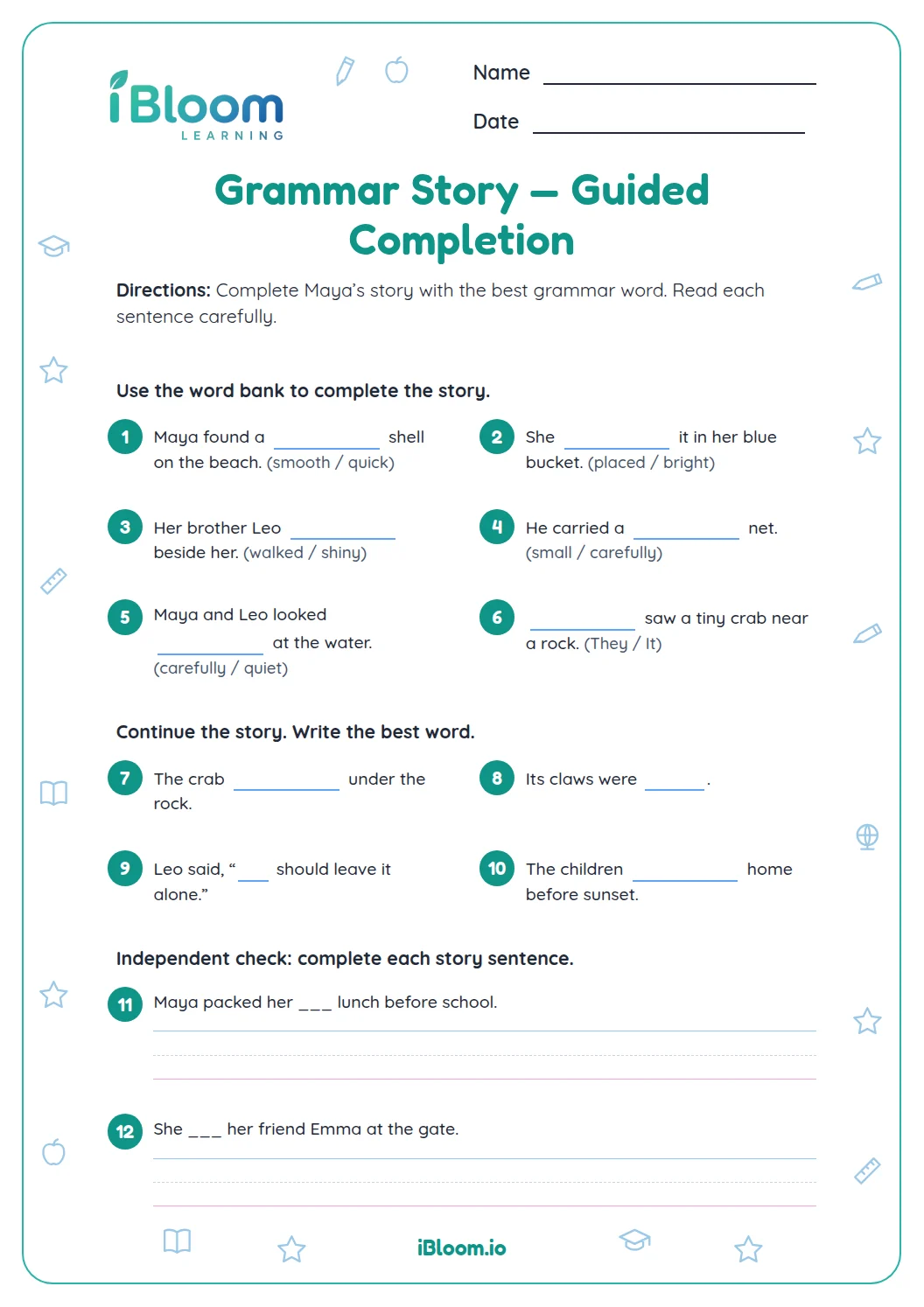
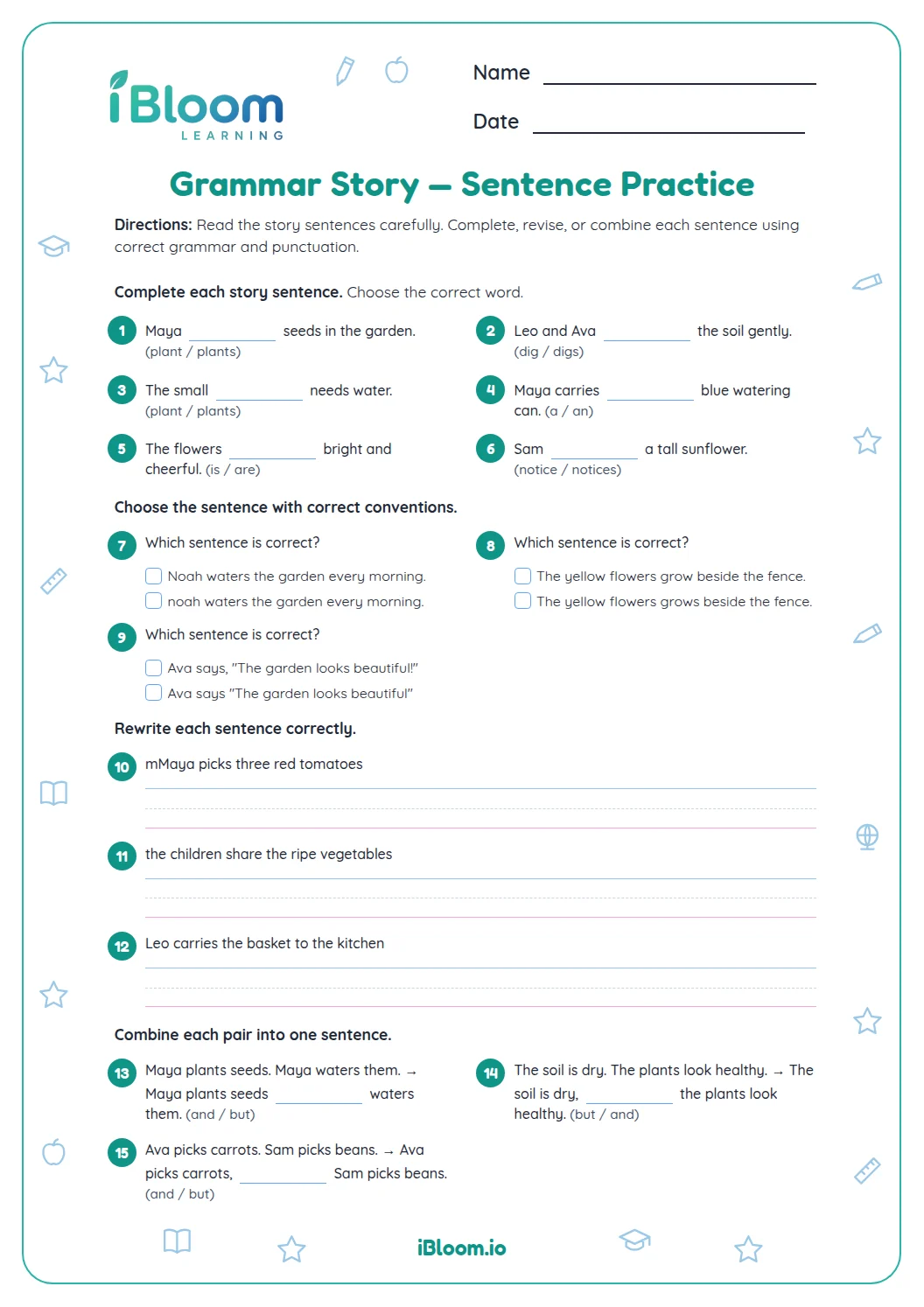

About this worksheet
This free printable gives Grade 3 students 15 sentence questions about nouns and verbs. They identify naming words and action verbs, then apply the ideas to mixed sentence examples and a short response across two parts. Two worksheet pages and a separate two-page answer key are included. The practice aligns with CCSS L.3.1.a.
Aligned to L.3.1.a
How can you spot a noun?
A noun names a person, place, animal, or thing. In “Lena paints a bright sign,” Lena and sign are nouns. Questions 1–5 ask students to name a noun from each sentence.
What does a verb tell you?
A verb tells what someone or something does or is. In “The rabbit hops across the grass,” hops is the action verb. Questions 6–15 ask students to identify verbs and apply both ideas.
Why read the whole sentence?
A word’s job depends on how it is used. Look at the surrounding words: a noun names something, while an action verb tells what that subject does. In “Three ducks swim in the pond,” ducks names animals and swim tells their action.
How to use this worksheet
- 1Read the complete sentence before choosing a word.
- 2Ask which word names a person, place, animal, or thing.
- 3Ask which word tells an action or state.
- 4Circle only the requested word.
- 5Use the sentence to explain the word’s job.
Common mistakes and quick fixes
The mistake
Choosing an adjective instead of the noun requested.
The fix
Choose the naming word, not a describing word such as small.
The mistake
Selecting a naming word when asked for an action.
The fix
When asked for an action, choose what the subject does, such as hops.
The mistake
Looking at one word without checking how it works in the sentence.
The fix
Check how the word works in that sentence; the same word can have different jobs.
Common Core alignment
Explain how nouns and verbs function in particular sentences.
On this sheet: Students find nouns and verbs and explain their jobs in sentences.
Show the official wordingHide the official wording
Explain the function of nouns, pronouns, verbs, adjectives, and adverbs in general and their functions in particular sentences.
What to practice next
Make more practice
Further reading
Questions parents and teachers ask
What do nouns and verbs do in a sentence?
A noun names a person, place, animal, or thing. A verb tells what someone or something does or is. This worksheet asks students to identify nouns and action verbs in complete sentences and to supply a noun and verb for a sentence about a frog.
How many questions are on the worksheet?
There are 15 questions on two pages. The first five ask for a noun, and the next questions focus on verbs before returning to mixed sentence examples. A separate two-page key lists acceptable answers. A word’s job depends on how it is used in the full sentence.
Can a sentence contain more than one noun?
Yes. “The rabbit hops across the grass” includes rabbit and grass as nouns. When a question asks for one noun, either is acceptable unless it names a specific person or thing to find. For the mixed examples, read the complete sentence before answering.
What is the verb in “Three ducks swim in the pond”?
The verb is “swim,” which tells what the ducks do. “Ducks” and “pond” are nouns because they name animals and a place. Reading the whole sentence helps students identify each word by its job. This supports careful, independent practice with the specific skill on this printable.
What should the student write for the frog question?
Question 13 asks for one noun and one verb for a sentence about a frog. The key gives “frog, jumps” as a model pair; students may use other fitting words, such as “frog, swims,” if they identify one naming word and one action word.