





About this worksheet
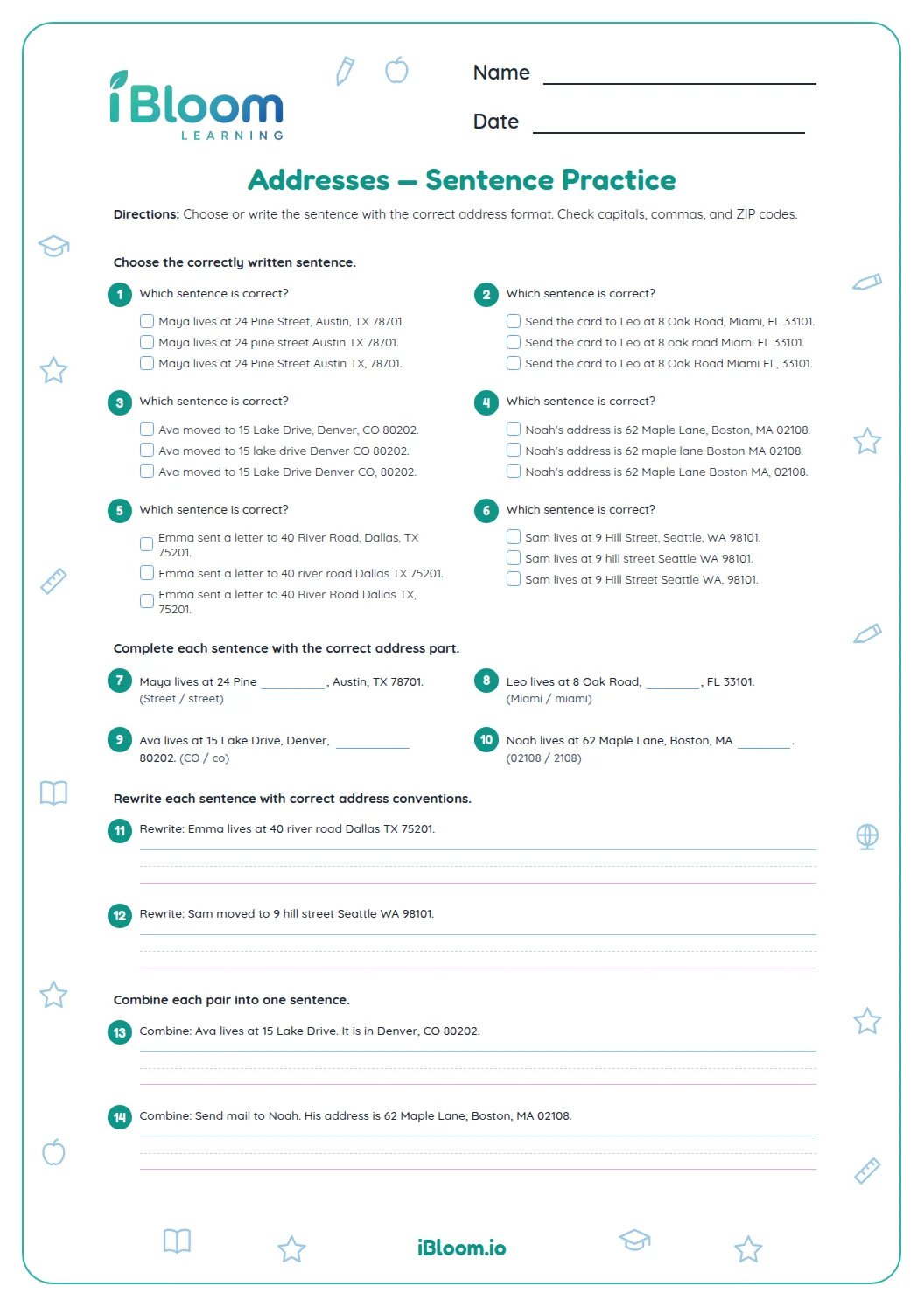
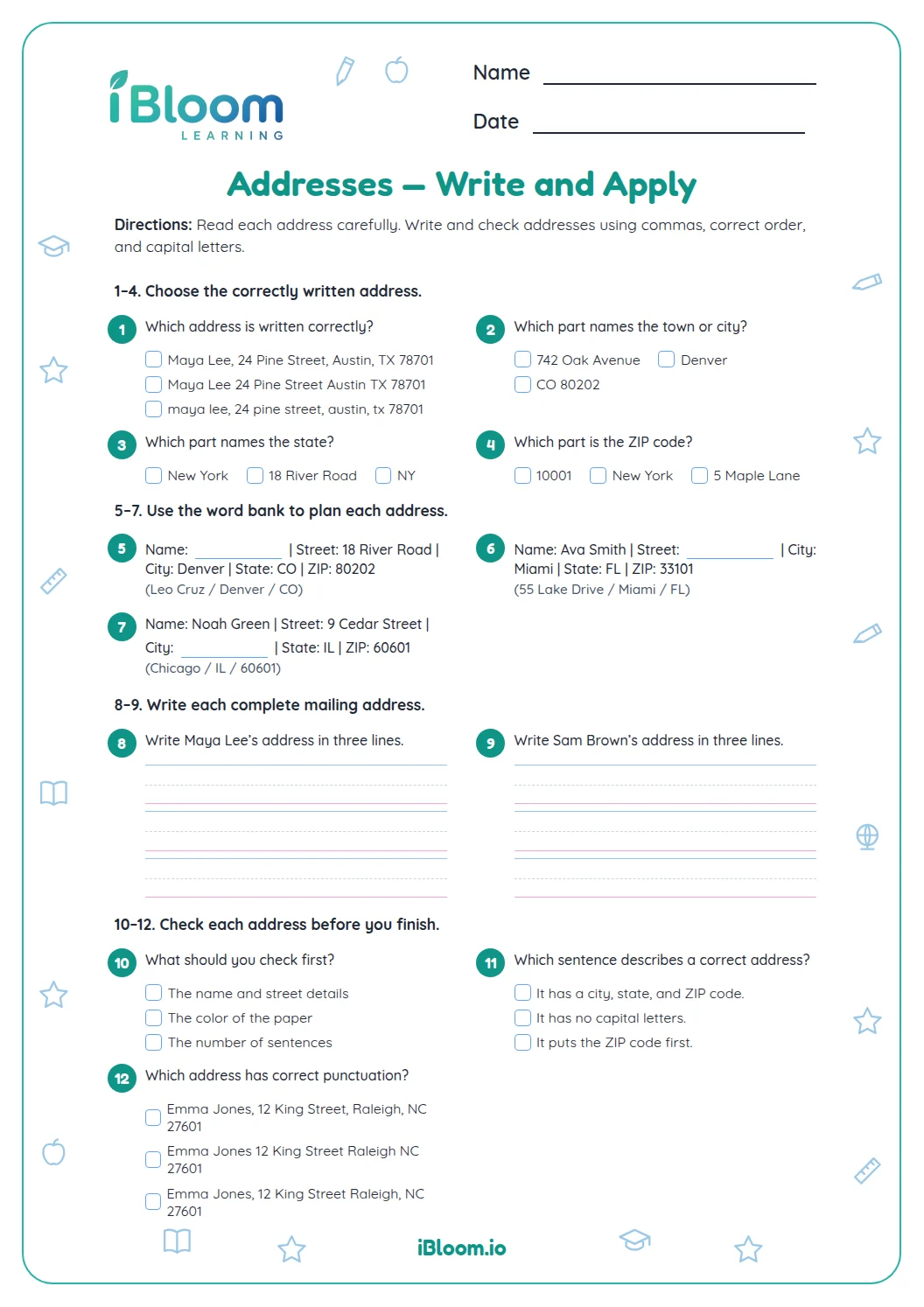
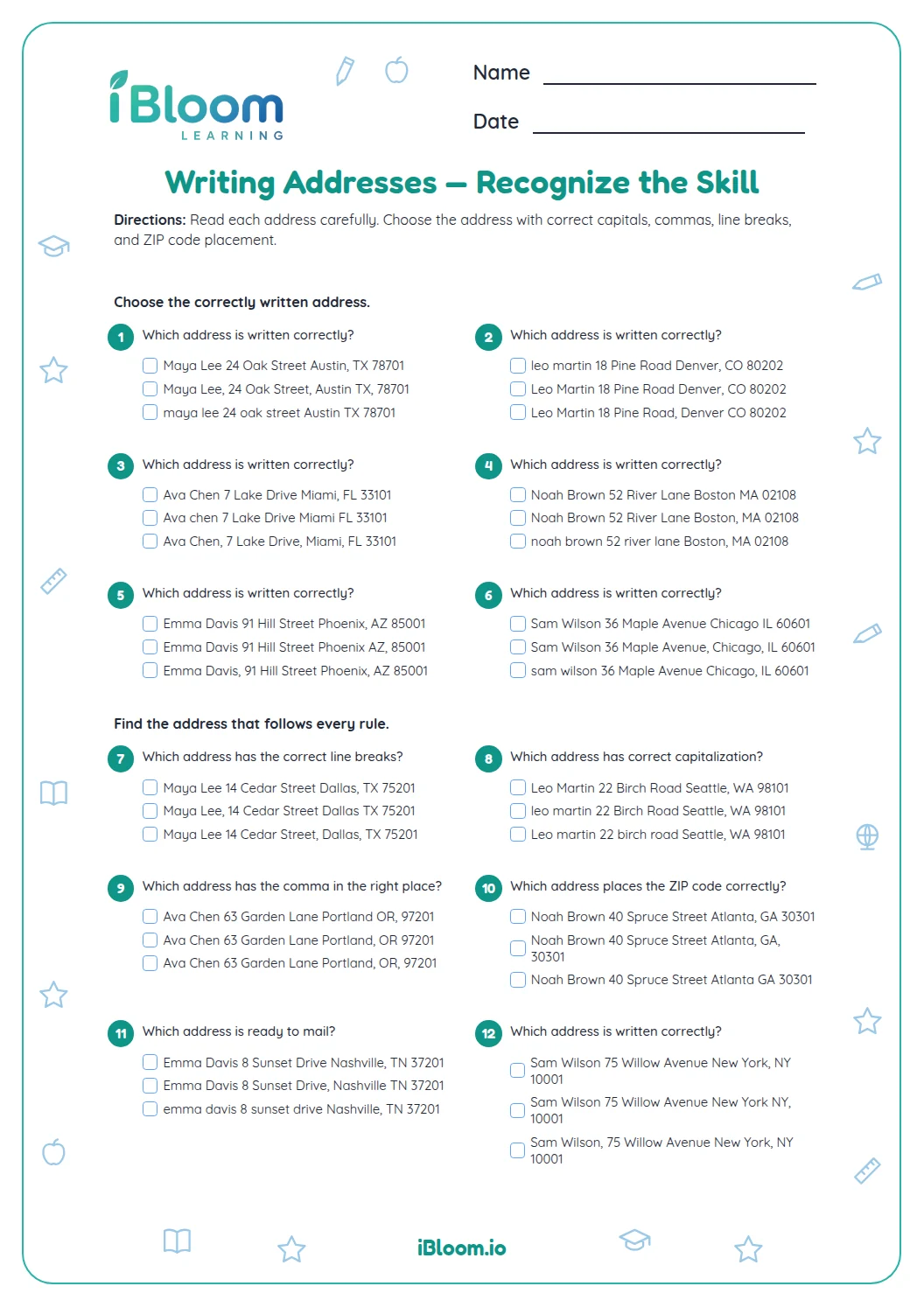
This Grade 3 printable teaches students to recognize and edit a standard US mailing address. Part A names the information on each address line. Part B completes address details, including the city and state comma, state abbreviations, and ZIP codes. The key lists each missing word, number, or punctuation mark. The capitalization and punctuation practice aligns with CCSS L.3.2.
Aligned to L.3.2
What are the parts of a mailing address?
A basic US mailing address has a street line followed by a city, state abbreviation, and ZIP code line. The street number and name stay together; the city is followed by a comma and the two-letter state abbreviation.
- 142 Oak Road
- 2Mesa, AZ 85201
- 3Street first; the city and state share a line, followed by the ZIP code.
Where does the comma go?
Put the comma after the city name and before the state abbreviation: “Salem, OR 97301.” Keep the state abbreviation before the ZIP code. The comma is not placed after the state or between the state and ZIP.
How do you complete each address detail?
Check each part in order: street number and name, city, comma, state abbreviation, ZIP code. Capitalize proper names and use capital letters for the two-letter state form. Part B asks you to complete address examples using that checklist.
How to use this worksheet
- 1Read the address prompts and name each part.
- 2Complete the Part A blanks about address parts.
- 3Complete Part B with address terms, numbers, or punctuation.
- 4Use the key to check each missing address detail.
- 5Compare both lines with the answer key.
Common mistakes and quick fixes
The mistake
Putting the ZIP code before the state abbreviation.
The fix
Keep the city, state abbreviation, and ZIP in that order on the second line.
The mistake
Leaving out the comma after the city.
The fix
Add the comma between the city name and state abbreviation.
The mistake
Writing a state abbreviation in lowercase.
The fix
Use two capital letters for the state abbreviation, such as OR or AZ.
Common Core alignment
This page gives students focused practice with the skills named in these Common Core standards.
Use standard English capitalization, punctuation, and spelling when writing.
On this sheet: Students identify and correct capitalization and comma placement in mailing addresses.
Show the official wordingHide the official wording
Demonstrate command of the conventions of standard English capitalization, punctuation, and spelling when writing.
What to practice next
Make more practice
Further reading
Questions parents and teachers ask
What goes on the first line of a mailing address?
The first line has the street number and street name, such as “42 Oak Road.” The second line has the city, state abbreviation, and ZIP code. The first questions identify that order; later blanks ask students to complete it. Students can follow this order on each example.
Where does the comma go in an address?
Put a comma after the city and before the state abbreviation, as in “Mesa, AZ 85201.” Do not put the comma after the state or between the state and ZIP code. The worksheet practices that placement in a short address line. That comma separates two address details.
How many questions are on this worksheet?
There are fourteen fill-ins. Students name address parts, add a city and state comma, and supply state abbreviations, ZIP codes, and street details. The answer key gives each missing word, number, or mark for checking. The examples use familiar US address formats.
Why are state abbreviations written in capital letters?
A state abbreviation uses two capital letters, such as AZ for Arizona or OR for Oregon. The capital letters help readers recognize the state form quickly. Part B asks students to supply missing address terms and punctuation. The abbreviation stays uppercase in the address.
How should a child check a corrected address?
Check that the street number and name come first, then the city, comma, two-letter state abbreviation, and ZIP code. Also check capitalization. The answer key gives each missing address part. Review the line order and punctuation before finishing. Review both lines in order before finishing each response.