



About this worksheet
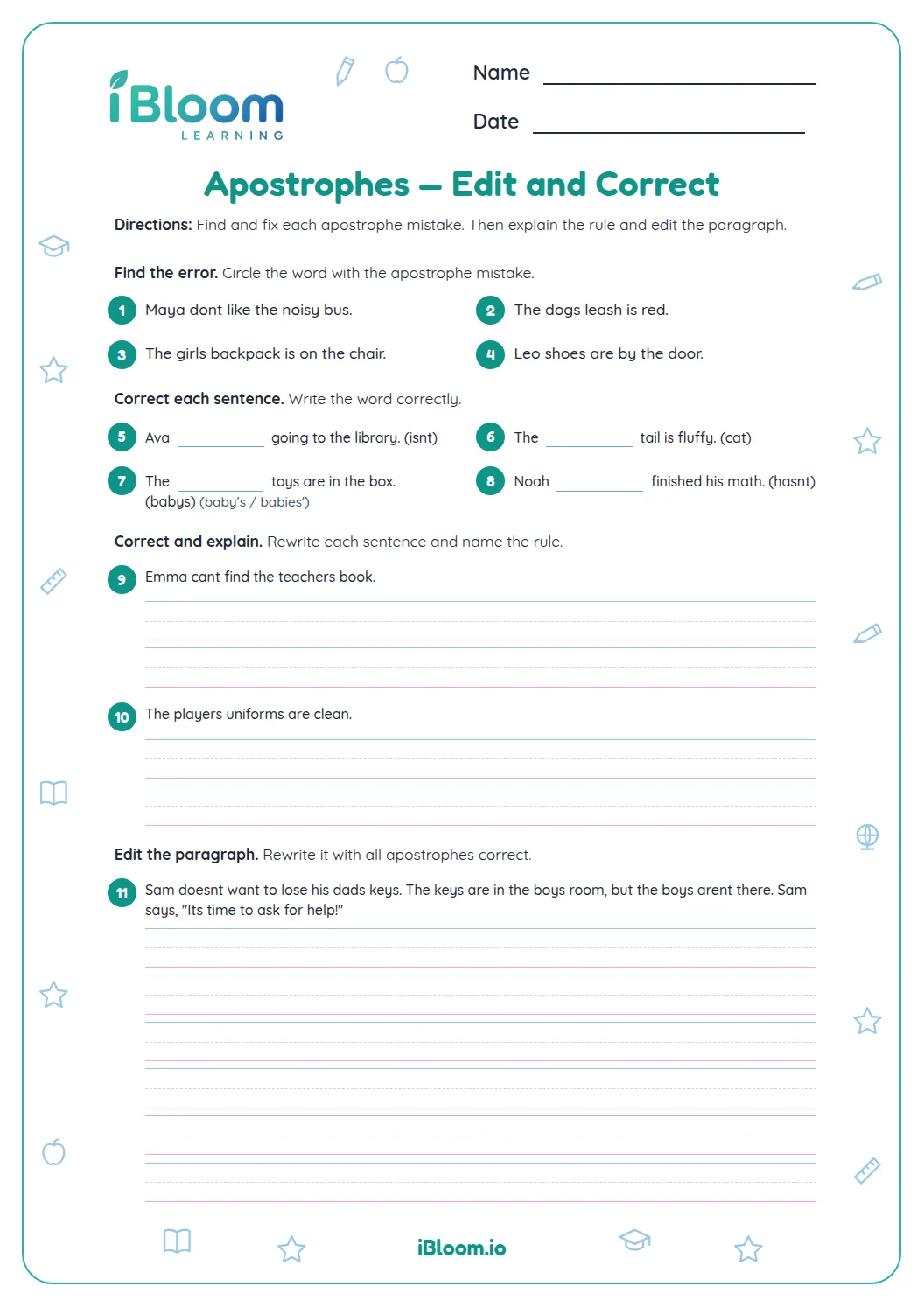
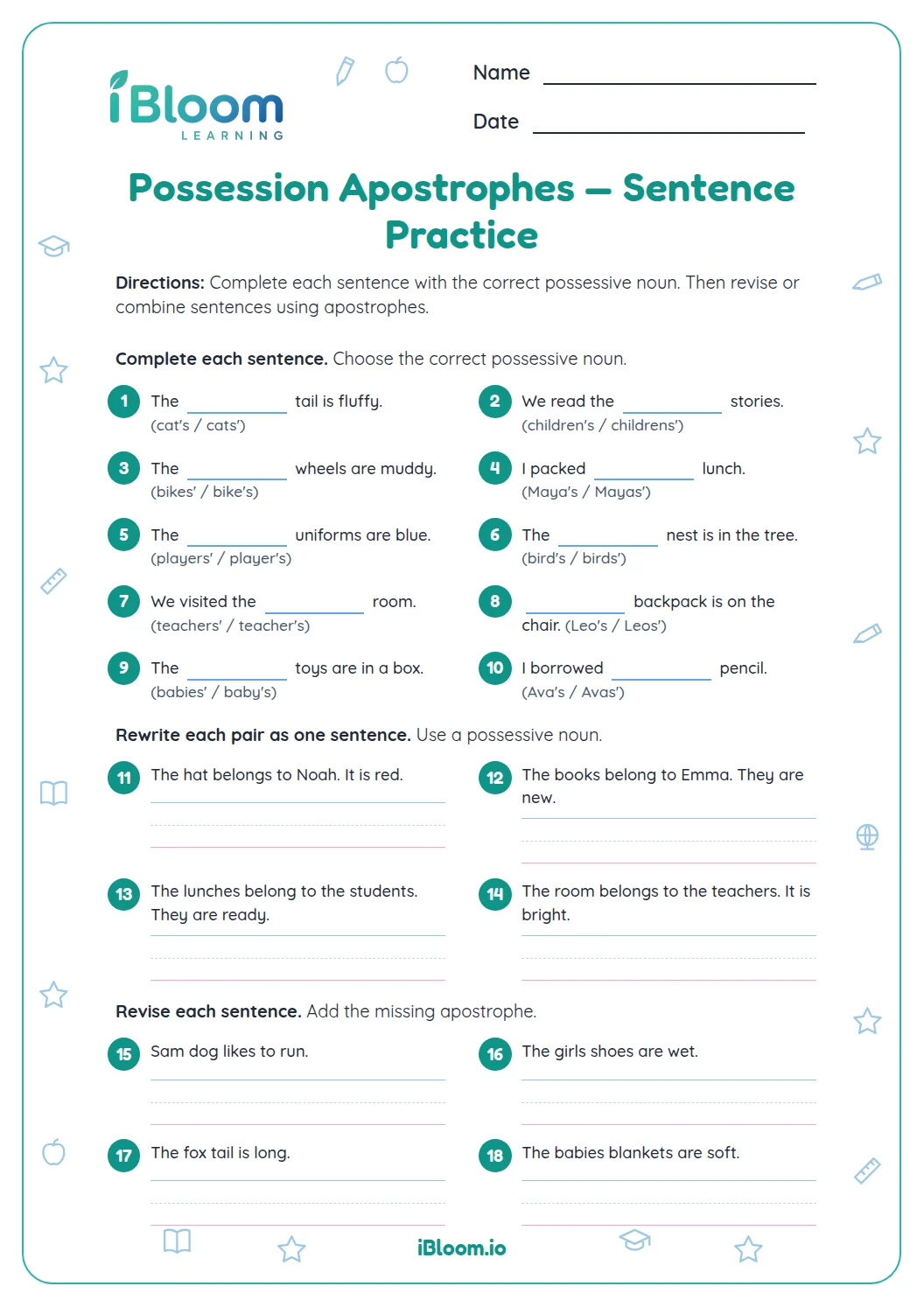
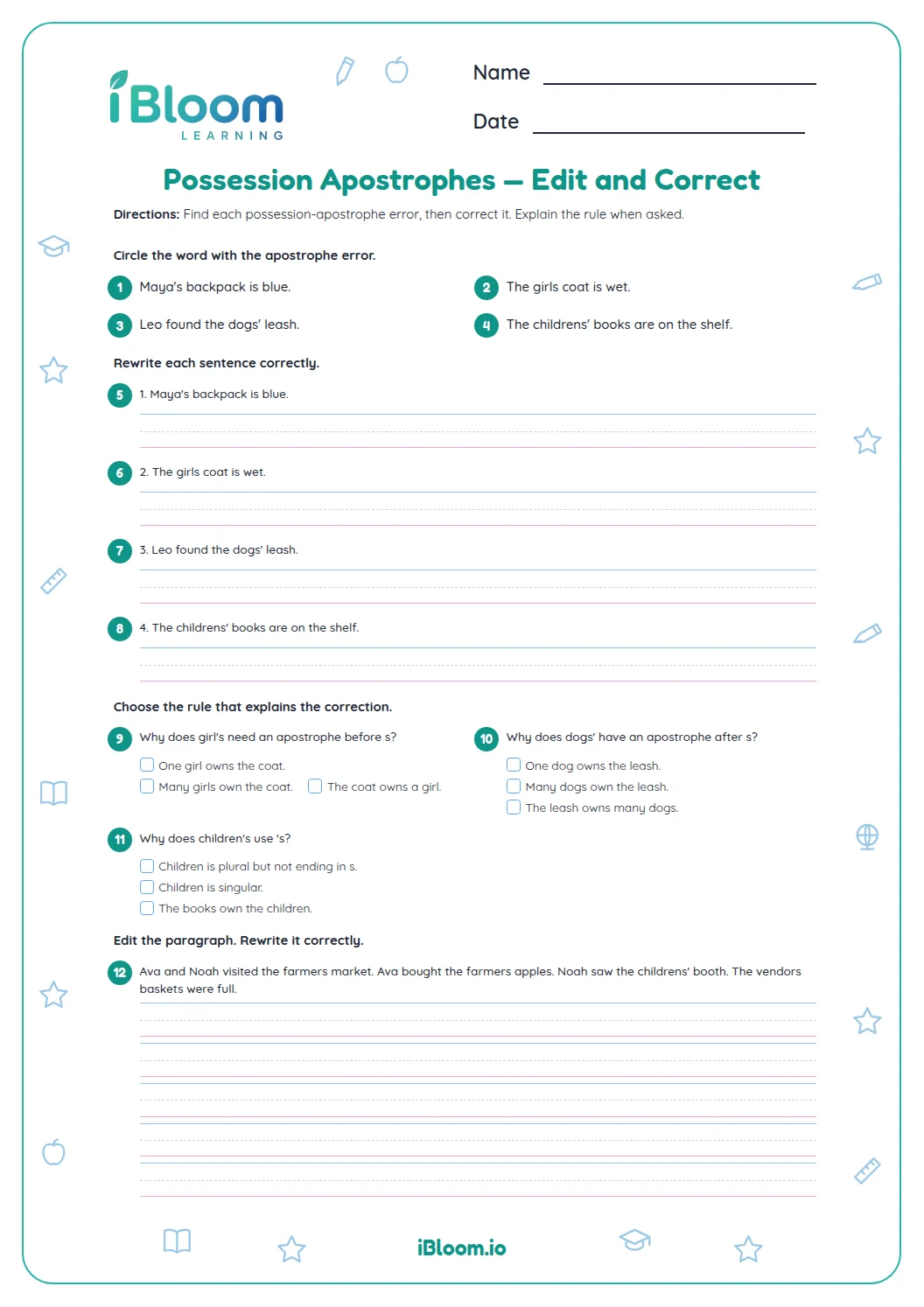
This free printable Grade 3 worksheet gives guided practice using apostrophes in contractions and possessives. Learners complete eight contractions, then eight noun phrases showing ownership, including singular owners, regular plurals, and the irregular plural children. The separate key shows each completed phrase.
Aligned to L.3.2
How do apostrophes work in contractions?
Part A joins two words and marks the letters left out. For example, is not becomes isn’t. The apostrophe goes where the missing letters would be.
- 1Maya ___ ready for school. (is not)
- 2Maya isn’t ready for school.
How do apostrophes show ownership?
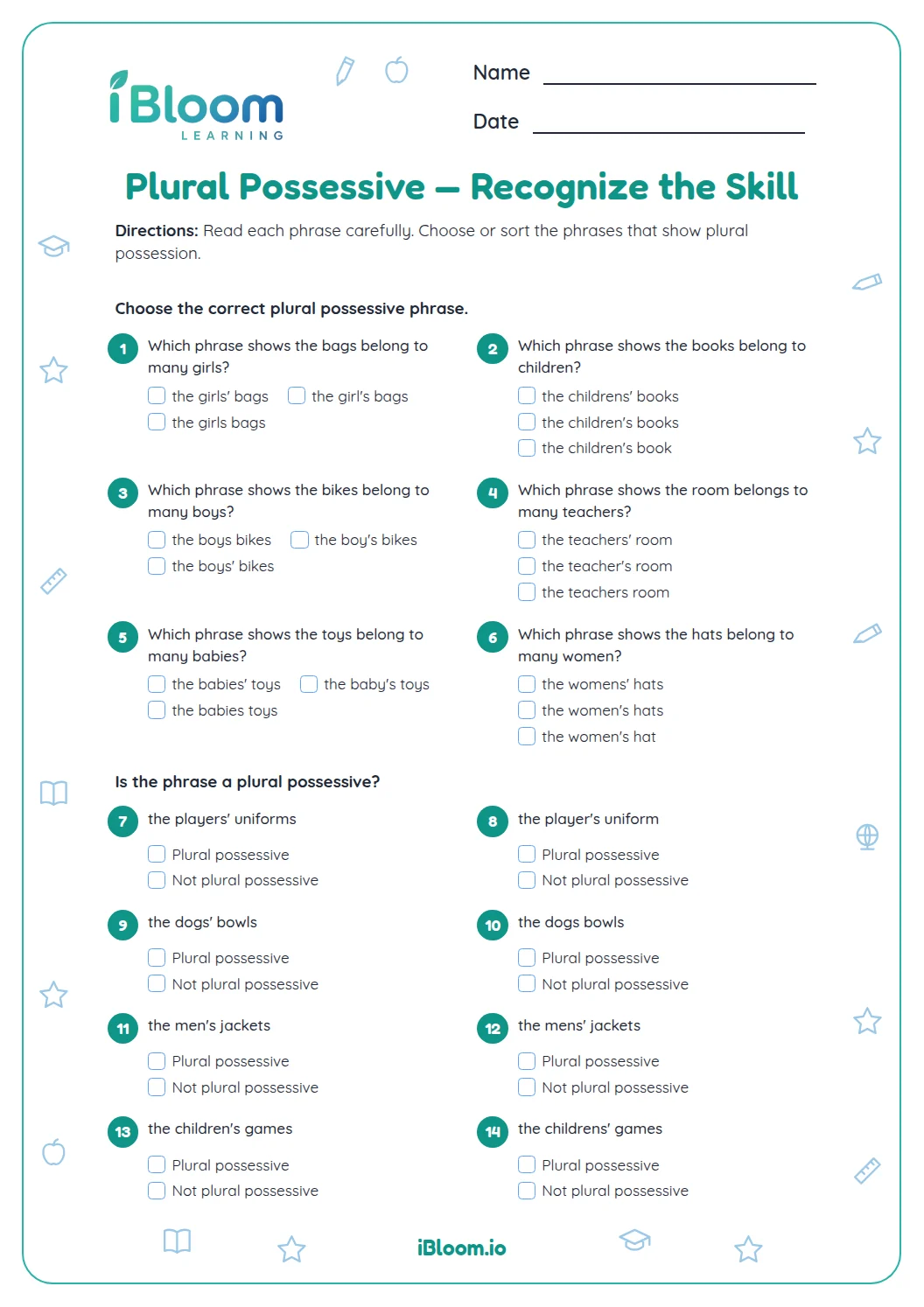
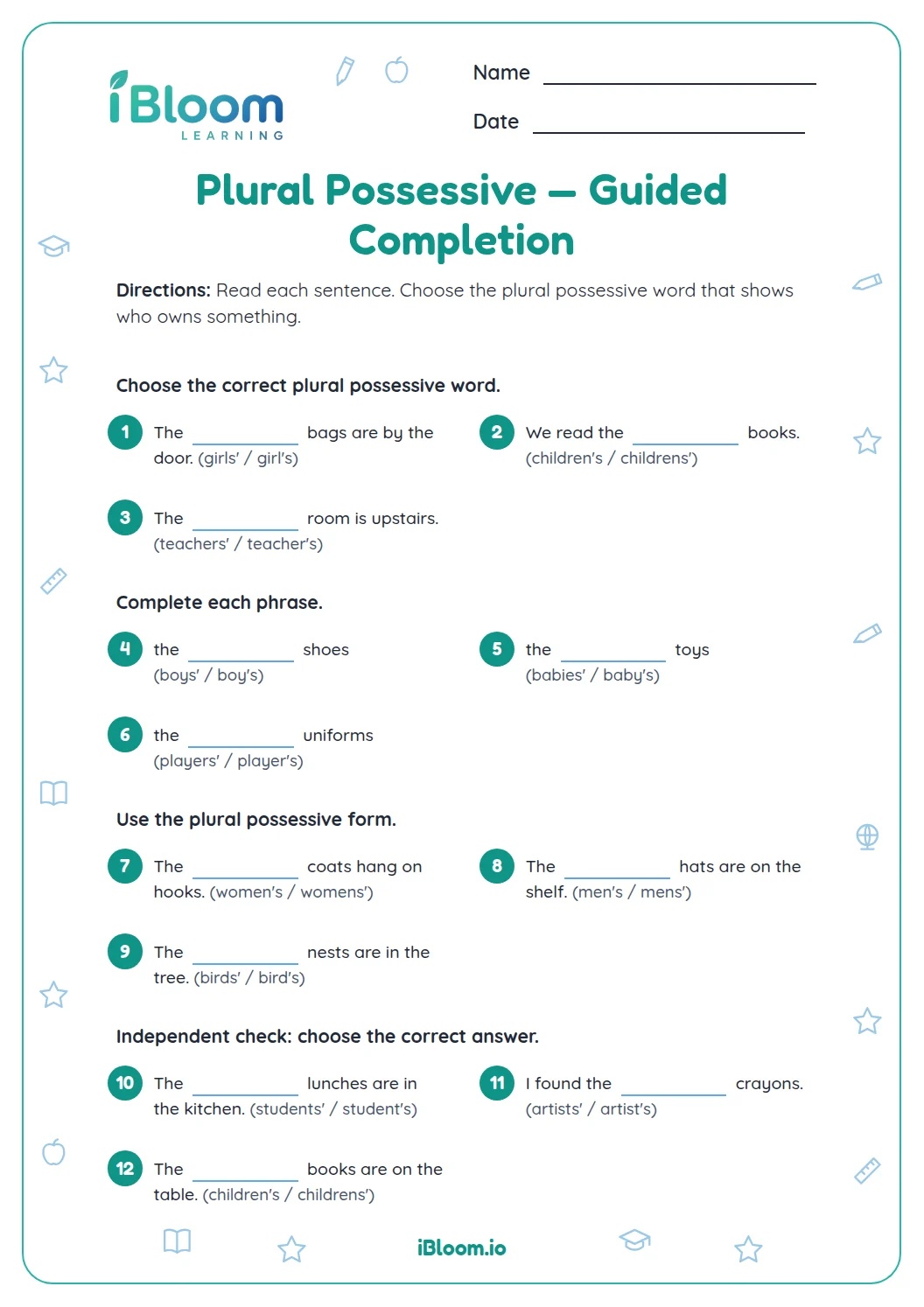
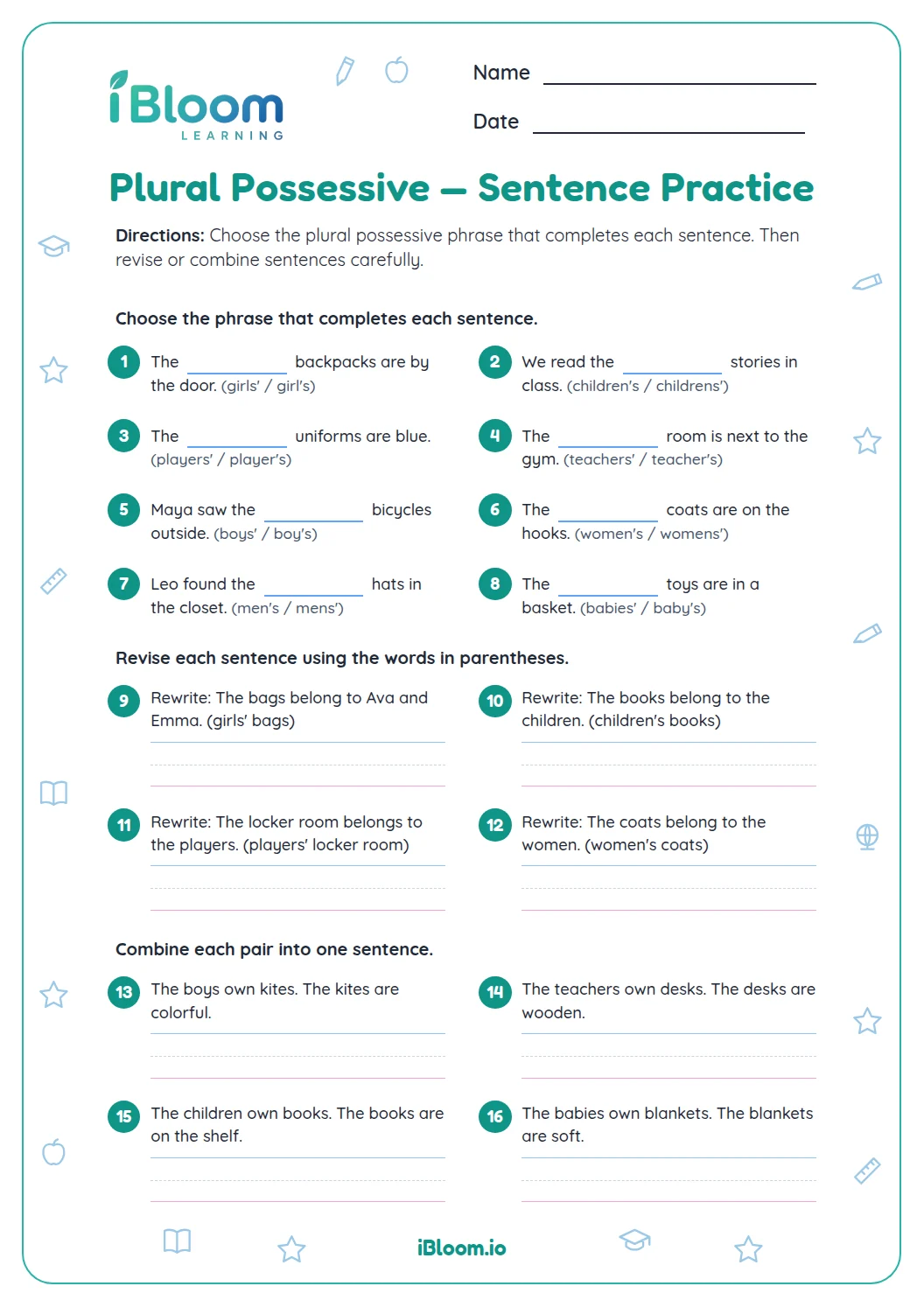
Part B gives an owner in parentheses. For one dog, write dog’s before tail. For a plural noun that already ends in s, place the apostrophe after s: girls’ hats. The irregular plural children takes apostrophe plus s: children’s coats.
How to use this worksheet
- 1In Part A, read the two words in parentheses.
- 2Join them into a contraction and mark the missing letters.
- 3In Part B, identify the owner in parentheses.
- 4Add apostrophe plus s for singular and irregular plural owners.
- 5For a regular plural ending in s, put the apostrophe after s.
Common mistakes and quick fixes
The mistake
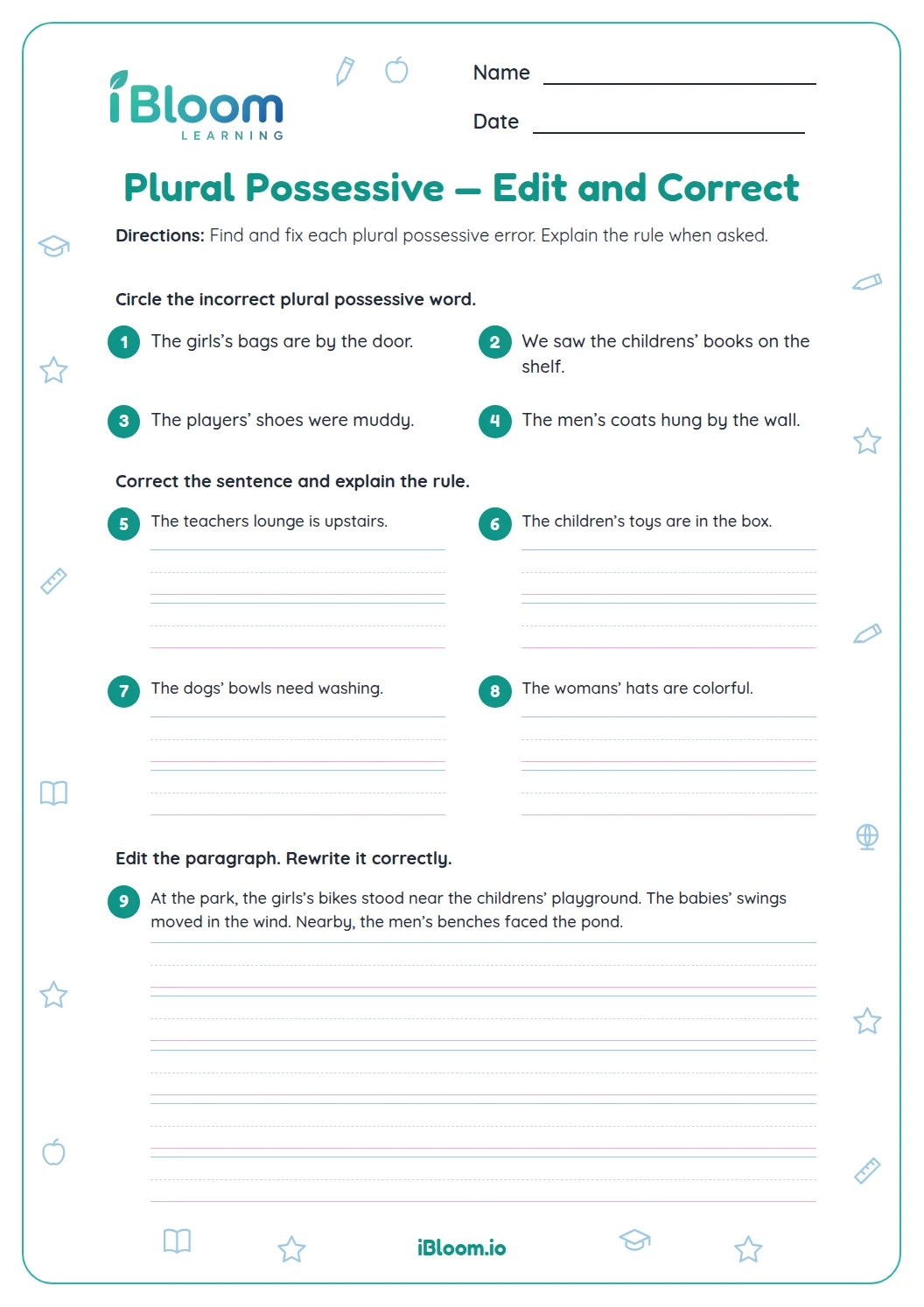
Writing girls’s for a plural noun that already ends in s.
The fix
Keep the plural s and place the apostrophe after it: girls’ hats.
The mistake
Writing childrens’ for the irregular plural children.
The fix
Children does not end in s, so add apostrophe plus s: children’s coats.
The mistake
Leaving out the apostrophe in a singular possessive.
The fix
Check for the owner, then add the apostrophe in dog’s, Lena’s, or principal’s.
Common Core alignment
Use apostrophes as punctuation when writing contractions and possessives.
On this sheet: Part B adds apostrophes to show who owns each named object.
Show the official wordingHide the official wording
Demonstrate command of the conventions of standard English capitalization, punctuation, and spelling when writing.
What to practice next
Make more practice
Further reading
Questions parents and teachers ask
How many questions are on this worksheet?
There are 16 questions on this printable. The tasks focus on apostrophes in contractions and possessives, and the separate answer key makes it easy to check each response after the learner finishes. The items are numbered in sequence, so learners can work from the first section to the last.
What is the difference between a contraction and a possessive?
A contraction joins two words and uses an apostrophe where letters are missing, as in isn’t for is not. A possessive uses an apostrophe to show ownership, as in dog’s tail or girls’ hats. This worksheet practices both uses. Have the learner point to the owner and identify whether the noun is singular or plural.
How should I use the answer key?
Let the learner finish a part before opening the key. Compare each response with the model, then reread the sentence or passage detail that supports it. For written answers, the key gives a sample response; another answer can work when it is accurate and supported.
How long does the worksheet take?
Allow about 20 minutes for 16 questions, with extra time for reading or discussing responses. A child can complete one part at a time and return to the rest later. The answer key is separate so it can stay out of view during practice.
What materials are needed?
Print the worksheet and its answer key, and have a pencil ready. The activities use the printed page, so no extra materials are needed. An adult may read directions aloud for a younger learner, then invite the child to choose or write each answer.