


About this worksheet
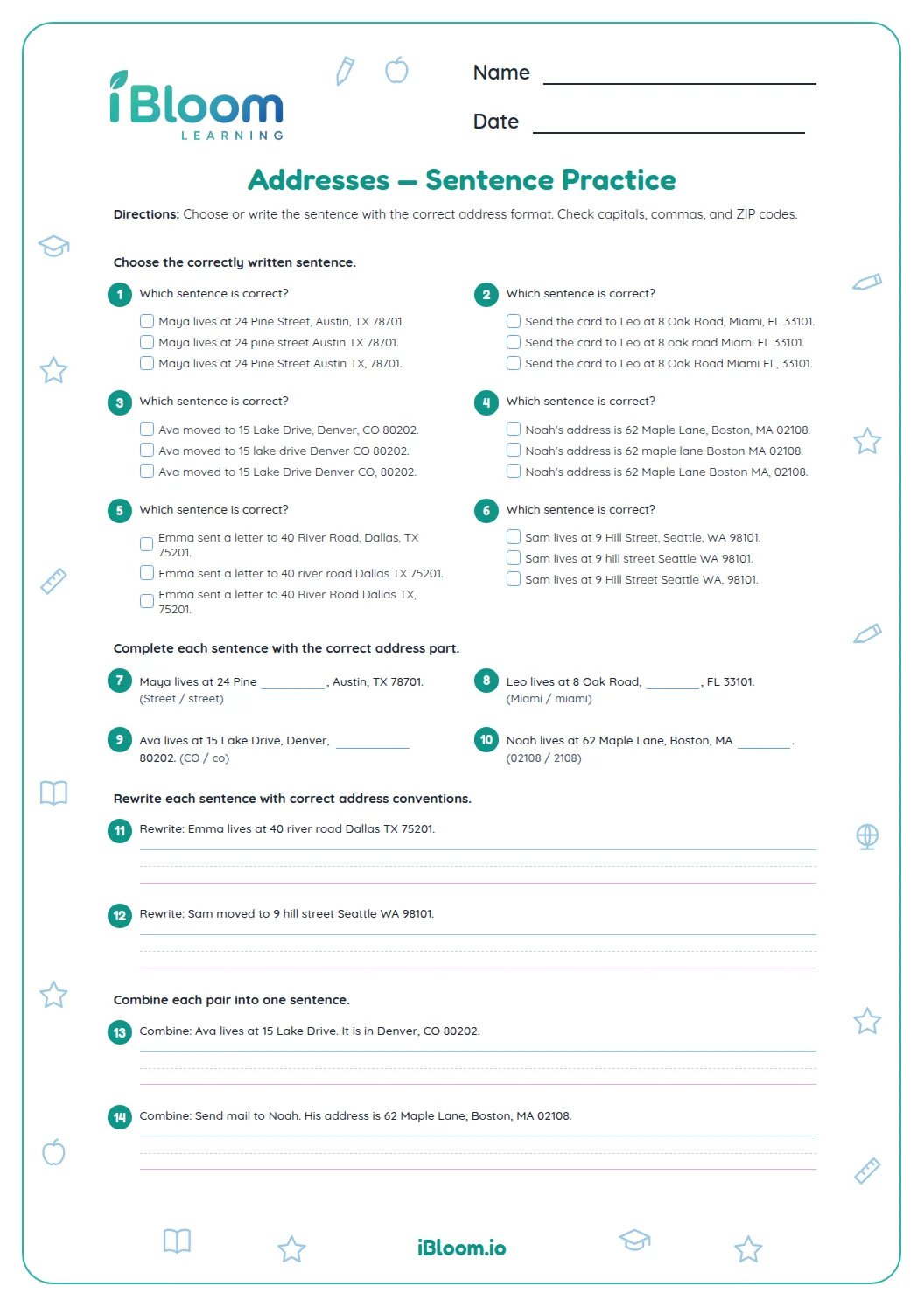
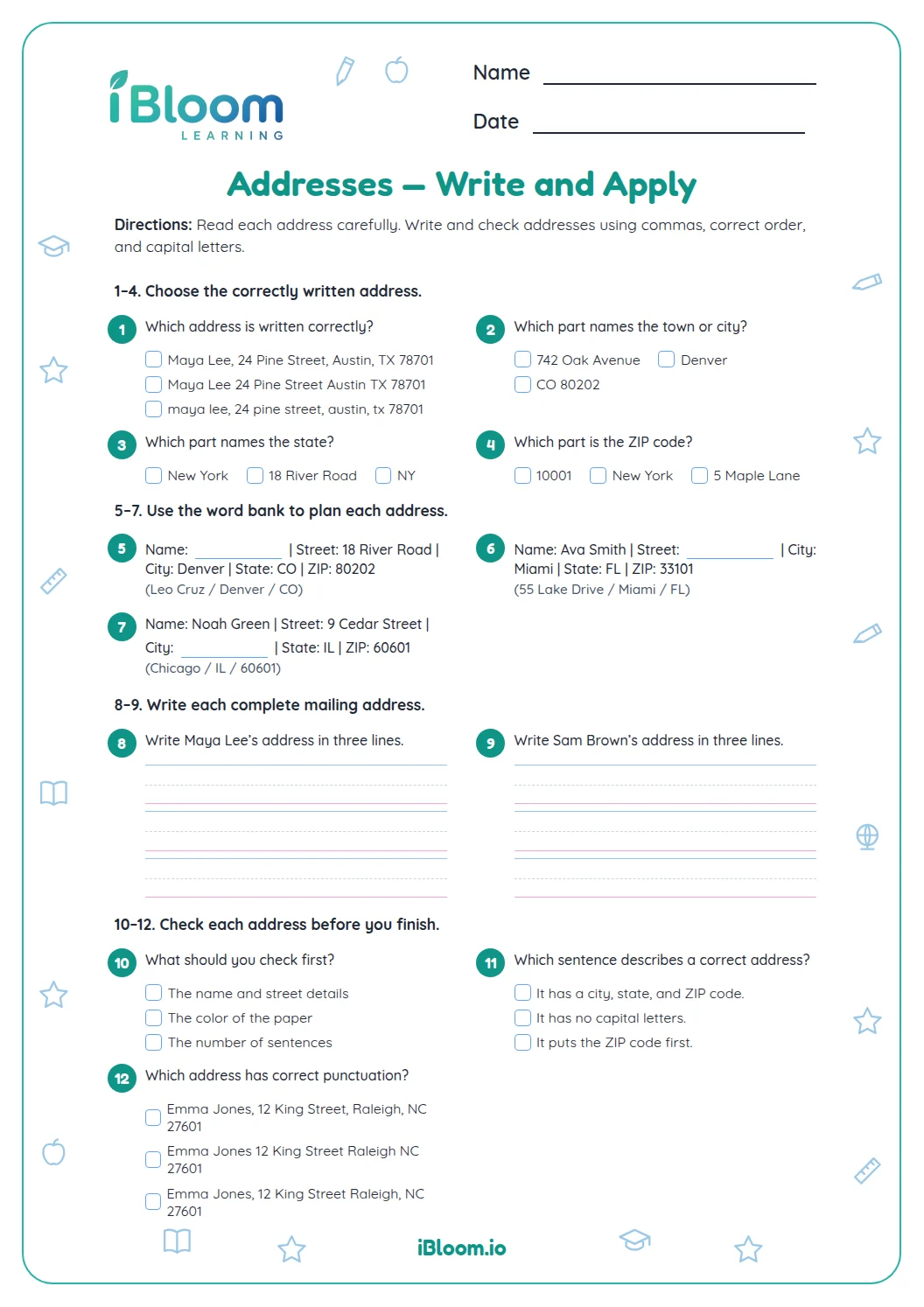
This free printable Grade 3 worksheet gives learners focused practice with addresses. Its 14 questions move from guided choices and completions to applying the skill independently. A separate answer key makes checking the work straightforward.
Aligned to L.3.2b
What belongs in an address?
The first part introduces addresses with short, clear examples. Read each complete prompt before choosing or filling an answer.
How do commas organize an address?
The later items apply addresses in varied contexts. Reread each response to make sure it fits the whole sentence or address.
How to use this worksheet
- 1Read the full address once before changing it.
- 2Mark where the street, city, state, and ZIP code begin.
- 3Place commas between the address parts.
- 4Check that the state abbreviation has two capital letters.
- 5Compare your rewritten line with the answer key.
Common mistakes and quick fixes
The mistake
Leaving out the comma between city and state.
The fix
Read the city and state as separate address parts.
The mistake
Putting the ZIP code before the state.
The fix
Keep the order city, state abbreviation, then ZIP code.
The mistake
Adding periods to postal state abbreviations.
The fix
Use two capital letters, such as OR or TX, without periods.
Common Core alignment
Use commas in addresses, as practiced in these address lines.
On this sheet: The completion prompts practice comma placement in written addresses.
Show the official wordingHide the official wording
Use commas in addresses.
What to practice next
Make more practice
Further reading
Questions parents and teachers ask
What will learners practice?
This worksheet gives learners focused practice with the skill named in its title. Fourteen short questions move through guided choices, sentence completions, and application. The separate answer key helps families check each response after the learner finishes the practice independently.
How should learners use the answer key?
Read the full prompt before choosing an answer, then reread the response to check whether it fits the sentence or address. The worksheet moves from guided examples toward independent application, so learners try the same skill in several contexts.
How long does the worksheet take?
Plan for about fifteen minutes to complete the fourteen questions carefully. Learners can pause to reread prompts, write neatly, and check their work with the separate answer key afterward. Writing speed and review time may change the total.
Can answers vary?
Some short response questions allow more than one sensible answer. The key gives a model response for those items; another answer is acceptable when it follows the prompt and uses the target skill accurately in context. Encourage learners to explain their choice aloud.
What materials are needed?
Use the printable worksheet and a pencil. Read the direction for each part, answer the questions in order, and use the separate key after finishing. For written items, check the response against the exact request and target skill.