

About this worksheet
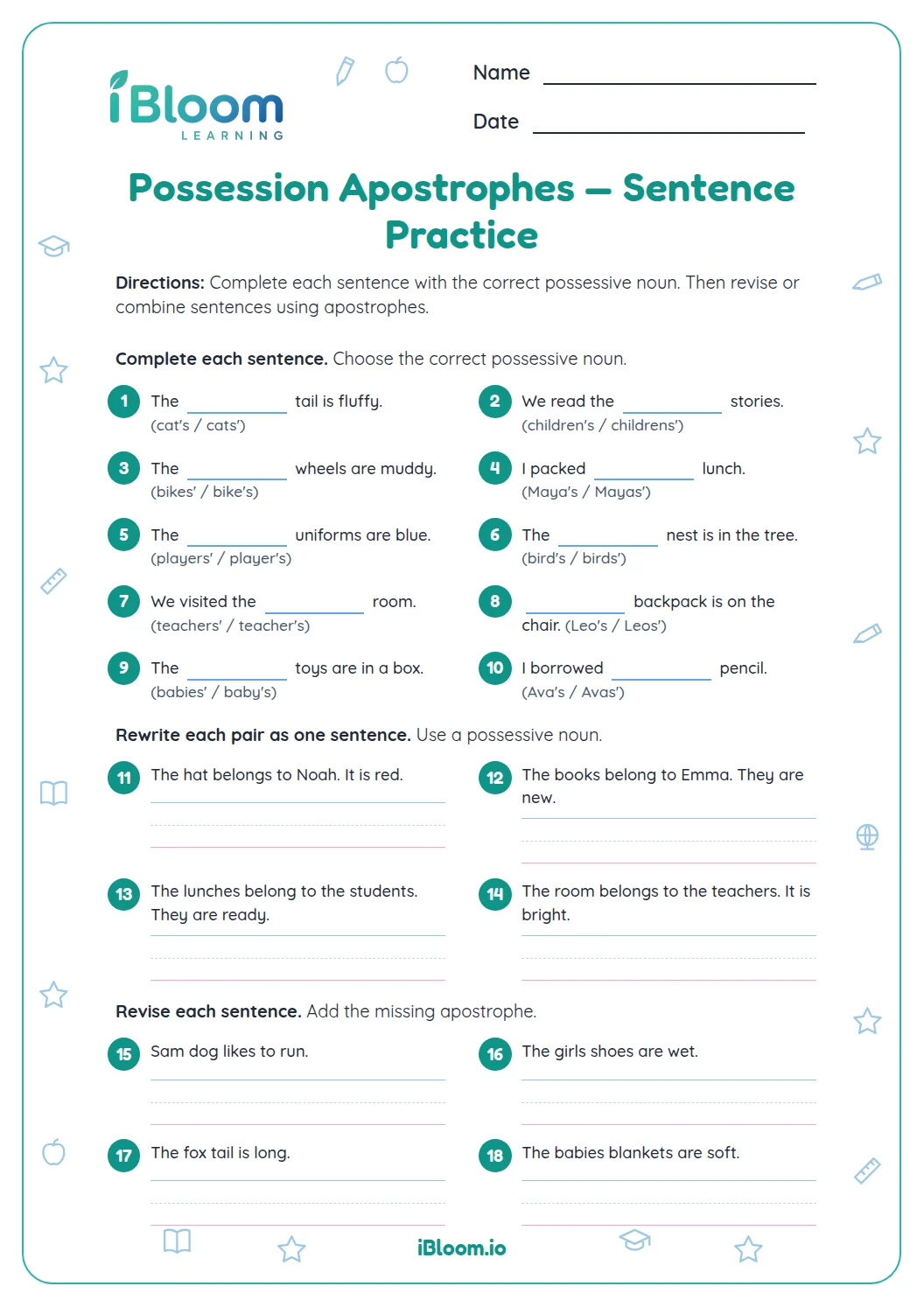
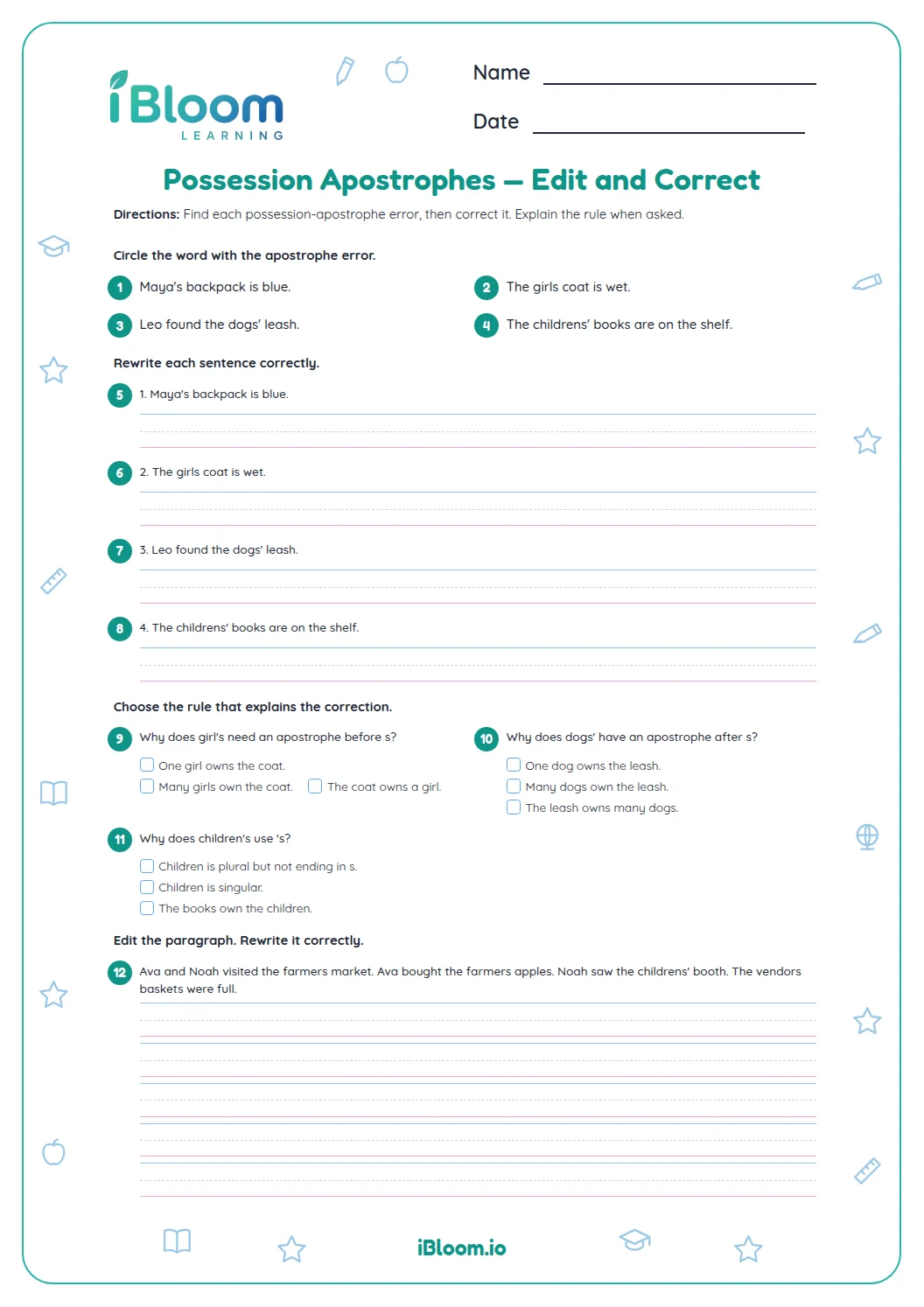
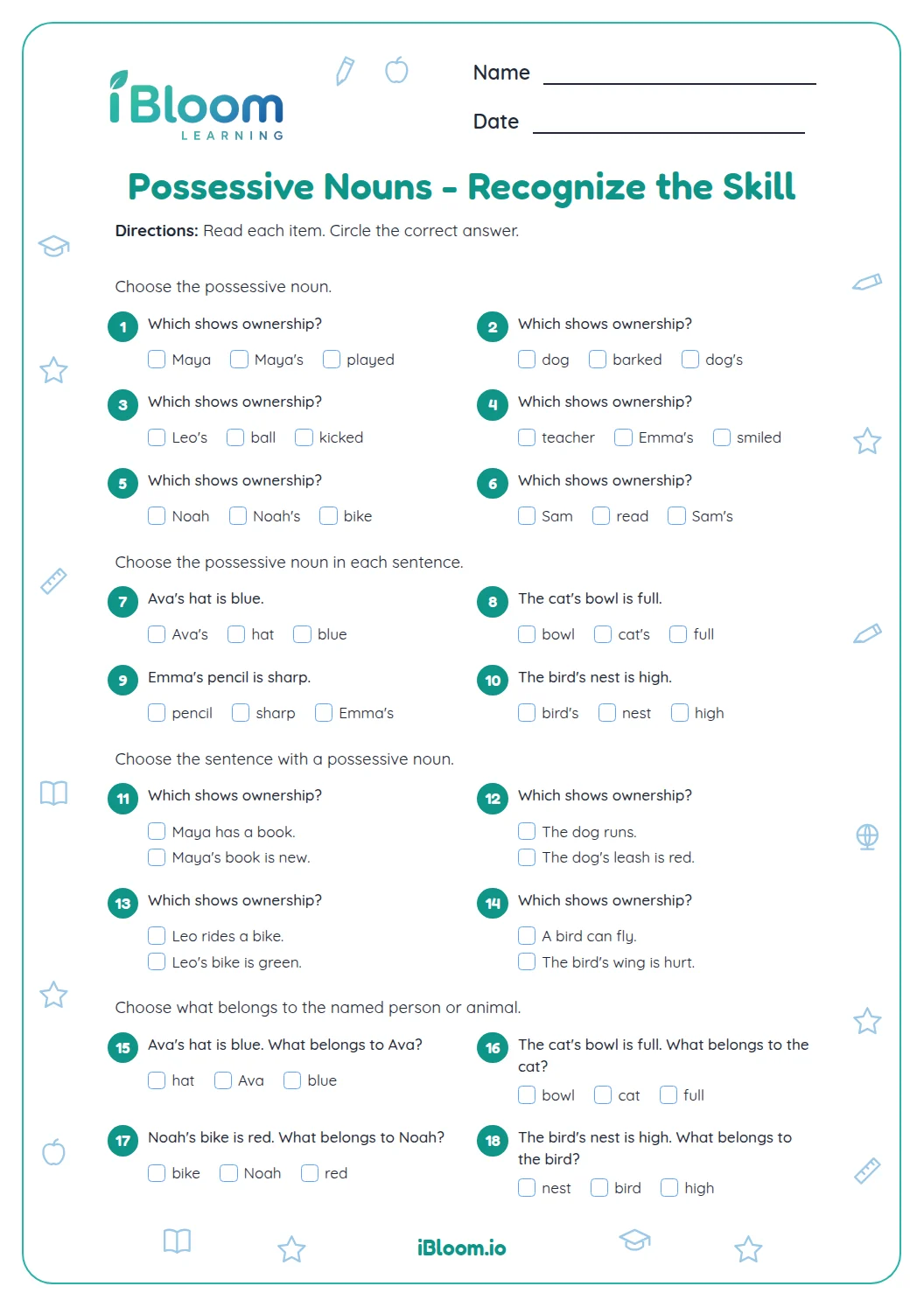
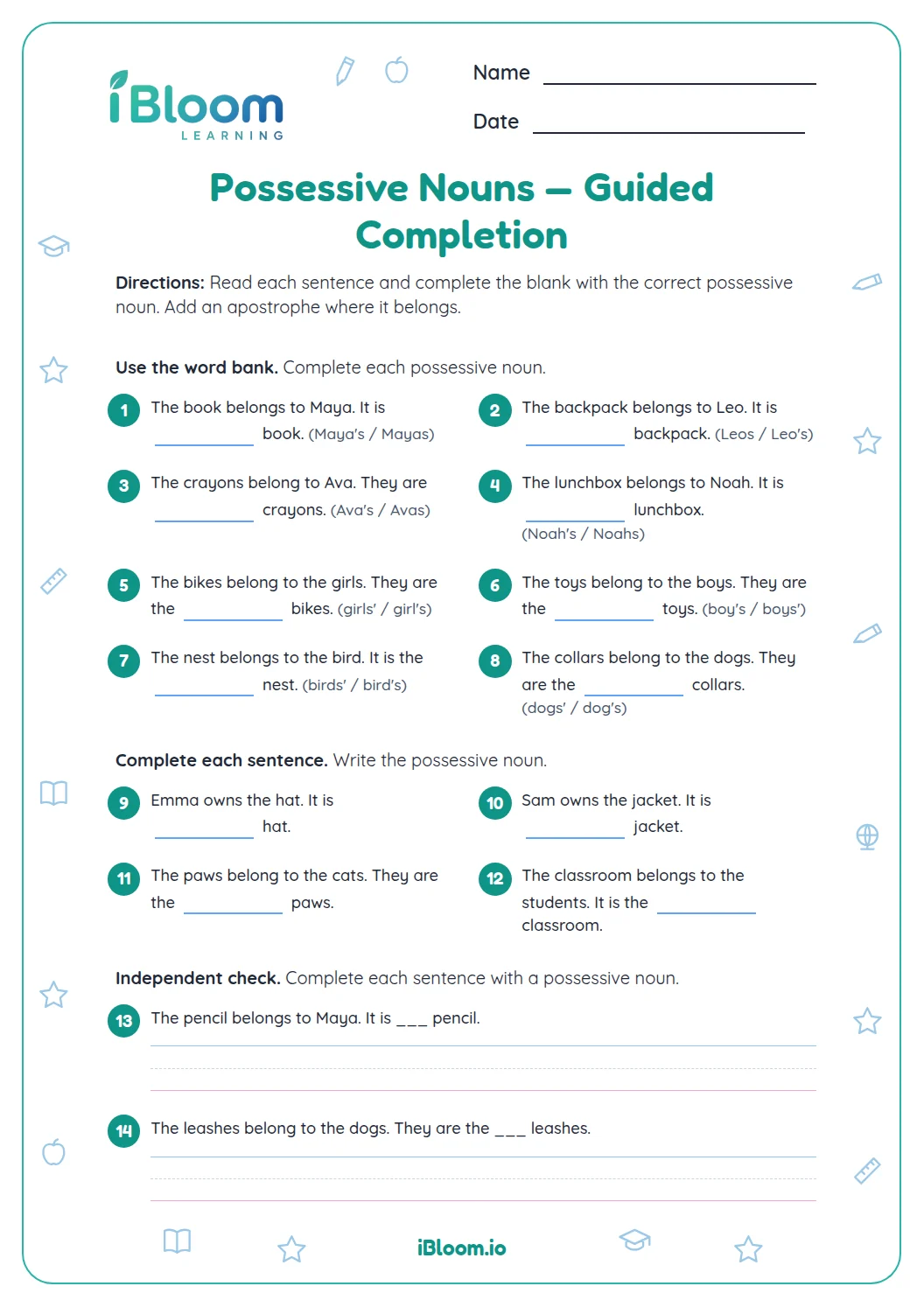
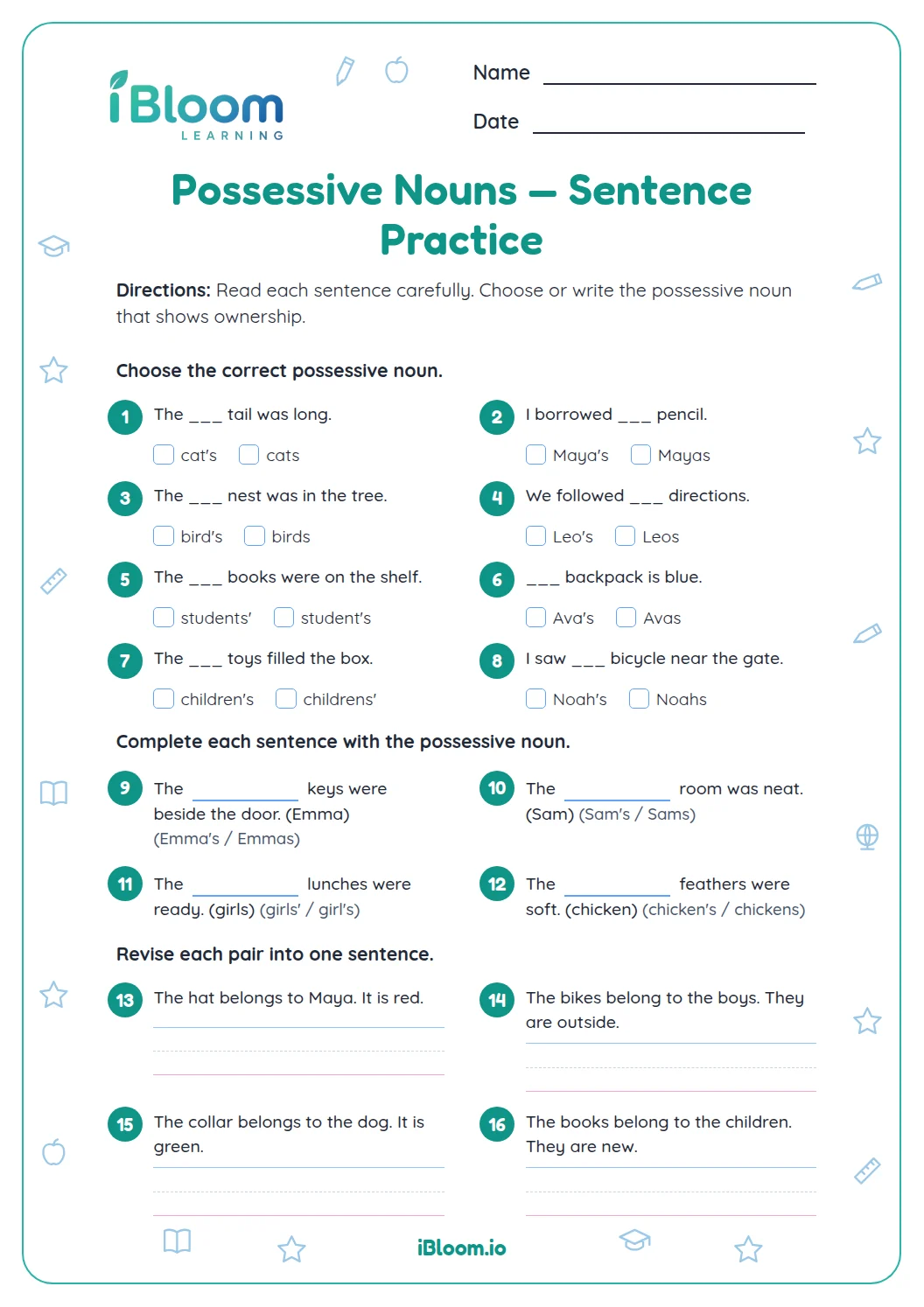
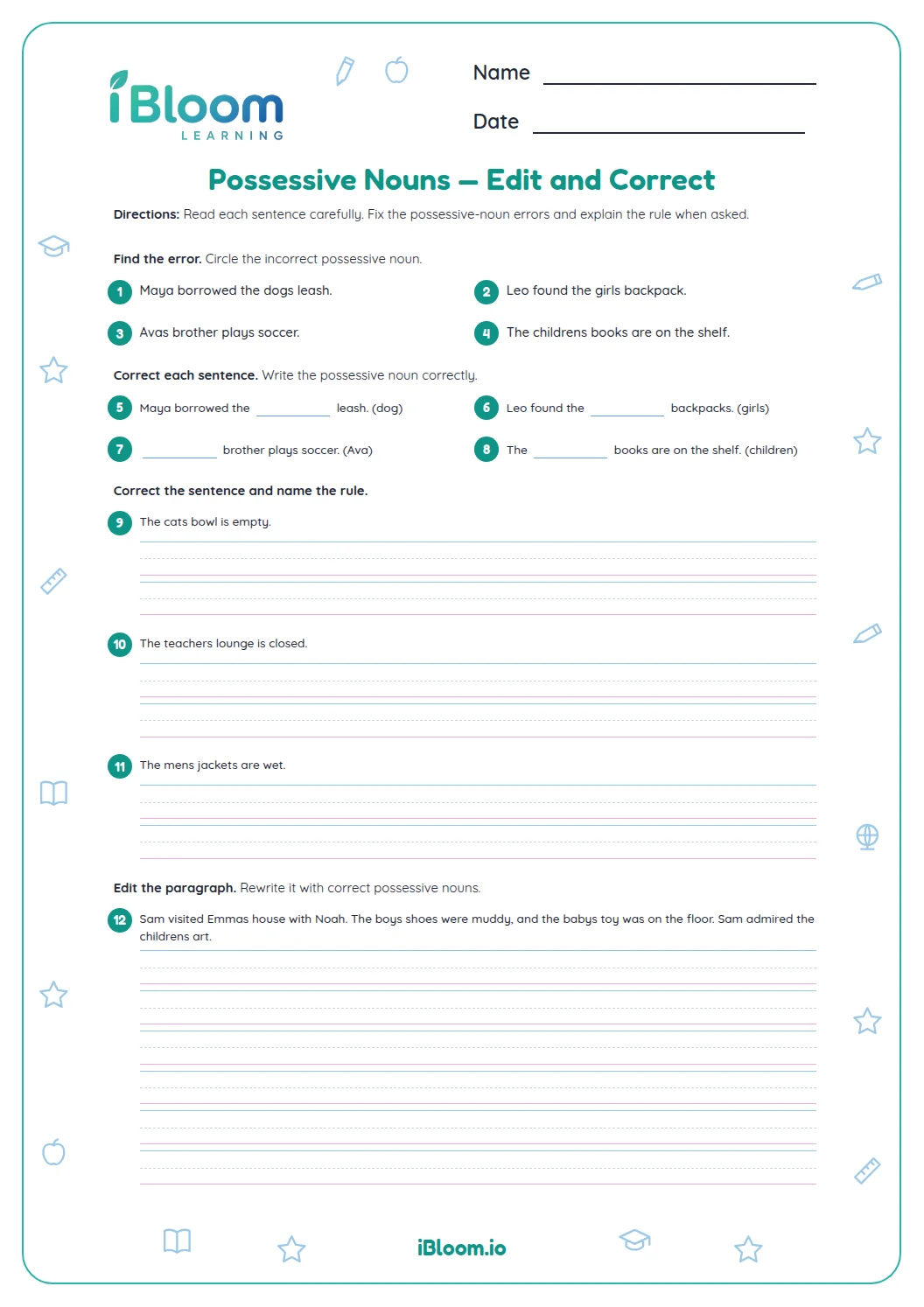
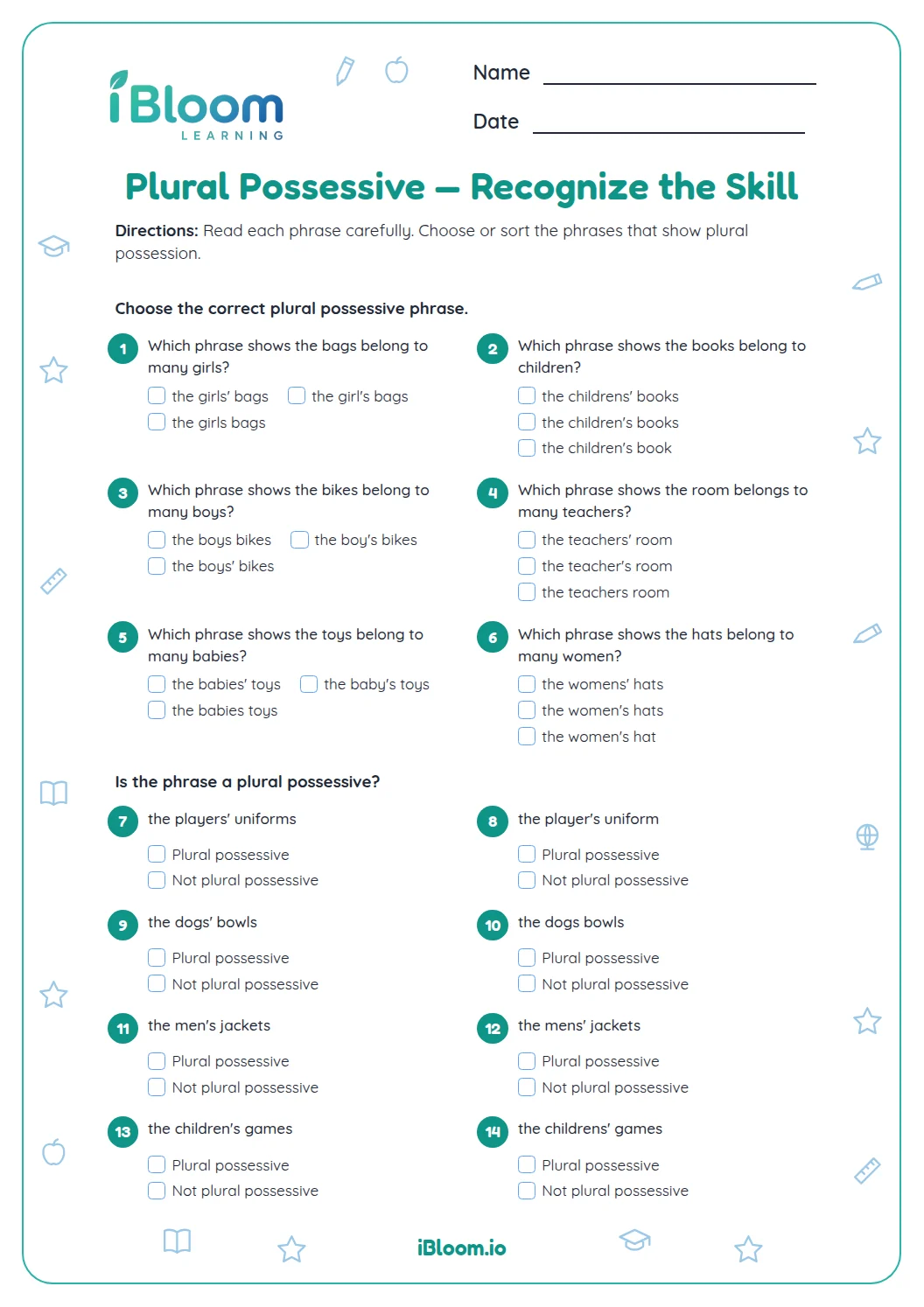
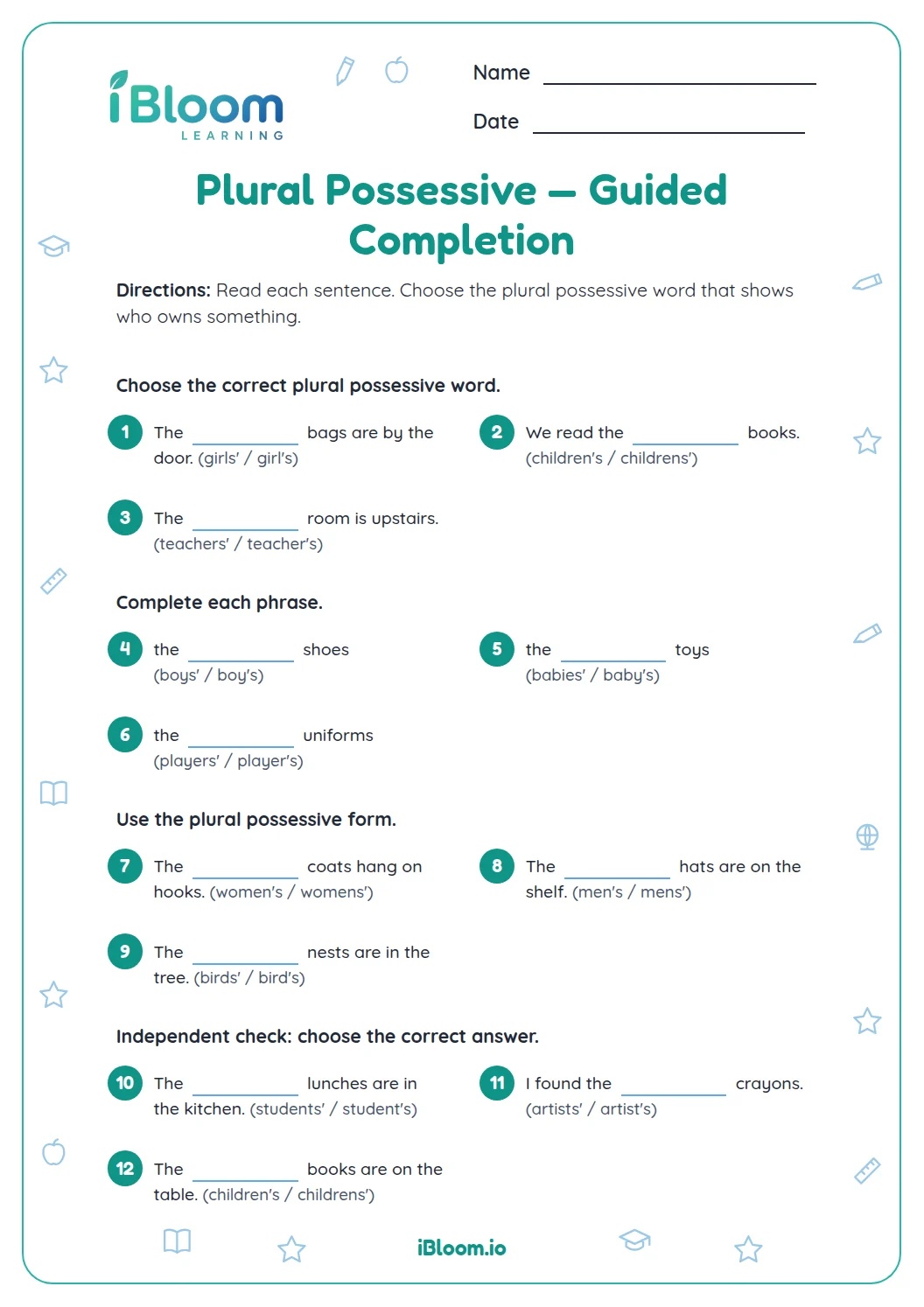
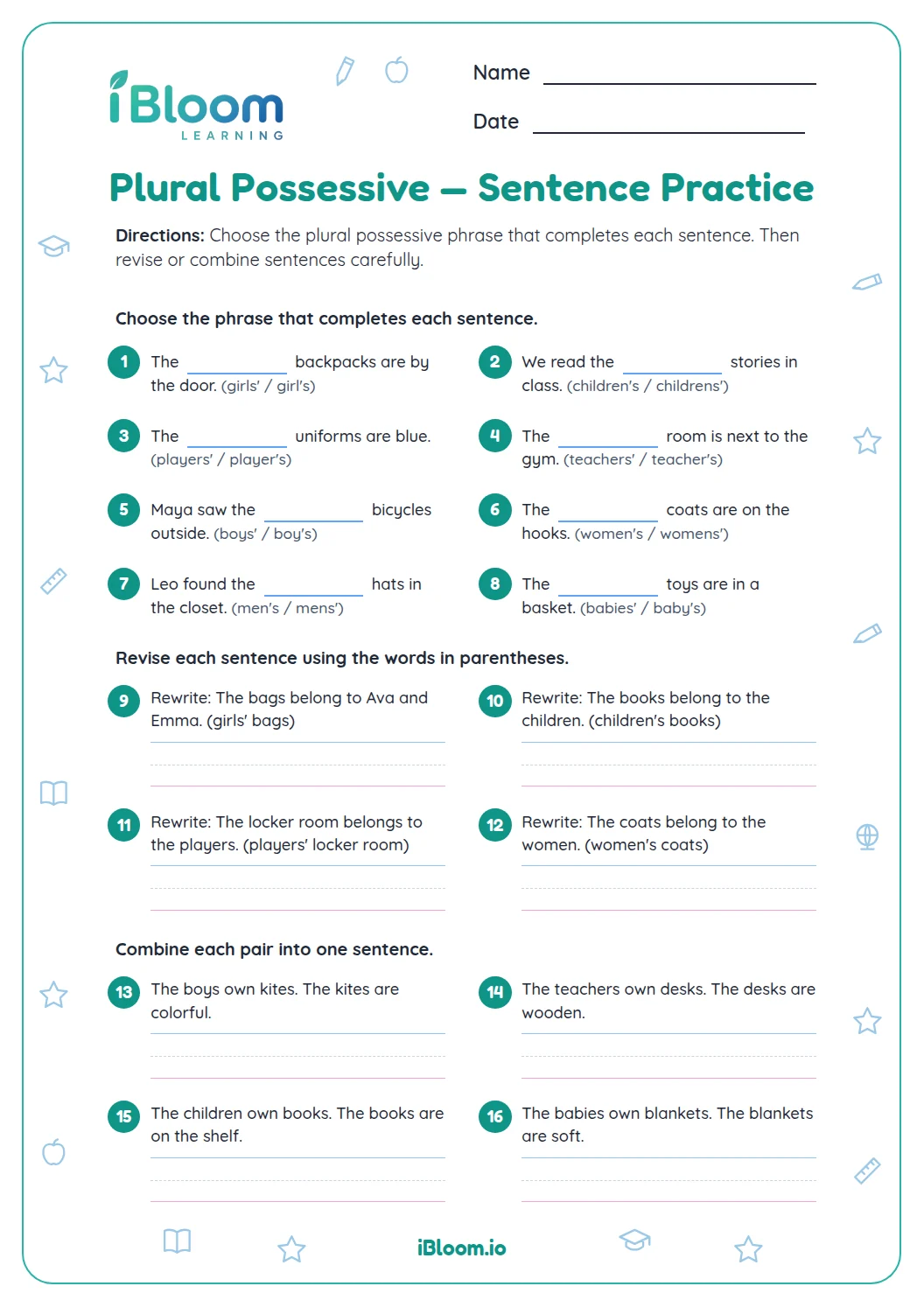
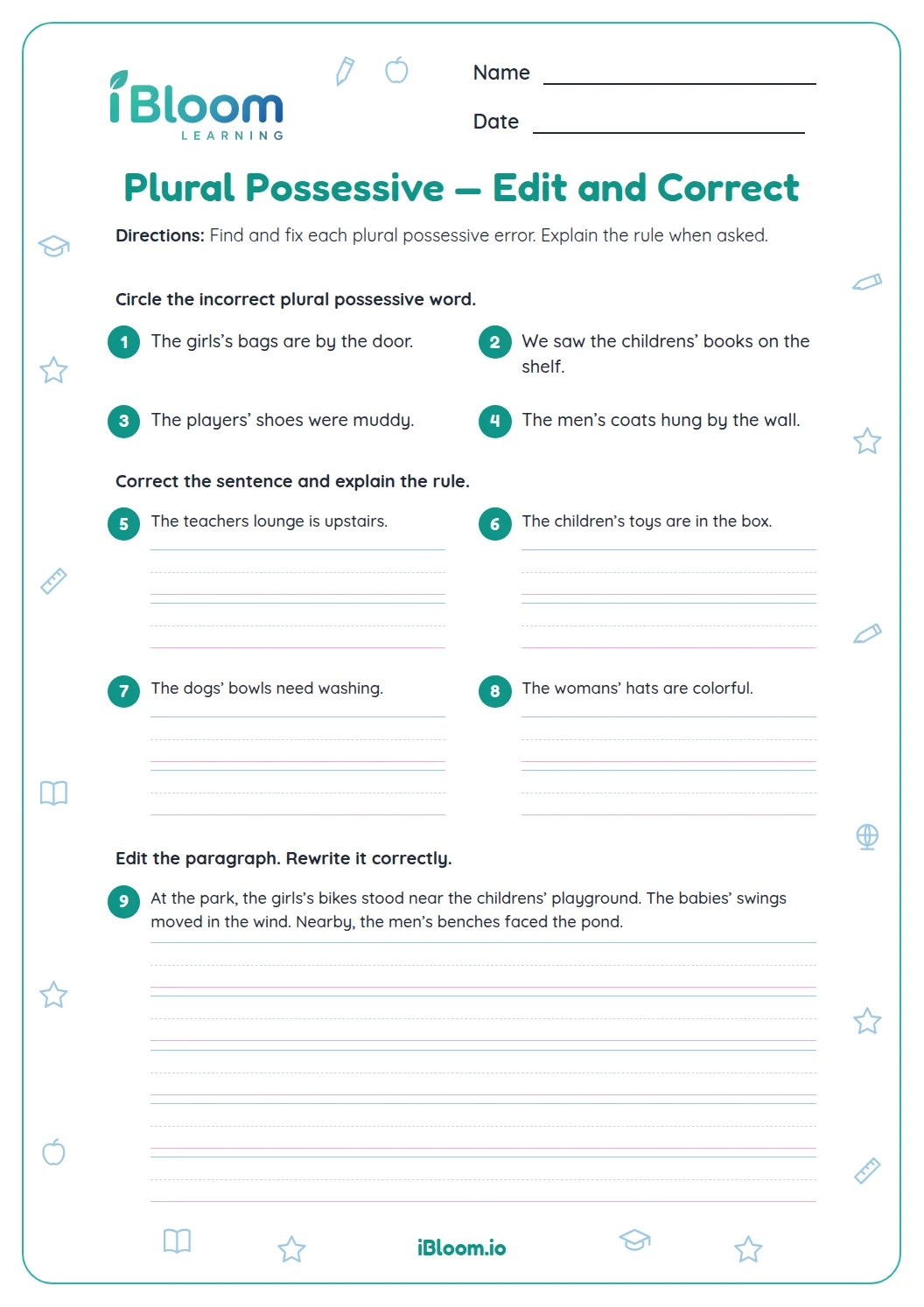
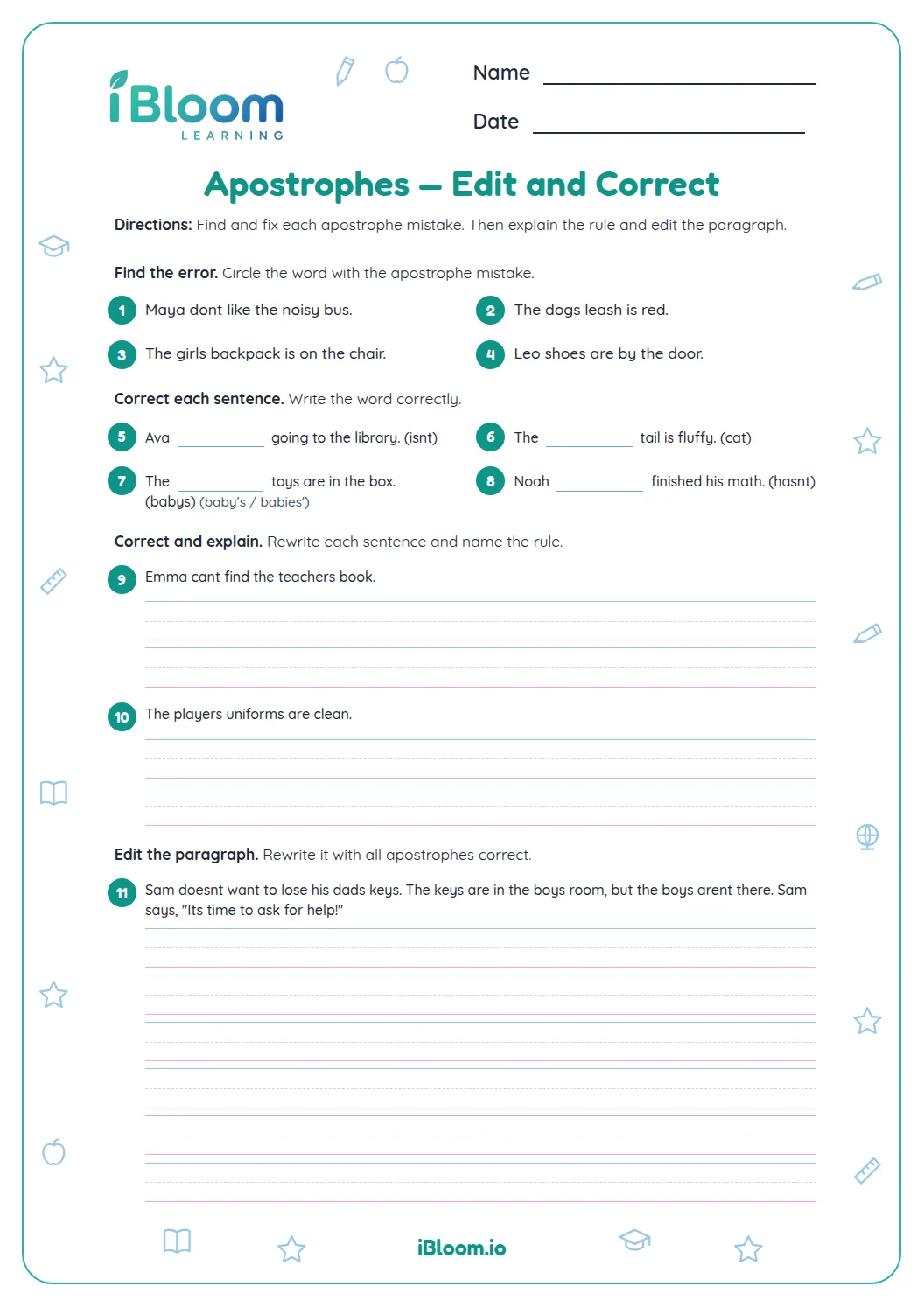
This free Grade 3 worksheet practices singular and plural possessive nouns. Students use a three-choice word bank, complete four guided sentences, and write three independent completions. The examples include a dog’s leash, children’s stories and students’ room, so children must notice whether the owner is singular, plural ending in s, or an irregular plural. The separate answer key lists the intended forms. The sheet aligns with Common Core L.3.2.d.
Aligned to L.3.2
How do you find the owner in a sentence?
Look for the person, animal or group that has something. The prompt names the owner in parentheses, then the blank asks for the possessive form. A singular noun usually adds apostrophe-s; a plural noun that already ends in s places the apostrophe after the s.
For question 1, dog is singular, so “The dog’s leash is red” shows one dog’s leash.
Where does the apostrophe go in a plural possessive?
When a plural noun already ends in s, add an apostrophe after the s: cats’ tails or students’ room. For the irregular plural children, add apostrophe-s because children does not end in s: children’s stories.
Question 6 uses children’s. The key keeps the whole irregular plural and adds ’s.
How can you check the completed phrase?
Read the sentence and ask “whose?” The word before the apostrophe should name that owner, and the noun after it should be something that owner has. Then check whether the owner is singular, plural ending in s, or an irregular plural.
The independent items ask students to use the same spelling pattern without answer choices.
How to use this worksheet
- 1Read the sentence and find the owner named in parentheses.
- 2Decide whether the owner is singular, plural ending in s, or irregular plural.
- 3Choose or write the possessive form with the apostrophe in the right place.
- 4Read the whole sentence and ask whose item it names.
- 5Check the form against the answer key.
Common mistakes and quick fixes
The mistake
Writing dogs when the sentence needs one dog’s leash.
The fix
Add apostrophe-s to the singular owner: dog’s.
The mistake
Writing students’s for a plural that already ends in s.
The fix
Put the apostrophe after the existing s: students’.
The mistake
Writing childrens’ for the irregular plural children.
The fix
Children does not end in s, so add apostrophe-s: children’s.
Common Core alignment
These standards describe the writing and language skills practiced on this sheet.
Use correct capitalization, punctuation and spelling when writing.
On this sheet: Each blank gives an owner noun; children form the singular possessive and use it in context.
Show the official wordingHide the official wording
Demonstrate command of the conventions of standard English capitalization, punctuation, and spelling when writing.
What to practice next
Make more practice
Further reading
Questions parents and teachers ask
What does the apostrophe show in these sentences?
It shows that one person, animal or thing owns or has the noun that follows. In “the cat’s bowl,” the bowl belongs to the cat. Each prompt gives the owner in parentheses, and the child adds the possessive form that completes the sentence.
How many items are included?
The page has 18 fill-in-the-blank sentences in two parts. Each prompt names one owner and asks the child to write its possessive form in context. The separate answer key lists the completed forms so an adult can check the apostrophe and spelling.
Why does the key use Luis’s?
For the singular name Luis, this worksheet uses the familiar singular possessive pattern: add apostrophe-s to the owner. The completed phrase is “Luis’s backpack.” Students should preserve the name as written and place the apostrophe before the added s. Read it aloud.
What is the difference between a possessive and a plural noun?
A plural noun tells that there is more than one person, animal or thing. A possessive noun shows ownership. The blank needs the owner’s form, so “cat’s bowl” names one cat’s bowl; “cats” alone would only mean more than one cat.
How can we check a completed answer?
Reread the sentence and ask whose item or feature it describes. Then check that the owner is copied correctly and that apostrophe-s follows it. For example, “the rabbit’s paw print” tells which animal made the print, and the sentence still reads naturally.