



About this worksheet
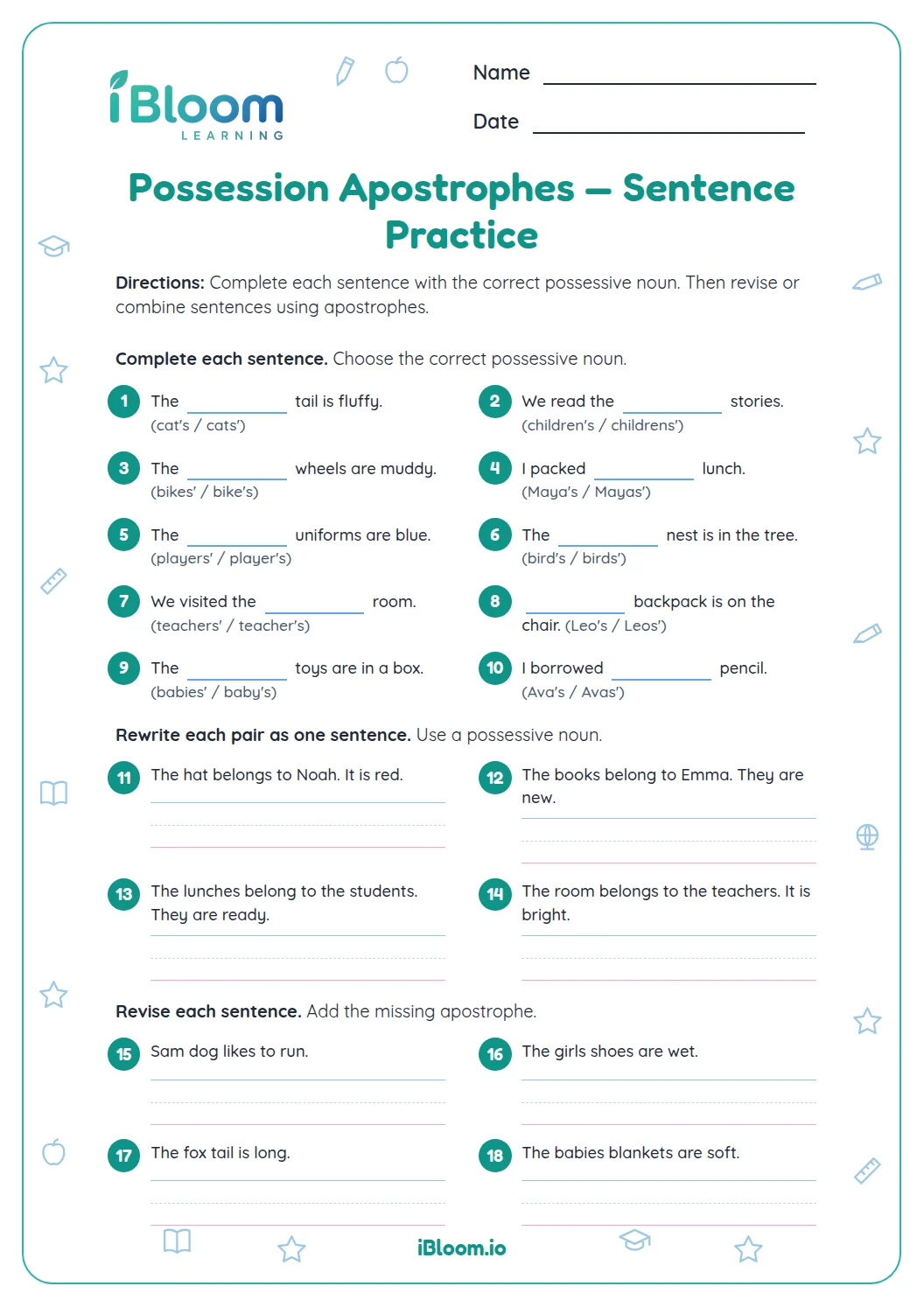
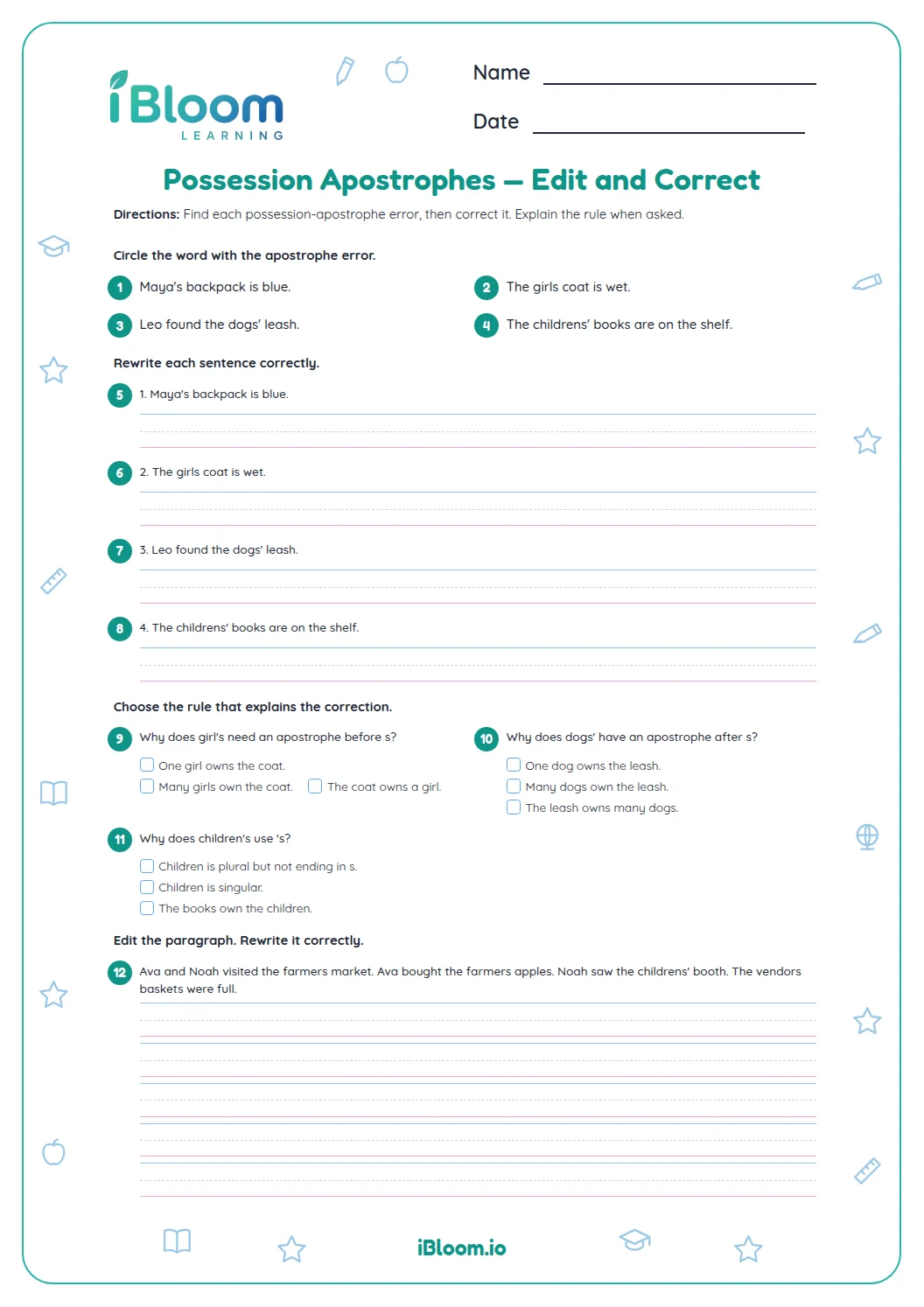
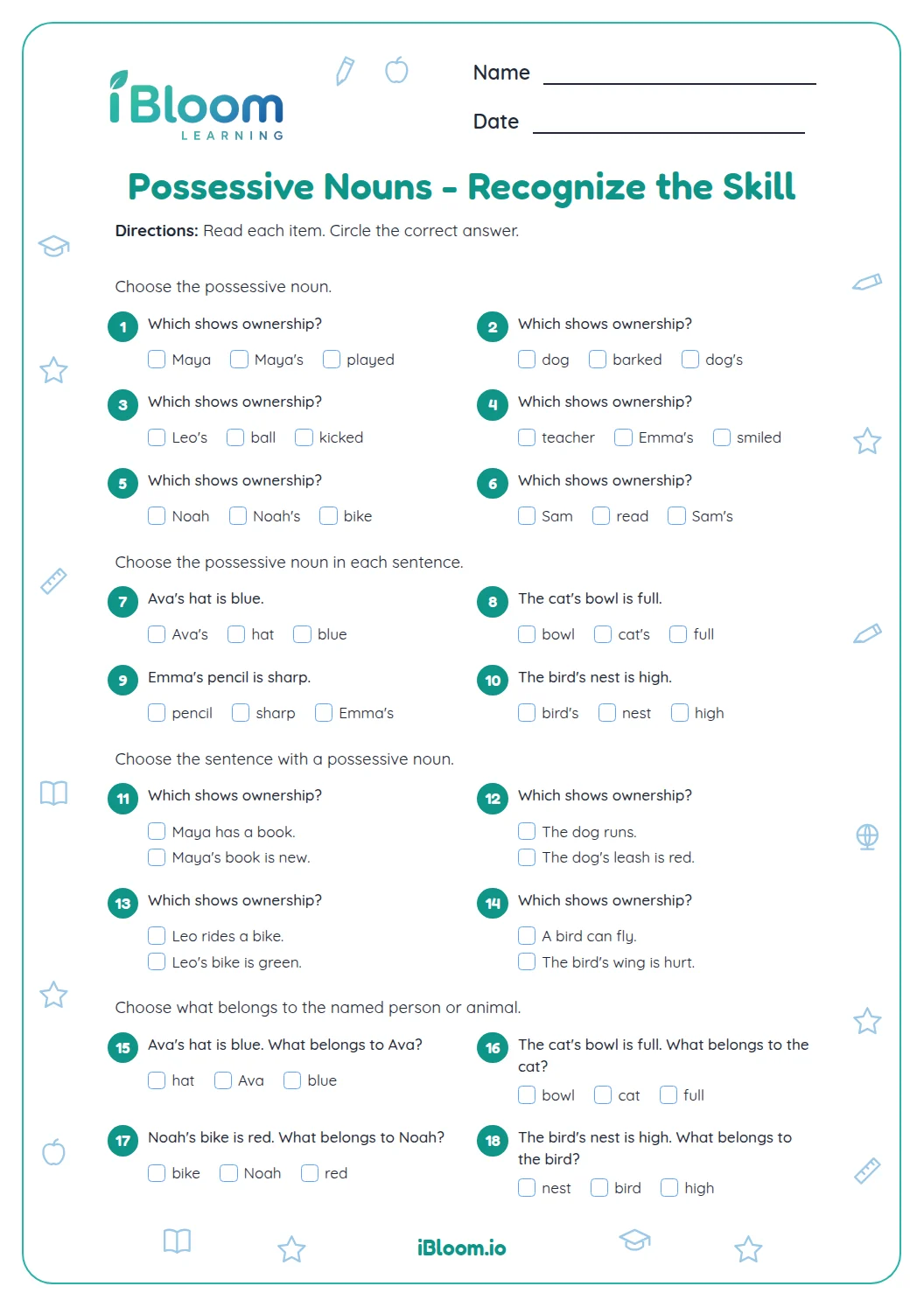
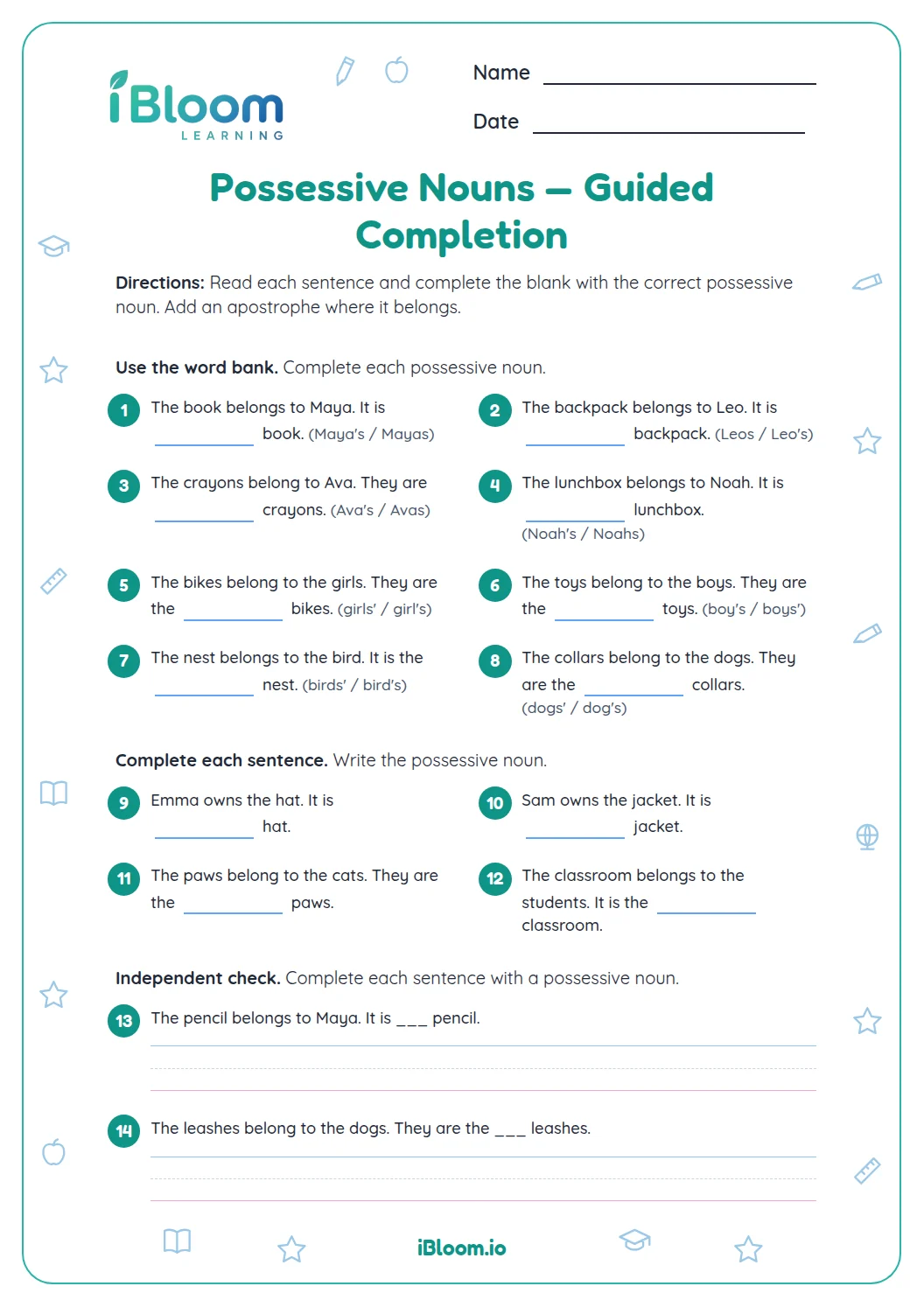
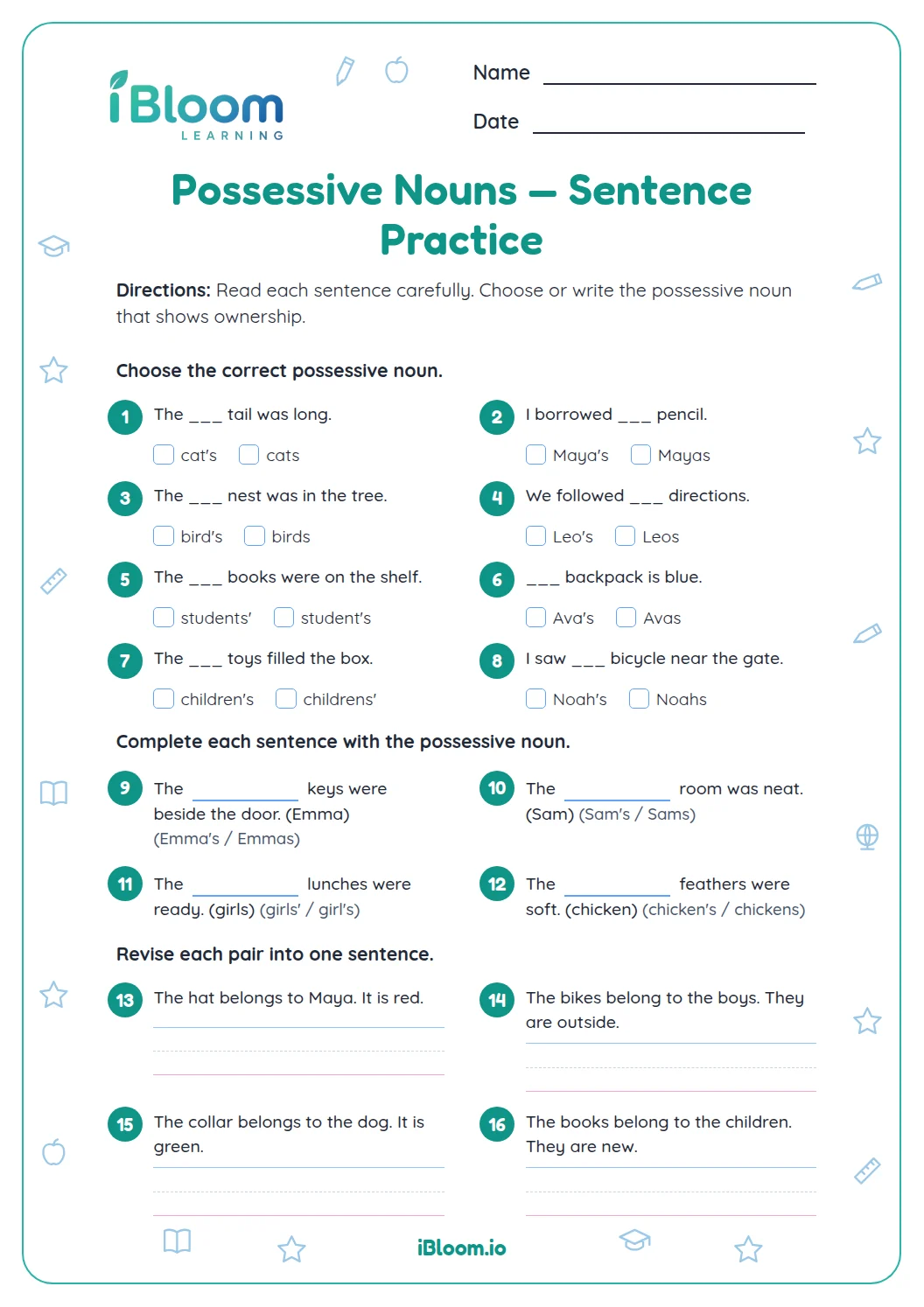
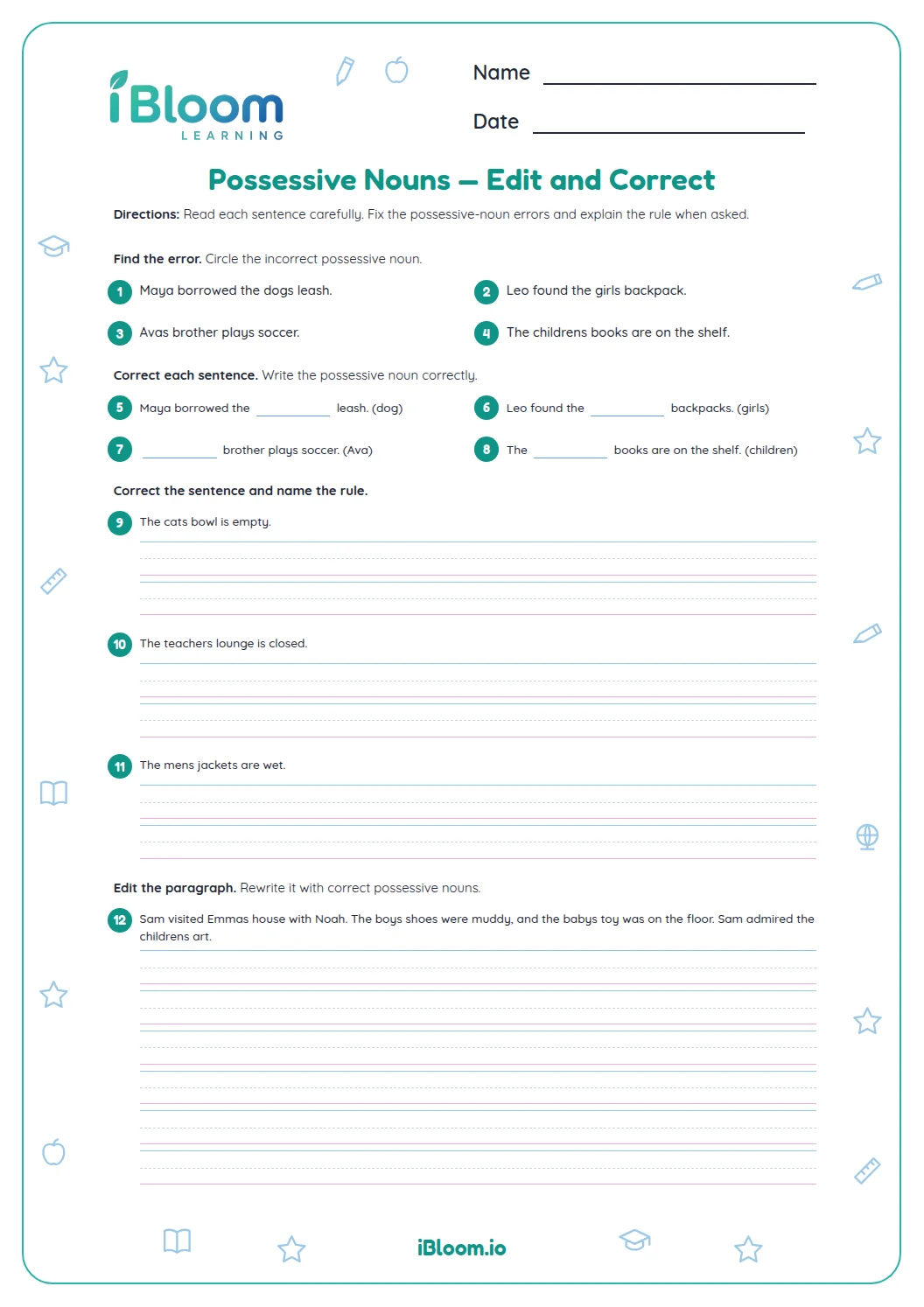
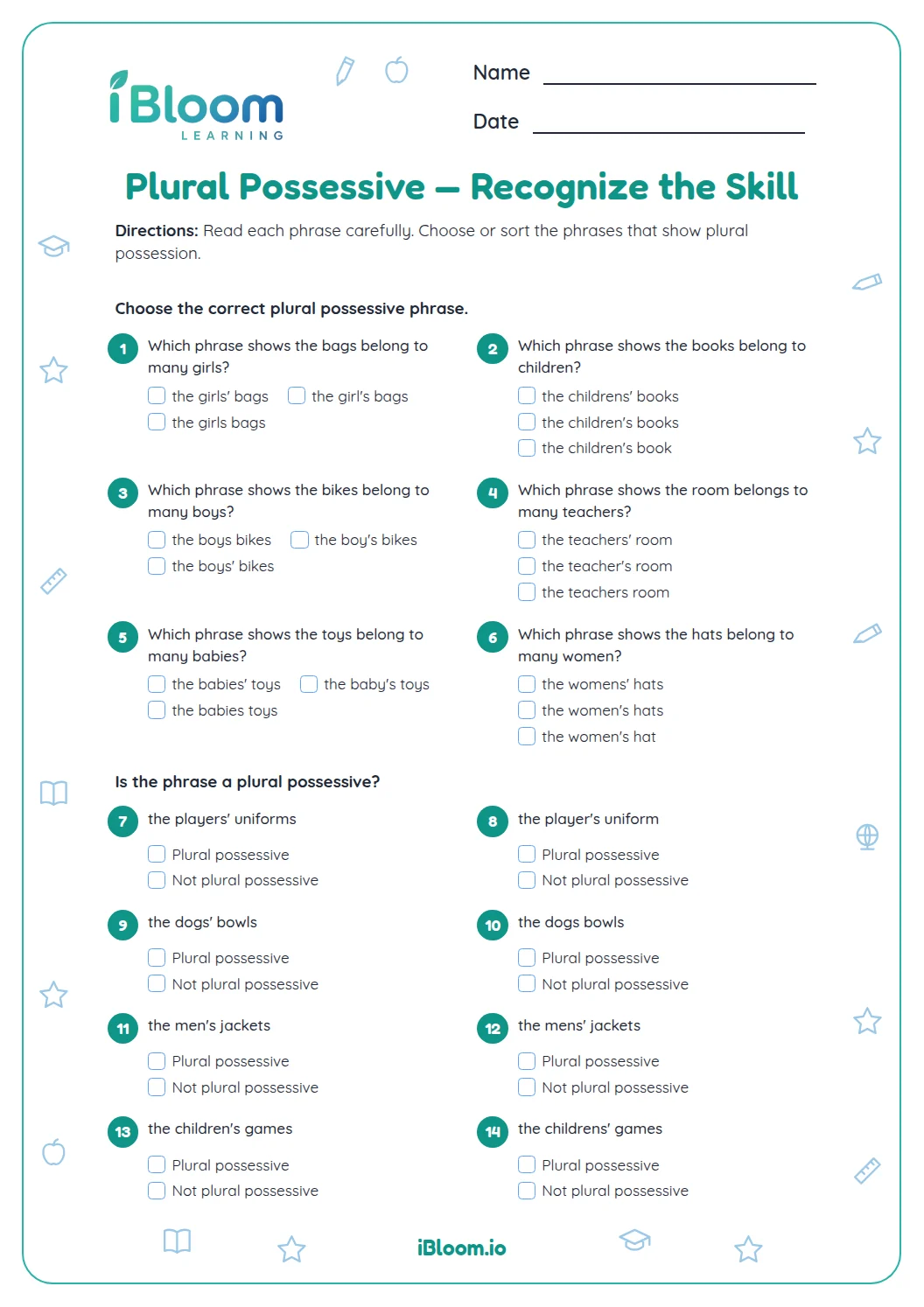
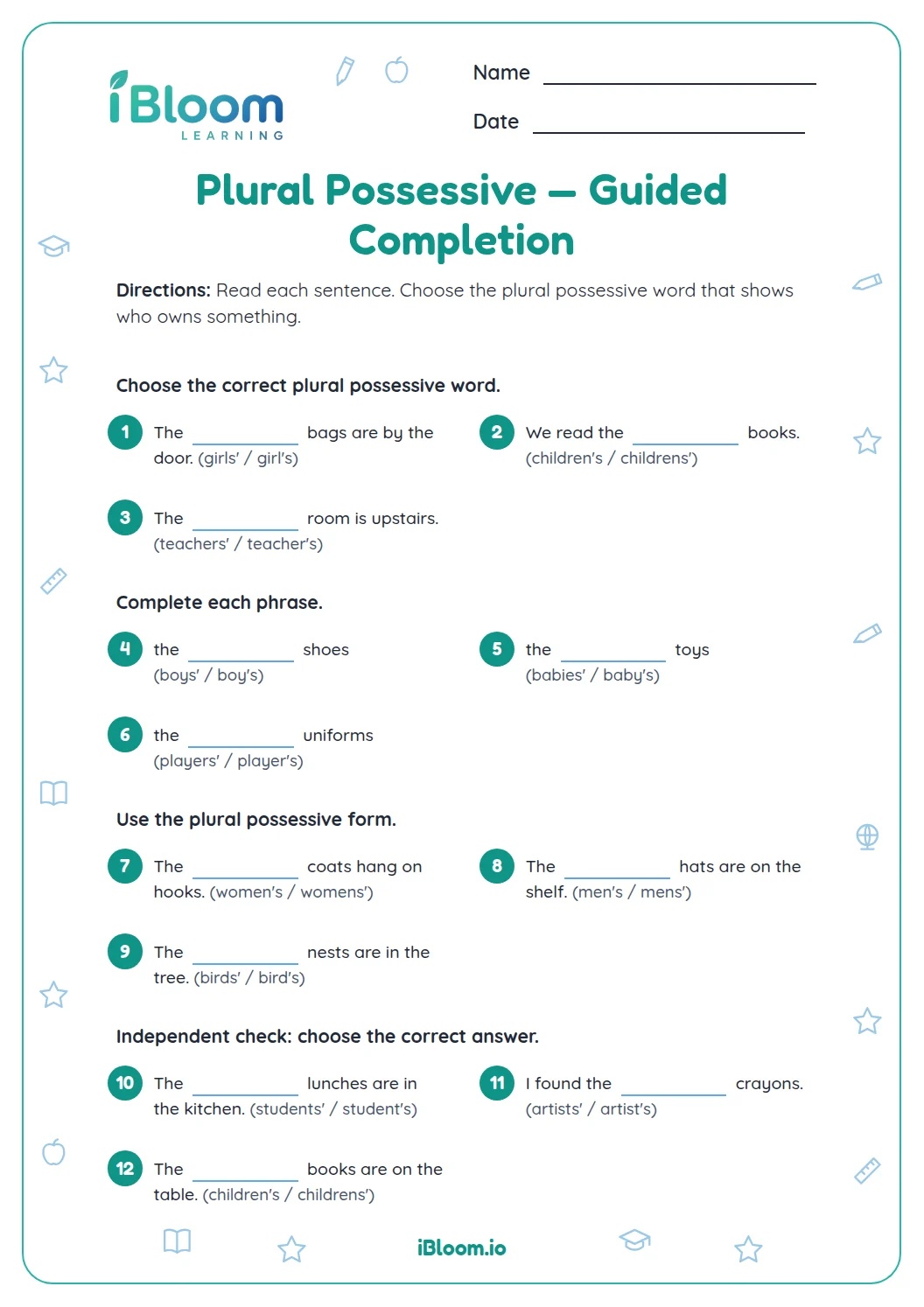
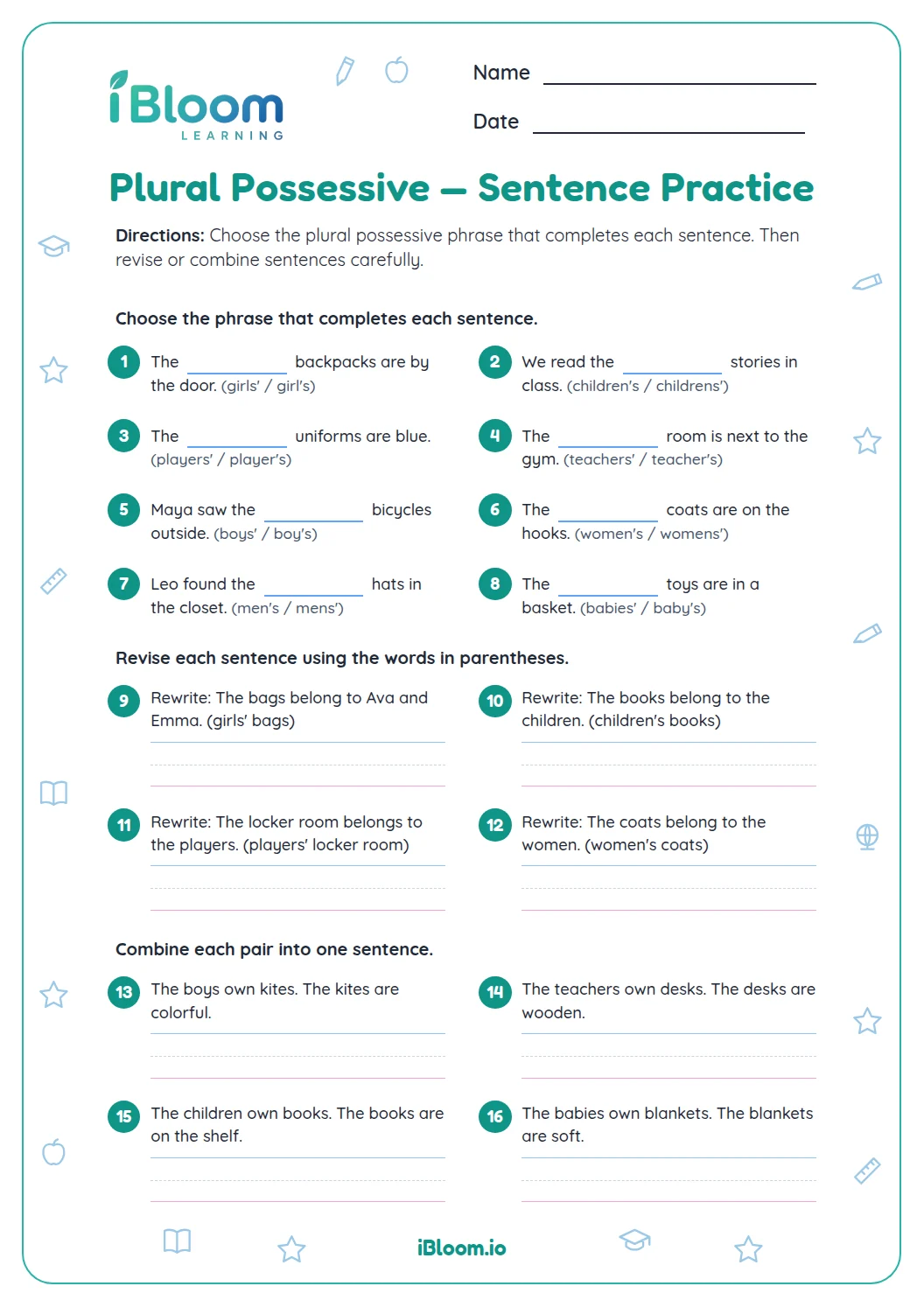
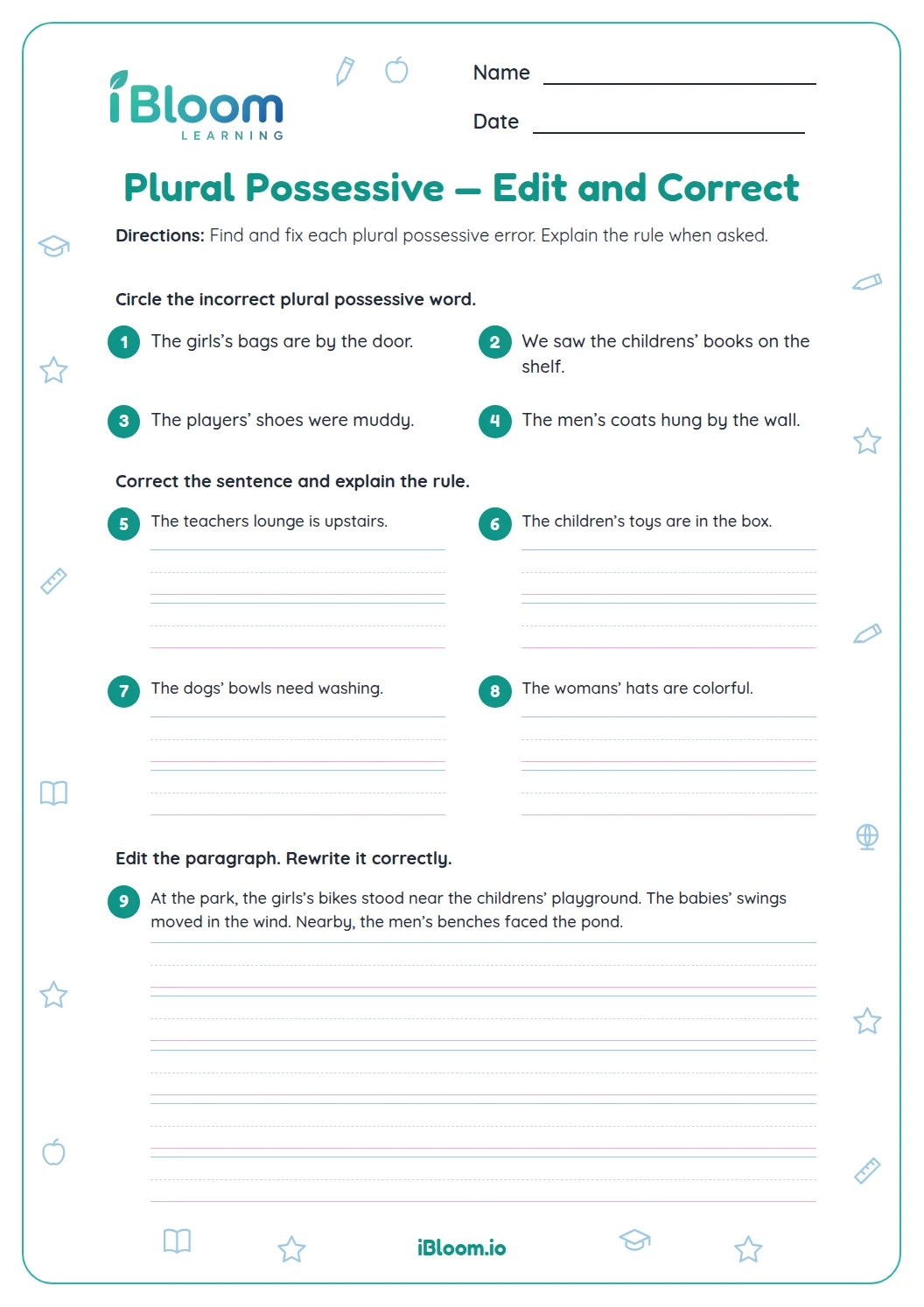
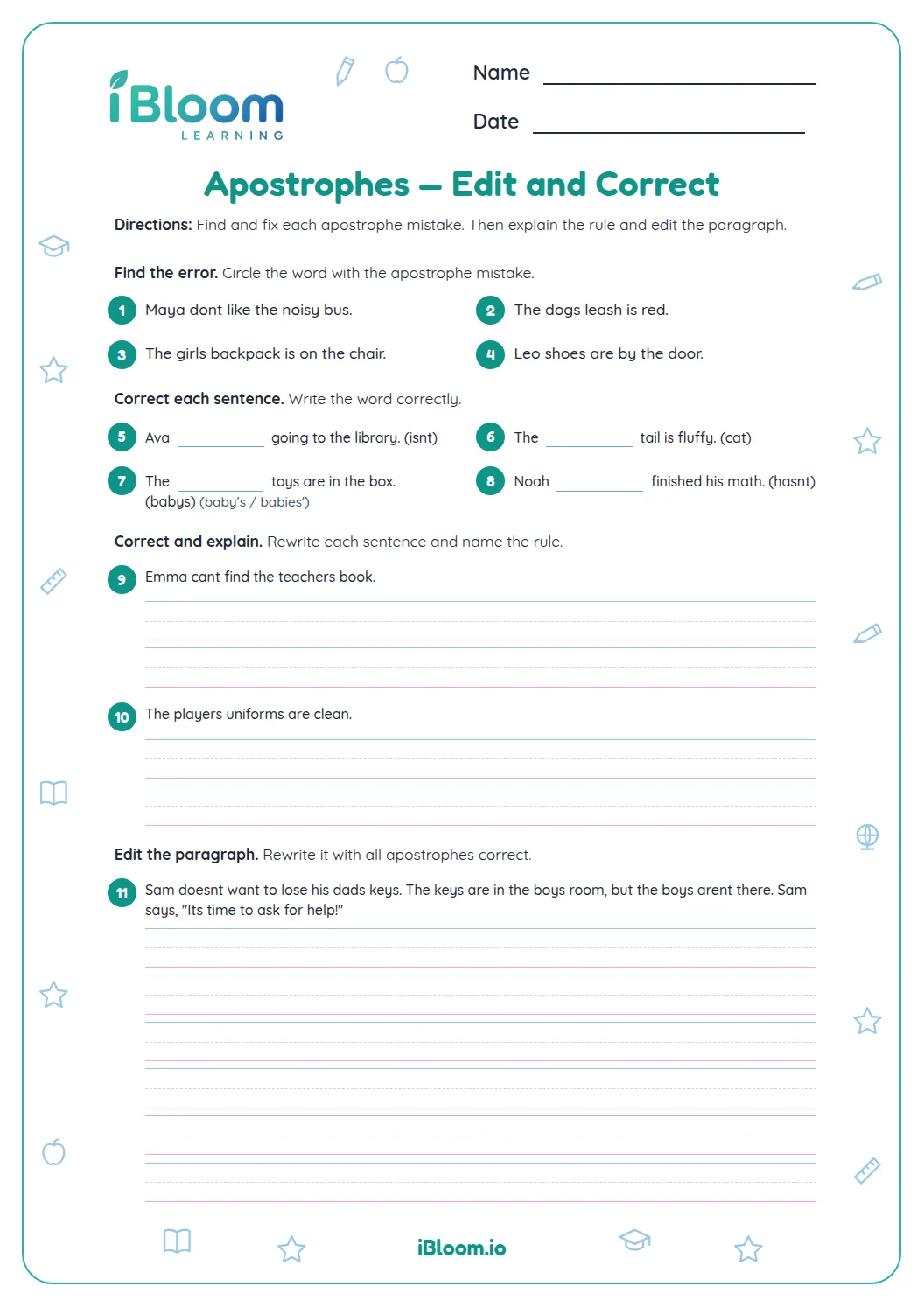
This Grade 3 worksheet helps children form possessives with apostrophes and apply them in writing. Learners add endings to owner nouns, choose between singular and plural forms, rewrite phrases, and write or correct sentences. The examples contrast one owner, such as the puppy’s leash, with plural owners, such as the girls’ hats. The questions align with CCSS L.3.2.d, which asks students to form and use possessives. A separate answer key includes sample responses for open writing items.
Aligned to L.3.2.d
Where does the apostrophe go for one owner?
For one owner, add apostrophe-s to the noun: the cat’s tail, Ava’s book. The owner word comes first, followed by the thing owned. In question 1, the cat owns the tail, so the phrase is cat’s tail.
Read the phrase aloud and ask “whose tail?” That question helps identify the owner before adding punctuation.
- 1The ___ tail swished. (cat)
- 2Owner: one cat
- 3Add ’s: cat’s tail
- 4Completed phrase: The cat’s tail swished.
How do apostrophes work with plural owners?
When a plural noun already ends in s, place the apostrophe after the s: the girls’ hats. If the plural noun does not end in s, add ’s: the children’s coats. This page focuses on regular plurals ending in s.
What does the worksheet ask children to write?
Fourteen questions move from completing possessives to choosing correct forms in phrases and sentences. The final two prompts invite learners to write sentences showing one owner and several owners.
- Part A adds possessive endings to singular nouns.
- Part B distinguishes singular and plural possessives.
- Part C rewrites phrases to show ownership.
- Part D applies and edits possessives in sentences.
How to use this worksheet
- 1Find the noun that names the owner.
- 2Decide whether the owner is singular or plural.
- 3For a singular noun, add apostrophe-s.
- 4For a plural noun ending in s, add an apostrophe after the s.
- 5Reread the full sentence and check whose item it is.
Common mistakes and quick fixes
The mistake
Writing childs instead of child’s for one owner.
The fix
Add apostrophe-s to the singular owner: child’s.
The mistake
Putting the apostrophe before the final s in girls’ hats.
The fix
Keep the plural s and place the apostrophe after it.
The mistake
Adding apostrophe-s to an item instead of its owner.
The fix
Ask “whose?” and attach the mark to the noun that answers.
Common Core alignment
This worksheet practices the following Common Core skill.
Form possessives with apostrophes in phrases and sentences.
On this sheet: Children form and edit singular and plural possessives.
Show the official wordingHide the official wording
Form and use possessives.
What to practice next
Make more practice
Further reading
Questions parents and teachers ask
How do you show that one noun owns something?
For a singular owner, add apostrophe-s to the owner noun: the teacher’s desk or the puppy’s leash. Put the owner before the item owned. The first section gives children a noun clue and asks them to form the possessive phrase.
Where does the apostrophe go for a plural noun ending in s?
Place the apostrophe after the final s: the players’ balls or the girls’ hats. The s is already the plural ending, so it does not need another one. Question 7 asks children to identify this pattern in a phrase about several birds.
Does this page practice contractions?
This page practices apostrophes to show ownership. A contraction joins words such as “do not” into “don’t,” while a possessive names who owns something. Ask “whose?” to check whether a sentence needs a possessive form. The worksheet’s final section keeps the examples focused on ownership.
What is the answer to “the hats of the girls”?
The possessive form is “the girls’ hats.” Girls is plural and already ends in s, so put the apostrophe after that s. This is question 9. Ask whose hats they are, then compare the plural owner with a singular owner before choosing the form.
How are the writing questions checked?
The key shows the correct possessive form for each item. For a singular owner, add apostrophe-s; for a plural owner ending in s, place the apostrophe after the s. Ask “whose?” to identify the owner, then check that the phrase or sentence keeps the intended meaning.
What should children practice next?
After forming possessives in phrases, try using them in longer sentences and short paragraphs. Editing practice can combine apostrophes with capitals and end punctuation so writers check more than one convention at a time. Ask the child to explain each change.