






About this worksheet
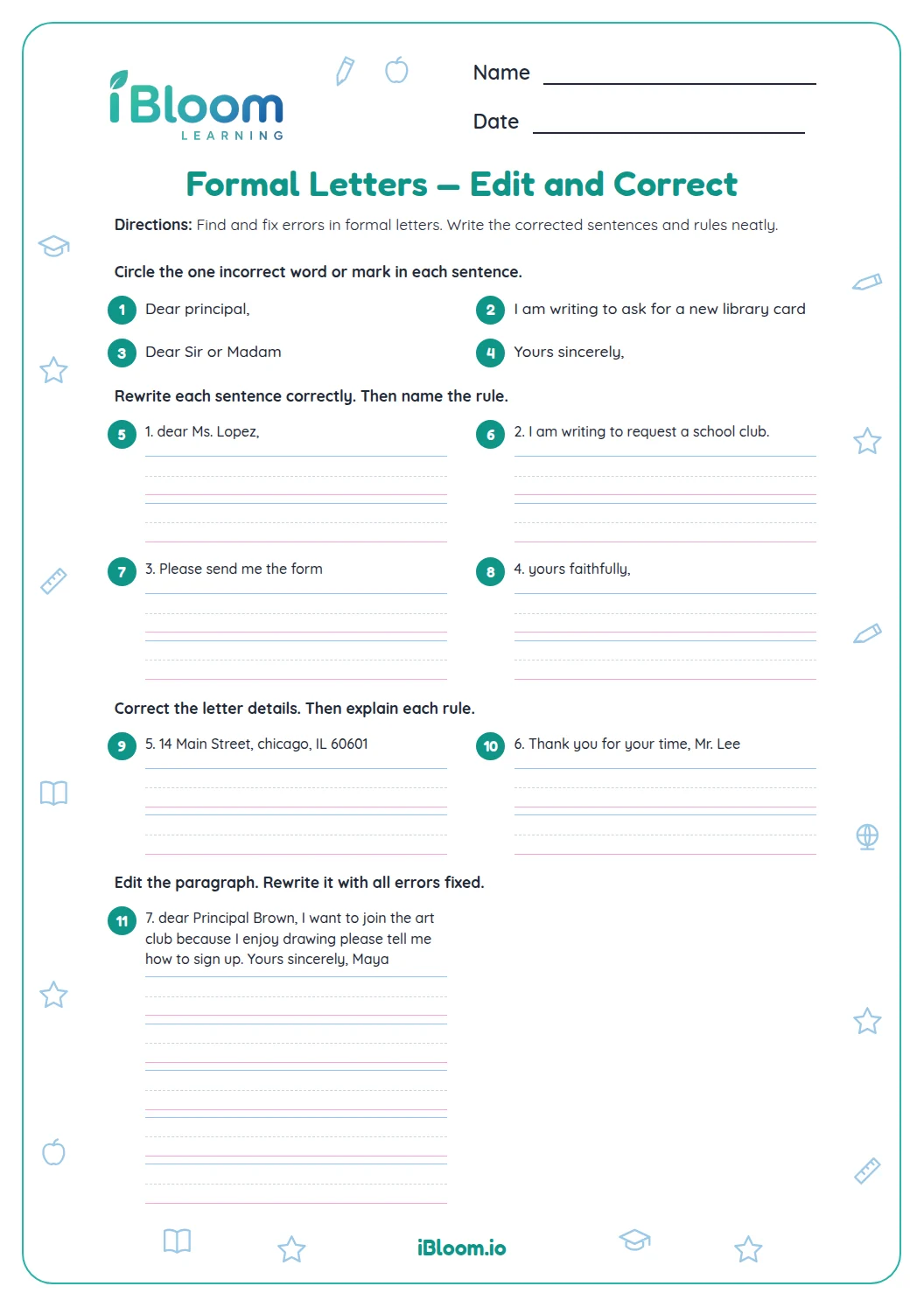
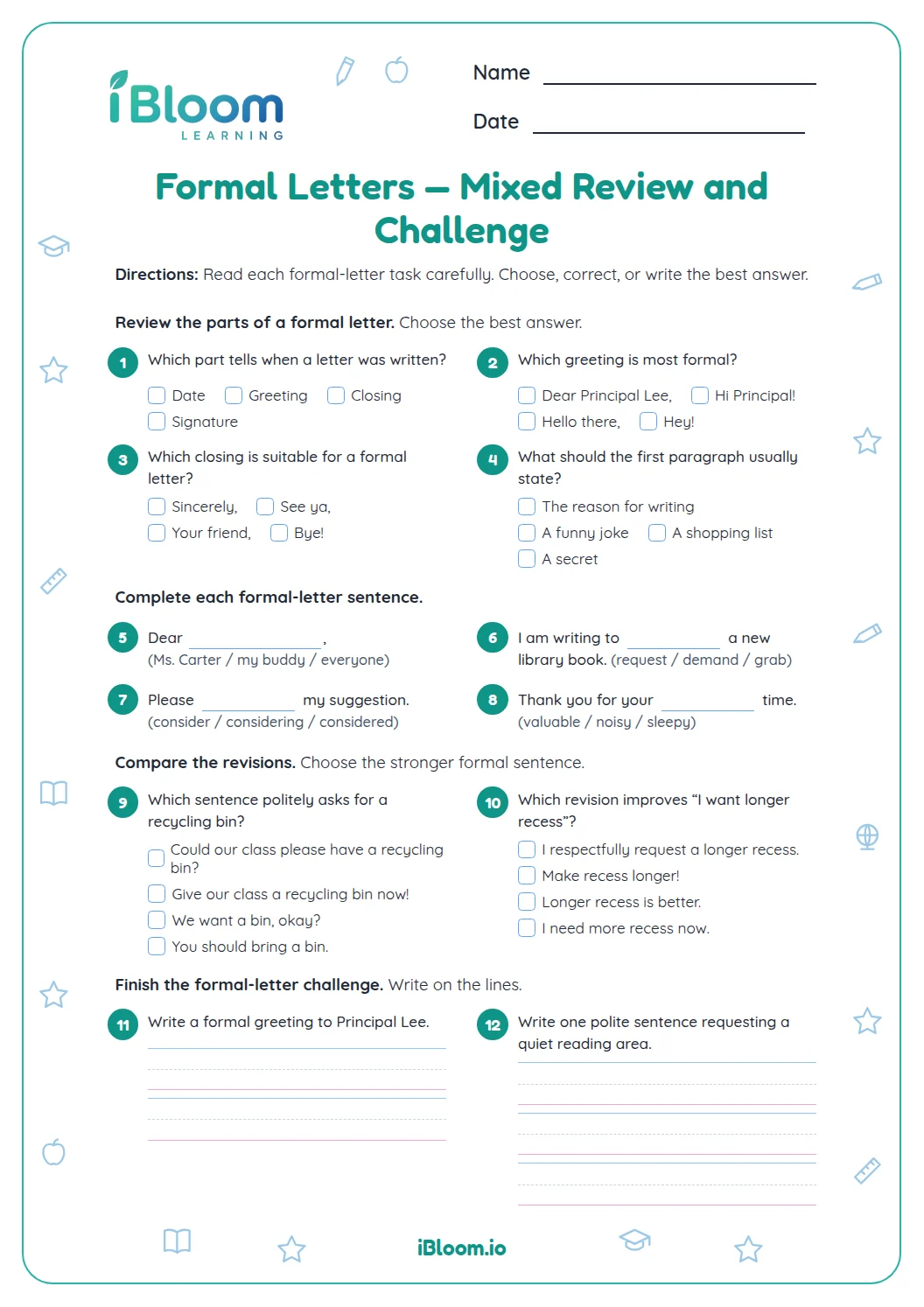
This Grade 3 writing worksheet guides children through the parts and tone of a formal letter. They identify a greeting and closing, complete a request to a principal, choose a clear purpose and supporting reason, and write two short lines. The printable includes 16 questions across three worksheet pages, with a separate answer key and sample responses for the open writing prompts.
Aligned to W.3.5
What parts help readers follow a formal letter?
A formal letter names the reader in its greeting, explains its purpose in the body, and ends with a polite closing followed by the writer’s name. The worksheet reviews these parts through short prompts.
How does Maya make a clear request?
Maya asks Principal Lee for a school garden. A direct request tells the reader what she wants; a relevant reason, such as giving students a chance to grow plants, explains why the idea could help.
What is one example of a supporting reason?
Question 12 asks children to identify “Students can grow plants.” That sentence supports the request for a school garden by naming what students could do there. The last two questions invite a child to write a similar reason and a proper closing.
How to use this worksheet
- 1Read the prompt and identify the letter part it asks for.
- 2Name the reader in the greeting.
- 3State Maya’s request in a direct sentence.
- 4Add a reason connected to the request.
- 5Use respectful wording in the request.
- 6Finish with a closing and signature.
Common mistakes and quick fixes
The mistake
Writing a request as a command.
The fix
Use a respectful question such as “Would you consider…?”
The mistake
Giving a reason without naming the request.
The fix
State what Maya wants first, then explain how it could help.
The mistake
Putting the signature before the closing.
The fix
Write the closing first and the writer’s name underneath.
Common Core alignment
This guided writing task gives learners practice planning and strengthening a short letter.
Plan and strengthen a formal letter with a clear request and relevant reason.
On this sheet: Learners complete a guided letter, select appropriate wording, and draft two related lines.
Show the official wordingHide the official wording
With guidance and support from peers and adults, develop and strengthen writing as needed by planning, revising, and editing. (Editing for conventions should demonstrate command of Language standards 1-3 up to and including grade 3 here.)
What to practice next
Further reading
Questions parents and teachers ask
What is a formal letter?
A formal letter is an organized message written in a respectful tone to a specific reader. This worksheet uses a request from a student to a principal, with a greeting, a clear purpose, a supporting reason, a closing, and a signature.
Why does Maya include a reason?
A reason helps Principal Lee understand why Maya is asking for a school garden. “Students can grow plants” connects the request to a student activity. Children also write their own supporting sentence in the final writing prompts, using a reason that makes sense for their request.
Are the final answers open-ended?
Yes. Children write a supporting sentence and a closing with Maya’s signature. The key provides sample responses, but other complete, polite sentences that fit the request can also work. A reader should be able to see what Maya is asking for and why it could help.
Where does a signature go?
The signature follows the closing. For example, write “Sincerely,” and then put “Maya” on the next line. Question 16 asks children to supply both parts in that order, giving practice with the final two pieces of a formal letter. This order keeps the signature attached to its writer.
How many questions and pages are included?
The worksheet has 16 questions spread across three practice pages, followed by three answer-key pages. The set includes formal-letter completion, five wording choices, and two short written responses. The key includes exact choices and sample responses for the two open items.
Does the worksheet ask children to write a full letter?
It guides children through the parts and tone of a model request, then asks them to draft a supporting sentence and closing. The prompts reinforce purpose, reasons, polite wording, and letter order while keeping the written responses short enough to review together.