






About this worksheet
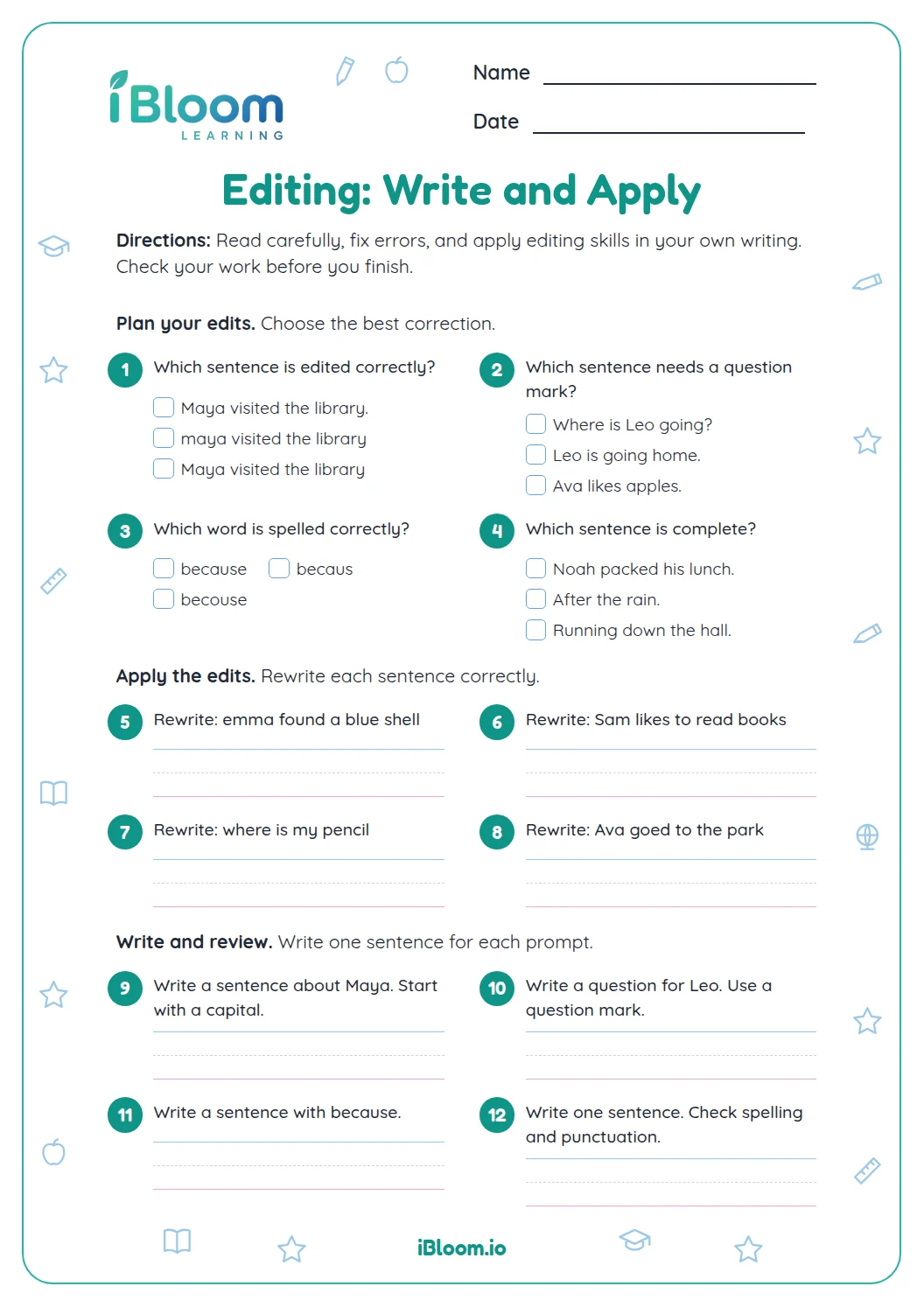
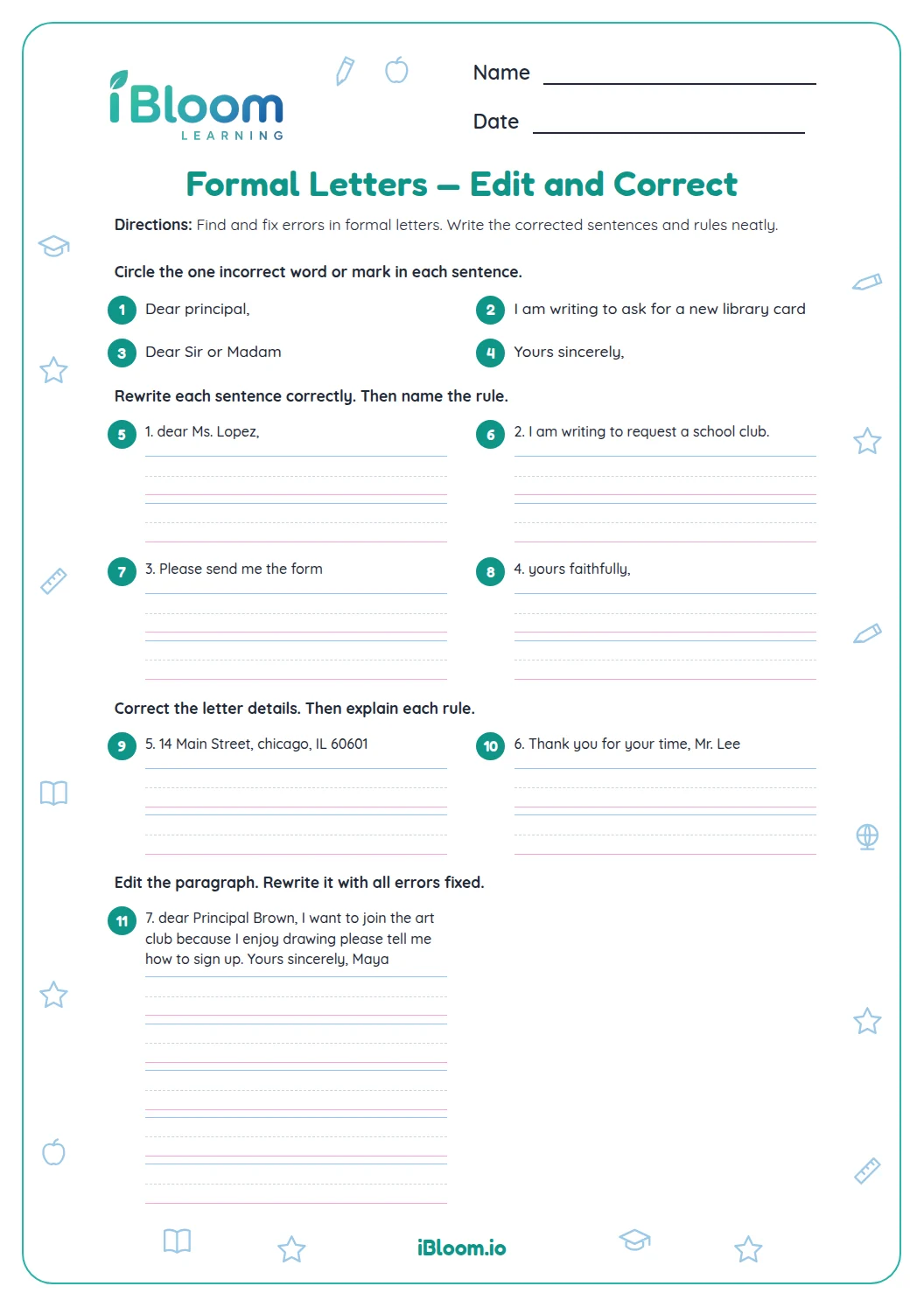
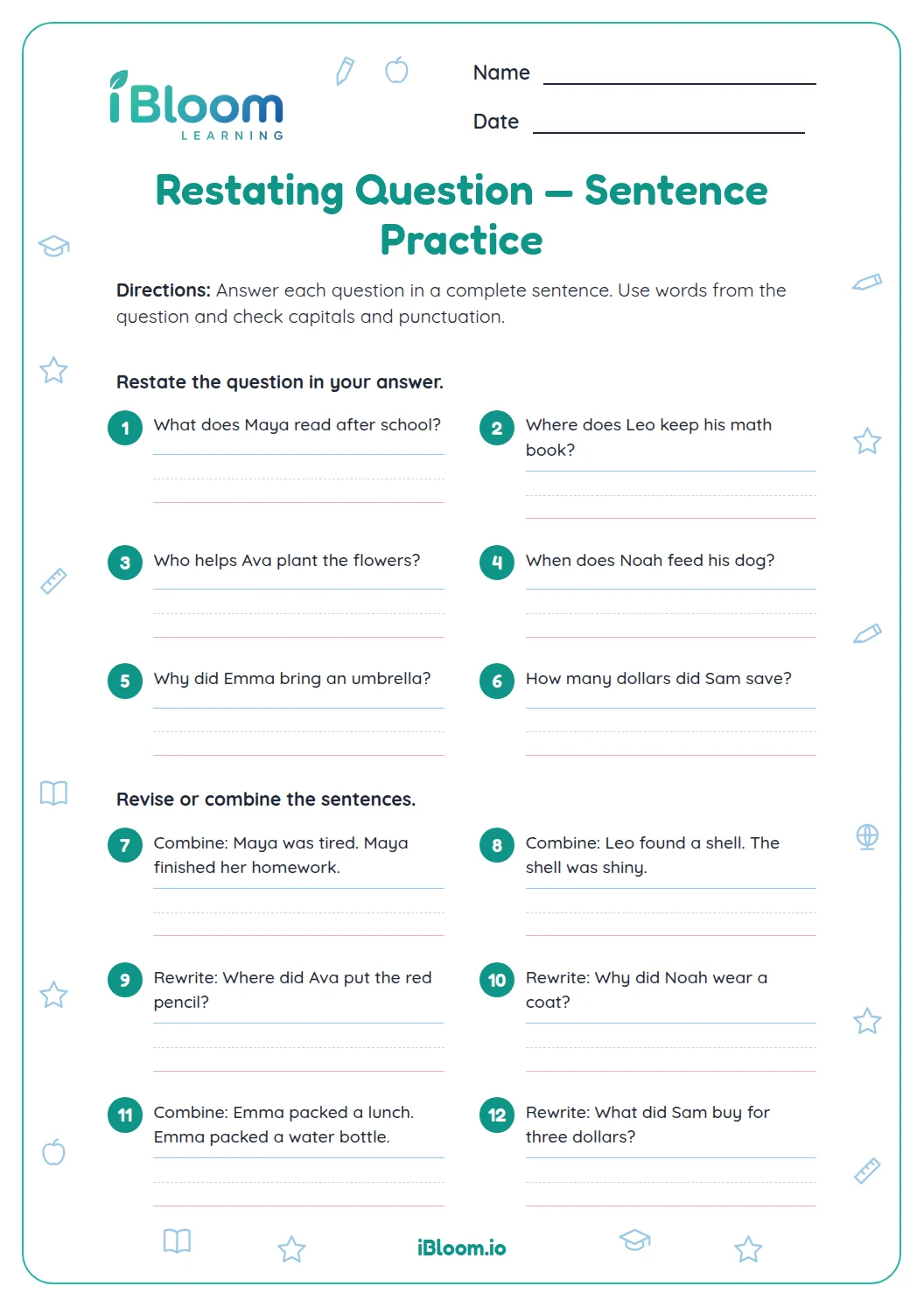
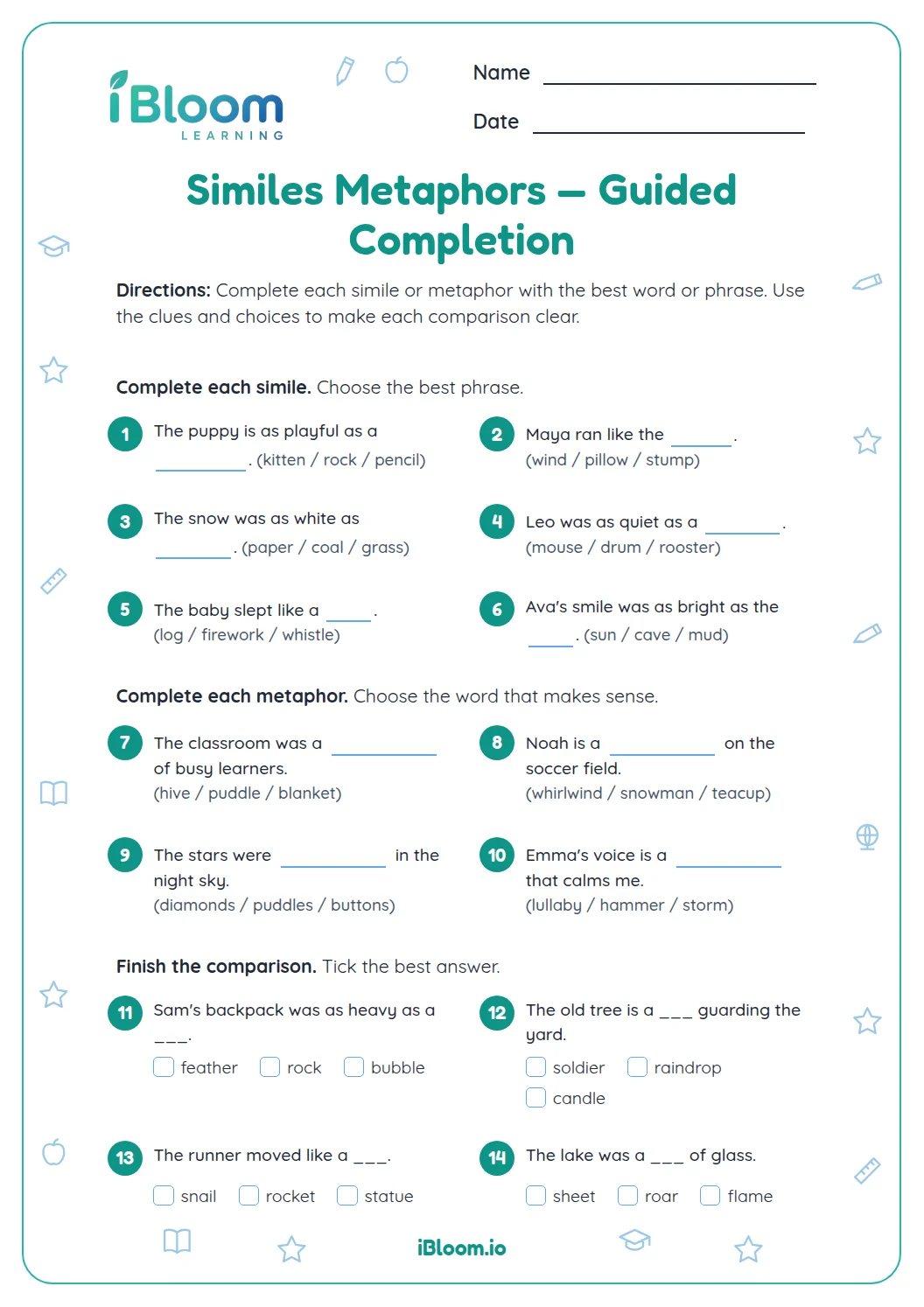
This Grade 3 editing worksheet gives students sentences to revise, then pairs of sentences to combine. Part A focuses on capitals, punctuation, and proofreading; Part B asks students to join related ideas while keeping the meaning clear. The 14 prompts follow the old sheet’s write-and-revise approach, and the answer key provides sample corrections.
Aligned to L.3.2 and L.3.1.i
What should students check while editing?
Read the sentence once for meaning, then check its first word, names, punctuation, and spelling. Part A includes capitalization, apostrophes, commas in a series, and end marks.
- 1Original: maya reads a book every night.
- 2Corrected: Maya reads a book every night.
How can two sentences become one?
Keep both ideas and connect them with a suitable conjunction or a clear relative phrase. Part B accepts different sentences when they preserve the pair’s meaning and use correct punctuation.
Why does the answer key show sample sentences?
Several pairs can be combined in more than one correct way. The key gives one model for each prompt; check that a child’s sentence preserves both ideas and reads as a complete thought.
How to use this worksheet
- 1Read the whole sentence before changing it.
- 2Check the first word, names, and end punctuation.
- 3Look for commas or apostrophes the sentence needs.
- 4For a pair, identify how the two ideas are related.
- 5Combine them and reread to check that both ideas remain.
Common mistakes and quick fixes
The mistake
Leaving a name or the first word lowercase.
The fix
Scan for the start of the sentence and every person or place name.
The mistake
Joining two ideas without a connecting word or punctuation.
The fix
Choose a conjunction such as and, but, or because, then read the combined sentence aloud.
The mistake
Changing the meaning while combining.
The fix
Check that the new sentence still includes both original ideas.
Common Core alignment
Use capitalization, punctuation, and spelling conventions when editing sentences.
On this sheet: Part A asks students to edit capitalization, punctuation, and spelling in complete sentences.
Show the official wordingHide the official wording
Demonstrate command of the conventions of standard English capitalization, punctuation, and spelling when writing.
Produce clear simple and compound sentences when combining related ideas.
On this sheet: Part B asks students to combine two related sentences into one clear sentence.
Show the official wordingHide the official wording
Produce simple, compound, and complex sentences.
What to practice next
Make more practice
Further reading
Questions parents and teachers ask
What does this sentence editing worksheet ask students to do?
Students rewrite seven sentences to correct conventions, then combine seven pairs of related sentences. The proofreading section includes capitalization, punctuation, and spelling details. In the second section, the answer key gives a sample combination, while other clear sentences that preserve both ideas can also work.
How many prompts are on the page?
There are 14 prompts in two parts. Part A has seven sentences to edit; Part B has seven pairs to combine. The prompts ask students to write revised sentences, so keep the separate answer key nearby for checking capitalization, punctuation, and whether both ideas remain.
What is a good way to edit a sentence?
Read it for meaning first, then check the beginning, names, punctuation, and spelling. In “maya reads a book every night,” capitalize Maya and add the final period if needed. Rereading the corrected version helps catch changes that make the sentence unclear.
Can a student combine a sentence pair in a different way from the key?
Yes. The answer key provides a sample sentence for each pair. A different response can be correct if it keeps both original ideas, forms a complete sentence, and uses punctuation and capitalization correctly. Ask the student to explain how the joining word connects the ideas.
Does the worksheet practice punctuation?
Yes. Students edit end marks, commas, and an apostrophe as part of proofreading. They also practice capitalizing sentence beginnings and proper names. The second part reinforces complete sentences by asking students to join related ideas rather than leave two fragments or unrelated clauses.