





About this worksheet
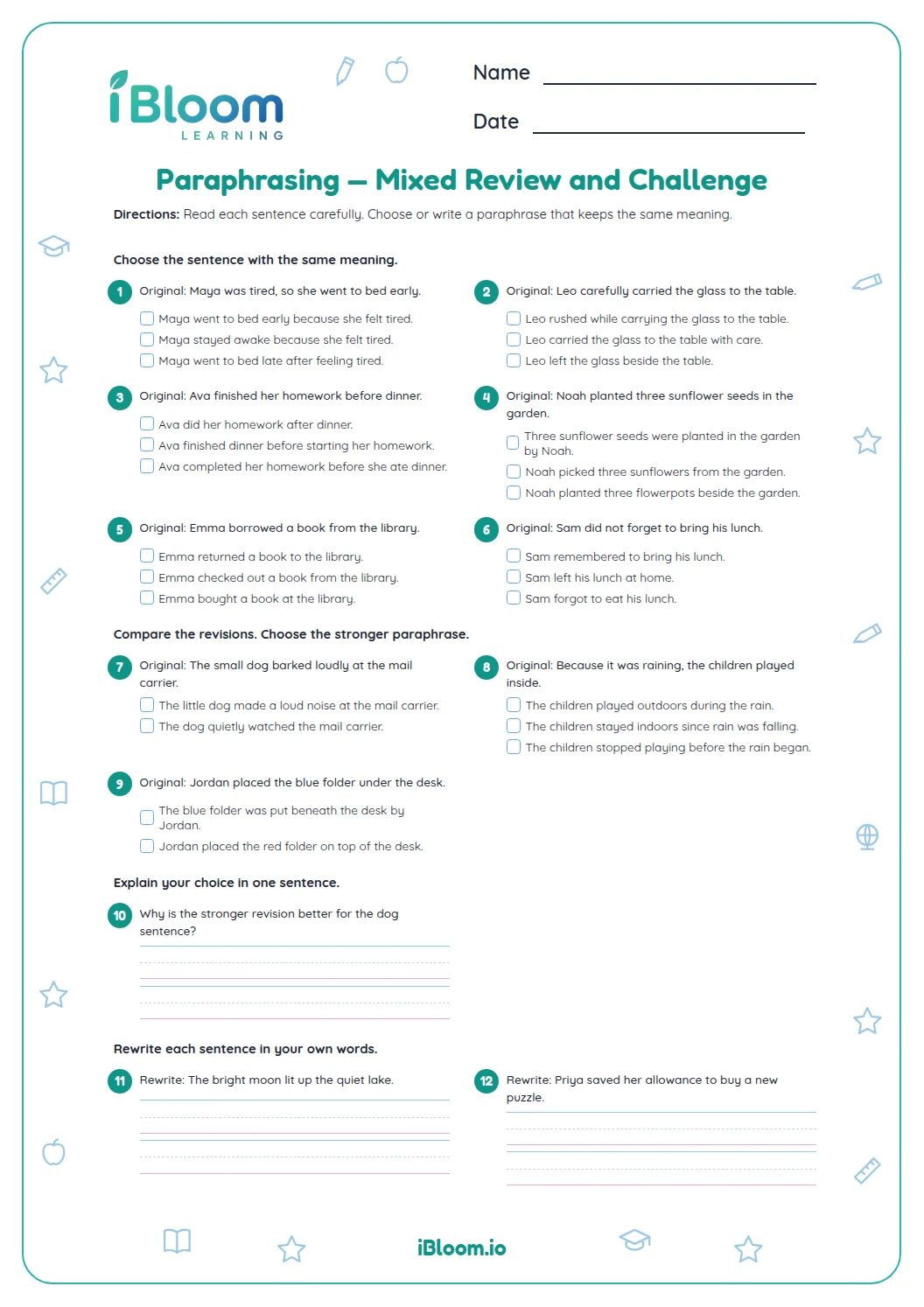
This Grade 3 worksheet practices paraphrasing: expressing an idea in new words while keeping its meaning. Students compare each original sentence with two options and choose the accurate paraphrase. The answer key lists one correct rewording for each of the 14 questions.
How can you tell whether a paraphrase keeps the meaning?
Compare the key information in both sentences. The wording may change, but the people, action, and idea should stay accurate. In question 1, “Bees get nectar” keeps the key idea that bees gather nectar from flowers.
- 1Original: Bees visit flowers for nectar.
- 2Paraphrase: Bees get nectar.
- 3The wording changes while the idea stays the same.
How do sentence frames help with paraphrasing?
A useful paraphrase keeps the source idea but changes its wording. In question 4, “Some birds build nests” restates “Birds make homes” with a different phrase. Read both options and choose the one that preserves the original meaning.
How can you check a paraphrase?
The remaining questions use the same choice format with fresh examples. Check who acted, what happened, and any detail that matters. For question 10, “She gave the plants water daily” keeps Lena’s action and its timing in new words.
What should you check before moving on?
Read the original and your paraphrase together. Ask whether both say who did what and include the same important detail. A paraphrase should not add a new reason or remove a key action.
How to use this worksheet
- 1Read the original sentence carefully.
- 2Identify its key person, action and detail.
- 3Try a new word or sentence order without changing the idea.
- 4Read both sentences together and check that they still match.
- 5Use the answer key to compare ideas, not just exact wording, for open responses.
Common mistakes and quick fixes
The mistake
Copying the original sentence word for word.
The fix
Change some wording or sentence order while preserving the same information.
The mistake
Changing a detail while looking for synonyms.
The fix
Check who acted and what happened in both versions.
The mistake
Leaving out part of a two-part idea.
The fix
For question 13, preserve both details: snow covered the trail and the hikers walked slowly.
What to practice next
Make more practice
Further reading
Questions parents and teachers ask
Is paraphrasing the same as copying?
No. Copying repeats the source wording, while paraphrasing expresses the same idea in different words. Each item on this worksheet pairs an original sentence with two choices. Students select the option that keeps the people, action, and important details without repeating the sentence exactly.
How many questions are on this worksheet?
There are 14 multiple-choice paraphrase questions in two parts. Each question has one original idea and two possible rewordings. The separate answer key marks one faithful paraphrase for each item, so a student can compare the chosen sentence with the source.
What should students look for in a paraphrase?
Students should look for the same main idea expressed in fresh wording. A good choice keeps the important person, action, and details. For example, “Bees get nectar” restates bees visiting flowers for nectar without changing who gathers it or what they gather.
Can the paraphrase use different words?
Yes. A paraphrase often uses a close synonym or a different sentence pattern. On this sheet, “A breeze moved the boat” restates that wind pushed the sailboat. The wording changes, but the cause and movement stay clear. Students can compare both sentences to check the idea.
How can an adult help check the answers?
Ask the student to point to the idea that stayed the same in the original and the chosen sentence. Then compare each answer with the key. If a choice changes who acted, what happened, or an important detail, reread the original and try the other option.