


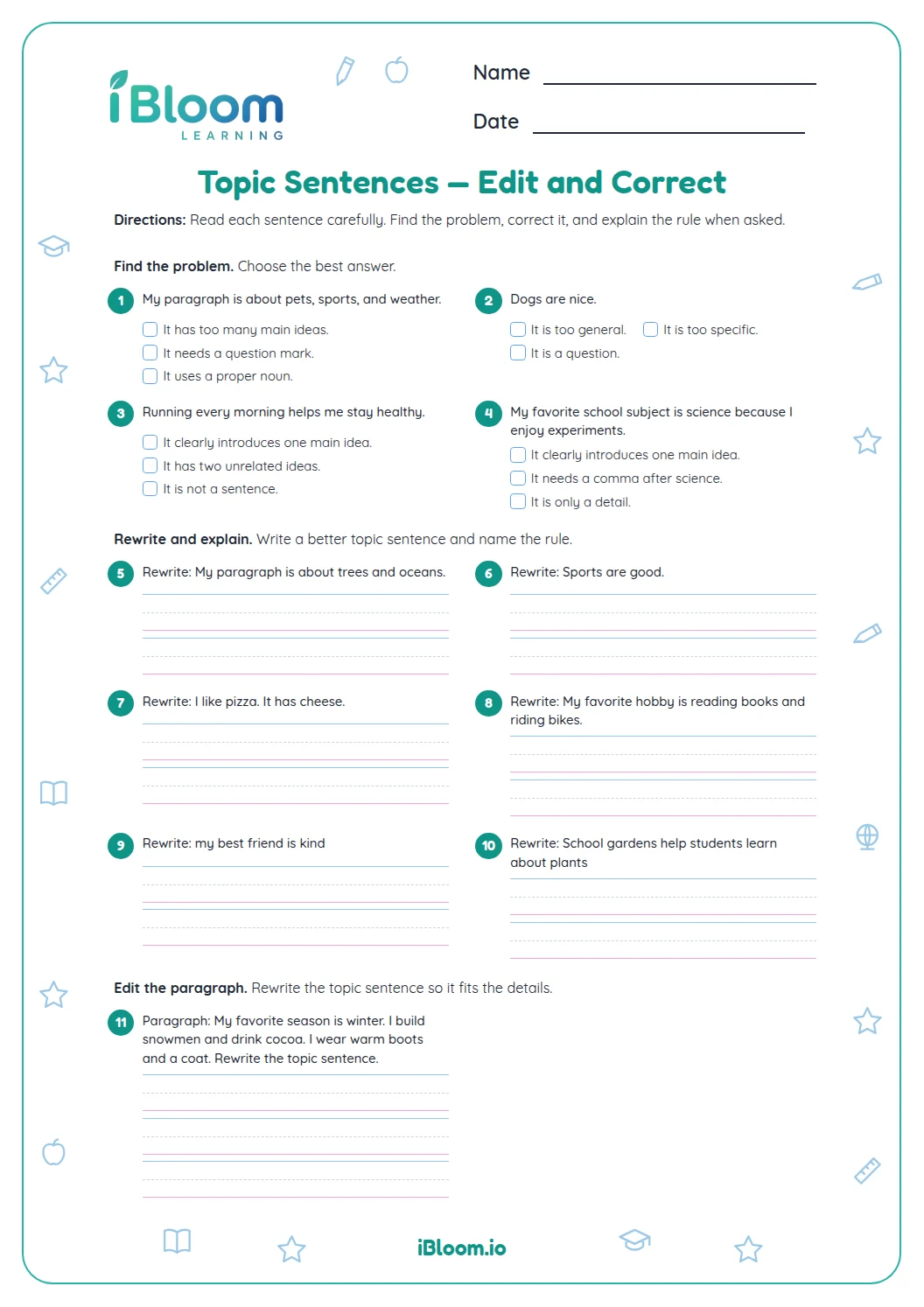
About this worksheet
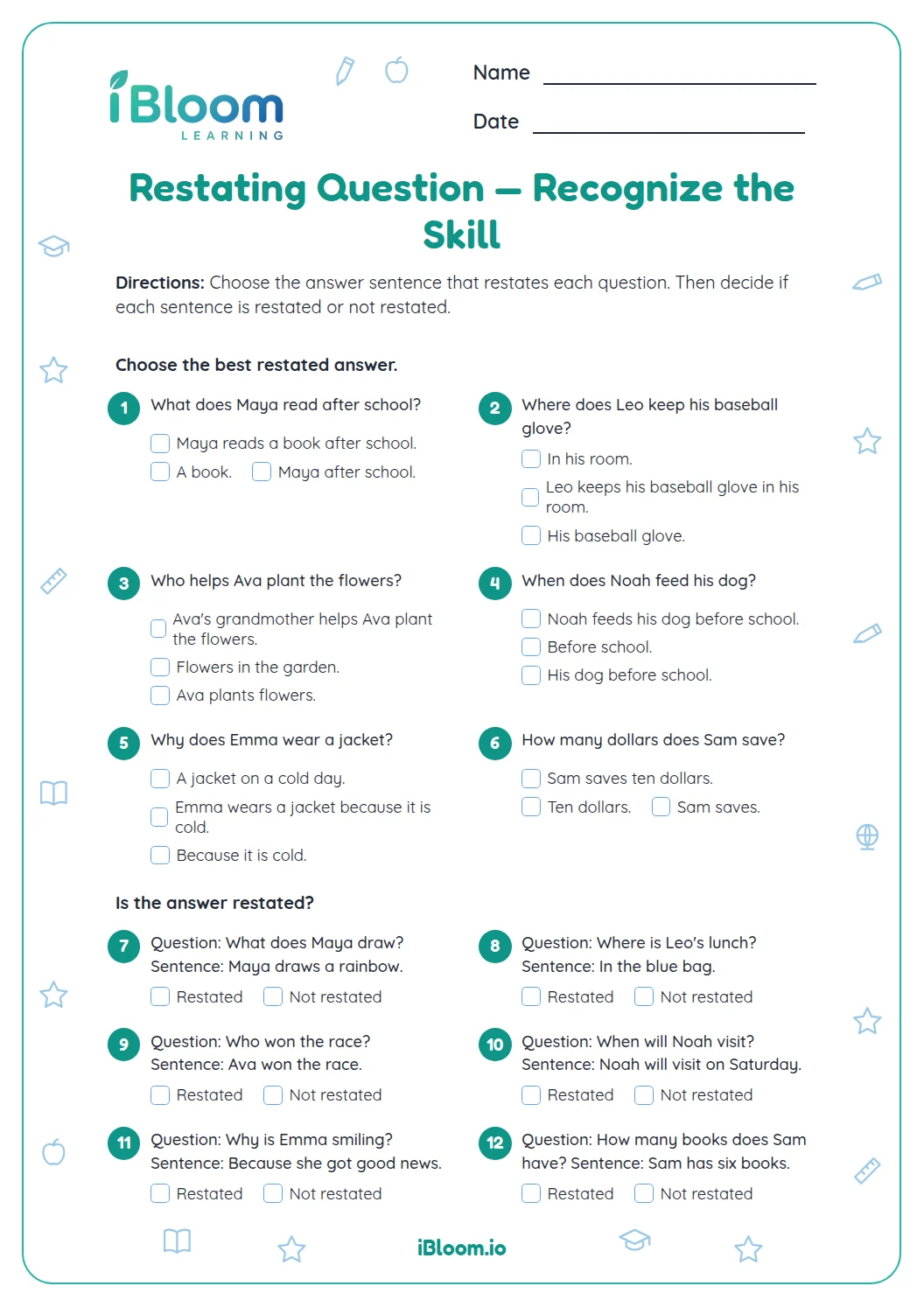
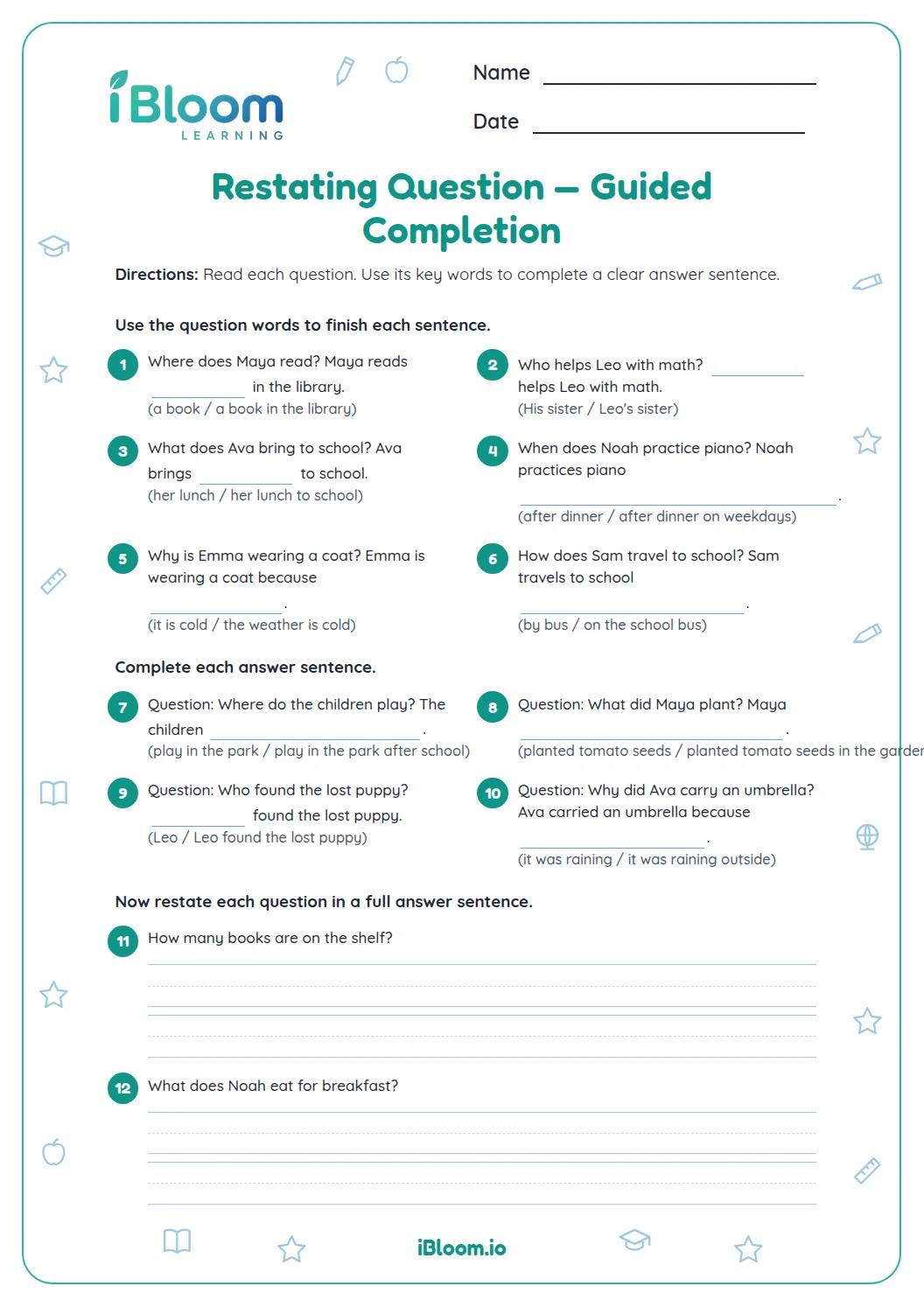
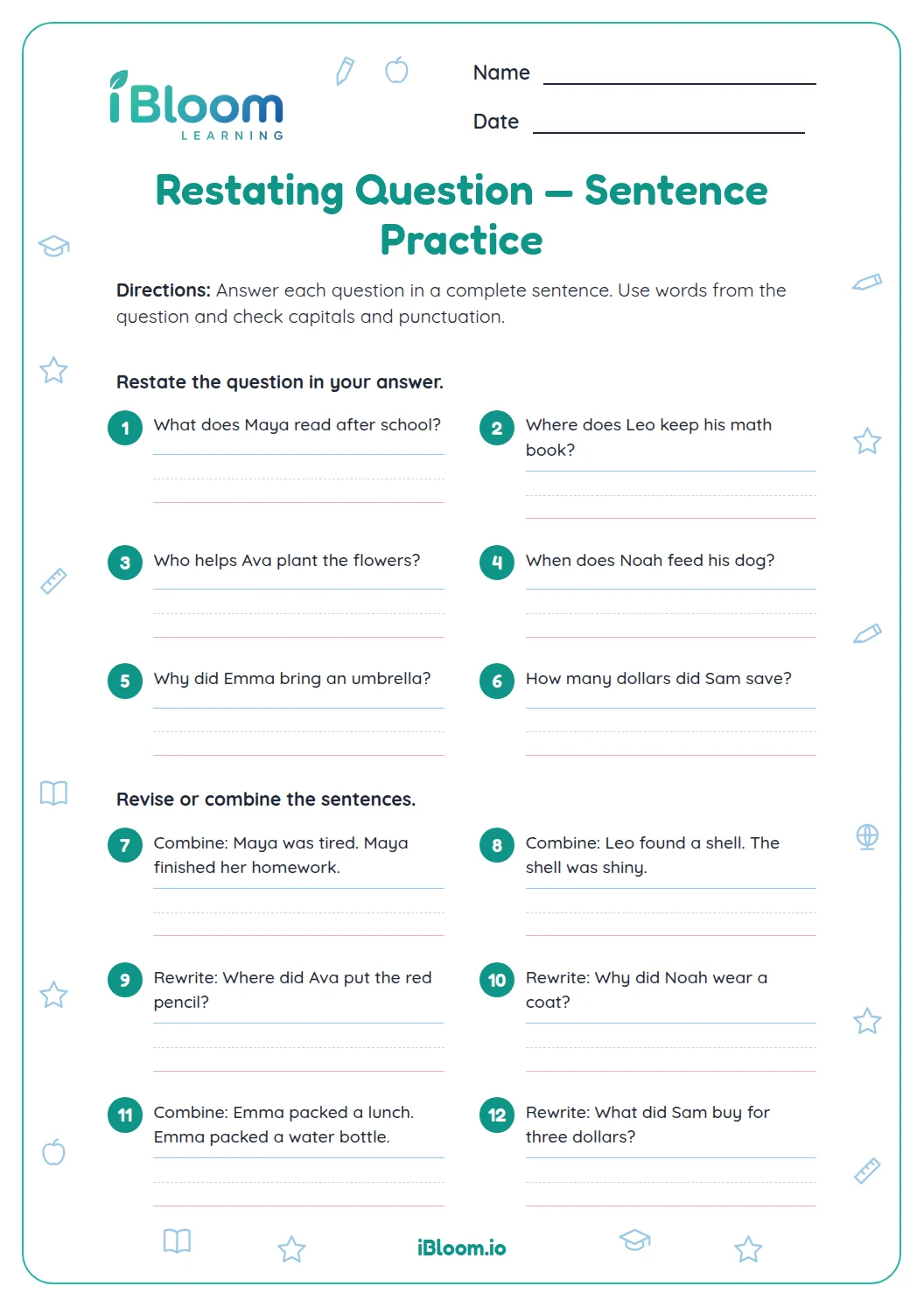
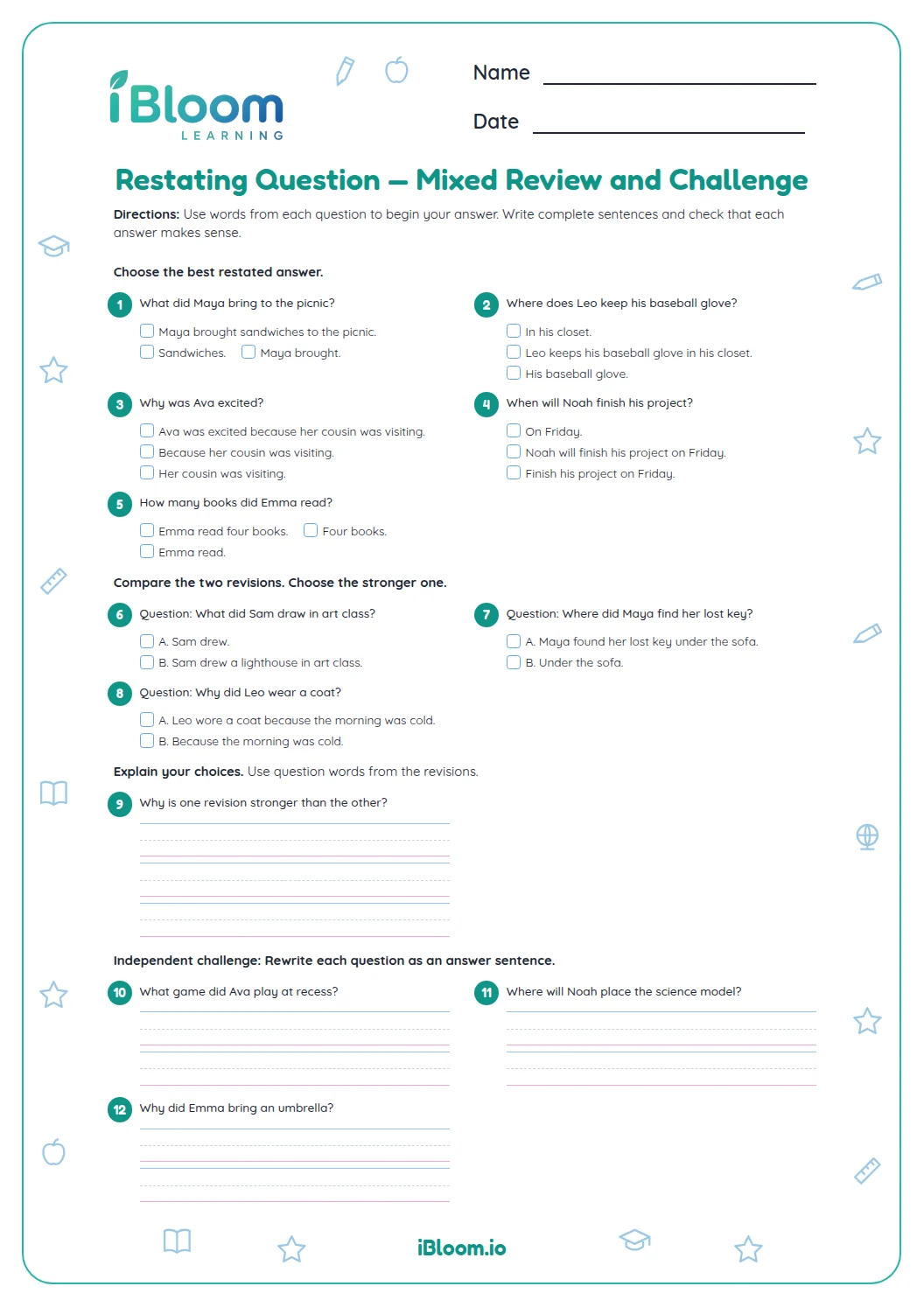
This Grade 3 writing worksheet helps children restate questions in complete, accurate sentences and edit fragments or answers that miss the question. Students choose strong restatements, use supplied details to complete sentence starters, and correct answers while keeping their meaning. The editing work connects to W.3.5, which asks students to strengthen writing through revision and editing. An answer key includes correct choices and sample sentences.
Aligned to W.3.5
What skill does this page practice?
A restated answer uses the question’s key words in a new sentence that gives the requested information. Editing checks that the sentence is complete and accurate.
How can a reader build a strong answer?
Read the whole prompt, find the detail or clue that answers it, and check that your response fits the question.
- 1Question: Where did the class practice?
- 2Fragment: the music room
- 3Edited answer: The class practiced in the music room.
What will children do on the worksheet?
The worksheet has 18 questions. The answer key follows the same order and gives sample wording for open responses.
How to use this worksheet
- 1Read the question and notice whether it asks who, what, where, when, why, or how.
- 2Choose the sentence that answers the question and names the needed subject.
- 3Use each supplied detail to complete its sentence starter.
- 4For fragments, add the words needed to make a complete answer.
- 5Reread each answer to confirm it answers the original question.
- 6Compare with the key; sample answers may use different accurate wording.
Common mistakes and quick fixes
The mistake
Writing only a place or time as a fragment.
The fix
Reread the prompt, find the relevant detail, and revise the response so it answers the question clearly.
The mistake
Changing the detail while adding words.
The fix
Reread the prompt, find the relevant detail, and revise the response so it answers the question clearly.
The mistake
Repeating the question without answering it.
The fix
Reread the prompt, find the relevant detail, and revise the response so it answers the question clearly.
Common Core alignment
Children practice revising and editing written answers for completeness and meaning.
Revise and edit a response so it is complete and keeps the intended meaning.
On this sheet: Children revise incomplete and inaccurate answers into complete sentences.
Show the official wordingHide the official wording
With guidance and support from peers and adults, develop and strengthen writing as needed by planning, revising, and editing.
What to practice next
Make more practice
Further reading
Questions parents and teachers ask
What does it mean to restate a question?
It means using the question’s key words to make a complete statement that answers it. For “Where does the library open?” a complete answer says, “The library opens at nine o’clock,” rather than giving only “At nine.” Question 4 models a time answer in a complete sentence.
How many questions are on this page?
There are 18 items: six multiple-choice choices, ten sentence-writing or editing tasks, and two final checks. The answer key provides the choices and sample wording for responses that can be written in more than one way. The final two questions check editing and sentence form.
Should every answer repeat the whole question?
No. A response should include enough information to make a clear sentence, but it can be concise. The child can reuse the question’s subject and important words while avoiding unnecessary repetition. Question 15 turns “the music room” into a full answer.
What makes an answer fragment incomplete?
A fragment may name a place or give a reason without forming a complete sentence. For example, “the music room” needs a subject and verb: “The class practiced in the music room.” The sheet asks children to edit both a place fragment and a reason fragment.
What should a child do when editing a response?
First check whether it answers the question. Then look for a subject, a verb, and an ending mark. The worksheet includes fragments that need to become complete answers, plus choices that test meaning and sentence form. Questions 17 and 18 check meaning as well as sentence form.
Can a child’s written answer differ from the key?
Yes. The key gives sample sentences, not the only possible wording. Accept another response when it is a complete sentence, answers the question, and matches the supplied detail. Questions 7–12 provide details and sentence starters for that practice. The key allows sensible alternatives.