





About this worksheet
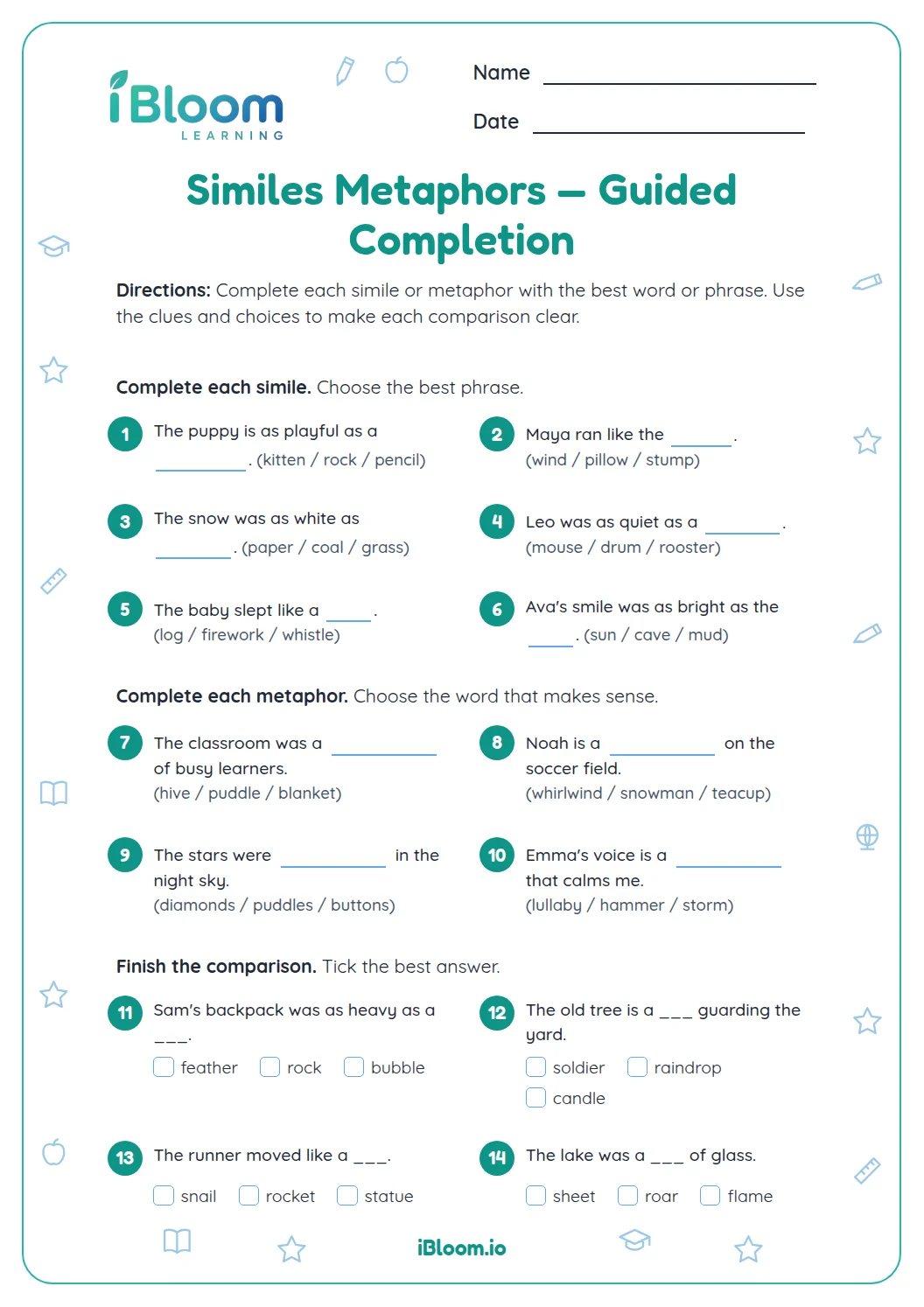
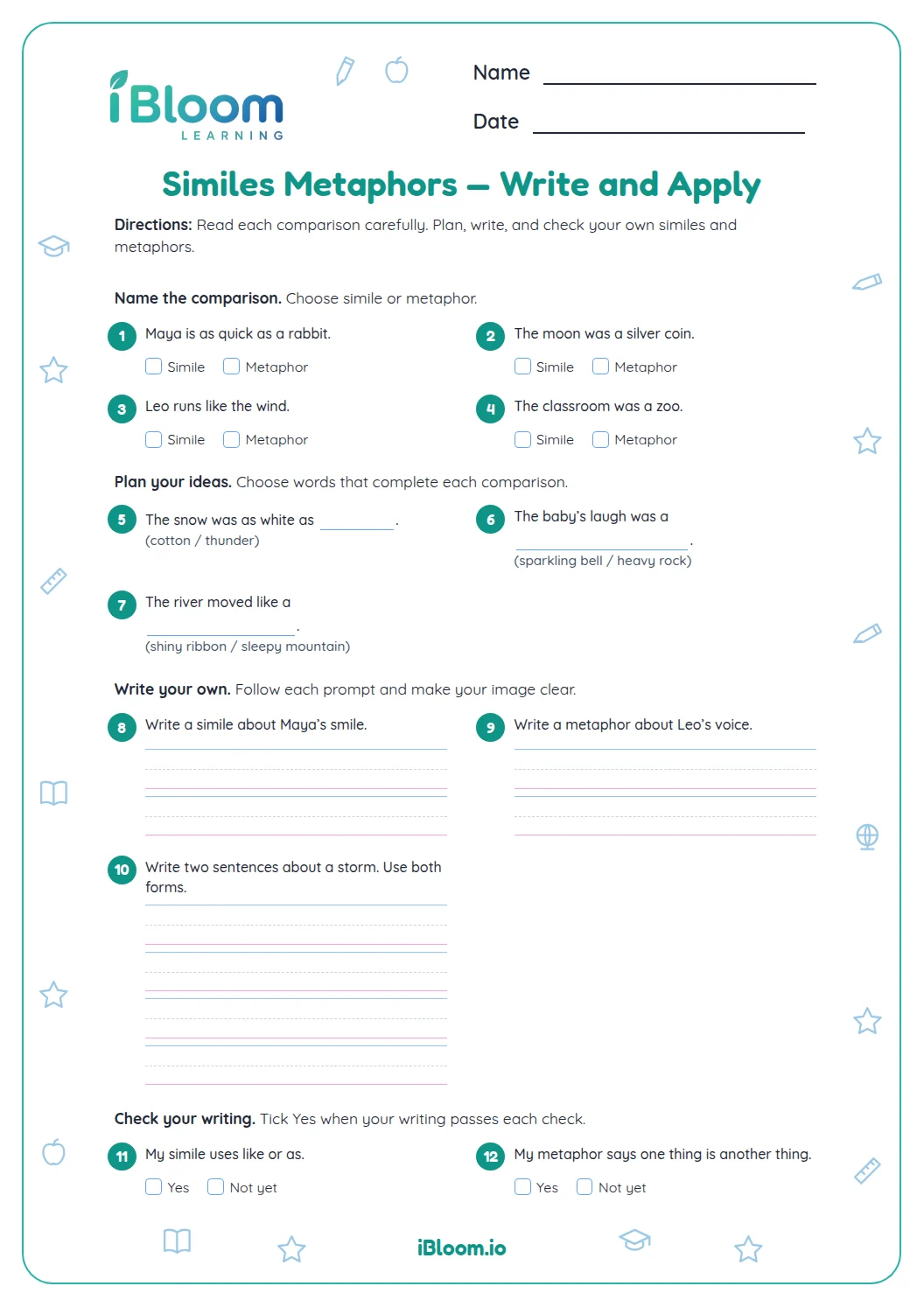
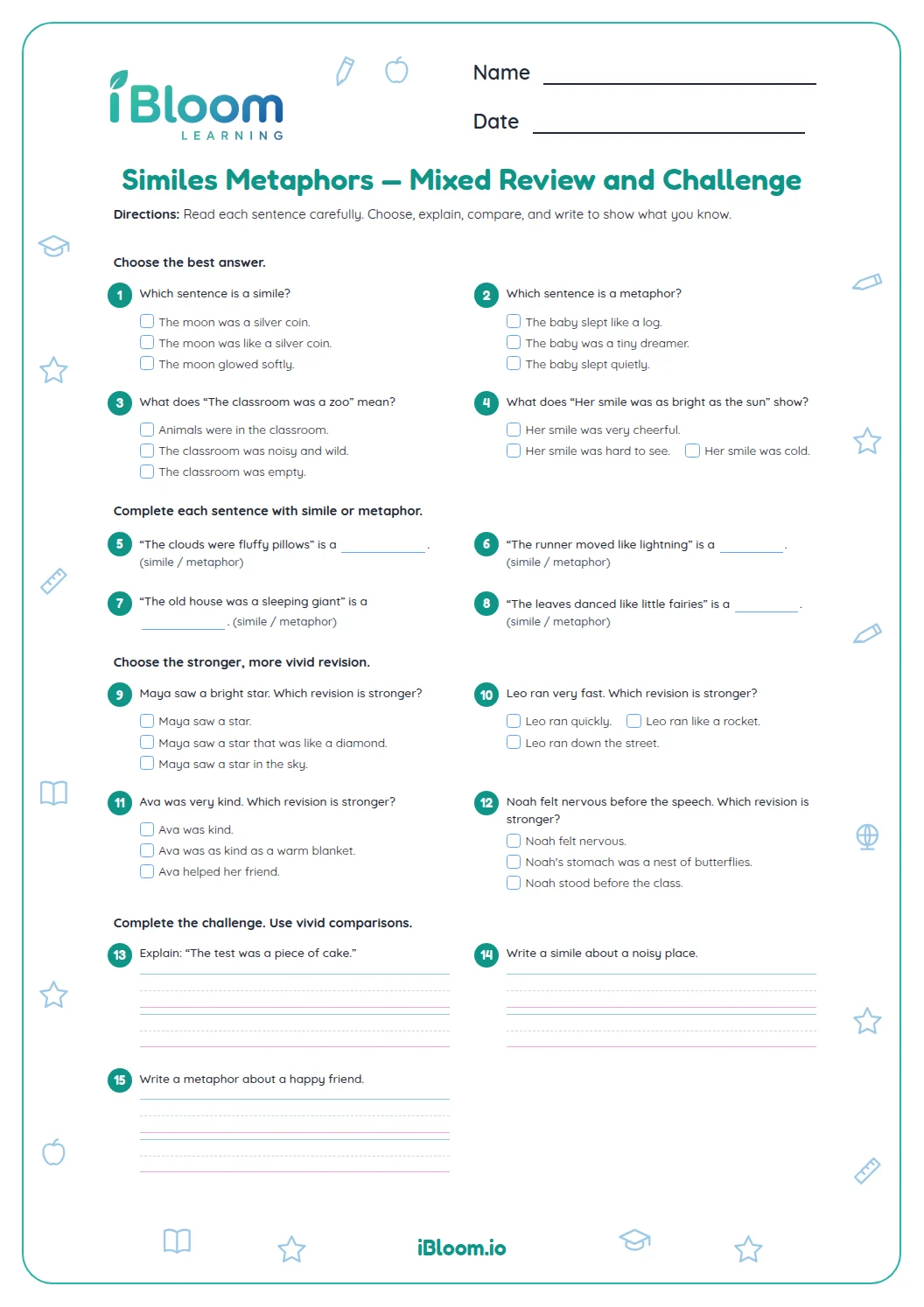
This practice set starts with recognition and meaning, then asks students to choose a fitting comparison and write their own. The examples use familiar classroom, weather, and nature images, with a single clear intended answer in the selected-response items.
Aligned to L.3.5
How can students spot similes and metaphors?
A simile compares things with like or as. A metaphor says one thing is another. The first six questions distinguish the forms and ask what a comparison suggests.
How do the sentence clues guide a comparison?
The completion items give context or a word bank. For “The snow was as white as a ___,” choose a fitting comparison such as a blanket. Read the full sentence to check its meaning.
How can students write a fresh comparison?
The final responses ask students to create or revise sentences. A good answer keeps the requested simile or metaphor and makes a clear comparison; the key gives one sample for open-ended prompts.
How to use this worksheet
- 1Look for comparison words such as “like” or “as” in a simile.
- 2A metaphor says one thing is another to suggest a likeness.
- 3Complete the guided phrases before writing original sentences.
- 4Check that each comparison makes sense and forms a complete sentence.
Common mistakes and quick fixes
The mistake
Calling every sentence with “as” a simile, even when it does not compare two things.
The fix
Find the two things being compared and ask what quality they share.
The mistake
Taking a metaphor literally, such as thinking a coach is really a lighthouse.
The fix
Explain the quality being transferred: the coach guides the team like a lighthouse guides ships.
The mistake
Calling every comparison a simile.
The fix
Check whether the sentence uses like or as, or states that one thing is another.
Curriculum alignment
Grade 3 language standards include explaining how words and phrases supply meaning and recognizing nonliteral meanings. Students use context and comparison to understand similes and metaphors.
Understand word relationships and nuances in meaning.
On this sheet: The comparison prompts ask learners to choose words that communicate a fitting quality.
Show the official wordingHide the official wording
Demonstrate understanding of figurative language, word relationships and nuances in word meanings.
What to practice next
Further reading
Questions parents and teachers ask
What makes a simile?
A simile compares two different things with words such as like or as. “Quiet as a mouse” compares a person’s quietness with a mouse. Students identify similes, complete comparisons, and write original examples that make a clear and sensible connection.
What makes a metaphor?
A metaphor describes one thing as another to suggest a shared quality. If a voice is called sunshine, the sentence means it is cheerful or bright, not that it is literally sunlight. Students use context to understand the comparison in each practice item.
Can students use their own sentence answers?
Yes. The final prompts invite original sentences, so the answer key gives one sample rather than the only possible wording. Accept a complete, sensible response that uses the requested simile or metaphor and keeps the main idea in the prompt.
How can a reader tell a comparison is nonliteral?
Ask whether the sentence could be true in a literal way. A classroom cannot really be a garden, but it can be a garden of ideas. The surrounding words help readers infer the quality being compared, such as growth, brightness, or quiet.
Can students use different answers from the key?
Yes. The written prompts allow many original comparisons. Accept a response when it follows the instruction, makes sense, and uses the requested simile or metaphor; the key provides one model, not the only possible sentence. The first six items have specific answers, while the later writing prompts invite variation.