






About this worksheet
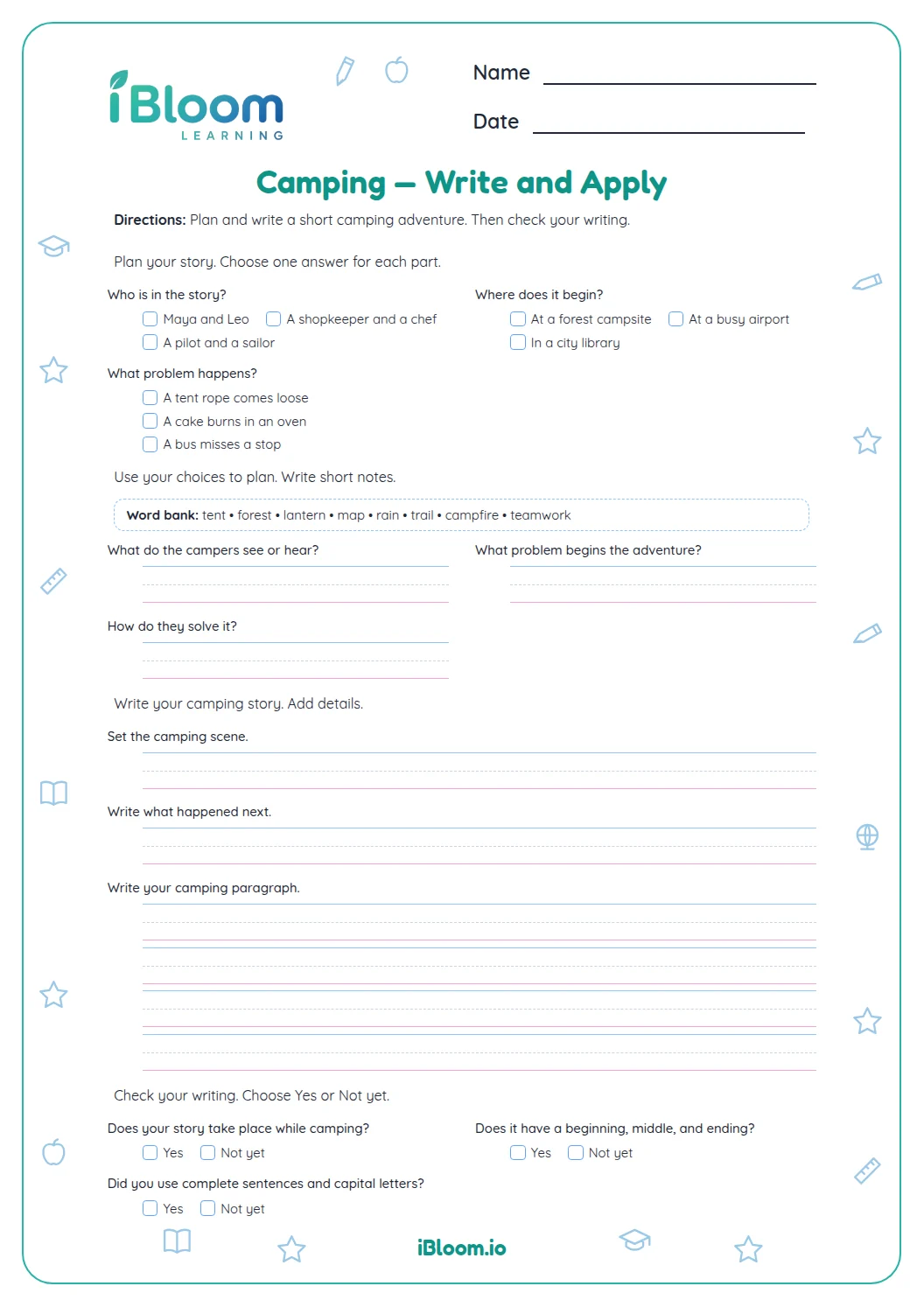
This printable gives Grade 4 students 15 camping narrative questions, followed by a separate answer key. Students select openings, sensory details, event order, and character actions, then write a scene continuation and a story resolution. The questions practice descriptive details and clear event sequence in an imagined narrative, as described by CCSS W.4.3.
Aligned to W.4.3
What story skills do the parts practice?
Part A uses a lost-puppy camping story to practice openings, setting details, a rising problem, and safe character choices.
- Part A: choose story elements
- Part B: strengthen and sequence details
- Part C: write a continuation and ending
How can a detail make the opening stronger?
Part B checks sensory details, event order, past tense, place, and a fitting title. The two short writing items let students continue the tent scene and resolve the campers’ problem.
- 1Choose the strongest opening for a story about a lost puppy.
- 2Answer: Paw prints circled our tent after the rain stopped.
- 3The clue leads into the later search for the puppy.
How can students shape the written ending?
The final response asks for a camping ending that resolves the lost-puppy problem and shows what the campers learned.
How to use the camping story worksheet
- 1Read the whole question before choosing a story detail.
- 2For sequence questions, say the events aloud in the order they would happen.
- 3In question 14, continue the zipper scene with one clear event and a concrete detail.
- 4In question 15, show how the campers respond and resolve the problem.
- 5Compare written answers with the key’s sample idea, not word for word.
Common narrative writing mistakes and fixes
The mistake
Choosing a detail that names the setting but adds no scene action.
The fix
Choose a detail that helps the reader picture a moment, such as rain sagging the tent.
The mistake
Putting events in an order that cannot happen.
The fix
Ask what the characters need to do first; pack before hiking and pitching camp.
The mistake
Ending with a new event but leaving the story problem open.
The fix
State what the campers do about the problem and how the scene turns out.
Common Core alignment
Students use descriptive details and event order to develop an imagined camping story.
Choose and write details and events that develop a camping narrative.
On this sheet: The selections and writing prompts practice narrative details, event sequence, and resolution.
Show the official wordingHide the official wording
Write narratives to develop real or imagined experiences or events using effective technique, descriptive details, and clear event sequences.
What to practice next
Make more practice
Further reading
Questions parents and teachers ask
What does this camping narrative worksheet include?
It has 14 questions about campers who hear a lost puppy near their tent. Students choose an opening, setting details, and events, then complete short sentences about sound, sequence, tense, place, and how the puppy gets home. The answer key gives the choices and missing words.
How many parts and pages are there?
There are 14 questions in two worksheet parts across two pages, followed by a two-page answer key. Part A uses choices about the lost-puppy story; Part B asks students to complete brief sentences about sequence, setting, and a safe resolution.
What is a good answer to the lost-puppy opening question?
“Paw prints circled our tent after the rain stopped” is strongest because it introduces an event and a change that can lead to more action. The other options state a general fact or preference. Ask students what might happen immediately after they spot the paw prints.
Do students need to copy the sample ending?
No. The answer key offers one possible response, not the only acceptable wording. An ending works when it follows the camping scene, explains what the characters do, and brings the problem to a clear close. Check the story logic and detail rather than matching the sample exactly.
How can I help with the final response?
Ask the student to name the story problem first, then decide what the campers do. A useful final sentence connects the solution with a character choice or realization. Have the student reread the ending and check that the reader can tell the problem is resolved.
Which writing standard is practiced?
The worksheet practices CCSS W.4.3 through choices and writing about descriptive details, event sequence, and a resolution in an imagined camping narrative. Its two open responses give students a chance to develop a scene in their own words. This final sentence also echoes the shared choice the campers made during the story.