




About this worksheet
This free printable worksheet gives grade 4 learners focused practice with narrative writing. It includes 16 questions in two parts and a separate answer key. It practices W.4.3 through prompts that ask learners to build or recognize the skill.
Aligned to W.4.3
How does this sheet build an eating story?
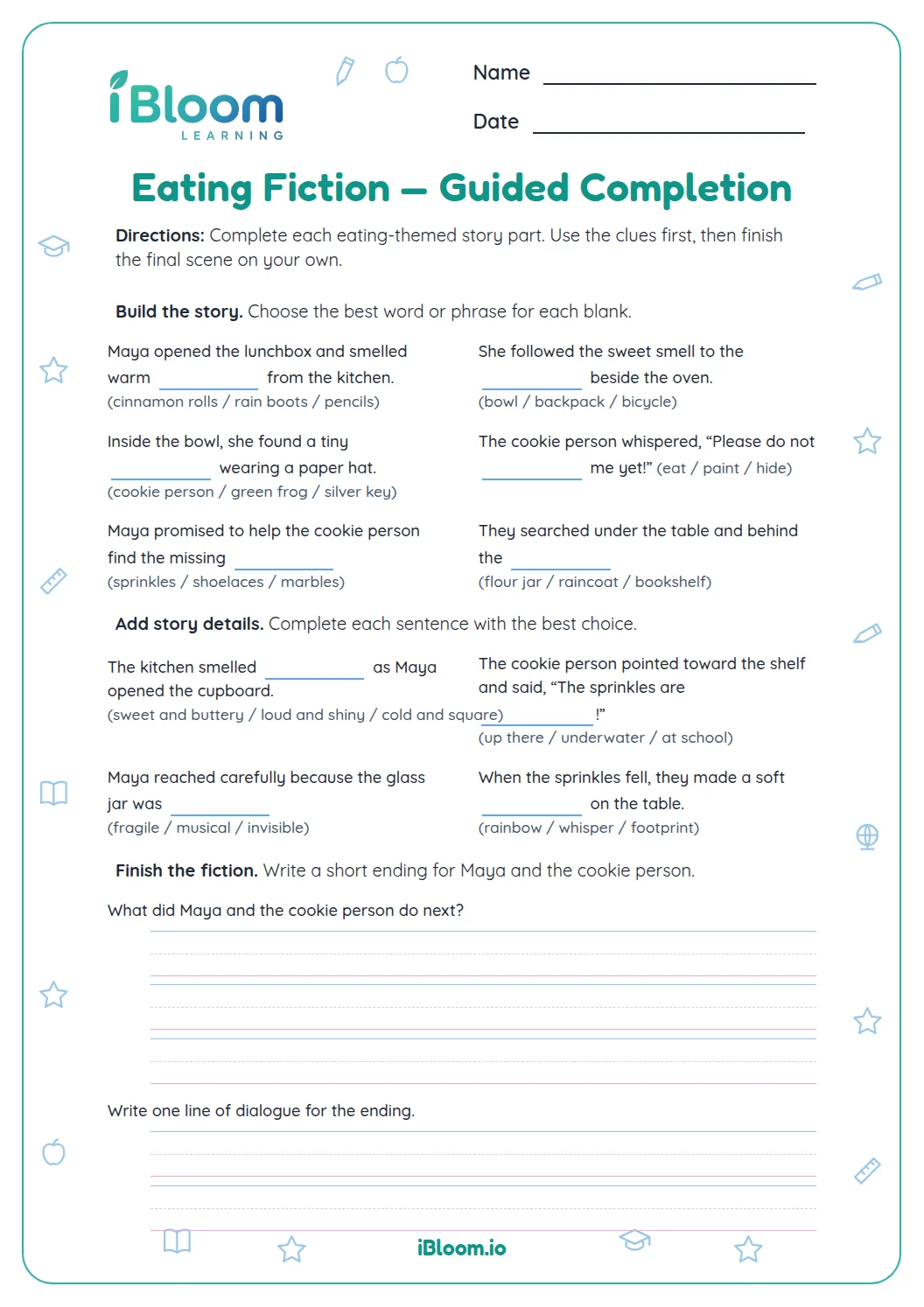
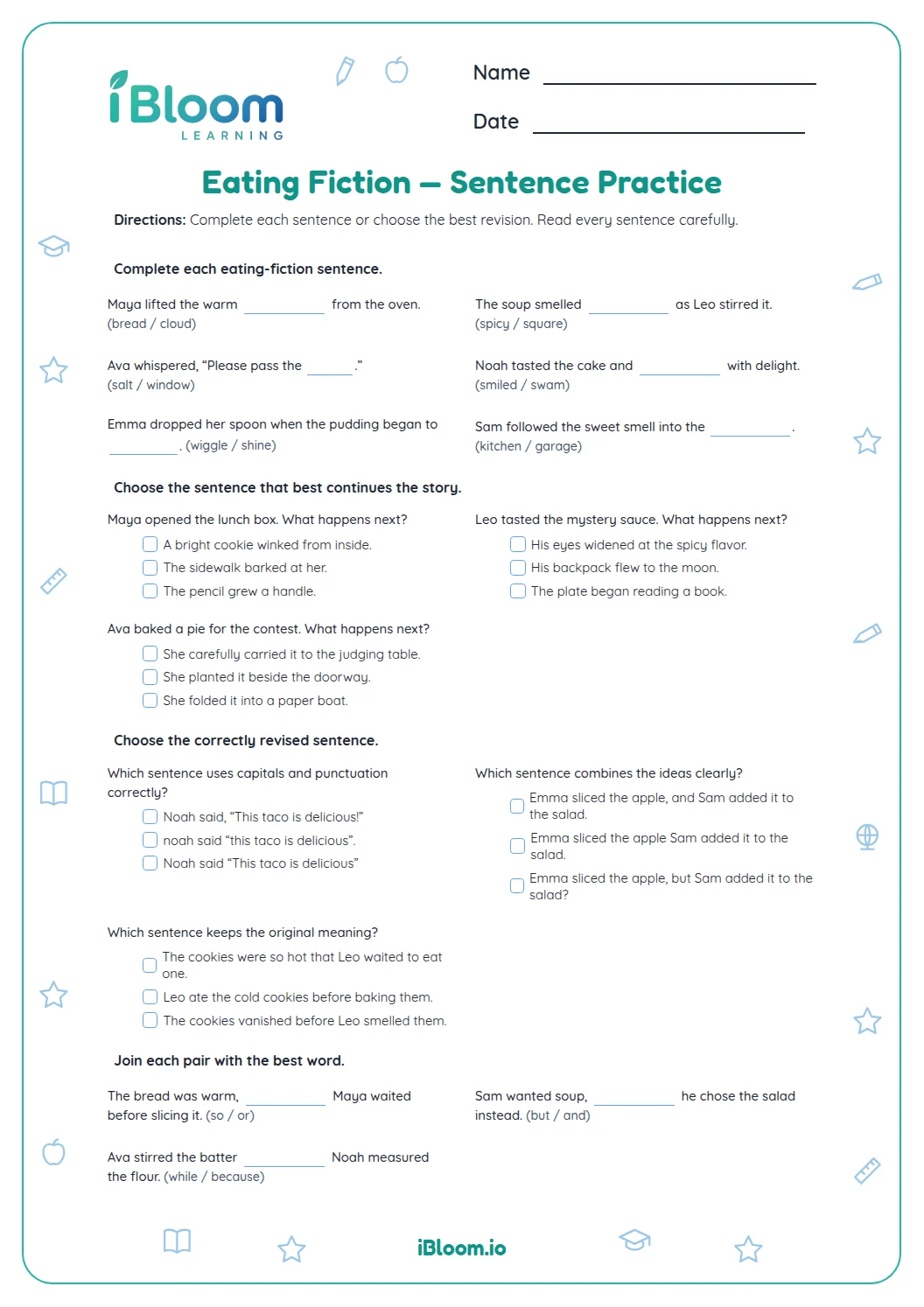
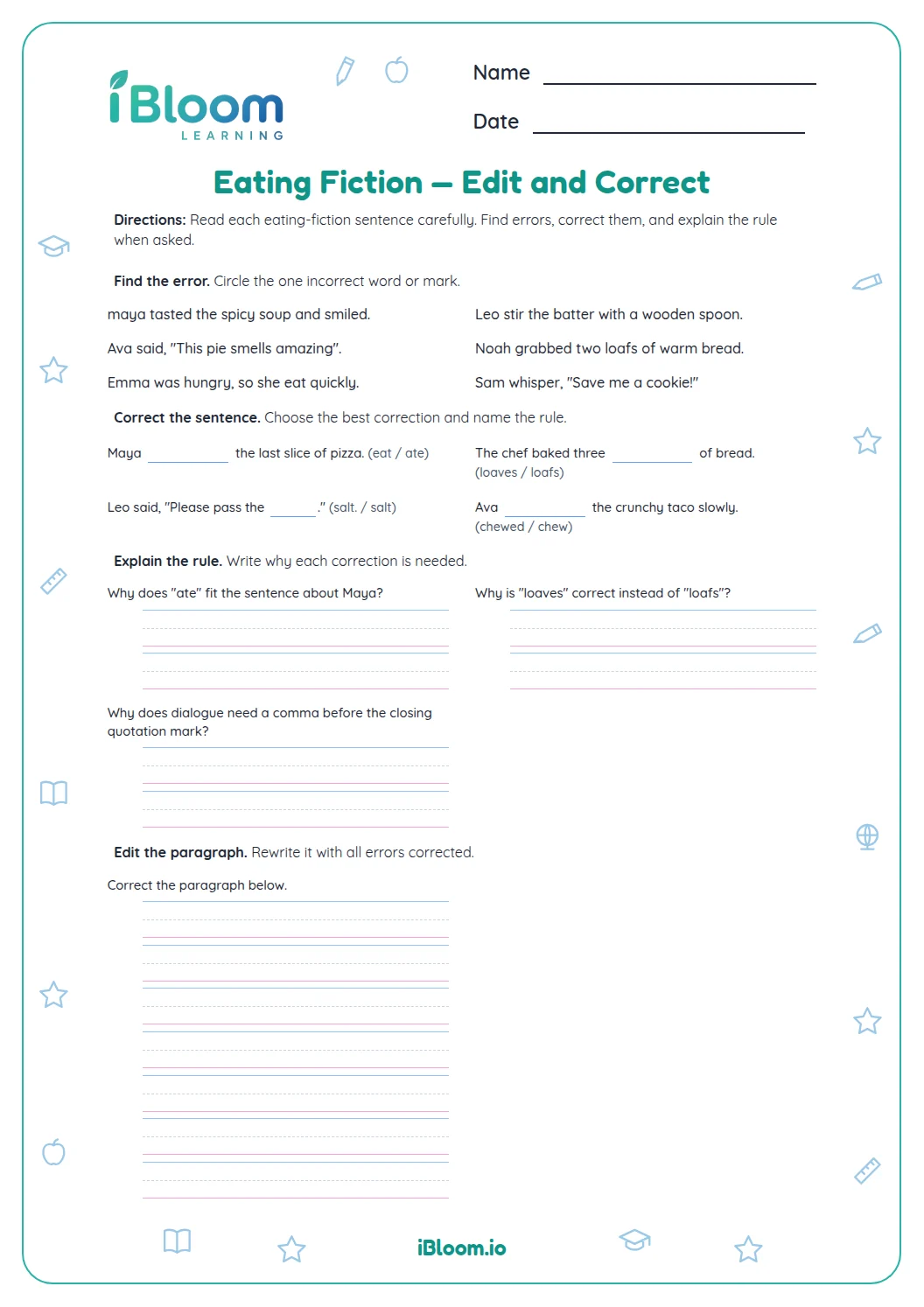
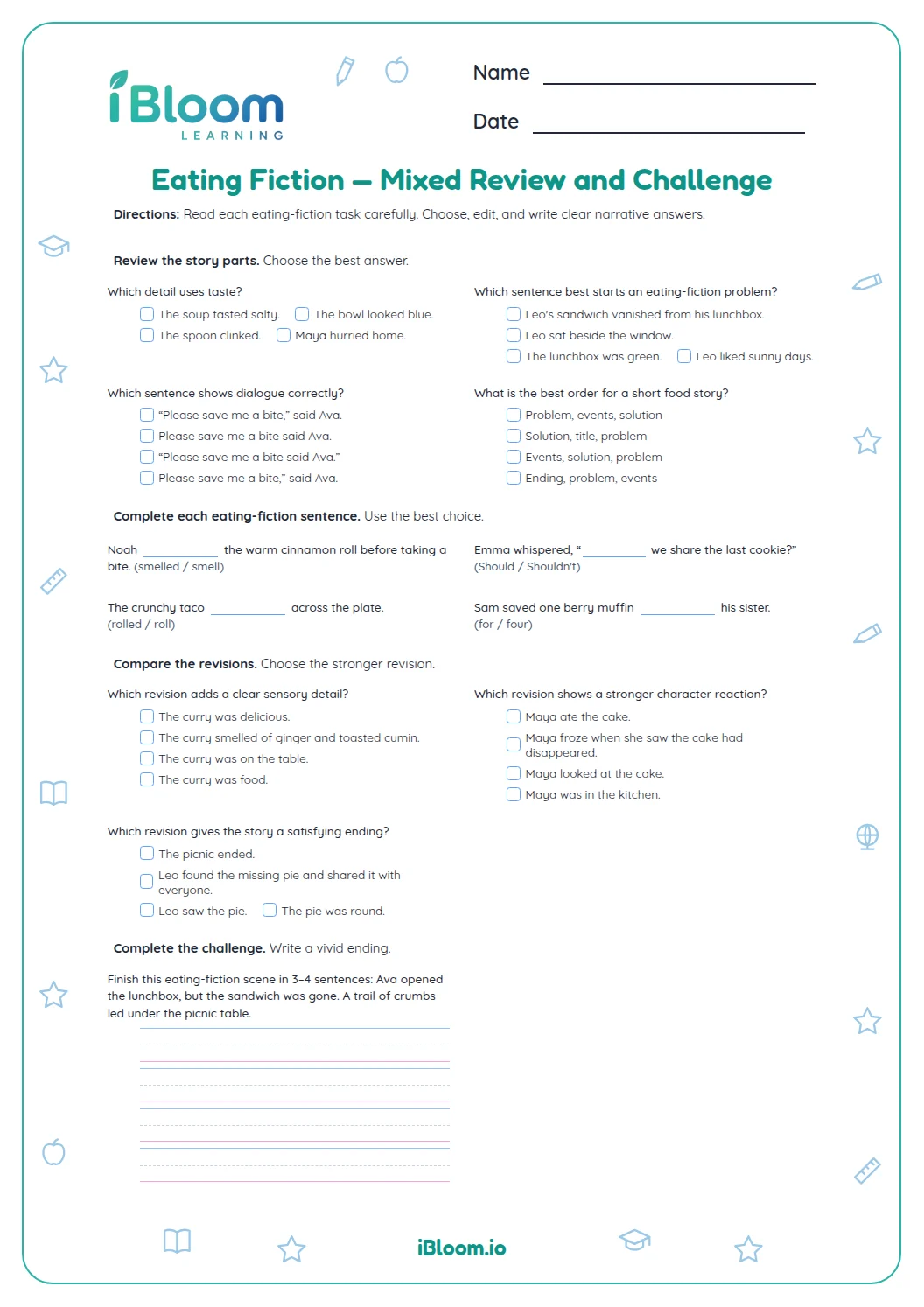
The 16 prompts guide a single fictional scene from the first taste of unusual soup to a resolved ending. The first eight establish the setting, character, sensory details, and problem; the next eight add reactions, obstacles, connected actions, and closure.
Question 1 asks for a character and place before the first taste. A useful start names both and hints at what is about to happen.
- 1Maya stepped into her grandmother’s kitchen.
- 2The steaming soup made a curious popping sound.
How can details move the events forward?
A narrative detail should help readers picture the scene or understand why an event happens. Sensory words build the setting; transition words make the sequence easier to follow.
- 1Prompt: Connect an action to what happens next.
- 2After Maya shut the window, the fish circled back to the bowl.
How can this page fit into practice time?
Complete one part at a time, pause to review, then finish the second part. Talk through one answer before asking the learner to continue independently.
How to use this worksheet
- 1Read the directions for build a story before starting.
- 2Work through the first part and check one answer together.
- 3Finish the second part independently when ready.
- 4Use the answer key to review each response.
Common mistakes and quick fixes
The mistake
Rushing past a clue in the prompt.
The fix
Reread the whole prompt and point to the detail that guides the response.
The mistake
Giving an incomplete response.
The fix
Check that the answer completes the requested word, sentence, or calculation.
The mistake
Skipping the review.
The fix
Compare each response with the key and correct it in a different color.
Common Core alignment
Organize imagined events with details and a clear sequence.
On this sheet: The prompts develop imagined events with sensory detail, character response, sequence, and resolution.
Show the official wordingHide the official wording
Write narratives to develop real or imagined experiences or events using effective technique, descriptive details, and clear event sequences.
What to practice next
Make more practice
Further reading
Questions parents and teachers ask
What skill does this worksheet practice?
This printable gives focused practice with the target skill. Learners complete two sets of prompts and can check each response against the separate answer key. Adults can read directions aloud, then encourage learners to explain how each prompt guided the response.
How many questions are included?
There are 16 questions, split into two parts of eight. The worksheet uses as many pages as the activities require, followed by a separate answer key. Each part offers a different kind of practice so learners can review the same skill in more than one way.
How can an adult support practice?
Read the directions and model one prompt aloud before independent practice. Then let the learner continue, offering a reminder to reread the clue or check the work when an answer seems uncertain. A brief discussion after each part can help reinforce the skill.
Do written responses have to match the key exactly?
For prompts asking learners to write, the key gives a sample response. Other clear answers that follow the directions are also acceptable. Questions with one expected response have exact answers listed, so learners can review those without guessing what counts.
How long should the worksheet take?
Plan for about 20 minutes, adjusting for handwriting, discussion, or careful checking. The two parts can be completed in separate sessions. Use the answer key after each part or wait until the end to review the full worksheet together.