
About this worksheet
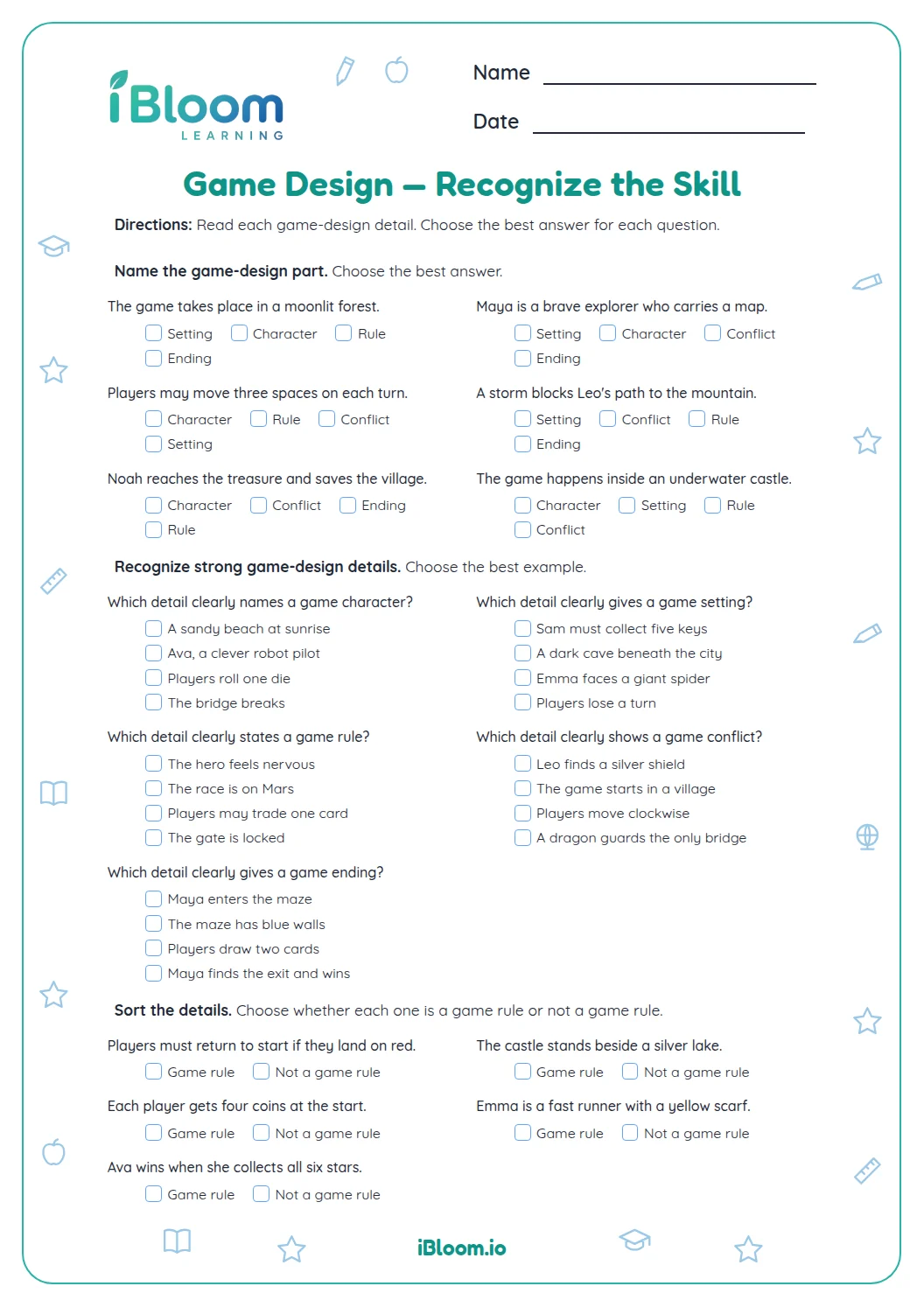
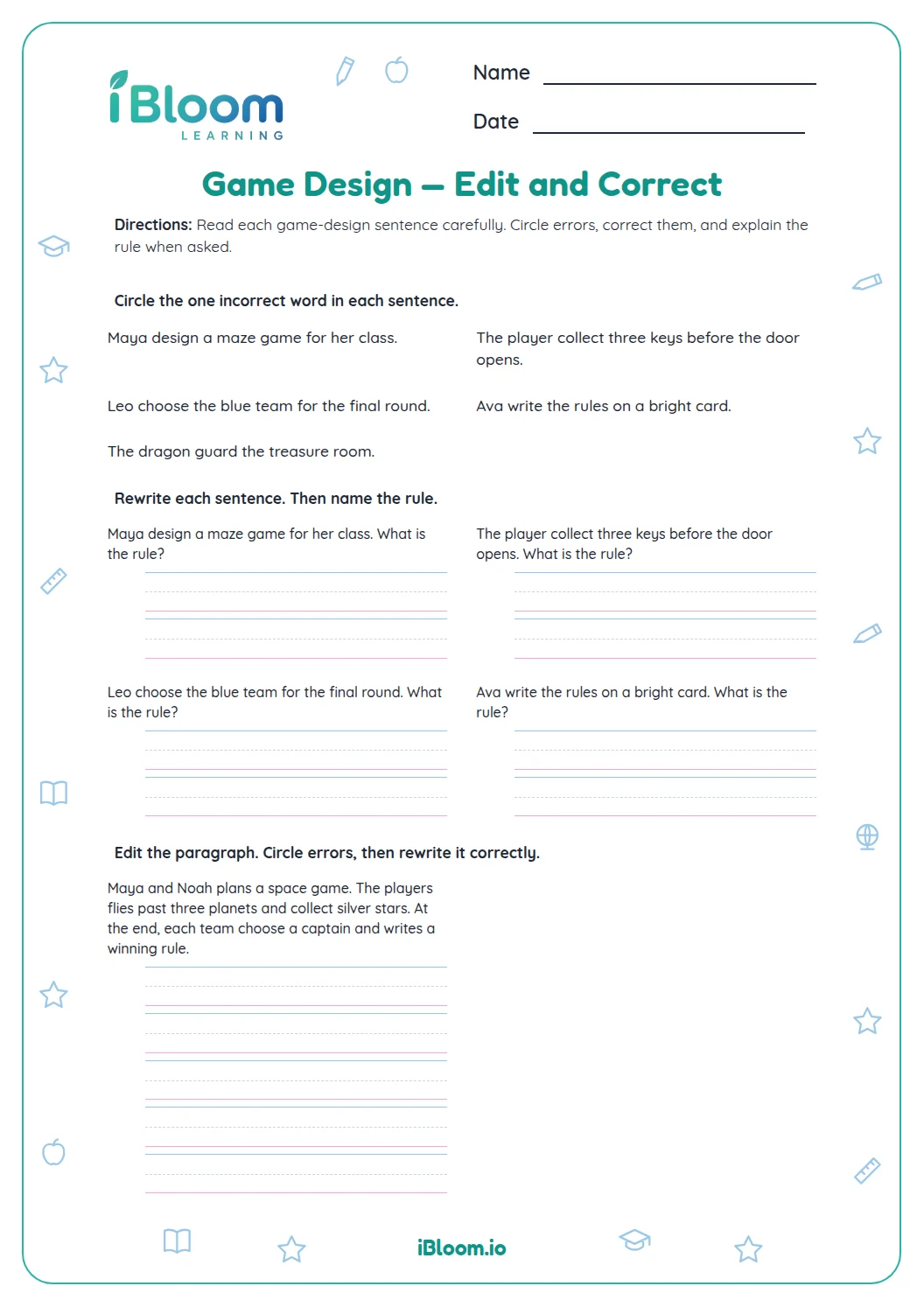
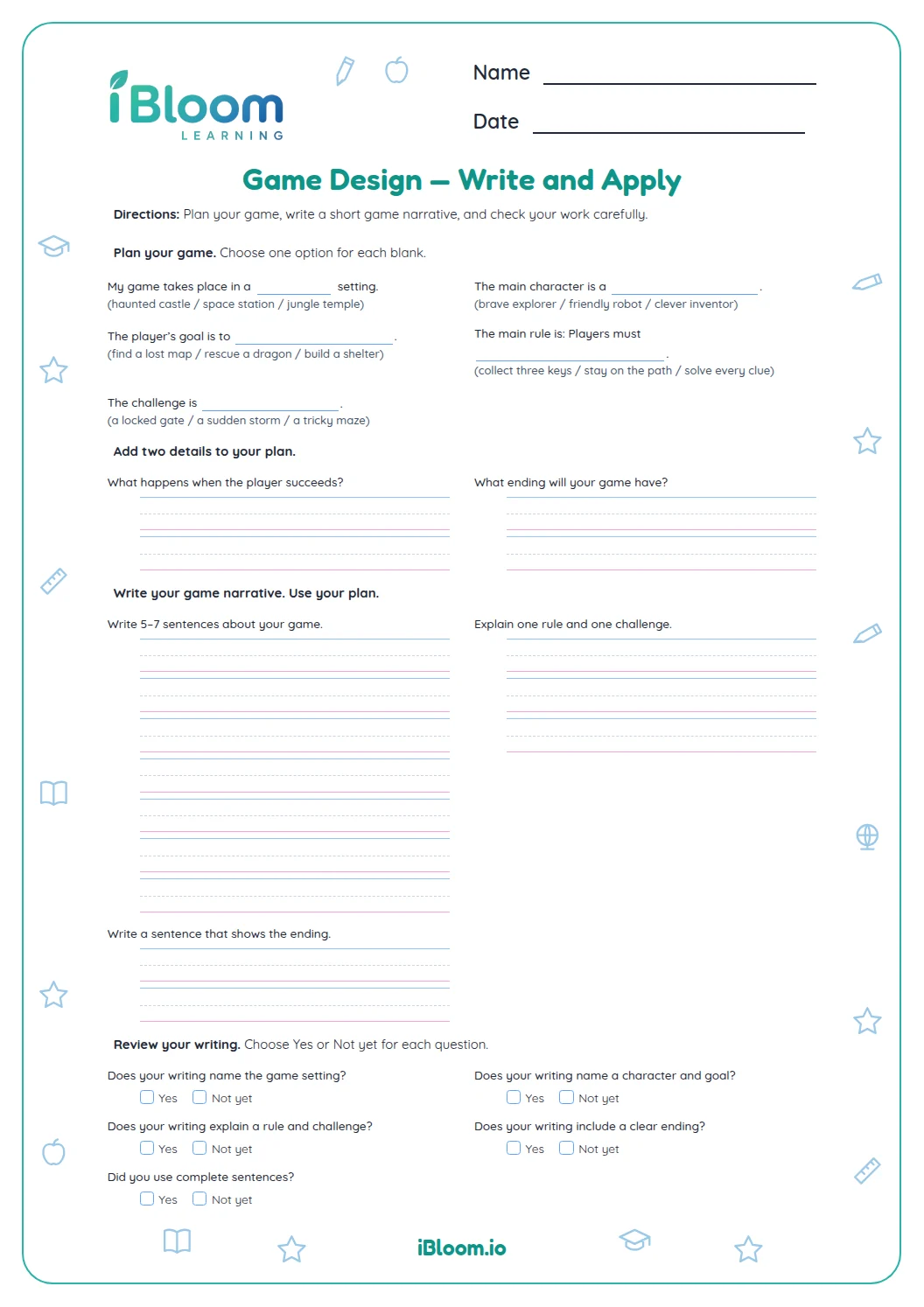
This Grade 4 guided-completion worksheet helps students build a clear game idea by naming its setting, goal, rules, obstacle, and ending. Across 15 prompts, students choose game-design details, complete short statements, and finish an independent game plan. The answer key gives the intended choices and sample details for open responses.
Which details make a game story easy to follow?
The prompts move from identifying game elements to completing details and finishing a short game plan. Students practice making each detail fit the story idea in the prompt.
- Identify settings, goals, obstacles, and endings
- Complete short game rules and story details
- Finish a setting and goal for an original game plan
How can a game problem lead to an ending?
A strong ending responds to the obstacle introduced earlier. The student can check that the character’s action makes the result possible and that the goal is still clear.
- 1Question 3: a bridge breaks before the dragon reaches the village.
- 2The bridge is the obstacle the player must address.
- 3Question 4 shows a possible ending: repair the bridge and lead the dragon home.
How to use this worksheet
- 1Name where the game takes place.
- 2State what the player is trying to do.
- 3Add an obstacle or a rule that shapes play.
- 4Choose details that make the scene specific.
- 5Write an ending that addresses the problem.
Common mistakes and quick fixes
The mistake
Giving a setting when the question asks for a goal.
The fix
Ask whether the detail names a place or an action the player must complete.
The mistake
Writing a problem with no possible response.
The fix
Add an action the character can take to move toward a solution.
The mistake
Making a rule too vague to follow.
The fix
Say exactly what a player may or must do.
What to practice next
Make more practice
Questions parents and teachers ask
What parts of a game story does this page practice?
Students identify and write a setting, goal, problem, rule, helpful detail and ending. The first questions offer choices, and the later prompts leave room for original ideas. Together, the parts help turn a broad game concept into events a reader or player can follow.
How much can an answer vary?
Several prompts have many sensible answers. The key gives one sample, but a different answer is also useful if it names a clear, specific detail and fits the sentence. For the multiple-choice questions, choose the one option that directly answers the question.
What makes a game goal clear?
A clear goal says what the player is trying to do, often with a finish point or a number of items to collect. “Gather three moonstones before sunrise” gives an action, a target and a time limit, so players can tell when they have succeeded.
How is a problem different from a rule?
A problem is an obstacle the character must solve, such as a locked tower blocking the way. A rule tells players what they may or must do, such as crossing a river only on stepping stones. A story can use both to make play understandable.
Can students invent a different game in the writing prompts?
Yes. The final prompts invite original settings, actions, rules and endings. The answer key shows one possible completion for each open response. A student’s idea can differ as long as it fits the prompt and makes sense within the game story.
How many questions and pages are included?
There are 15 questions in two parts: four multiple-choice items and eleven fill-in completions. The worksheet uses two pages, followed by a separate two-page answer key. Each completion has a specific answer in the key, so students can check how a setting, goal, rule, obstacle, or ending fits the game plan.