
About this worksheet
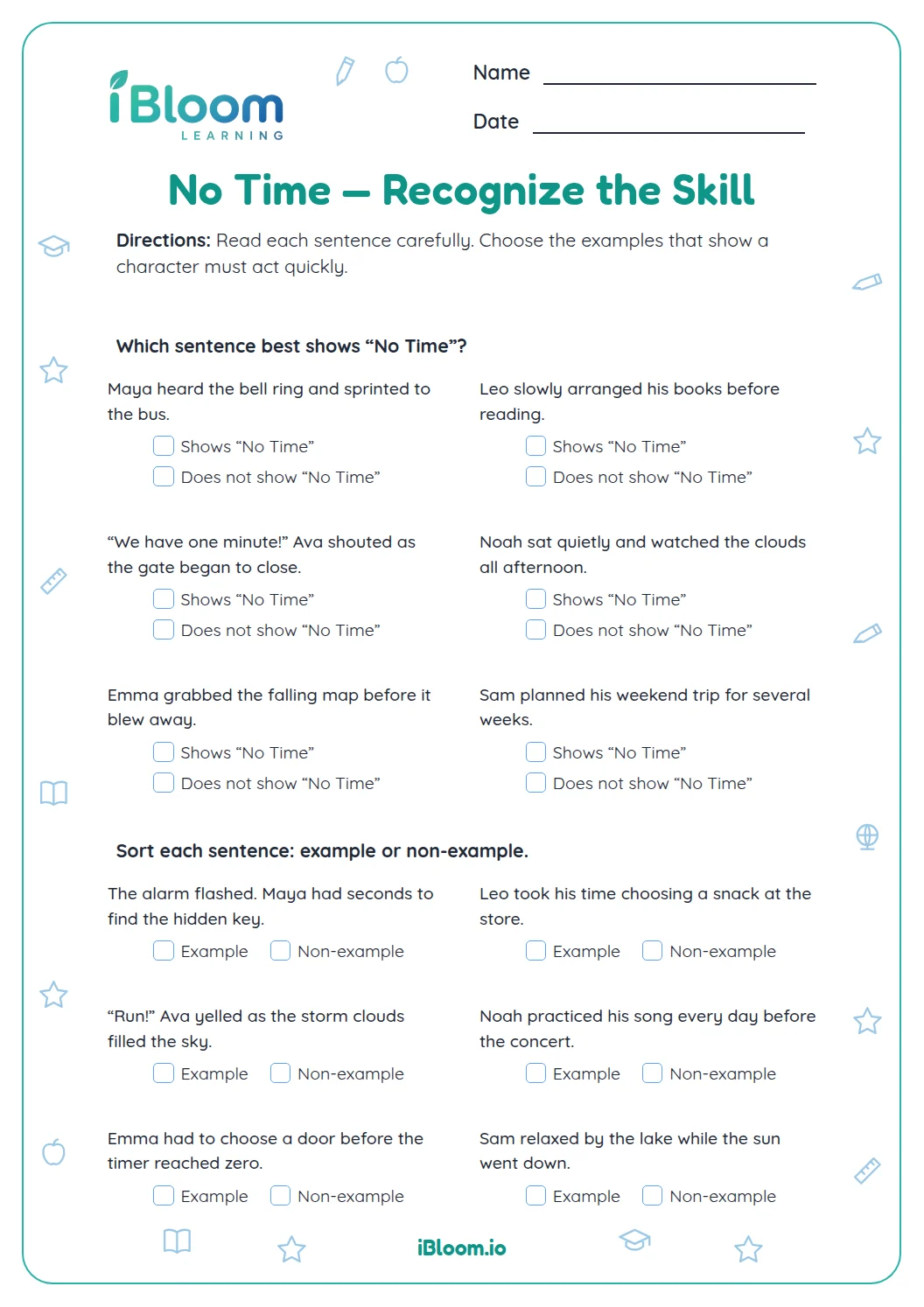
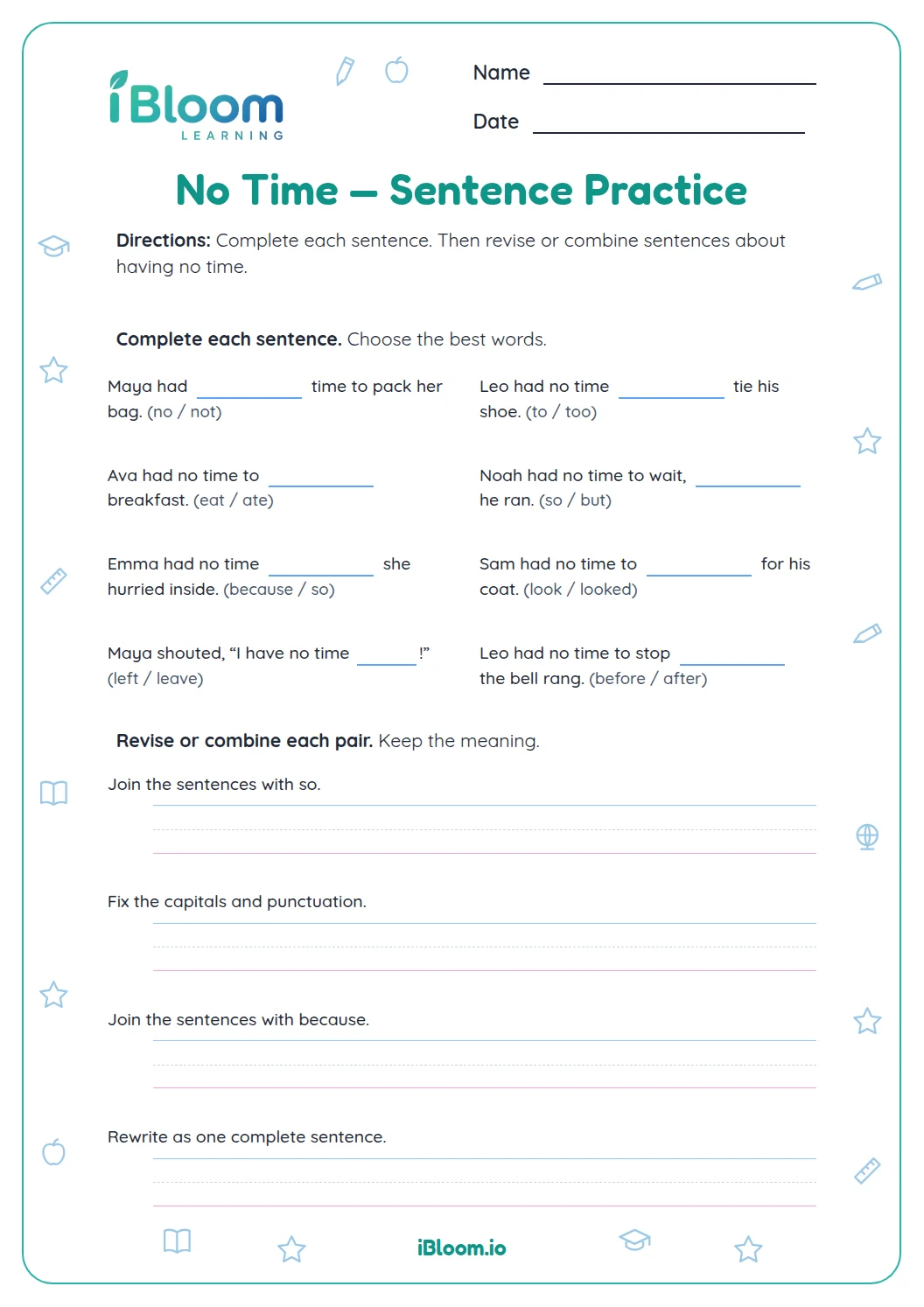
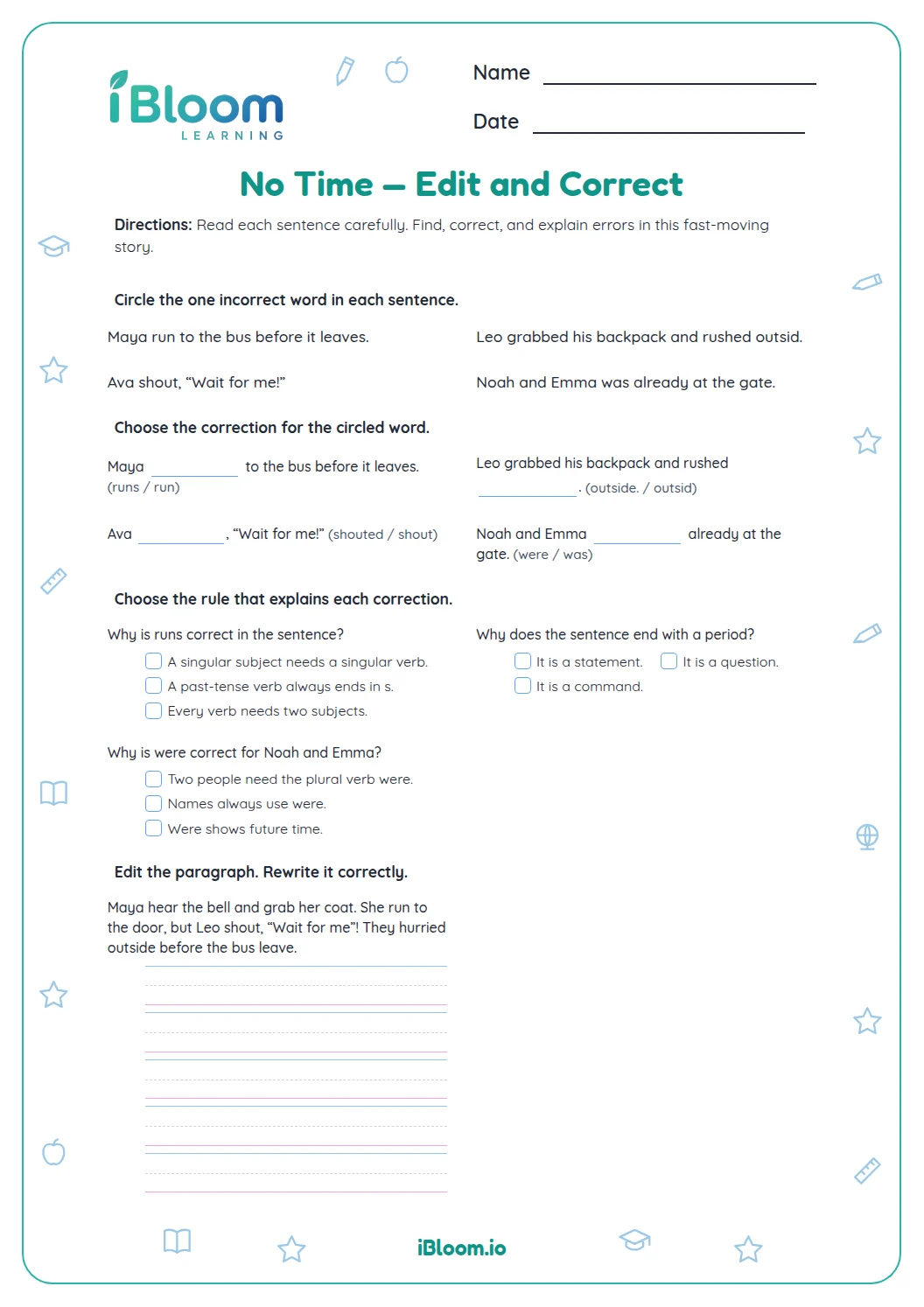
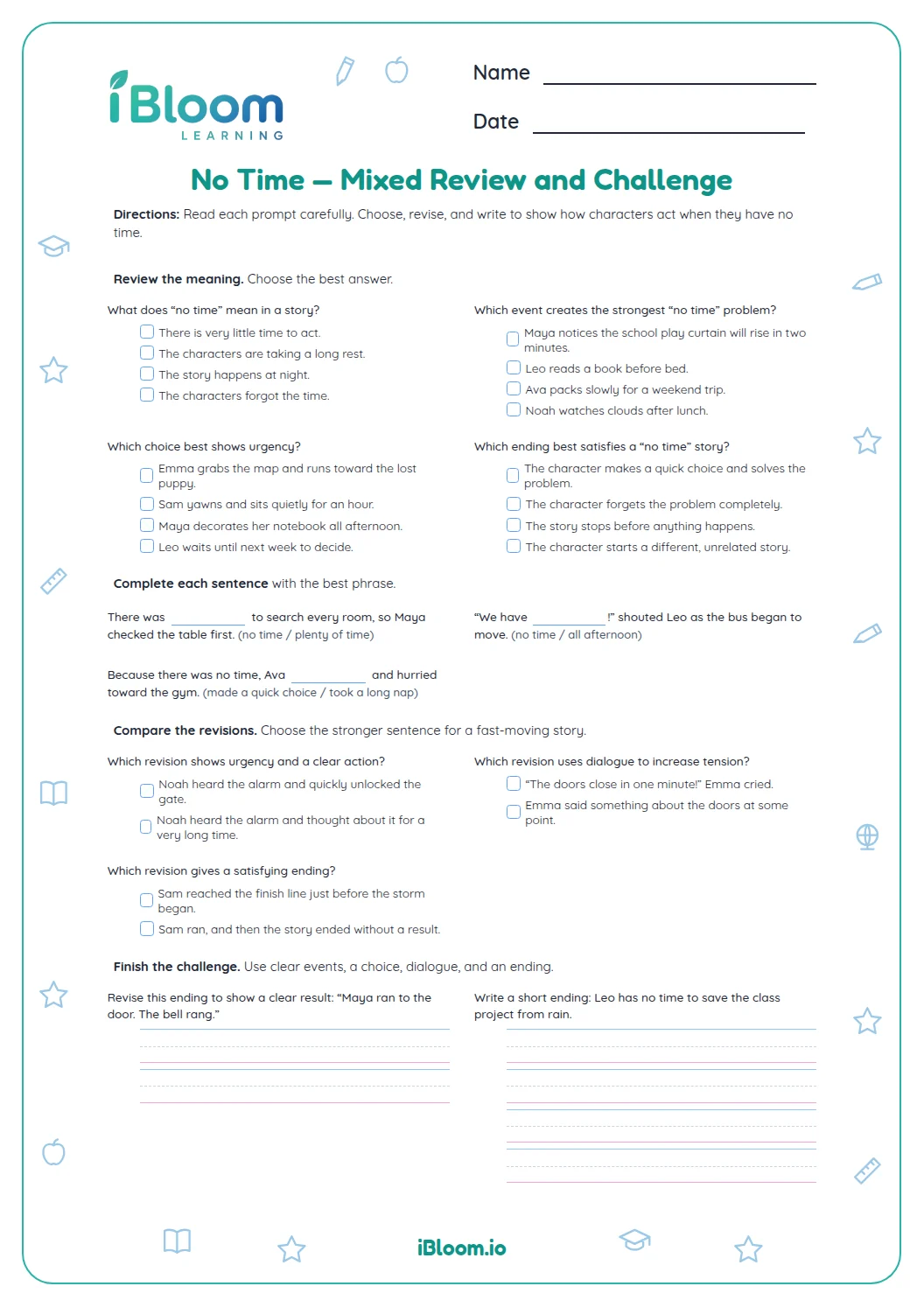
This Grade 4 narrative writing worksheet uses the “No Time” story situation to help students complete story moments. In 14 prompts, writers add logical next events, finish sentences with dialogue or description, and choose details that show a character’s reaction or help readers picture a scene. The practice supports Common Core W.4.3: developing real or imagined events with descriptive details and a clear sequence. A separate key gives sample completions for open responses.
Aligned to W.4.3
What is in the guided practice?
Part A begins Maya’s bus story. Part B asks students to choose words that fit the next sentences. Part C continues the same story with dialogue, a transition, details and an ending.
The prompts keep Maya, Leo and the bus sequence from the old “No Time” sheet, then give children room to add fitting story details.
- Part A: write a possible next event
- Part B: choose a fitting word or phrase
- Part C: complete the story with details and an ending
How can a next event feel logical?
A next event grows from what just happened. If a bus is closing its doors, a character might wave to the driver. Ask what the character sees, wants or needs right now.
- 1Maya reached the bus. What did she do next? → Maya climbed aboard.
- 2The action follows the problem and moves the story forward.
What makes a detail vivid?
A concrete detail gives a reader something to picture, hear or feel. “Cold blue light filled the narrow room” gives more information than “The room was there.” A character’s movement can also show a feeling without naming it.
How should a short story moment end?
A closing line should follow from the event just before it. If the character finds a missing key, the next line can show relief or what the key makes possible. Read the sequence from beginning to end to check that it makes sense.
How to use this worksheet
- 1Read the situation and identify the character’s immediate problem.
- 2Choose an action that follows from that problem.
- 3Use the sentence starter to add a precise detail or dialogue.
- 4For choice questions, pick the line that shows a feeling or paints a scene.
- 5Reread the moment to check its order and meaning.
Common mistakes and quick fixes
The mistake
Adding an event that does not connect to the situation.
The fix
Ask what the character would naturally do next.
The mistake
Naming a feeling without showing it in a scene detail.
The fix
Add a movement, sound or sensory clue that helps readers infer the feeling.
The mistake
Using a transition that does not match the order.
The fix
Use “Next” for a following event and “Meanwhile” for something happening at the same time.
Common Core alignment
These standards describe the narrative writing practiced on this page.
Build a narrative with events in a natural order and precise details.
On this sheet: Students complete narrative moments with actions, dialogue, transitions and sensory detail.
Show the official wordingHide the official wording
Write narratives to develop real or imagined experiences or events using effective technique, descriptive details, and clear event sequences.
What to practice next
Make more practice
Further reading
Questions parents and teachers ask
Do students need to match the sample answers exactly?
No. Part C uses open completions, so the key gives examples rather than the only possible lines. Accept a different complete response if it follows the prompt and fits what Maya and Leo are doing. Part B choices have a specific best answer because each sentence provides context.
What does “No Time” mean in this worksheet?
“No Time” is the bus-catching situation from the original page in the morning. Maya wakes late, grabs her backpack, hurries outside and sees the bus starting to leave. Students complete the sequence so each event follows naturally from the one before it.
How can I help a child who is stuck?
Ask what Maya can see or needs at that moment. For an open response, offer a prompt such as “What could she do next?” and let the child finish the idea. For a choice question, reread the whole sentence and test each option aloud.
Why does the worksheet include dialogue?
Dialogue shows what a character says and can move a scene forward. In Part B, Leo calls to Maya, and in Part C students imagine what he says to help her. Quotation marks show readers which words belong to the speaker.
What should a useful story detail do?
A useful detail helps a reader picture an action, setting or feeling. “Her backpack bounced as she ran” adds a visible clue that Maya is hurrying. A detail should fit the event and give the reader information beyond “she went.”