


About this worksheet
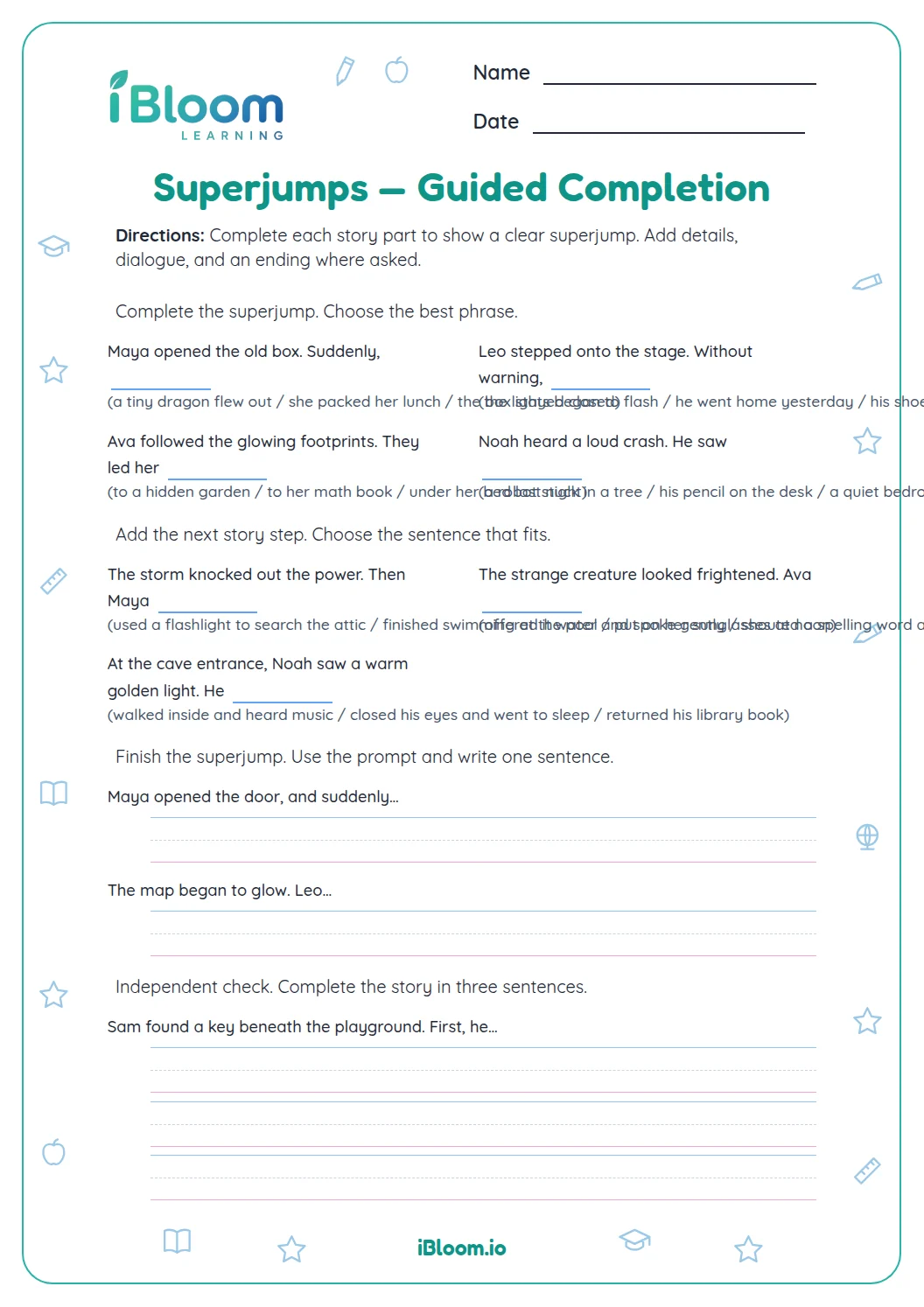
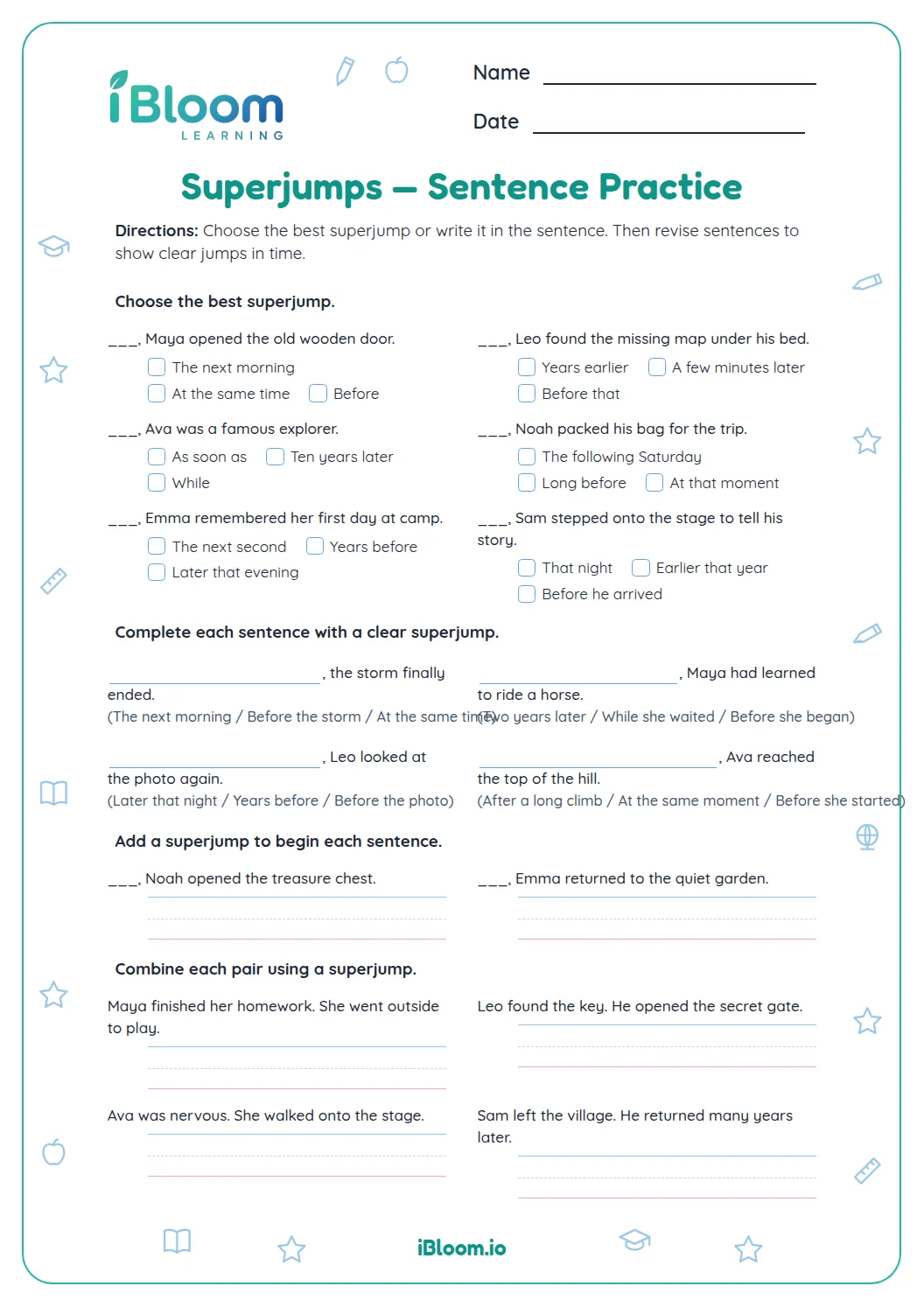
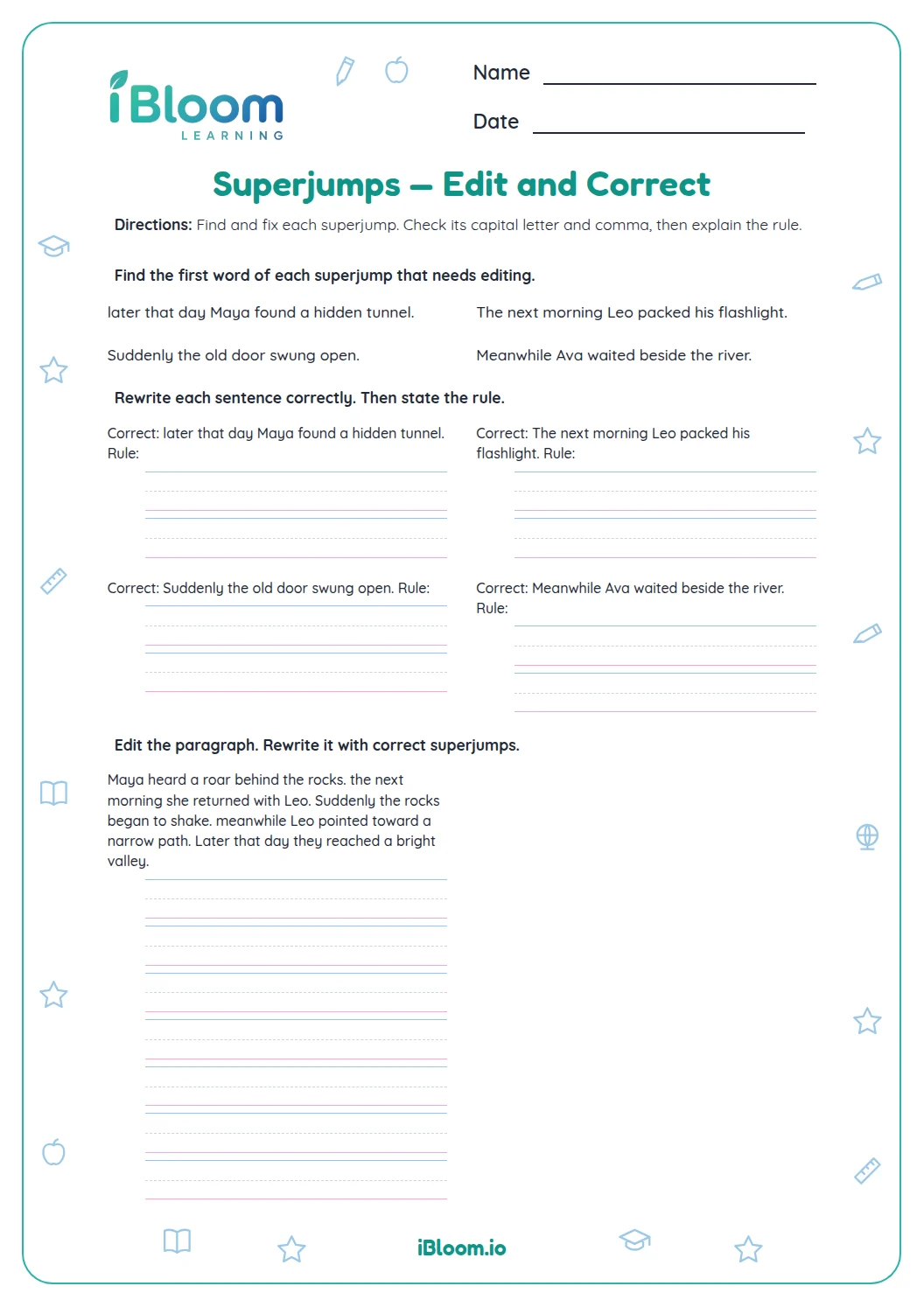
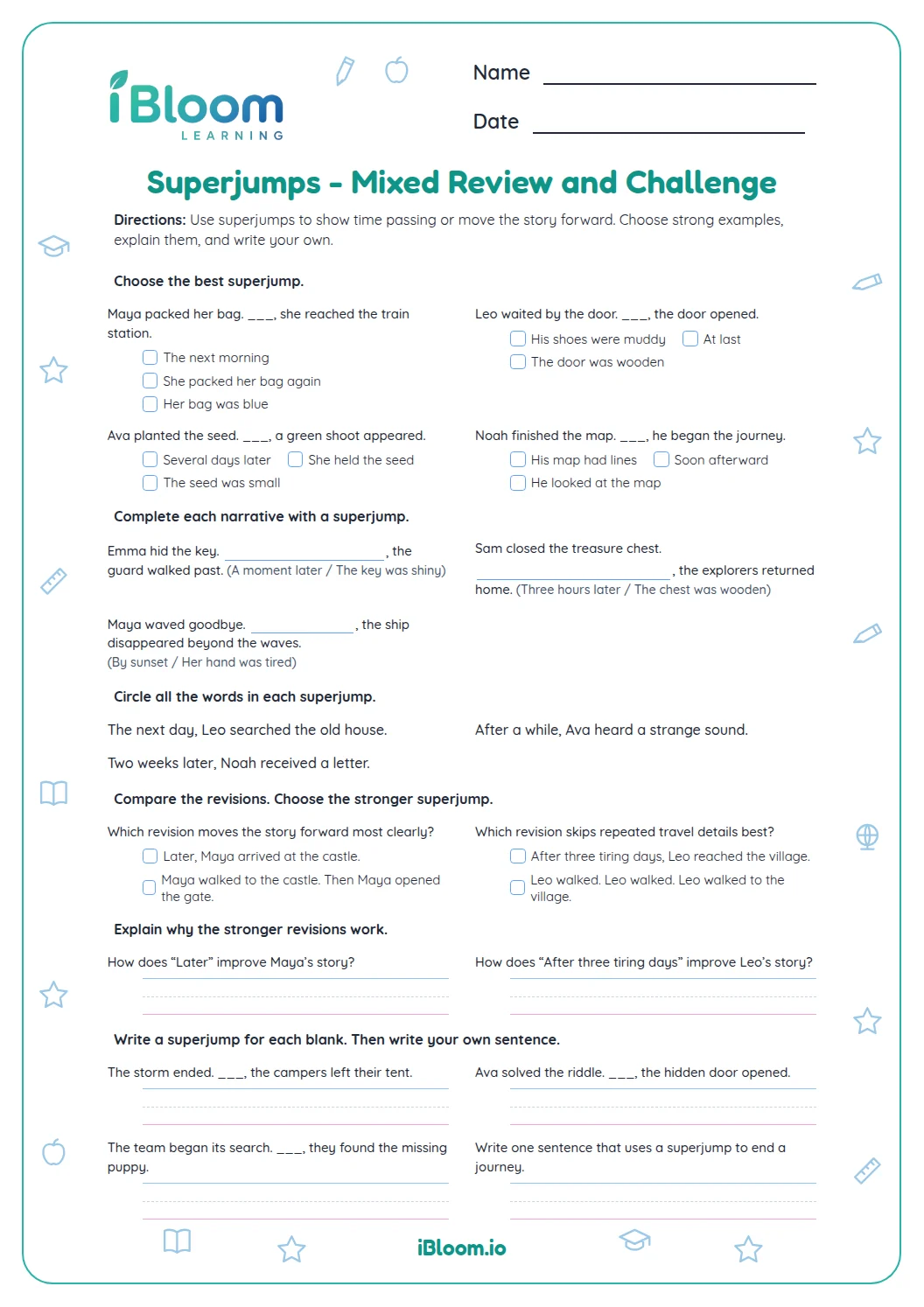
This Grade 4 narrative worksheet teaches students to recognize a superjump, a time phrase that moves a story to a later moment. Seven paired sentences ask students to find the time shift; seven more examples ask them to classify a sentence. The answer key marks each choice so students can compare how time phrases change a story timeline.
How can I spot a superjump?
Look for words that tell readers a later time has arrived. In question 1, “Next morning” moves the story beyond Maya opening the box.
- 1Maya opens the box.
- 2Next morning, Maya opens the box.
- 3The second sentence begins later.
How is a superjump different from an action?
An action tells what happens; a superjump signals that time has moved ahead. “Sam pushes open the door” names an action without a time shift. “Later that night, Sam packs his bag” adds a phrase that places the event later.
What happens in the second part?
Questions 8–14 ask students to classify a single sentence as Superjump or No superjump. They can point to the time phrase when one appears, then check the key for the intended choice.
How to use this worksheet
- 1Read both choices in a pair.
- 2Look for a phrase that names a later time.
- 3Choose the sentence that moves the story forward.
- 4For questions 8–14, decide whether a time shift is stated.
- 5Check the key and name the time clue.
Common mistakes and quick fixes
The mistake
Calling every action a superjump
The fix
An action says what happens; a superjump also signals a later time.
The mistake
Skipping a short phrase such as “later”
The fix
Scan the beginning and middle of the sentence for words that tell when.
The mistake
Treating any word after “after” as a time jump
The fix
Check whether the phrase names a time, such as “after lunch,” rather than simply an event or object.
What to practice next
Make more practice
Questions parents and teachers ask
What does superjump mean on this worksheet?
A superjump is a phrase that tells readers a story has moved forward to a later moment. Examples include “the next morning,” “after lunch” and “two days later.” The worksheet contrasts those phrases with sentences that name an action but do not state a time shift.
Is every sentence with an action a superjump?
No. An action tells what a character does, while a superjump signals that time has moved ahead. “Maya opened the box” names an action. Adding “The next morning” places the action at a later moment and makes the time shift clear.
Which time phrases appear in the practice?
Students see “next morning,” “minutes later,” “that evening,” “after lunch,” “the next day,” “later that night,” and “two days later.” Each phrase gives a clue about when the event happens in relation to an earlier moment. Students can underline the phrase they used.
How can a student check for a time jump?
Ask when the action happens and look for a phrase that places it later. If the sentence only names an action, choose No superjump. In the paired questions, compare both sentences and identify the one that includes a later time phrase.
How many questions are on the worksheet?
There are 14 questions in two parts. The first seven ask students to choose the sentence with a superjump from a pair. The next seven ask them to classify a single example. A separate answer key lists each choice and makes checking straightforward.