



About this worksheet
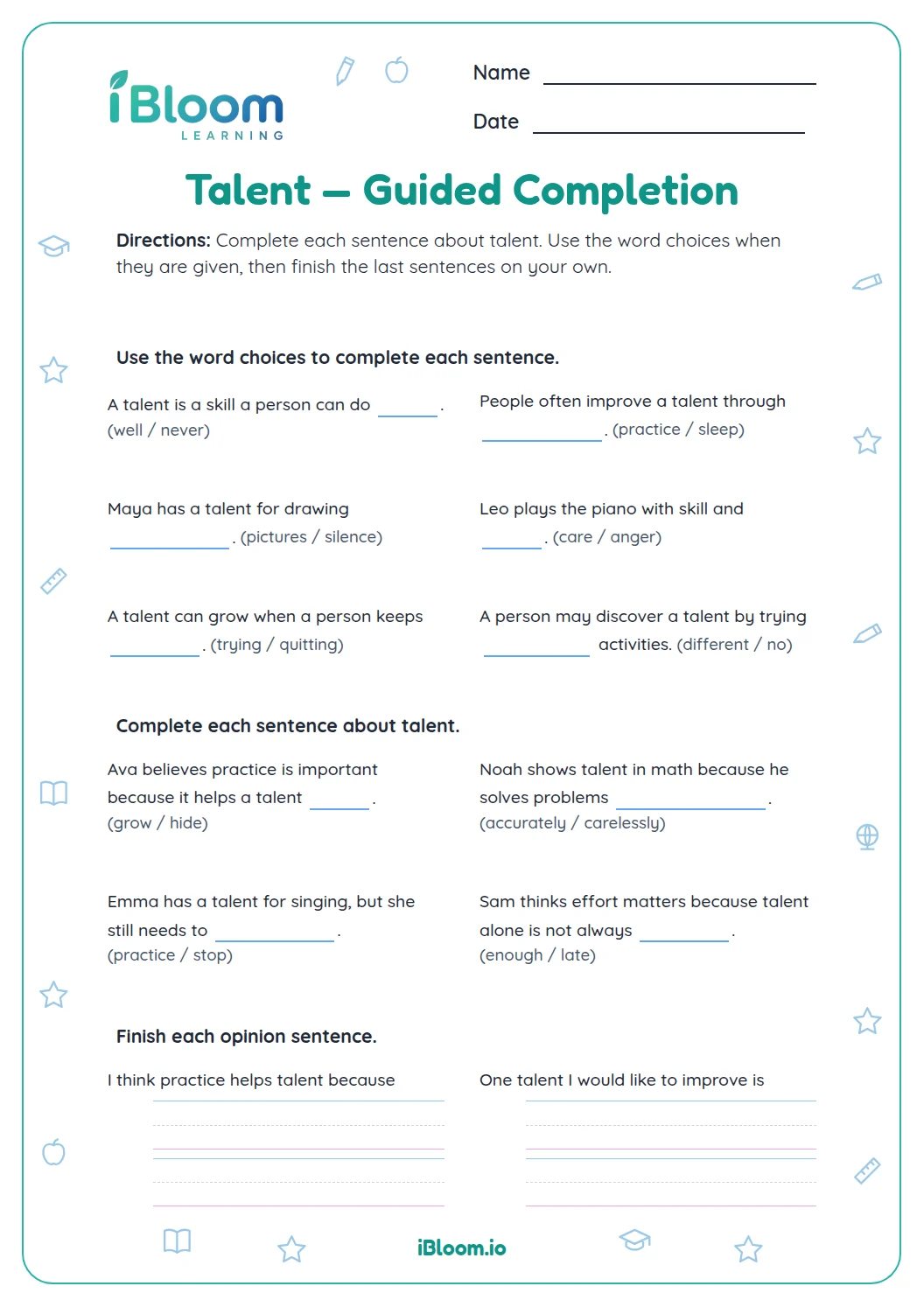
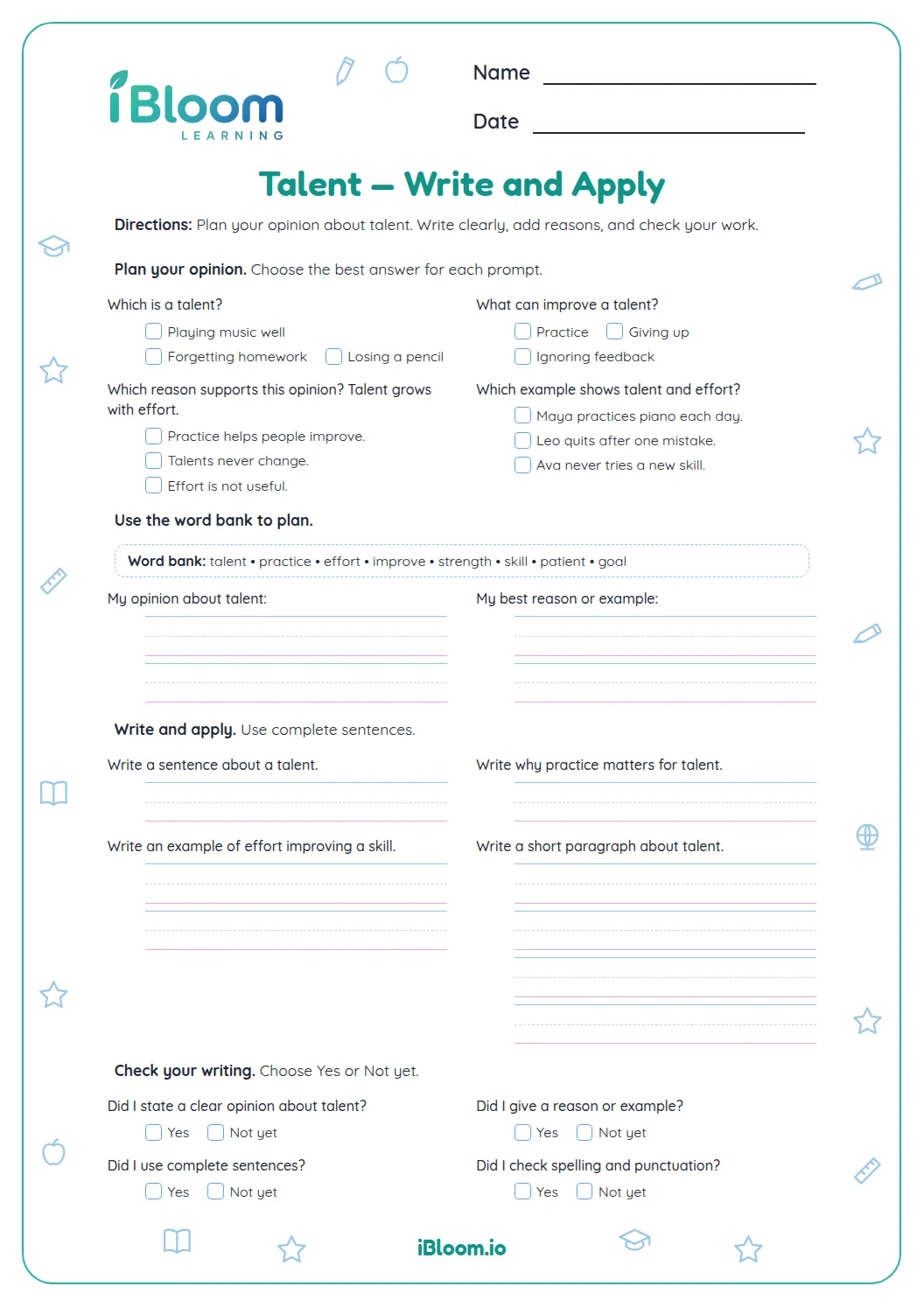
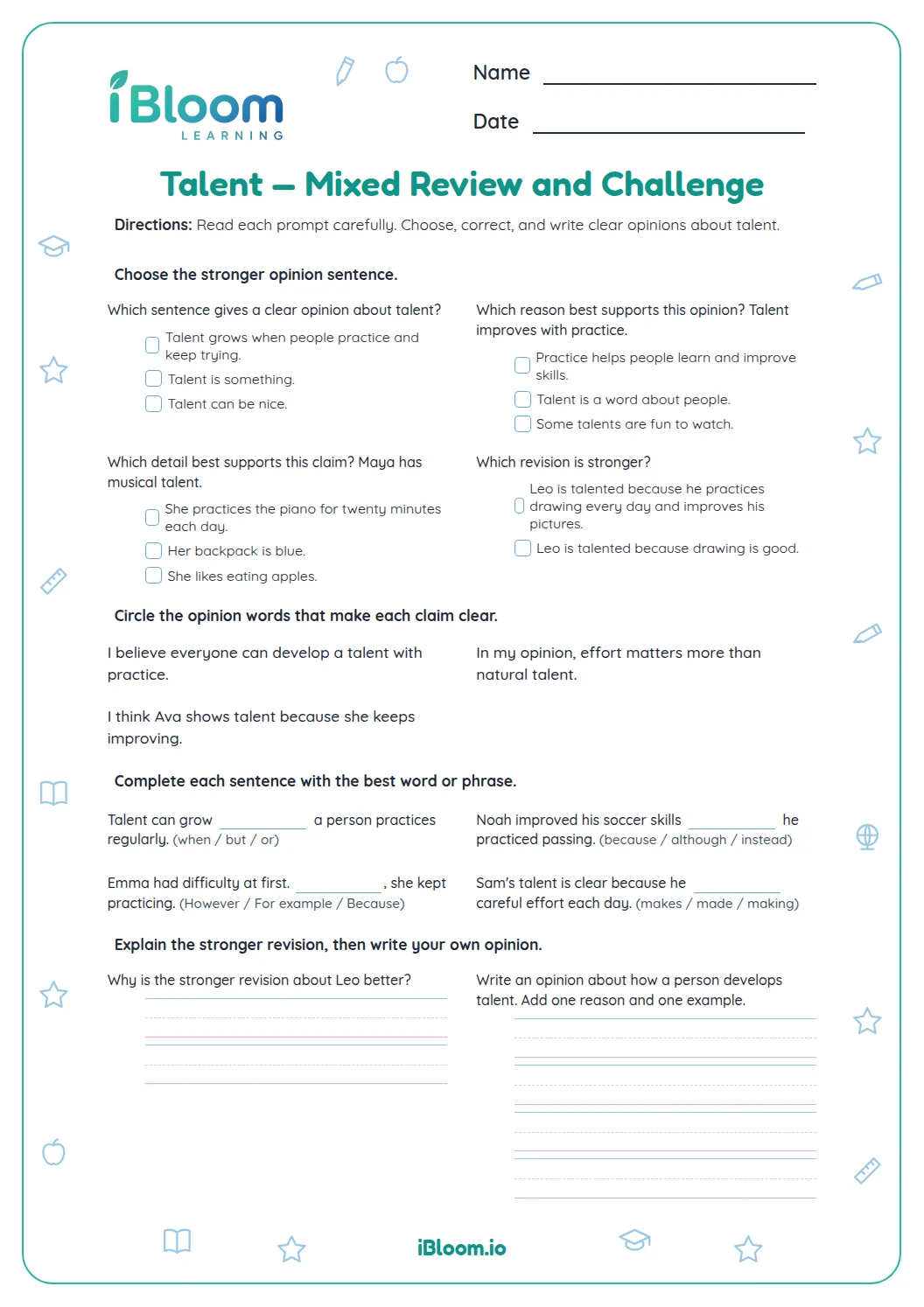
This free printable gives Grade 4 students 16 questions about writing opinions on talent. Part A distinguishes opinions, facts, and relevant reasons. Part B asks students to write and revise claims about skills, practice, and teamwork. It practices Common Core W.4.1 by supporting a point of view with reasons and information, and includes a separate answer key with sample responses.
Aligned to W.4.1
What does each part ask students to do?
Part A has eight choices about claims, facts, reasons, linking words, and respectful comparisons. Part B has eight writing tasks, from adding a reason to revising a claim or writing a short conclusion.
How can a reason support an opinion?
Question 1 gives the sentence “Maya plays violin confidently because she practices each day.” The opinion describes her playing; the because-clause explains how practice supports that skill.
- 1Opinion: Maya plays confidently.
- 2Reason: she practices each day.
How are facts different from opinions?
A fact can be checked, such as how long someone has taken art lessons. An opinion expresses a judgment, such as which talent is most exciting. Facts can support an opinion when they connect to the point being made.
How can students make a comparison respectful?
Describe how different talents help people rather than ranking one person above everyone else. In Part B, a clear reason can explain how a skill helps a team, shares ideas, or improves through practice.
How to use this worksheet
- 1Read the prompt and decide whether it asks for a fact, an opinion, or a reason.
- 2For a choice, check which option answers the whole question.
- 3For a written response, state the opinion before giving its reason.
- 4Use a specific detail that connects to the claim.
- 5Reread for respectful wording and a complete sentence, then compare with the sample key.
Common mistakes and quick fixes
The mistake
Treating a fact as an opinion.
The fix
Ask whether the statement can be checked; “Luis took lessons for two years” is verifiable.
The mistake
Adding a detail that does not support the claim.
The fix
Explain how the detail relates to the opinion, such as practice helping a skill improve.
The mistake
Calling one talent better than every other talent.
The fix
Describe how different skills can help people or a group in different ways.
Curriculum alignment
This worksheet practices the skills named in the standard below.
Support an opinion about talent with clear reasons and relevant information.
On this sheet: Students select and write opinion sentences supported by relevant reasons and details.
Show the official wordingHide the official wording
Write opinion pieces on topics or texts, supporting a point of view with reasons and information.
What to practice next
Make more practice
Further reading
Questions parents and teachers ask
What is an opinion sentence?
An opinion sentence tells what a writer thinks or believes. A reason helps a reader understand why the writer holds that view. Question 1 pairs an opinion about Maya’s violin playing with the detail that she practices each day, so the two parts work together.
How can a student choose a good reason?
Choose a detail that explains or supports the opinion. Practicing can help a pianist play a song more smoothly, so it supports the idea that talent can grow. Owning a piano is a fact, but by itself it does not explain why practice develops a skill.
Can students write about any talent?
The open prompts invite students to write about talents such as music, art, cooking, teamwork, or learning a new skill. A response should state an opinion and give a fitting reason. Students may use their own wording when it keeps the same clear idea and support.
How are facts different from opinions?
A fact can be checked, such as the number of years someone has taken lessons. An opinion expresses a judgment, such as whether drawing is exciting. Part A asks students to identify facts and opinions so they can tell a claim from the information that may support it.
What does the answer key show for writing questions?
The key provides a sample response for each open writing prompt. Students can phrase an answer differently if it clearly responds to the prompt and includes a fitting reason where asked. Check the claim and support rather than requiring an exact copy of the sample.