




About this worksheet
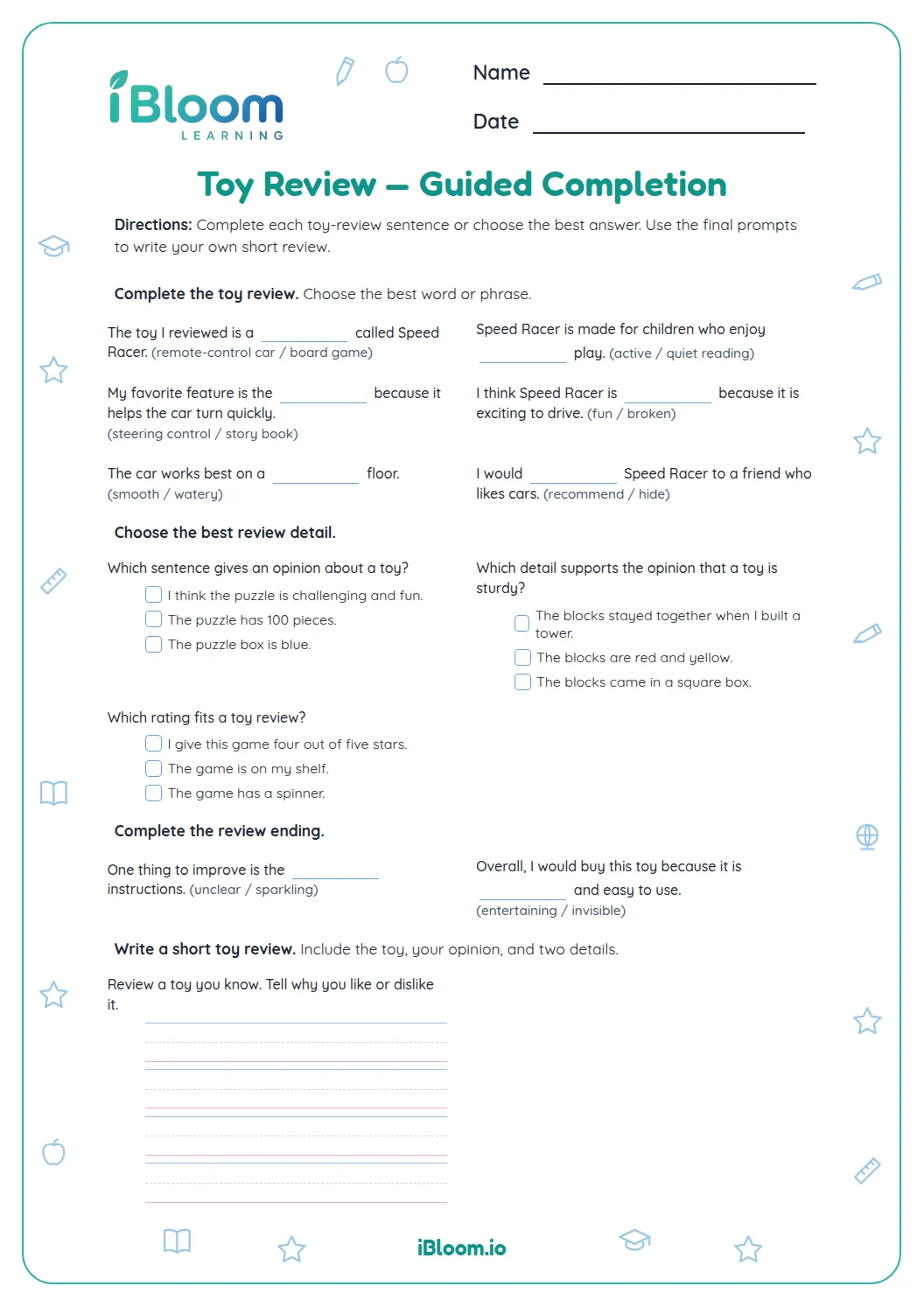
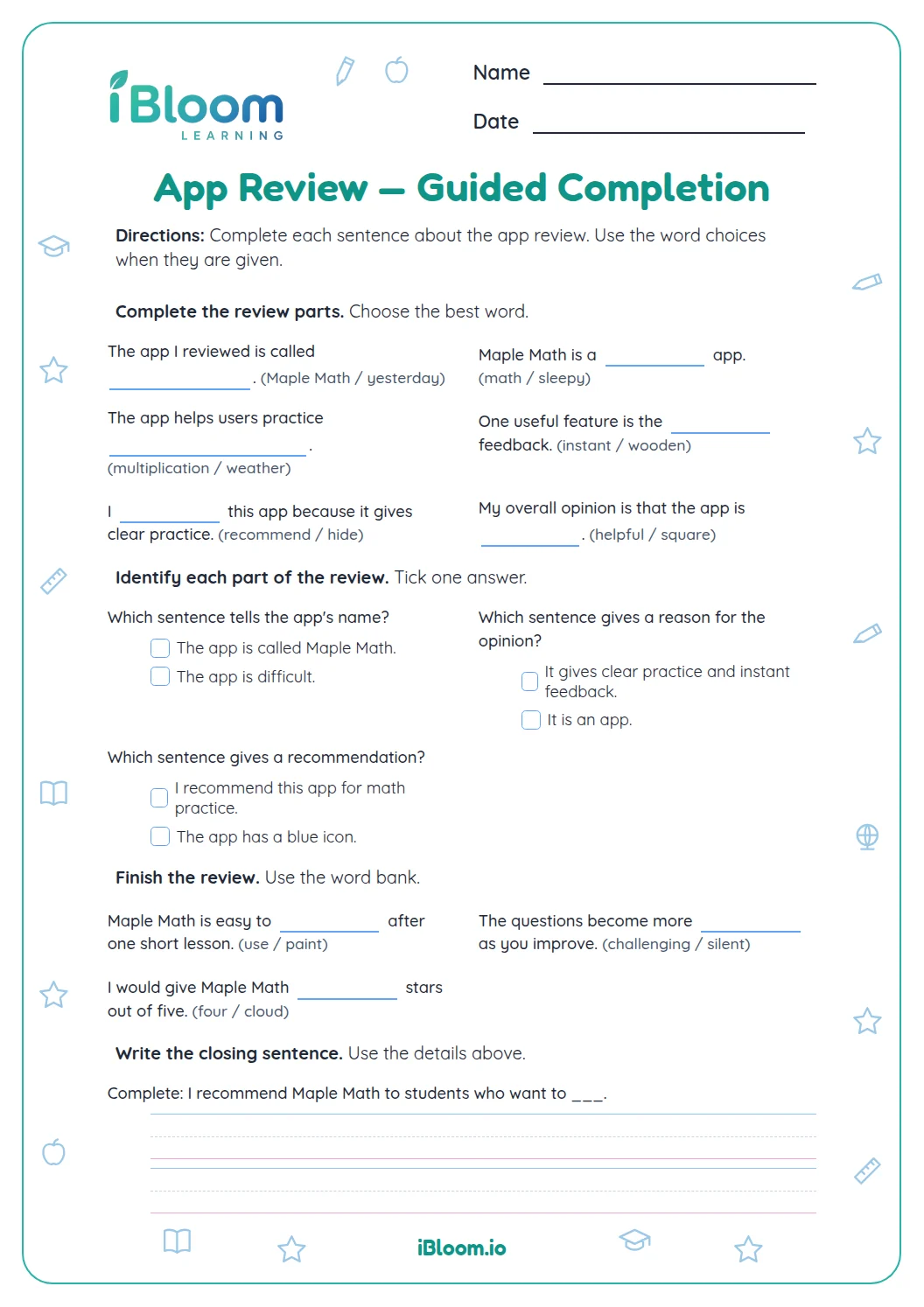
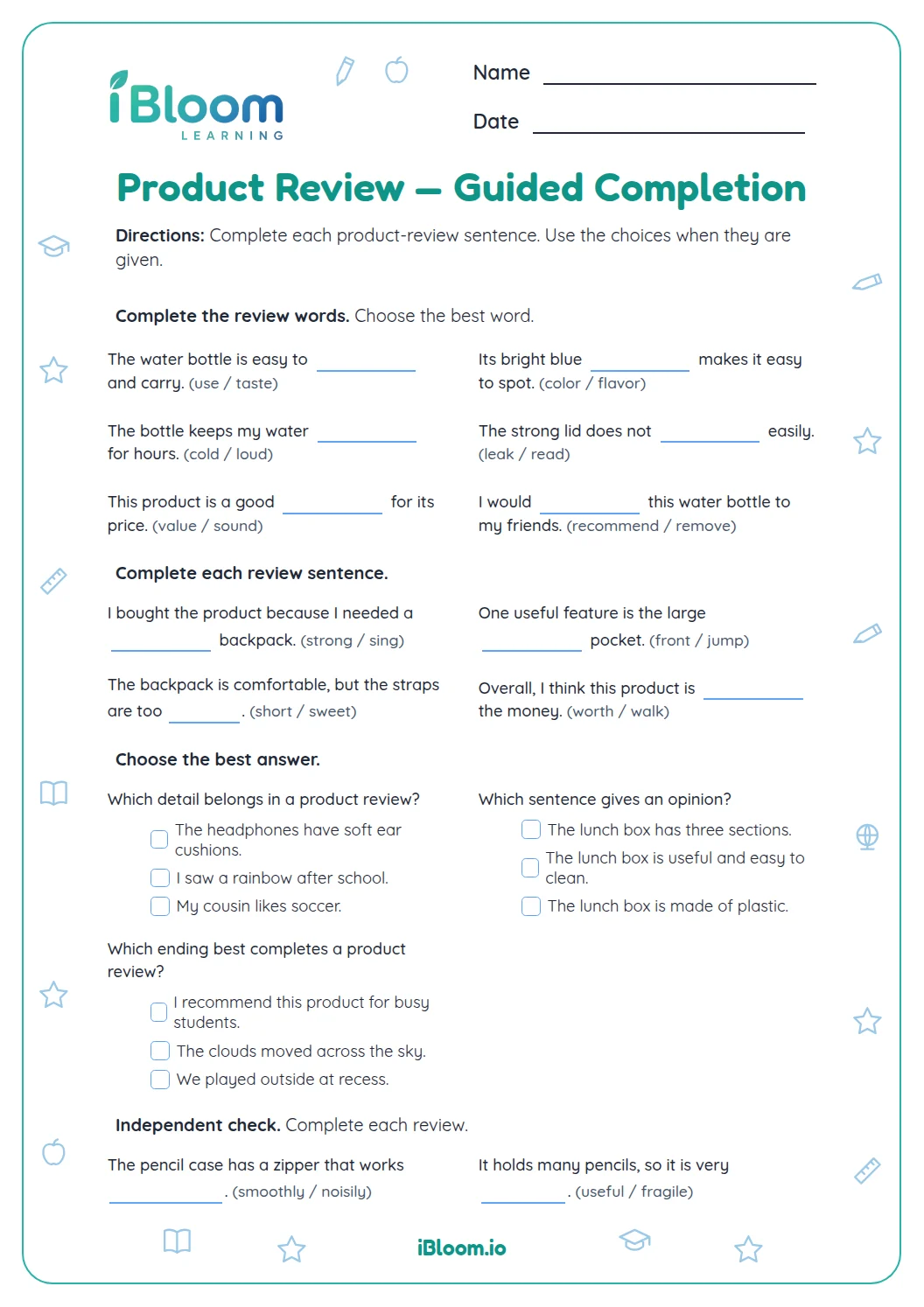
This Grade 4 worksheet uses short sentences about Zip, an imaginary robot toy, to help students identify parts of an opinion review. Its 14 multiple-choice questions cover opinions, reasons, checkable details, a weakness, an opening, a recommendation, and an off-topic sentence. The answer key gives the best choice for each item. Students practice recognizing how reasons and details support an opinion.
What jobs do review sentences do?
A toy review gives a judgment and information that helps a reader understand it. This sheet uses Zip, an imaginary robot, throughout. Students name the opinion, reason, checkable detail, opening, weakness, and recommendation in each sentence.
Question 1, “Zip is my favorite toy,” is an opinion. Question 2 describes what happens when the green button is pressed, so it is a checkable detail.
- 1“Zip is my favorite toy.” → opinion
- 2“The wheels turn when I press the green button.” → checkable detail
How does a reason support an opinion?
An opinion tells what the reviewer thinks. A reason gives a why; a detail adds information a reader can check. Some sentences combine an opinion and a reason, so look for the word because and name the explanation that follows it.
In question 3, “Zip is fun” is the opinion and “its wheels turn in circles” is offered as the reason.
How can a reader spot useful review parts?
A weakness names a limitation of the toy, while a recommendation tells a reader what the reviewer suggests. A sentence about planting beans does neither; it is off topic for a toy review.
Question 6 names a possible weakness: the remote has only two buttons. Question 4 recommends Zip to maze fans.
How to use this worksheet
- 1Read the review example in each question.
- 2Choose the label that best describes its job.
- 3For a reason, ask why the reviewer holds the opinion.
- 4For a detail, look for information someone could check.
- 5Use the answer key to discuss why a tempting choice is a different review part.
Common mix-ups
The mistake
Choosing a fact when the question asks for an opinion.
The fix
A fact can be checked; a phrase such as “my top pick” tells what the reviewer thinks.
The mistake
Calling any sentence about a toy a reason.
The fix
A reason explains an opinion. Ask “Why does the reviewer like it?” and look for the explanation.
The mistake
Treating a product detail as a recommendation.
The fix
A recommendation advises a reader to try or choose the toy; a detail only describes it.
What to practice next
Make more practice
Further reading
Questions parents and teachers ask
How many questions are on this worksheet?
Students answer 14 multiple-choice questions in two parts. They identify opinions, reasons, evidence, recommendations, openings, and weaknesses in toy-review examples. The answer key gives the best label or classification for each item, so an adult can check responses quickly.
What is the difference between an opinion and a reason?
An opinion tells what the reviewer thinks; a reason explains why. In “Zip is fun because its wheels turn in circles,” “Zip is fun” gives the opinion and the because-clause gives the reason. Students identify the job each piece plays.
Is Zip a real toy?
No. Zip is an imaginary robot used to keep the examples on one topic. The sentences mention its wheels, green button, and remote, but the worksheet does not provide product information about a toy for sale. Zip is a made-up character created for this worksheet; no real product or outside knowledge is needed to answer the questions.
What is a checkable detail?
A checkable detail gives information that a reader could verify by using or inspecting the toy. “The wheels turn when I press the button” describes something a reader could test. The worksheet asks students to distinguish that kind of detail from an opinion or recommendation.
Why does the worksheet include a weakness?
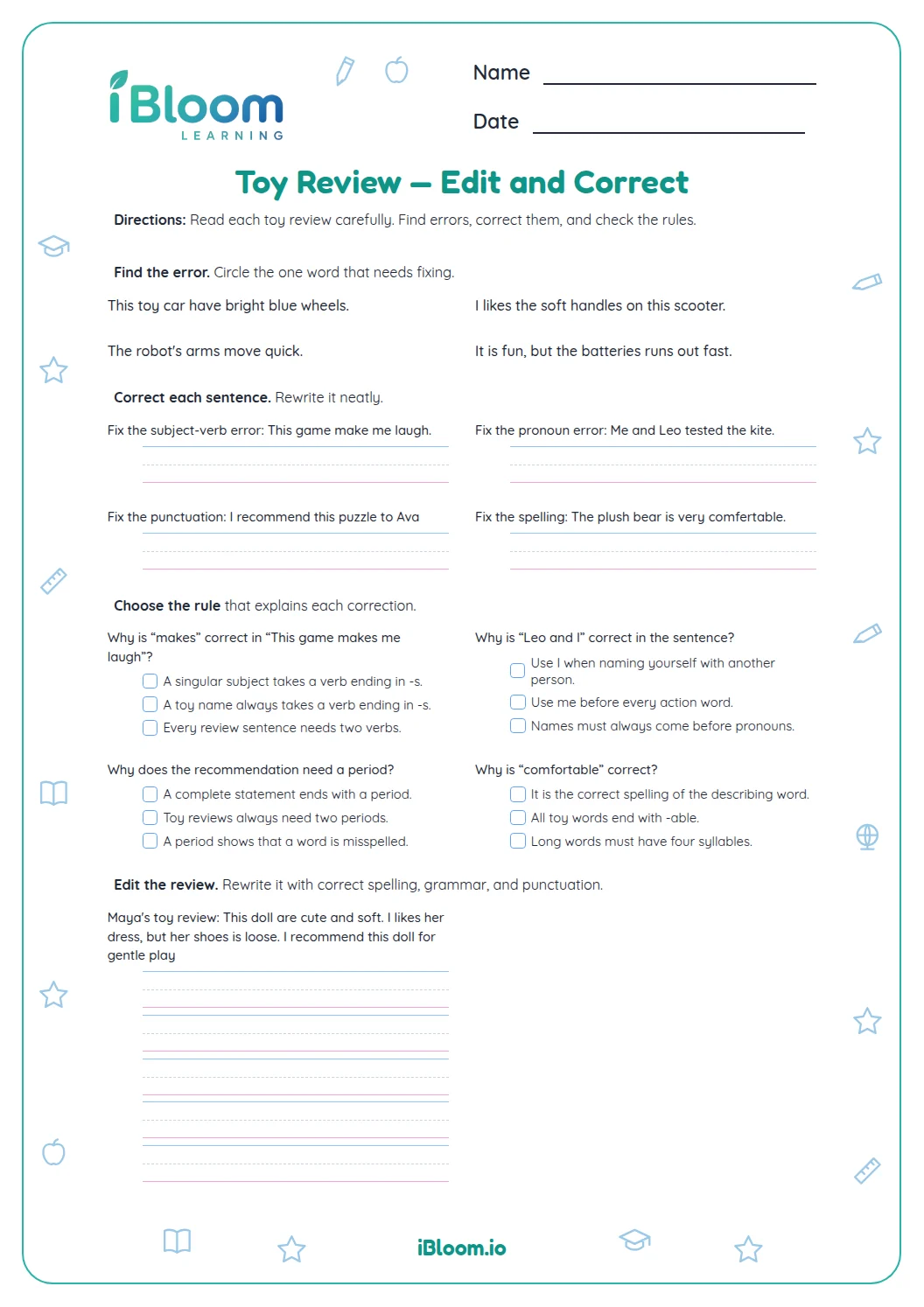
A weakness tells a reader about a possible drawback. “The remote has only two buttons” names a limitation, while an unrelated sentence about planting beans does not describe the toy. Naming both positive and limiting details can help a review inform its reader.
What can students do after this practice?
Students can use the related review pages linked below to identify these parts in another context. They can also draft a short toy review with one clear opinion, a reason, a checkable detail, and a recommendation for a reader who might enjoy the toy.