




About this worksheet
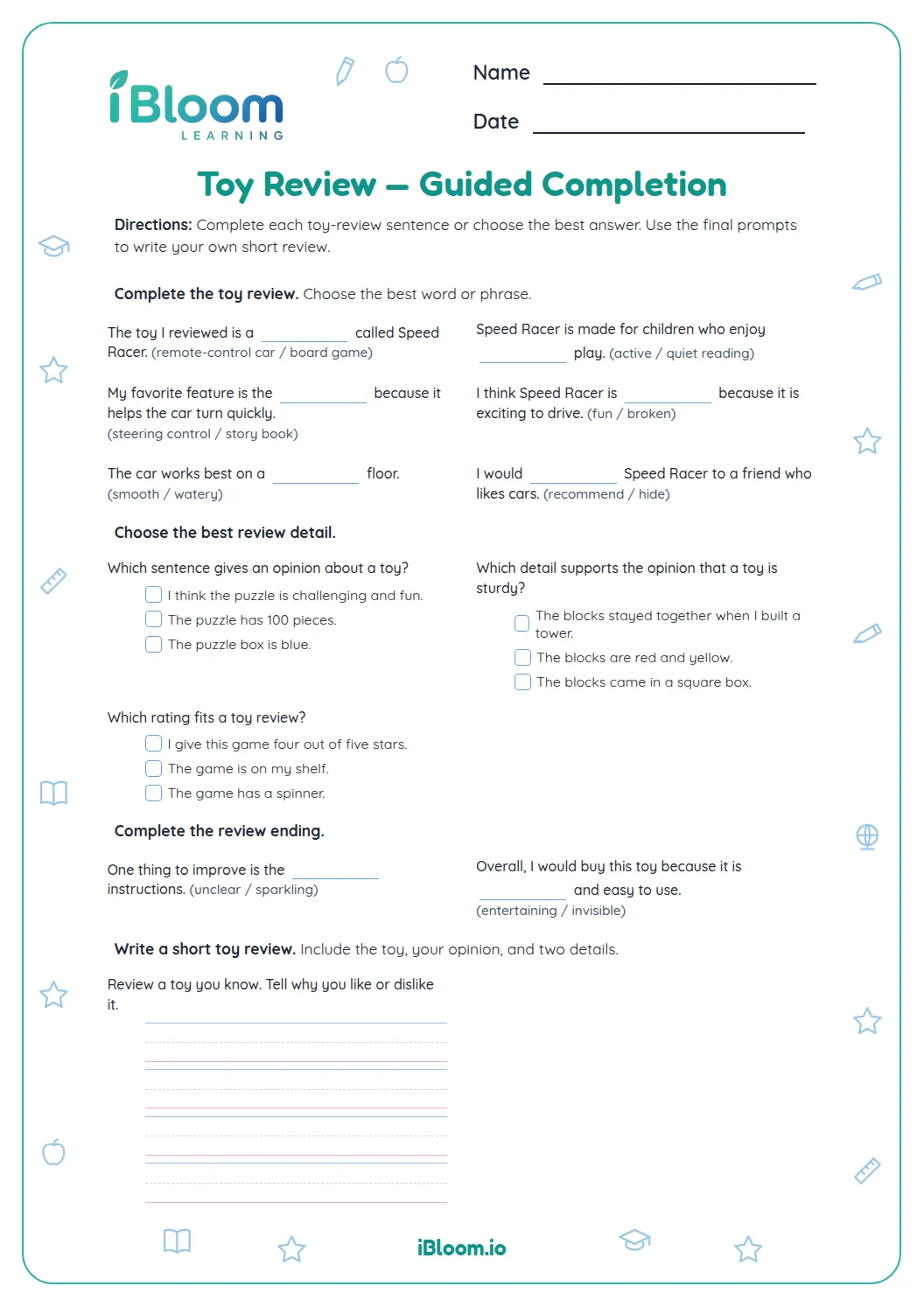
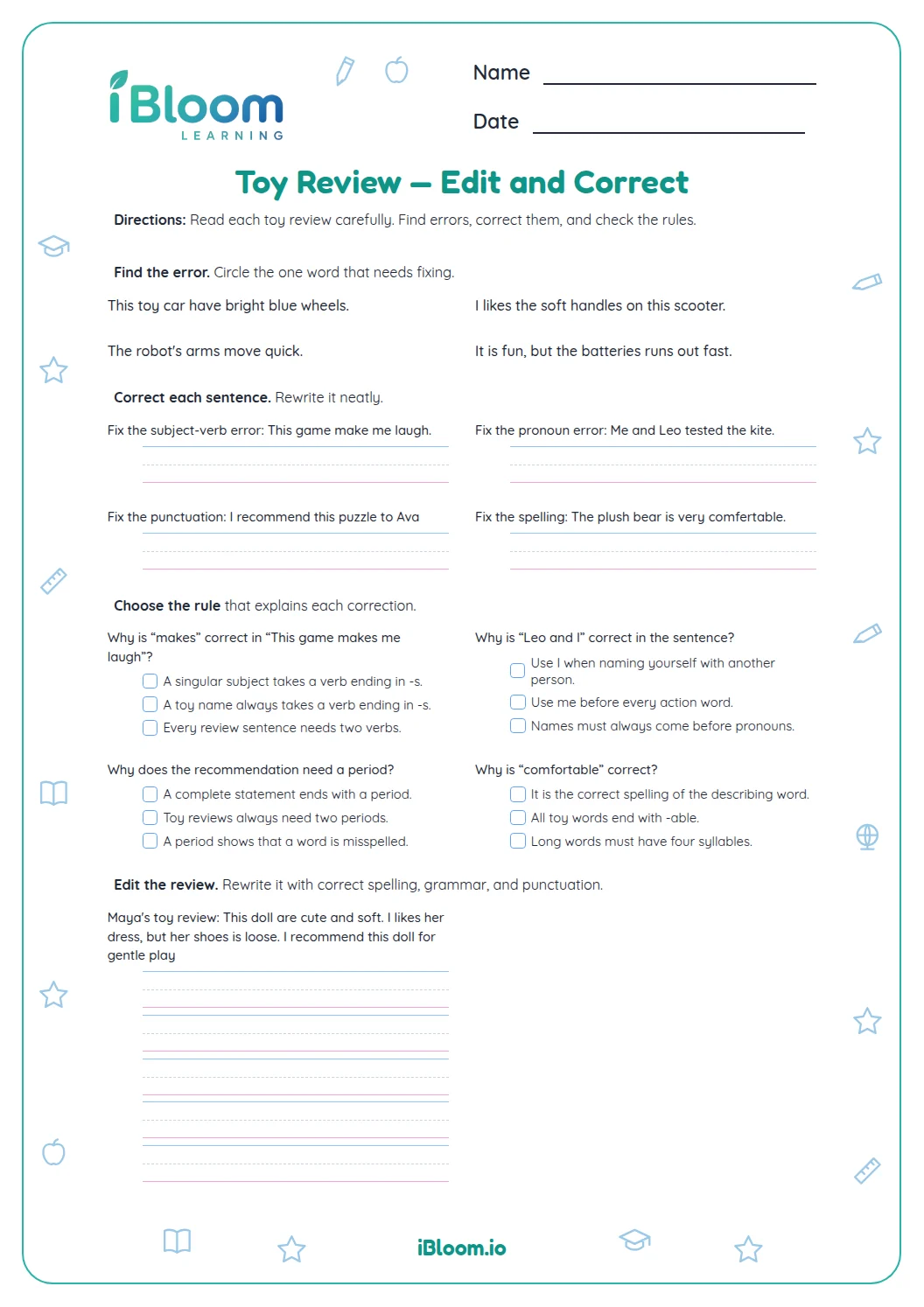
This Grade 4 writing worksheet uses toy reviews to practice stating an opinion and supporting it with a reason or specific feature. Children first identify opinions, supporting details, and linking words, then write and improve review sentences. It includes 16 questions across three worksheet pages and a three-page answer key with sample responses. The work practices CCSS W.4.1 by supporting a point of view with reasons and information.
Aligned to W.4.1
How can I tell an opinion from a fact?
“The kite is red” can be checked by looking at the kite. “The kite is the most fun toy to fly” tells what the writer thinks, so it is an opinion.
What makes a reason support an opinion?
A reason explains why the writer recommends a toy. For a building set, “It lets me build many different models” supports the opinion that the set is enjoyable.
How do I write a complete review sentence?
Start with a recommendation or opinion, then add a reason or detail. For example: “I recommend the kite because it stays steady in a breeze.” The reason explains the recommendation.
How to use this worksheet
- 1Read each choice and decide whether it states an opinion, a fact, or a reason.
- 2Match a reason to the opinion it actually supports.
- 3Use “because” to connect an opinion and its explanation.
- 4In writing items, include a clear toy opinion and a specific reason or feature.
- 5Check that every sentence is complete and that the reason matches the opinion.
Mistakes to watch for
The mistake
Listing a toy feature without giving an opinion.
The fix
Say what you think or recommend about the toy.
The mistake
Giving a reason that does not support the opinion.
The fix
Explain how the detail makes the toy enjoyable or useful.
The mistake
Stopping after “because.”
The fix
Finish the sentence with a complete reason.
State a toy opinion and support it with reasons and details.
On this sheet: Students write toy-review sentences with a clear opinion supported by a reason or feature.
Show the official wordingHide the official wording
Write opinion pieces on topics or texts, supporting a point of view with reasons and information.
What to practice next
Make more practice
Further reading
Questions parents and teachers ask
What is the difference between a fact and an opinion in a toy review?
A fact can be checked, such as a board game having 64 squares. An opinion tells what the writer thinks, such as calling a game a favorite rainy-day choice. The worksheet asks children to recognize both kinds of statements.
How many questions are on the page?
There are 16 questions across three worksheet pages and a three-page answer key. Part A covers opinions, reasons, details, and linking words; Part B gives children short writing tasks about toy reviews. Sample responses appear in the key.
What should a supporting reason include?
A supporting reason explains why the writer recommends or likes a toy. A specific feature helps when the writer explains why it matters to someone playing with the toy. This connection makes the review clearer and more convincing.
Can written responses differ from the answer key?
Yes. The key gives sample responses for open-ended prompts. A different sentence can also work when it is complete and its reason clearly supports the opinion or explains why a toy feature matters to a player. Check for a complete thought.
How can “because” improve a review?
“Because” links an opinion to its explanation. In “I recommend the puzzle because its clues are clever,” the clause after “because” tells why the writer recommends it. Use a complete reason that fits the opinion and the toy.