

About this worksheet
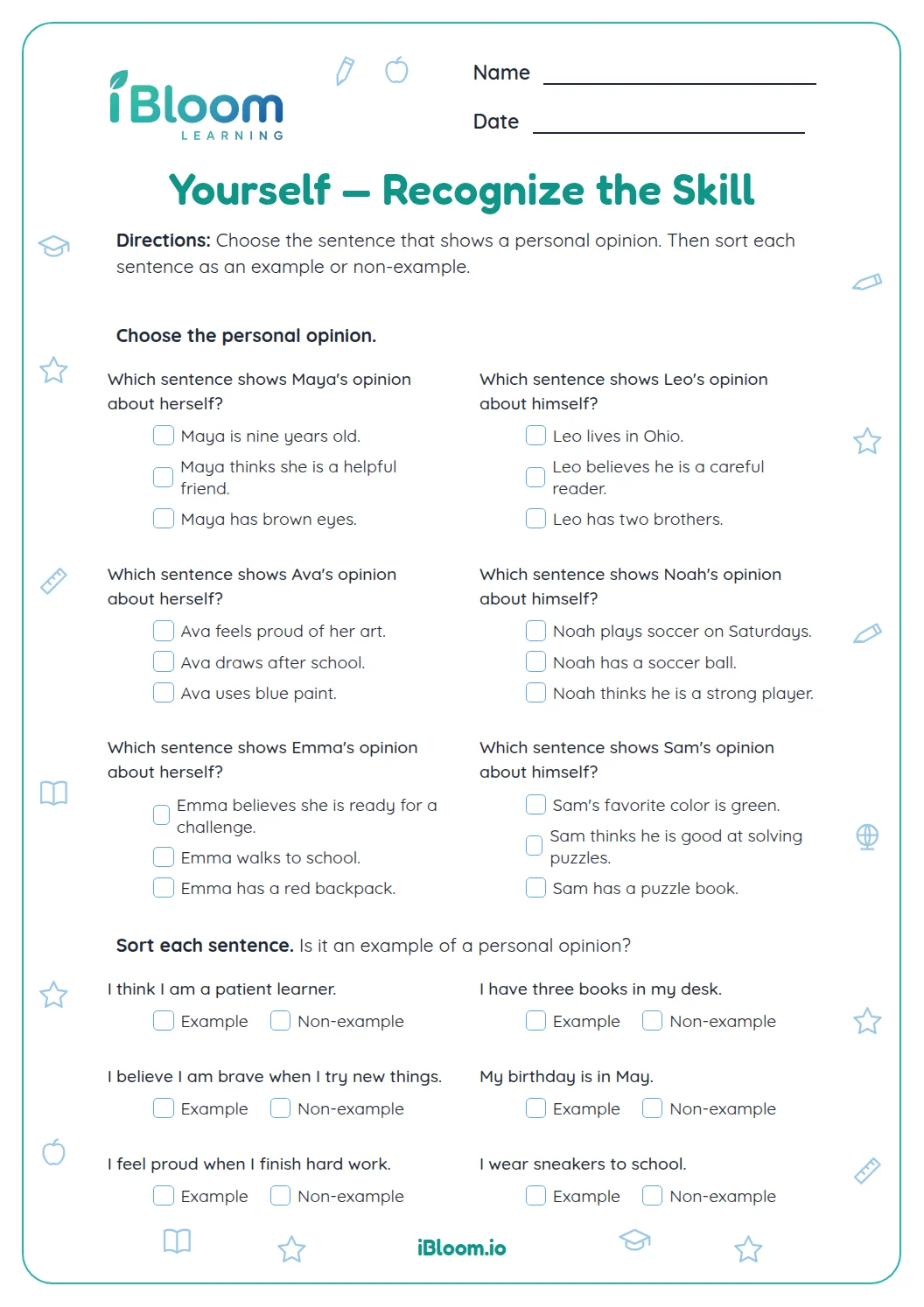
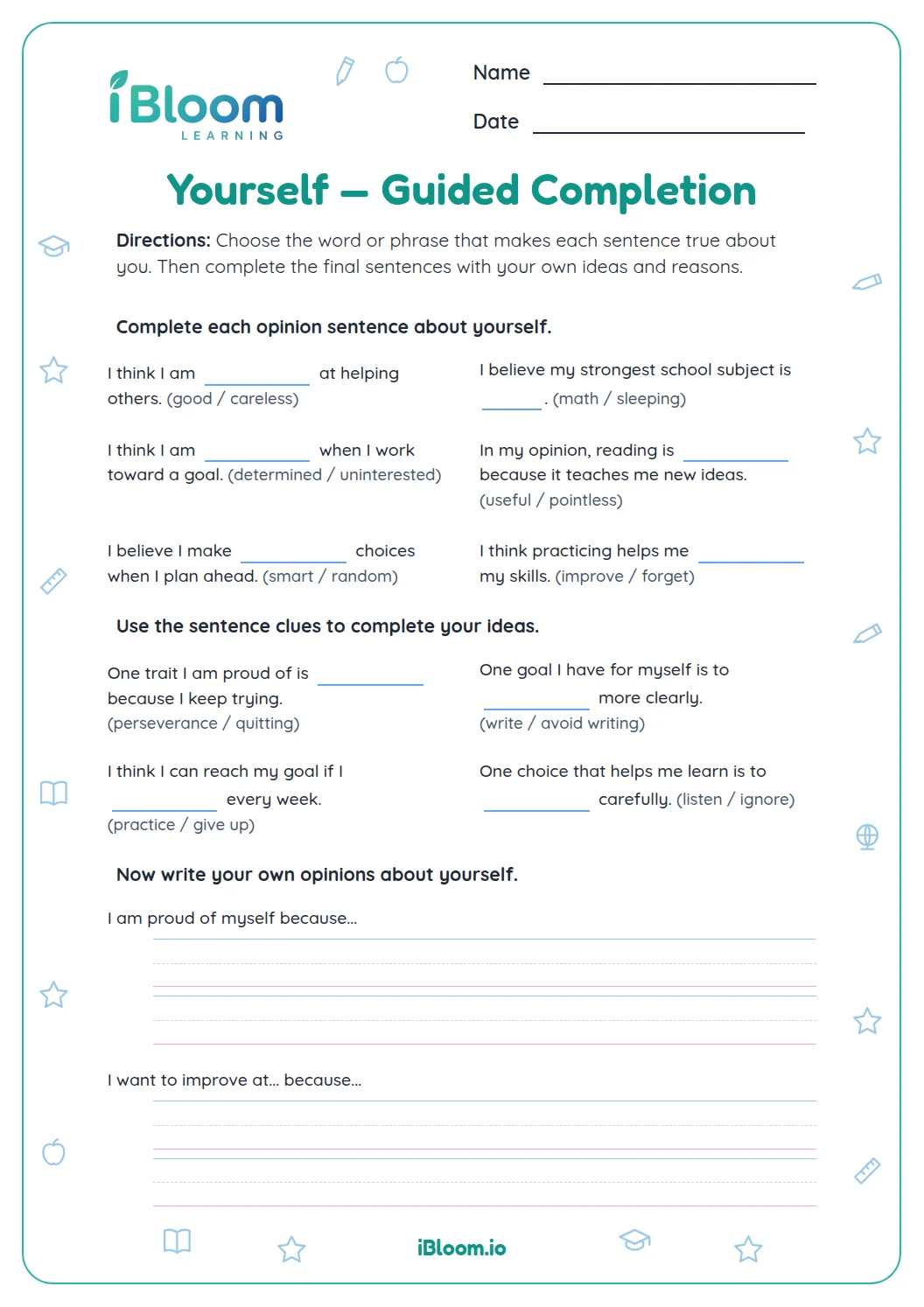
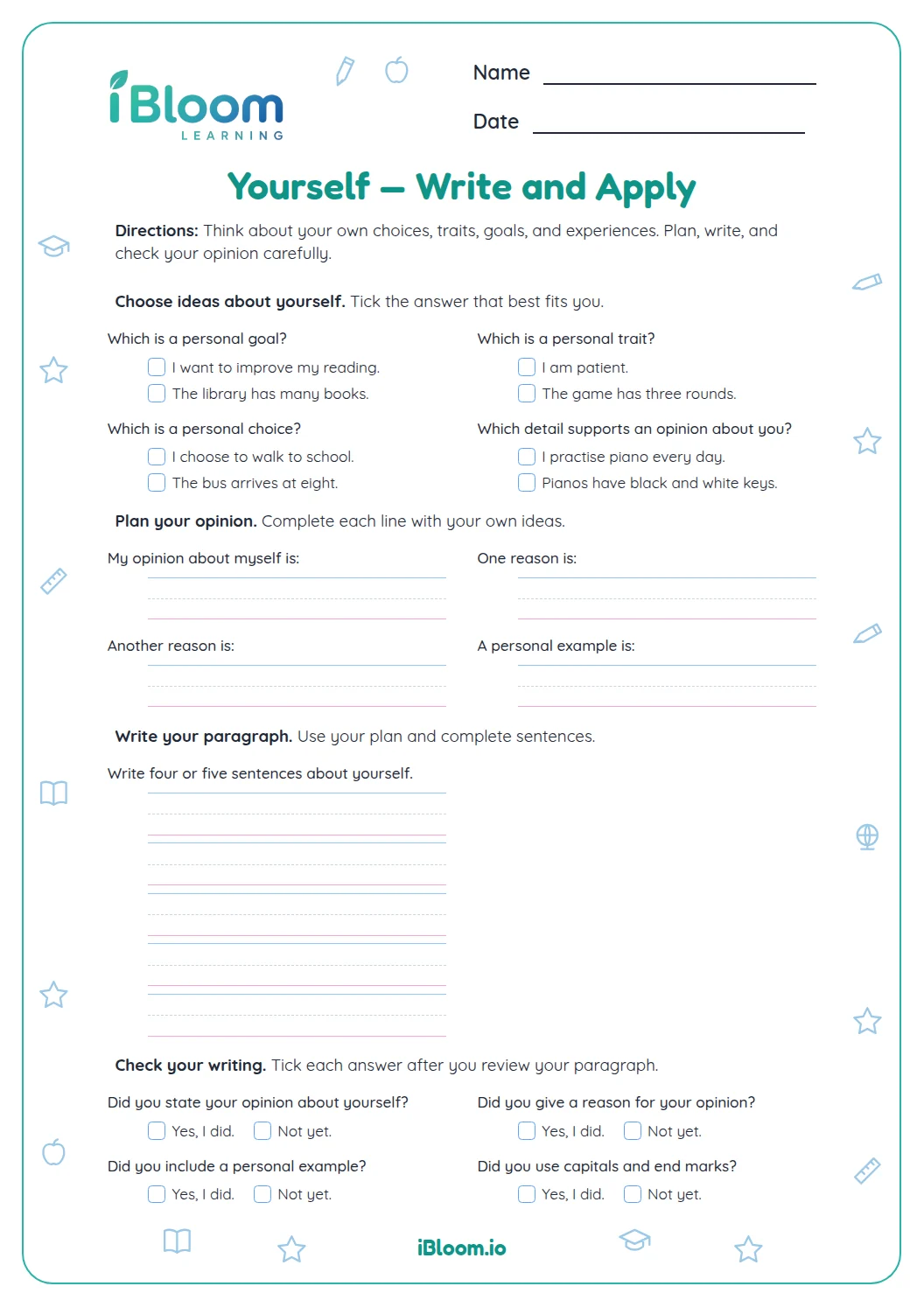
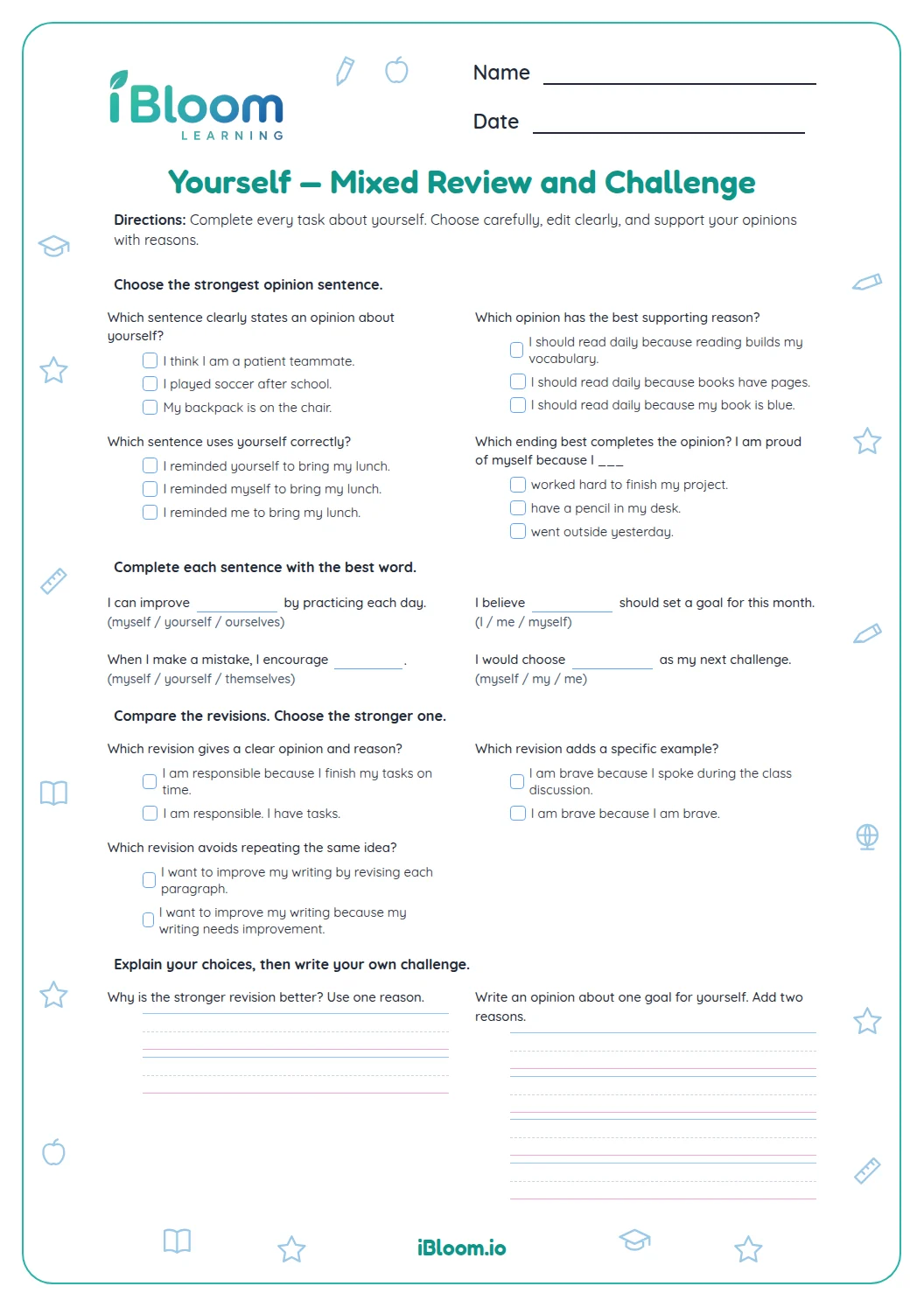
This Grade 4 grammar worksheet focuses on yourself as a reflexive pronoun. Students choose correct sentences, complete examples, and repair incorrect uses such as “You can remind you.” The final items ask learners to select a corrected pair and a sentence that uses yourself correctly. The 14 questions keep attention on how yourself refers back to you or adds emphasis, with a separate answer key.
Aligned to L.4.1
When does yourself refer back to you?
Use yourself when the subject you and the object name the same person. In “You can remind yourself,” you do the reminding and receive the reminder.
- 1You should be proud of yourself. → yourself refers back to you.
What does yourself mean after by?
By yourself means alone or without another person’s help. The pronoun still refers to you, as in “Did you make this plan by yourself?”
- 16) Did you make this plan by ___? → yourself
Can yourself add emphasis instead?
Yes. A reflexive pronoun can emphasize who did the action. In “You can choose the best goal yourself,” yourself points back to you and adds emphasis. It cannot stand alone as the subject.
- 1You can choose the best goal yourself. → yourself emphasizes you.
How to use this worksheet
- 1Find the subject of each sentence before choosing a pronoun.
- 2Use yourself when you refers to the same person as the object.
- 3Read each completed sentence aloud to check that it makes sense.
- 4For editing, replace you with yourself only when both refer to the same person.
- 5Compare written examples with the key; accept other grammatical sentences with the same use.
Common mistakes and quick fixes
The mistake
Using yourself as the subject: “Yourself can choose a goal.”
The fix
Use you as the subject: “You can choose a goal yourself.”
The mistake
Writing you after a verb when it refers to the same person: “You can remind you.”
The fix
Use yourself because you both do and receive the reminding.
The mistake
Using yourself when the sentence refers to another person: “I believe in yourself.”
The fix
Use you in “I believe in you”; the speaker and listener are different people.
Common Core alignment
This grammar page practices a pronoun choice in complete sentences.
Use standard English grammar and pronouns correctly in writing and speaking.
On this sheet: Students choose and edit sentences to use yourself as a reflexive pronoun or for emphasis.
Show the official wordingHide the official wording
Demonstrate command of the conventions of standard English grammar and usage when writing or speaking.
What to practice next
Make more practice
Further reading
Questions parents and teachers ask
What does yourself mean?
Yourself is a reflexive pronoun that refers back to you in the same sentence. In “You can remind yourself,” you are both the person reminding and the person being reminded. It can also add emphasis, as in “You can choose the goal yourself.”
Can yourself be the subject of a sentence?
No. Use you as the subject, then use yourself later if the sentence calls for it. “You can choose the best goal yourself” is correct; “Yourself can choose the best goal” puts the reflexive pronoun in the subject position.
When should a student write you instead of yourself?
Use you when the sentence refers to a different person, as in “I believe in you.” Use yourself when you refers to the same person as the object, as in “You should trust yourself.” Find who acts before choosing the pronoun.
How many questions are on the page?
There are 14 questions in three parts. Students choose correct uses, complete sentences, correct pronoun errors, and finish two application checks. The answer key gives corrections and sample wording; another grammatical sentence is acceptable when it follows the same rule.
What does by yourself mean?
By yourself usually means alone or without help. In question 6, “Did you make this plan by yourself?” asks whether you made it without another person. Yourself still refers back to the subject you. It does not mean that you should do something to yourself.
Can yourself be used for emphasis?
Yes. In “You can choose the best goal yourself,” yourself emphasizes who can choose. The sentence already has the subject you, so yourself adds emphasis at the end rather than replacing the subject. The subject you remains in the sentence as the person doing the action.