

About this worksheet
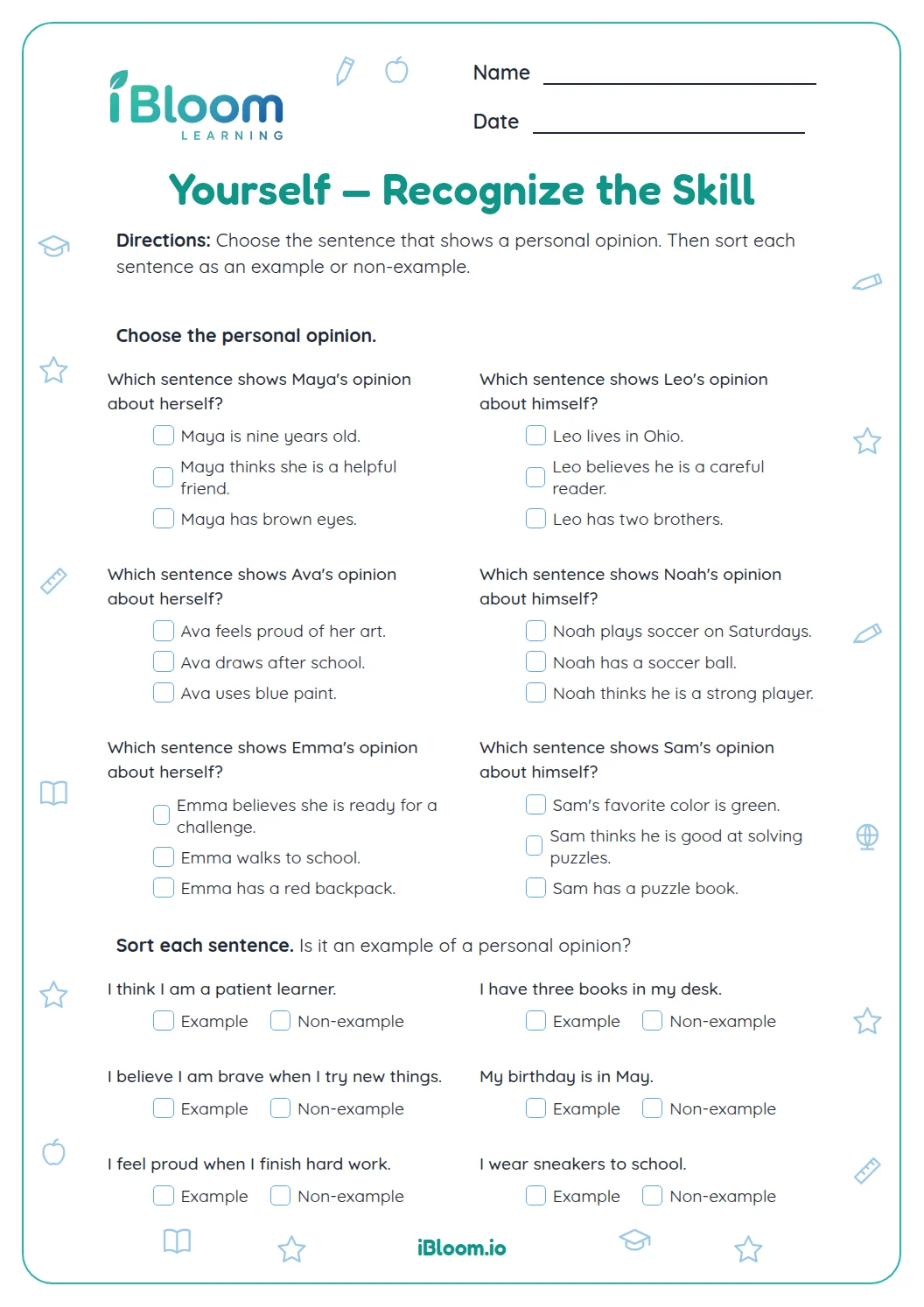
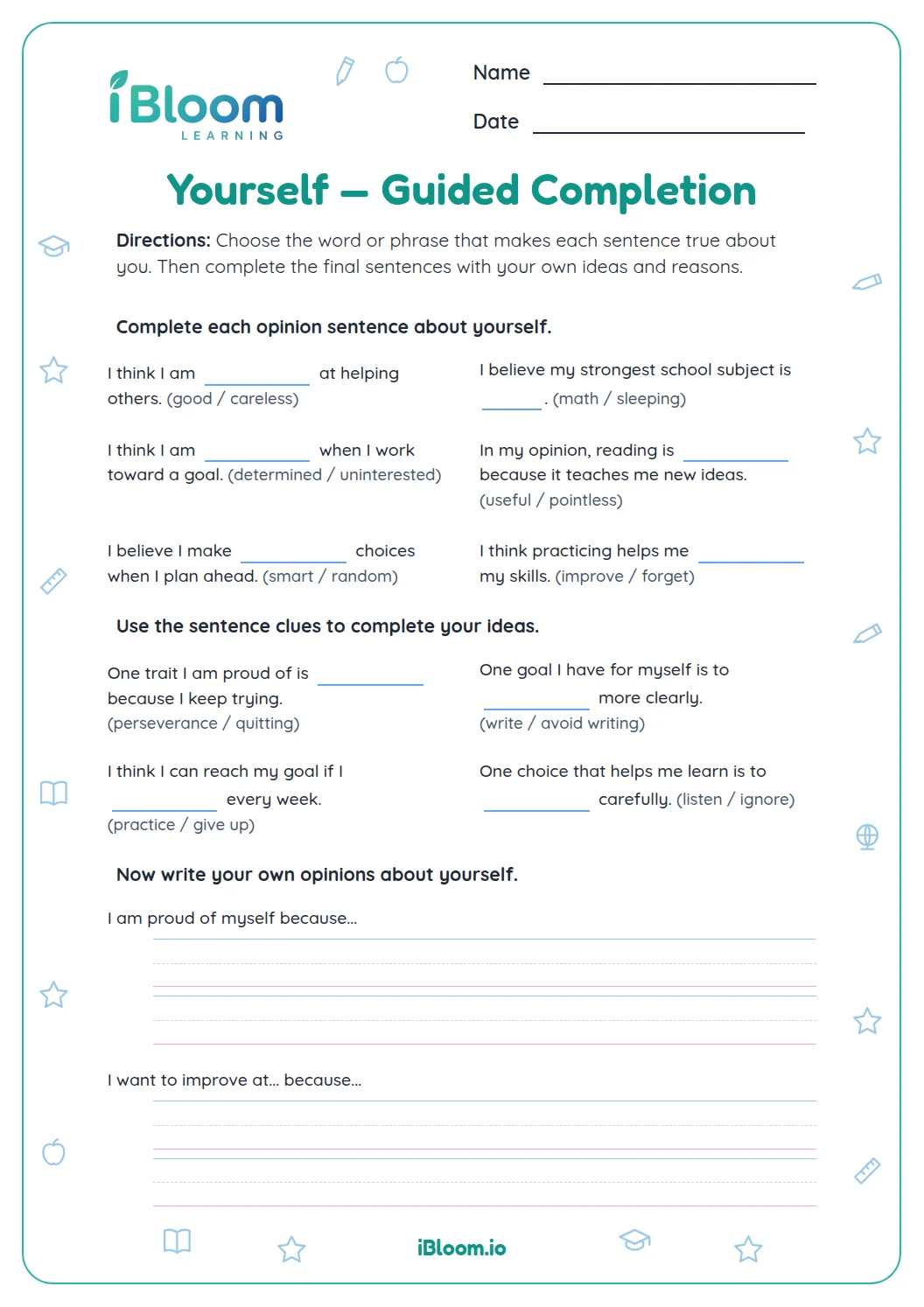
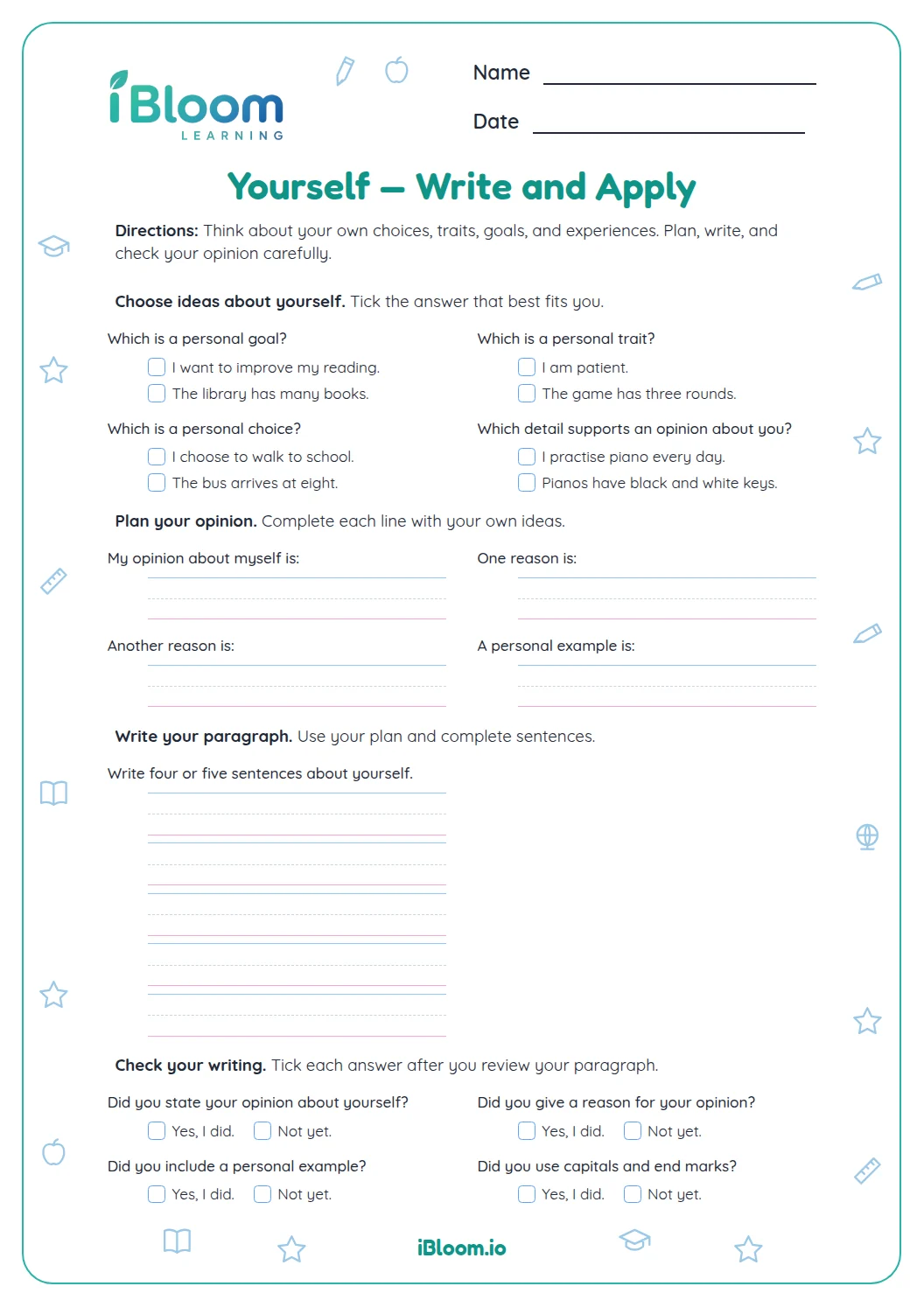
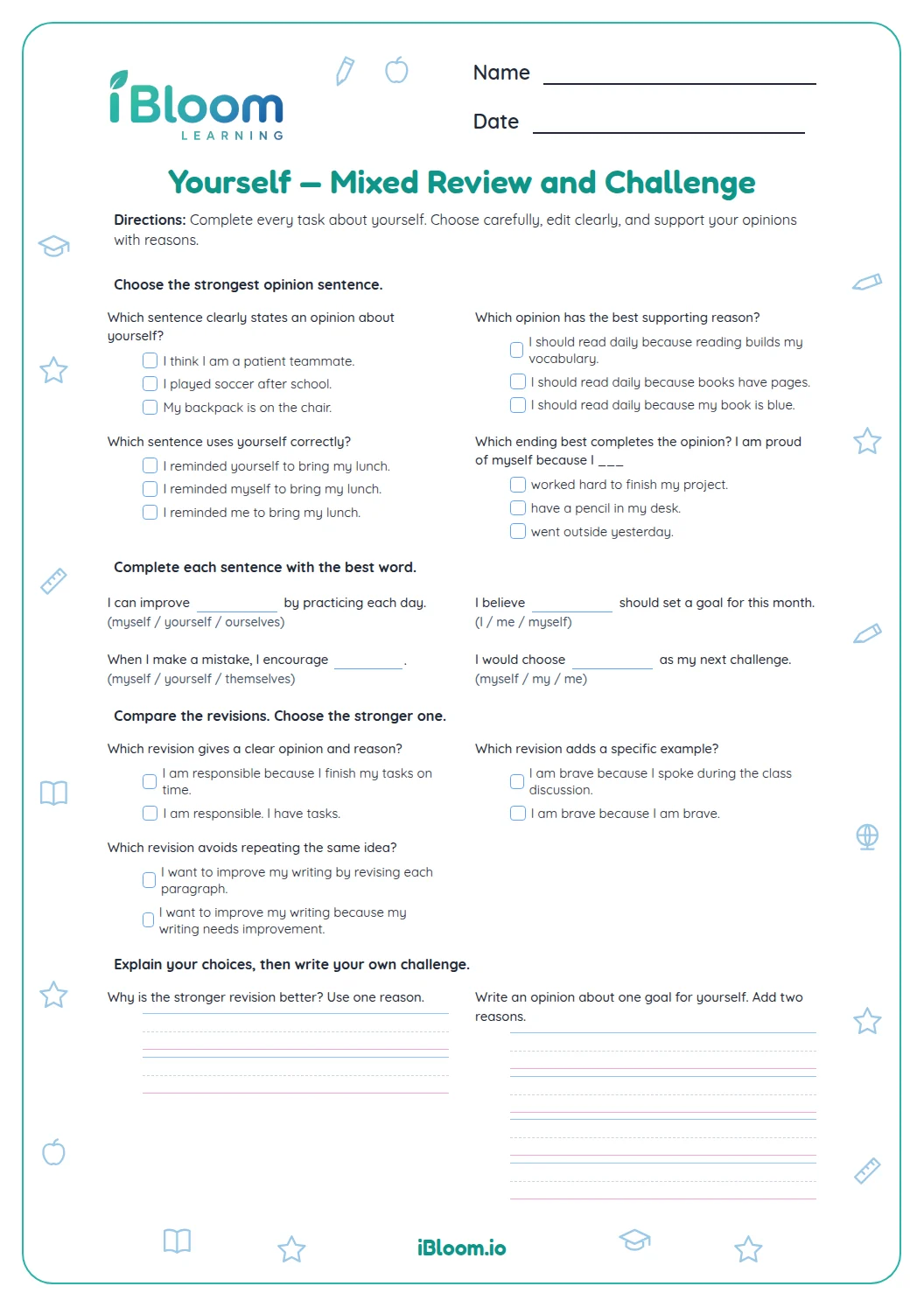
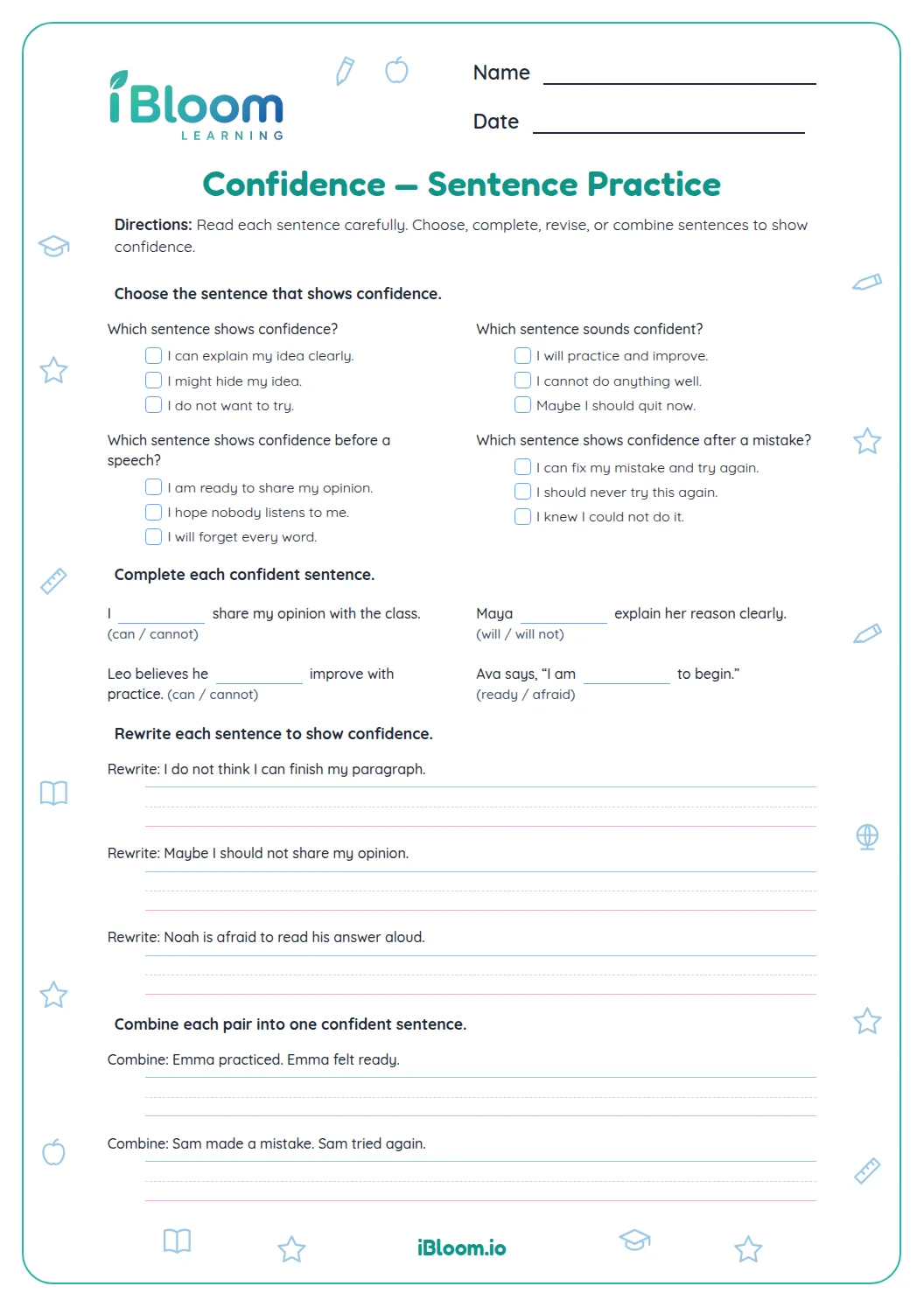
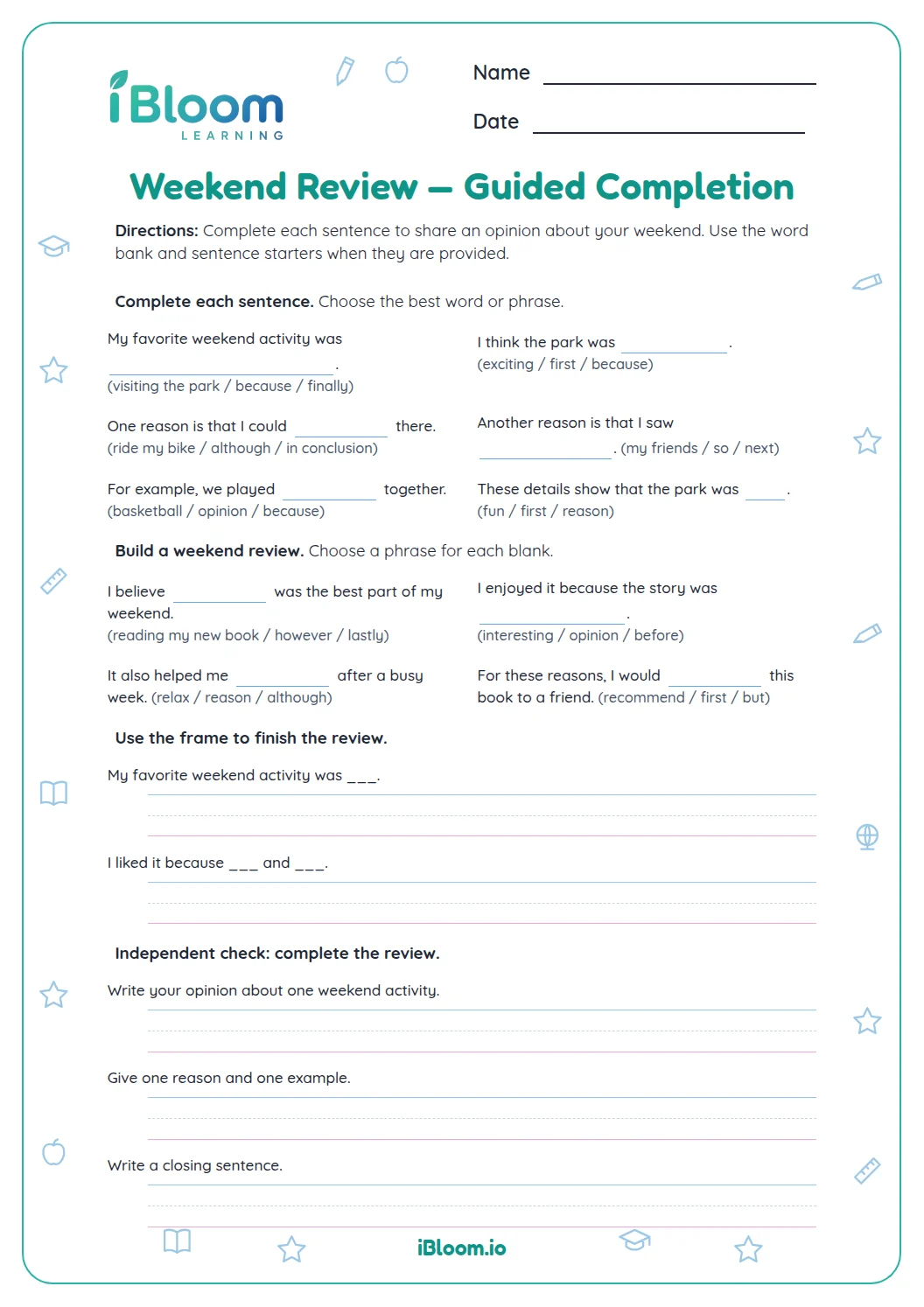
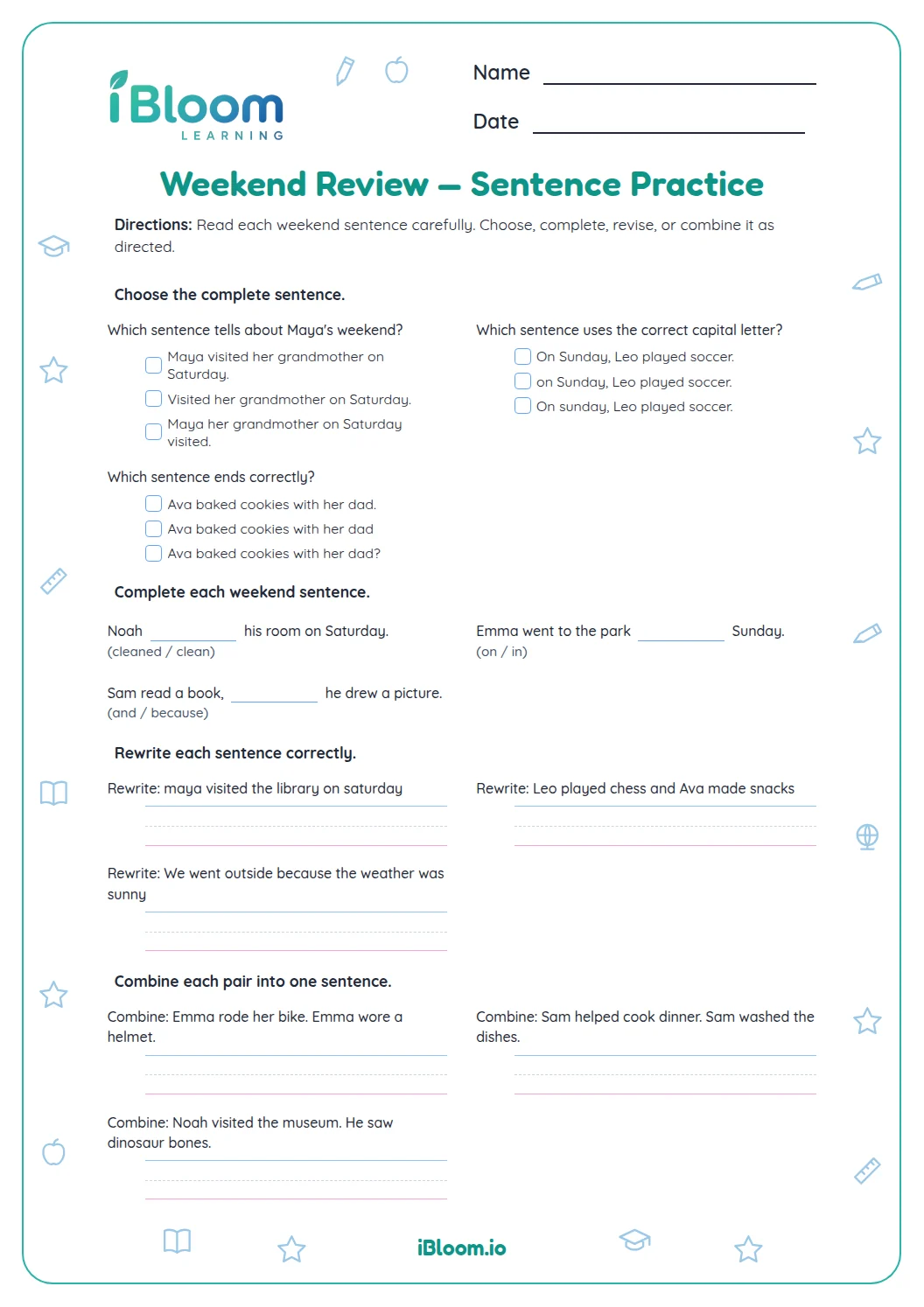
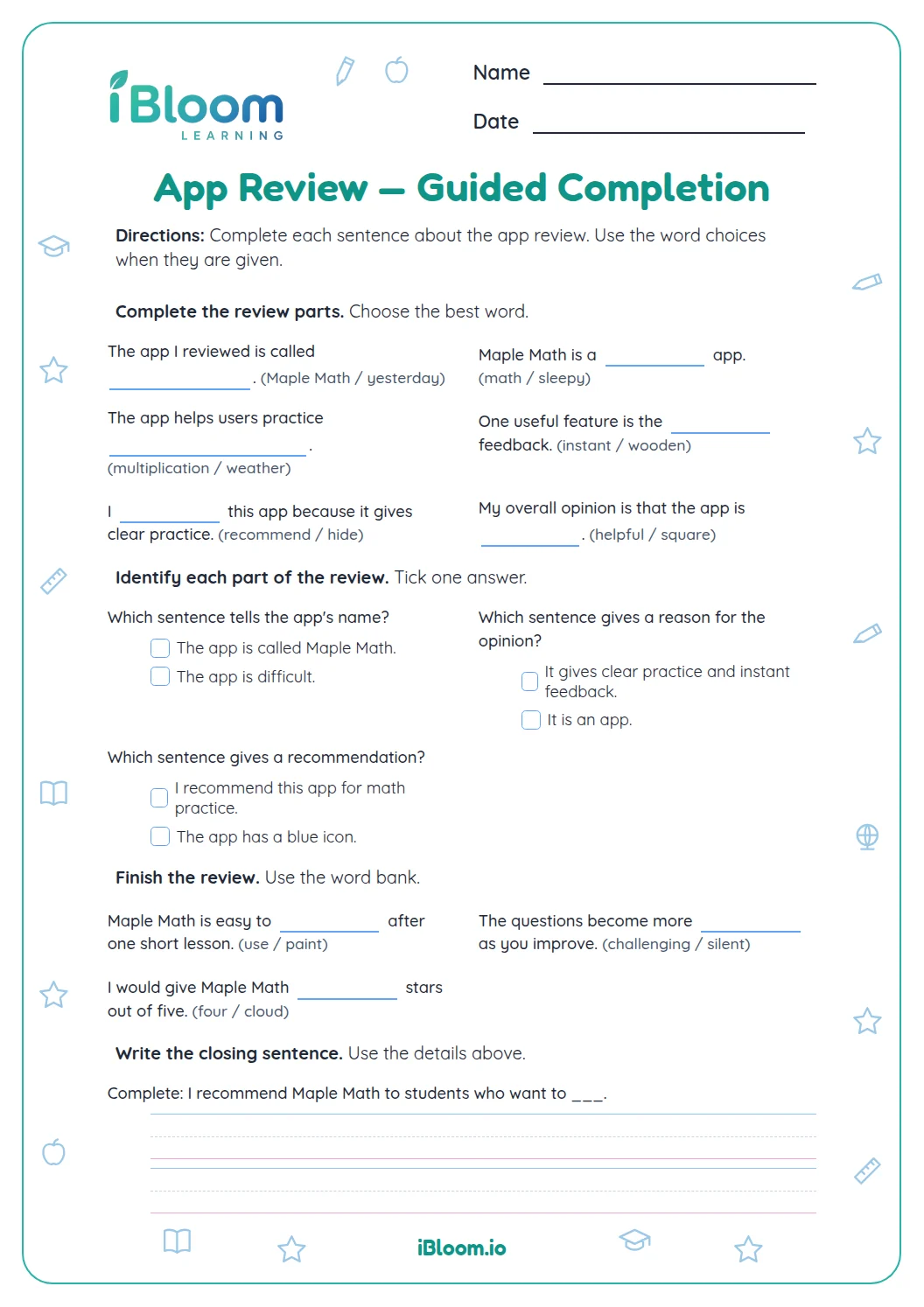
This Grade 4 sentence practice worksheet uses the “yourself” prompt to build complete personal sentences. Students choose the right word in four statements, identify opinions and supporting details, revise two sentences for capitalization, and combine three pairs of ideas with because, and, or so. The answer key shows the expected choices. The page practices Common Core L.4.1 and L.4.2: complete sentences, grammar and usage, capitalization, and punctuation.
Aligned to L.4.1 and L.4.2
How does a reason support an opinion?
An opinion tells what a writer thinks. A reason explains why the writer thinks it. Questions 5–8 ask students to recognize an opinion, a supporting reason, and a conclusion.
How do linking words connect ideas?
Because gives a reason, and joins related ideas, and so can show a result. In question 11, “because” connects practicing with the goal of improving.
- 1I practice. I want to improve.
- 2I practice because I want to improve.
How can personal sentences be revised?
Questions 1–4 complete first-person sentences. Questions 9–10 correct capitalization, and questions 11–13 combine two thoughts with a named linking word.
How to use this worksheet
- 1Read each personal sentence and choose the word that completes it.
- 2Choose a point of view or reason that fits the prompt.
- 3For revision items, select the sentence with correct capitalization.
- 4For combining items, choose the conjunction that preserves the relationship between ideas.
- 5Check the selected answers with the key.
Common mistakes and quick fixes
The mistake
Giving a fact that does not explain the opinion.
The fix
Ask whether the detail answers why the writer holds that opinion.
The mistake
Repeating the opinion without a supporting reason.
The fix
Add a specific action, example or detail after because.
The mistake
Ending with a new idea instead of closing the response.
The fix
Use a concluding phrase and return to the main point.
Common Core alignment
The questions practice complete sentences, grammar choices, capitalization, and punctuation.
Use standard English grammar and usage to form complete sentences.
On this sheet: Students choose grammatical sentence completions and identify complete opinions and supporting details.
Show the official wordingHide the official wording
Demonstrate command of the conventions of standard English grammar and usage when writing or speaking.
Apply standard capitalization and punctuation when revising sentences.
On this sheet: Students select corrected capitalization and punctuation and combine ideas with a coordinating conjunction.
Show the official wordingHide the official wording
Demonstrate command of the conventions of standard English capitalization, punctuation, and spelling when writing.
What to practice next
Make more practice
Further reading
Questions parents and teachers ask
What makes a sentence complete?
A complete sentence expresses a full thought, starts with a capital letter, and ends with punctuation. The first questions ask students to choose words that make personal statements complete, then later items practice revising and combining sentences for clarity.
What does this worksheet mean by “yourself”?
Students write or select sentences about their own qualities, goals, choices, and effort. The prompts use familiar first-person ideas such as being proud, practicing, reaching a goal, and keeping promises, so the writing stays connected to personal experience.
How should a student revise the sentences?
Look for the first word and the pronoun I, then capitalize them. Add the correct ending punctuation. The revision answers in the key show the expected capitalization and period while keeping the original meaning, so children can focus on these sentence conventions.
How do because, and, and so connect ideas?
Because introduces a reason, and joins related thoughts, and so can show a result. The final items provide two short thoughts and name the joining word, so students can focus on making one clear sentence that preserves the meaning of both original ideas.
What does a reason add to an opinion?
A reason tells why the writer holds a point of view. “I am dependable” is an opinion; “I keep my promises” gives support. Questions 6, 8, and 14 ask students to recognize reasons or details that make a personal opinion easier for a reader to understand.