





About this worksheet
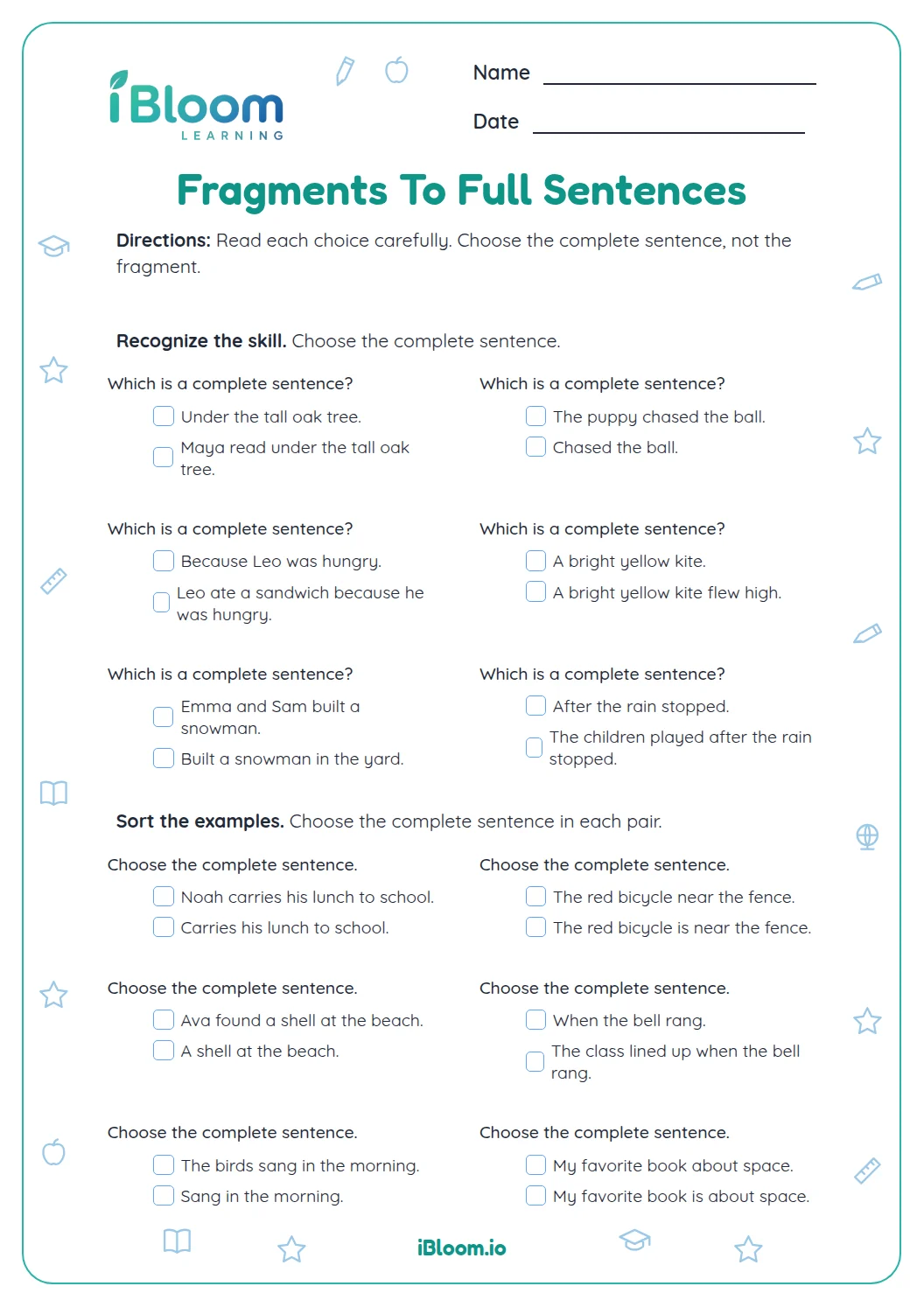
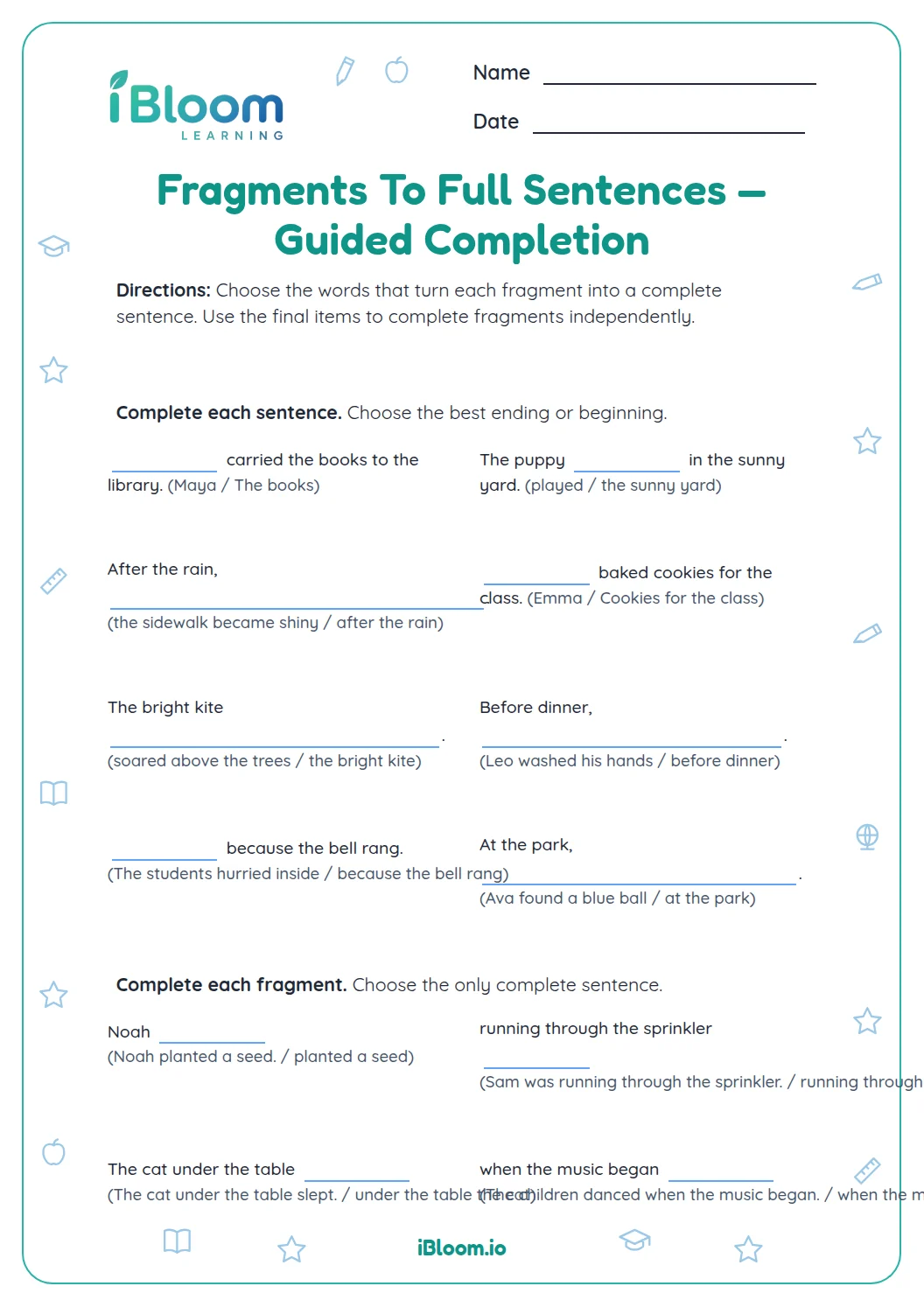
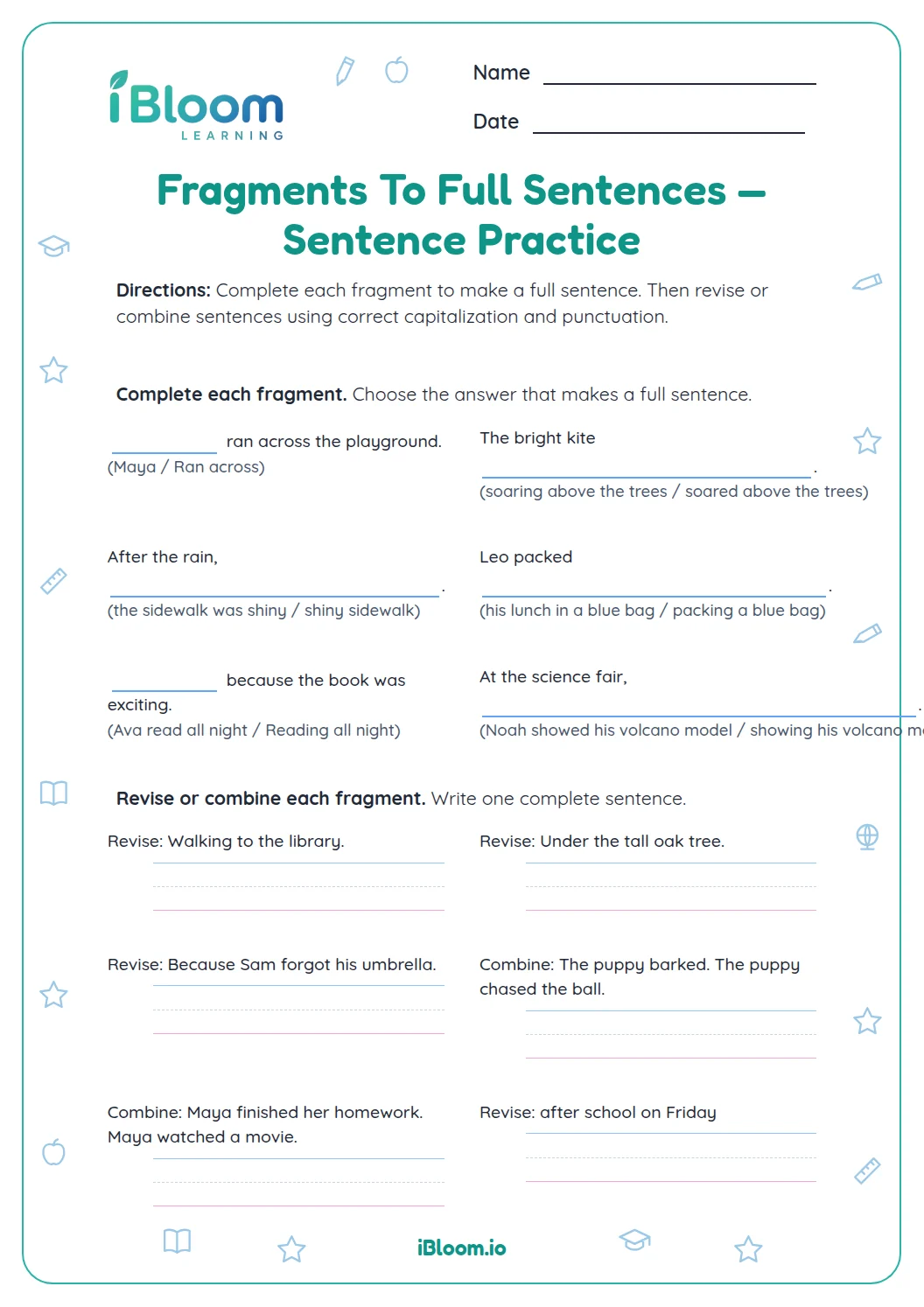
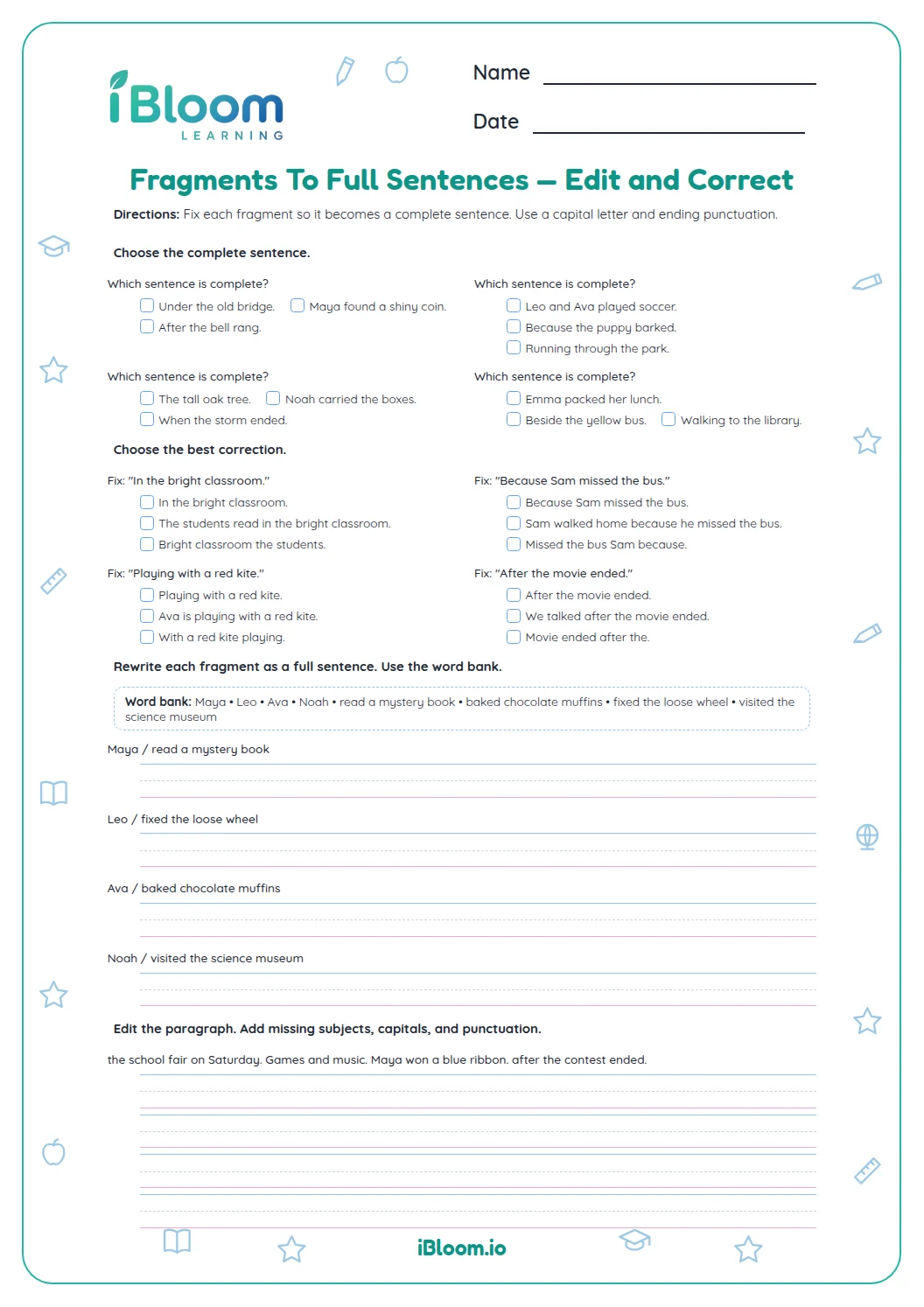
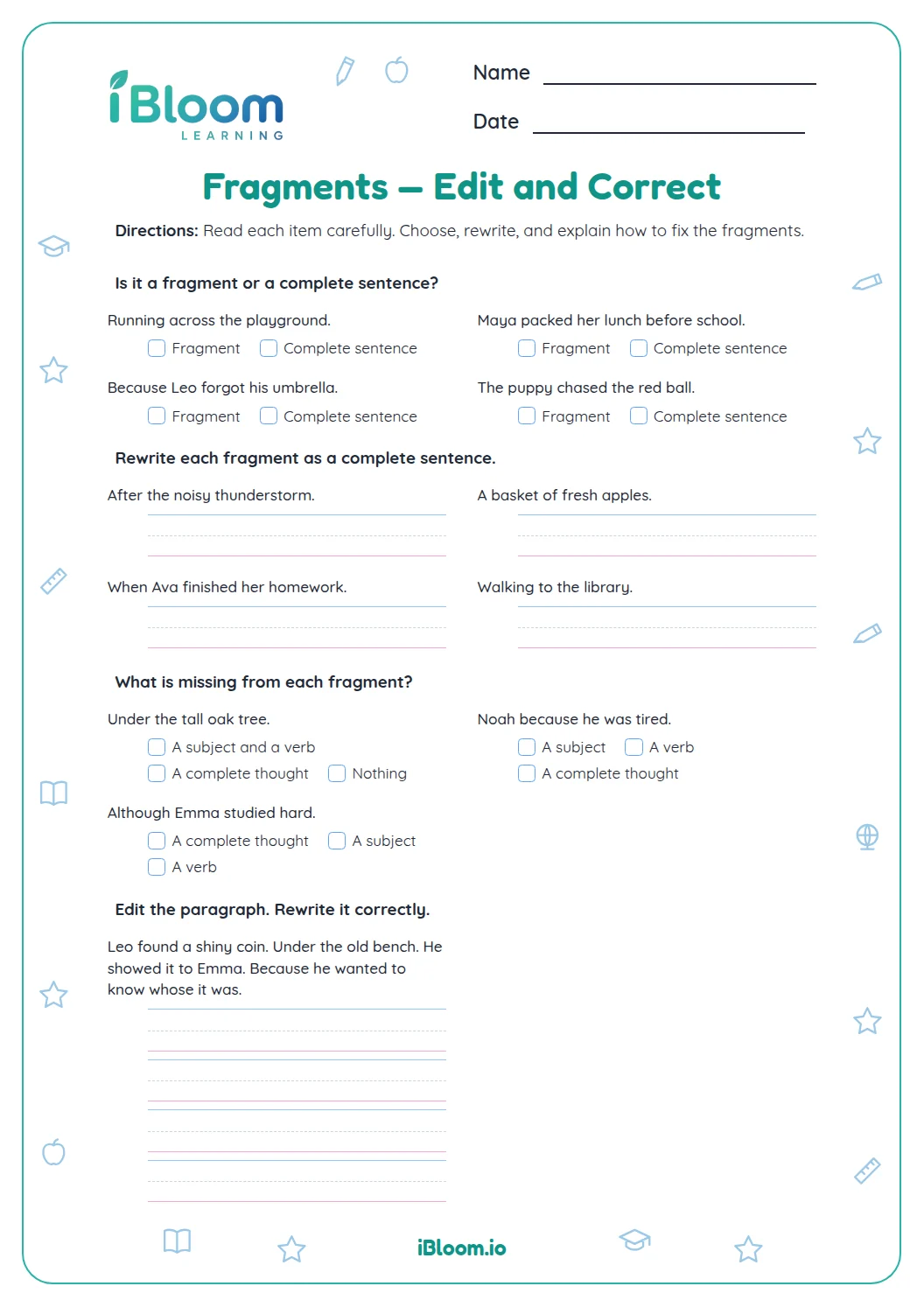
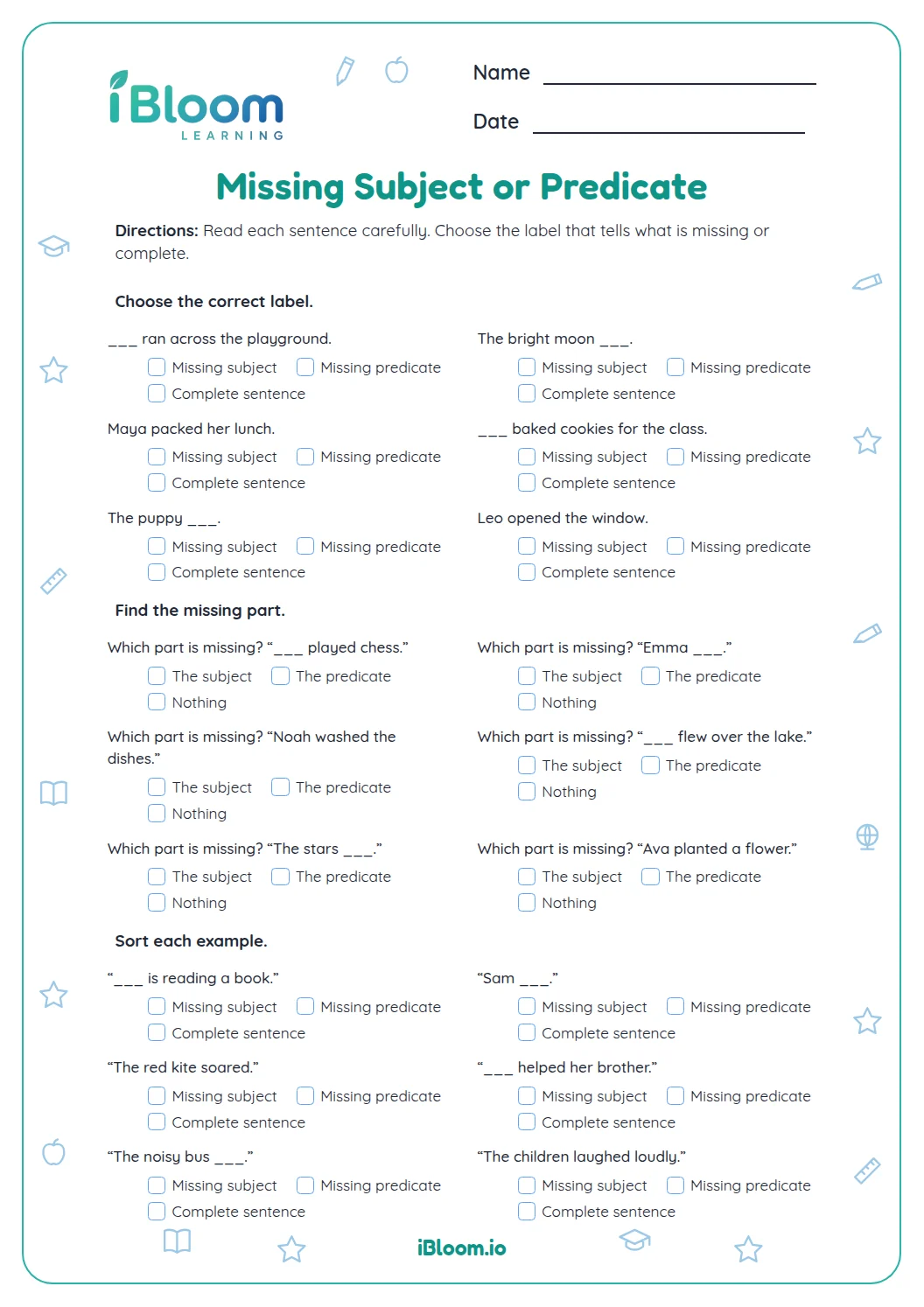
This Grade 4 worksheet helps students recognize complete thoughts, spot fragments, and choose revisions that complete unfinished groups of words. Fourteen multiple-choice questions move from identifying complete sentences and missing parts to selecting a full revision. The separate answer key marks the best choice for each item.
Aligned to L.4.1.f
How can students spot a fragment?
A complete sentence expresses a finished thought. A fragment may lack a subject, a predicate, or a main clause that completes a dependent-clause opening. “Because it was late” leaves the reader wondering what happened.
- 1“Because it was late.” is a fragment.
- 2“When the bell rang, the class lined up.” is complete.
- 3The main clause finishes the thought.
What do a subject and predicate do?
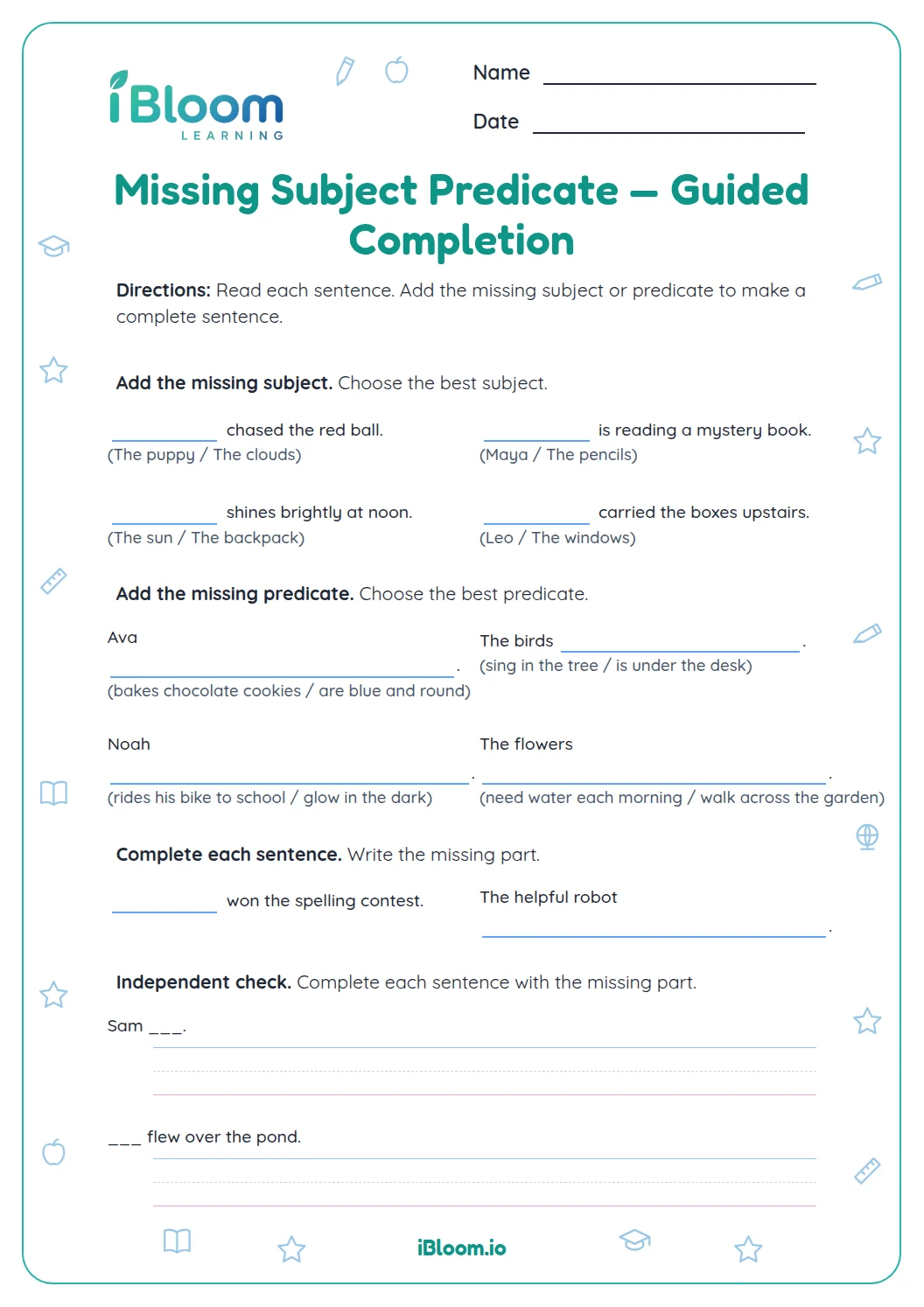
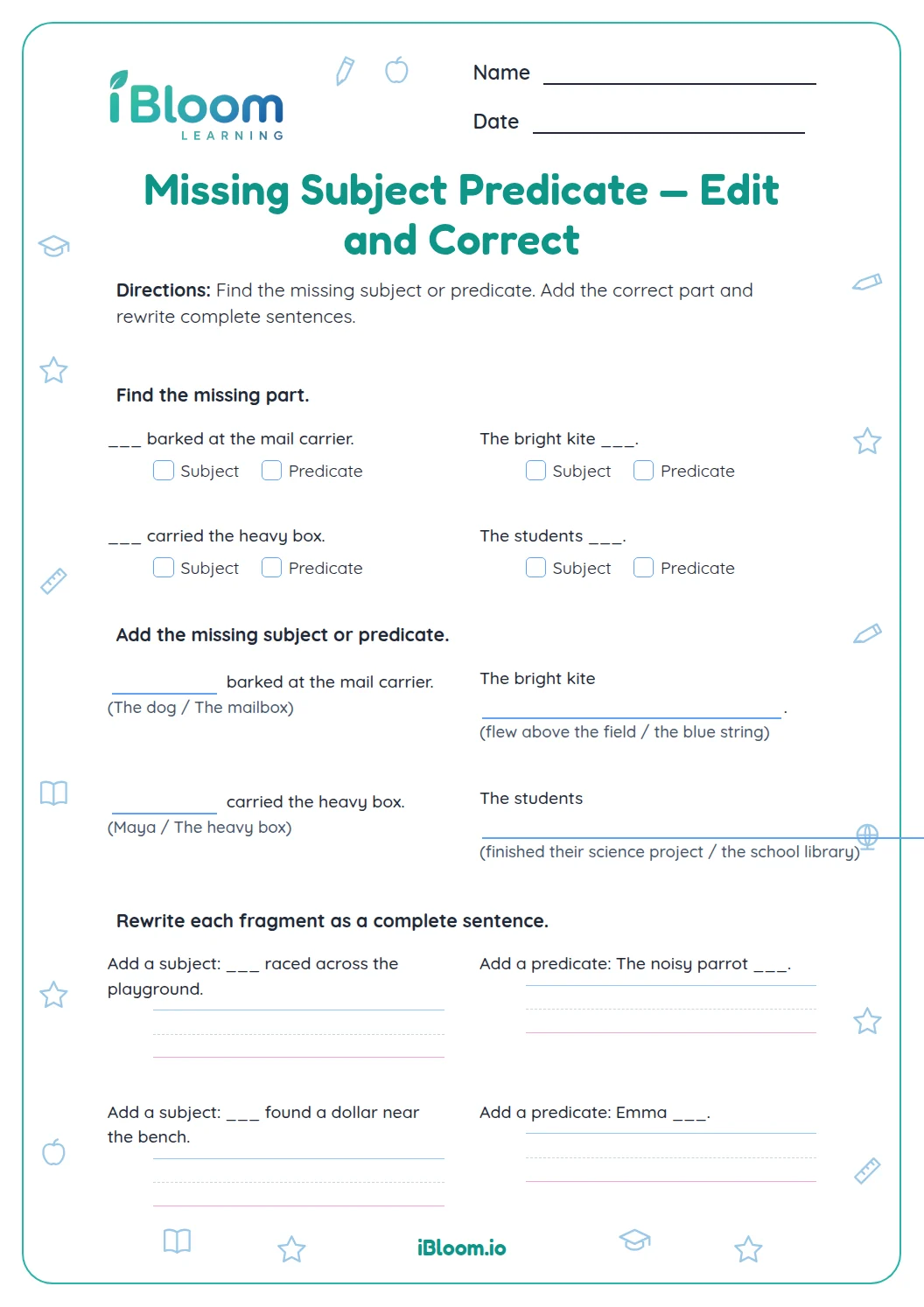
The subject names who or what the sentence is about. The predicate tells what the subject does or is. “The kite flew” has both; “The blue kite” does not tell what the kite did or was.
How can a fragment become a sentence?
Add the missing information or connect the dependent clause to a main clause. For “Before the game,” a complete continuation is “our team stretched.” Read the full sentence to check that it expresses a finished idea.
- 1Before the game, ___.
- 2Our team stretched.
- 3The added words complete the thought.
How to use this worksheet
- 1Read the whole group of words once.
- 2Find who or what it is about.
- 3Find what that subject does or is.
- 4Complete a dependent-clause starter with a main clause.
- 5Read each choice as a complete sentence.
Mistakes to watch for
The mistake
Treating “Because the bus was late” as a complete sentence.
The fix
Add what happened because the bus was late.
The mistake
Adding an action but leaving out who did it.
The fix
Name a subject before or with the predicate.
The mistake
Leaving a dependent clause by itself.
The fix
Attach a main clause that completes the thought.
Curriculum alignment
The recognition and revision practice directly addresses the Grade 4 standard for complete sentences.
Recognize fragments and run-ons and revise them as complete sentences.
On this sheet: Students identify fragments and choose complete-sentence corrections that supply missing parts.
Show the official wordingHide the official wording
Produce complete sentences, recognizing and correcting inappropriate fragments and run-ons.*
What to practice next
Make more practice
Further reading
Questions parents and teachers ask
How many questions are on the worksheet?
There are 14 multiple-choice questions. Students identify complete thoughts and fragments, find missing sentence parts, and choose revisions that complete fragments. The answer key marks the best choice for each question. The final choices practice completing fragments in context. The later items check sentence repairs.
What is a sentence fragment?
A fragment is a group of words that does not express a complete thought. It may be missing a subject, a predicate, or a main clause that finishes a dependent-clause starter. “Because the bus was late” leaves the reader waiting for what happened.
What does a complete sentence need?
For this practice, students look for a subject and predicate that express a complete thought. “The rain tapped on the roof” names what the sentence is about and what it did, so the reader gets a finished idea rather than an unfinished group of words.
Can a sentence begin with “Because” or “When”?
Yes. A sentence can start with a dependent clause if a main clause completes the thought. “Because the bus was late, we waited” is complete; “Because the bus was late” by itself leaves the reader waiting for what happened next.
Does the answer key give complete-sentence examples?
Yes. The key marks the best choice for every item. Students can read the corrected sentence aloud to check that it supplies a missing subject, predicate, or main clause and expresses a complete thought with appropriate end punctuation. The examples show more than one way to finish a thought.
Which standard does this worksheet practice?
CCSS L.4.1.f asks students to produce complete sentences and recognize and correct inappropriate fragments and run-ons. This worksheet focuses on complete thoughts and fragment repairs, with choices that add missing sentence parts or finish dependent clauses in context. Students apply the standard while judging sentence choices.