





About this worksheet
This free Grade 4 worksheet uses subjects and predicates to check whether sentences express complete thoughts. In Part A, children choose complete subjects and predicates, including their describing words. Part B asks them to distinguish complete sentences, fragments and run-ons. Part C turns that analysis into writing: children add missing parts and repair sentences. The 14 questions practice Common Core L.4.1f, producing complete sentences and correcting fragments and run-ons. A separate answer key gives exact answers for the choices and labels, plus sample sentences for the four written repairs.
Aligned to L.4.1f
What makes a subject or predicate complete?
A complete subject includes the naming word and the words that describe it. In “The tiny green frog leaped,” the complete subject is The tiny green frog. A complete predicate includes the verb and the words that finish what it says about the subject.
Question 3 puts another noun inside the subject: “The box of crayons fell.” Crayons belongs to the phrase of crayons; the sentence tells what the box did. The complete subject includes that whole phrase.
Can a fragment contain both a subject and a verb?
Yes. “Because the bus was late” contains a subject and a verb, but because makes the reader wait to hear what happened as a result. Question 11 asks children to keep that beginning and finish the thought.
A sentence check therefore needs more than finding a noun and a verb. Ask whether the words express a complete thought on their own.
- 1Beginning: Because the bus was late,
- 2Ask: What happened because it was late?
- 3Add a complete thought: we missed the game.
- 4Sample repair: Because the bus was late, we missed the game.
What makes the final part a challenge?
The four repairs require different decisions: add a predicate, add a subject, finish a dependent beginning and split a run-on into two sentences. Children cannot solve every item by adding the same kind of word.
For the last item, check both new sentences. The rain stopped needs its period, and We went outside needs its capital W and final period. The key labels the written responses as samples so other grammatical repairs can be accepted.
Use sentence parts to check meaning
- 1Review the difference between frog and the complete subject The tiny green frog.
- 2Complete Part A, keeping all the describing words in the chosen part.
- 3Read each Part B item aloud and ask whether the thought is finished.
- 4Write the four Part C repairs, following the particular direction for each.
- 5Check the key and explain one fragment repair and one run-on repair.
Sentence-review slips and fixes
The mistake
Choosing only frog when asked for the complete subject.
The fix
Include The tiny green with frog because those words belong to the subject.
The mistake
Marking Because the bus was late as complete because it has a subject and a verb.
The fix
Ask what happened because the bus was late, then add that complete thought.
The mistake
Changing a run-on only by inserting a comma.
The fix
For question 12, use a period after stopped and capitalize We to make two sentences.
Common Core alignment
Identify complete sentences and repair fragments and run-ons.
On this sheet: Children classify sentence forms and write four repairs using complete subjects and predicates.
Show the official wordingHide the official wording
Produce complete sentences, recognizing and correcting inappropriate fragments and run-ons.*
What to practice next
Make more practice
Further reading
Questions parents and teachers ask
Are children finding simple or complete subjects?
They are finding complete subjects and complete predicates in Part A. A complete subject includes its describing words, so the answer for question 1 is The tiny green frog. Choosing only frog identifies the central noun but leaves out words that the direction asks children to include.
What do C, F and R mean in Part B?
C means complete sentence, F means fragment and R means run-on. A complete sentence expresses a finished thought. A fragment leaves the reader waiting for part of that thought. A run-on joins complete thoughts without appropriate punctuation or a connecting word. The directions print all three labels.
Why is Because the bus was late a fragment?
It leaves the reader waiting to learn what happened because of the delay. The words contain a subject and a verb, but because introduces a dependent thought. Question 11 reuses this beginning so children can finish it, for example by adding that they missed the game.
Must written answers match the key word for word?
Not usually. Questions 11–14 invite different complete repairs, and the key provides one sample for each. Check that the subject or predicate makes a complete thought, that the because-clause has a main clause, and that the run-on becomes two complete sentences. Accept another clear repair that follows the prompt.
How should children repair the last run-on?
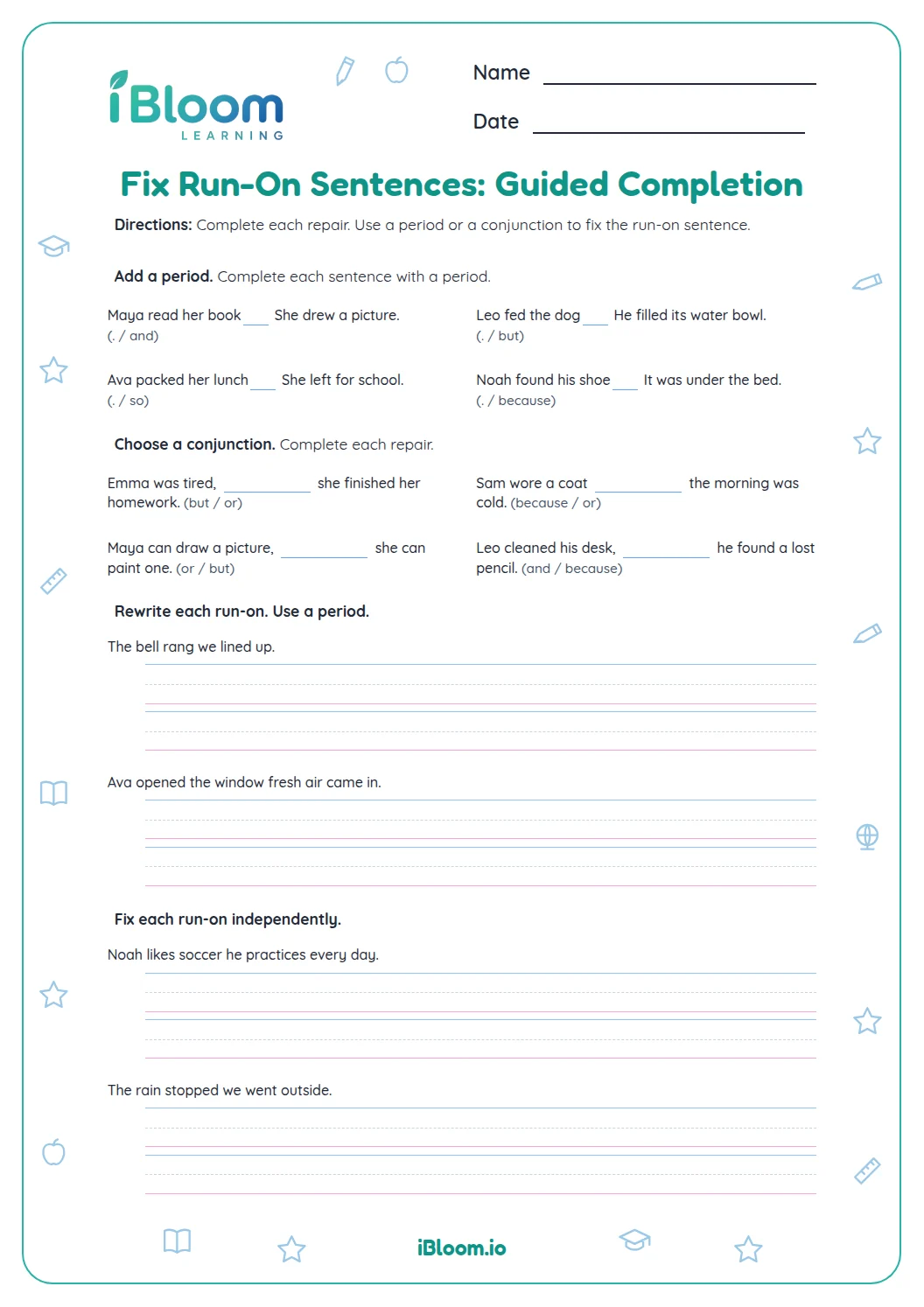
They should write two sentences: “The rain stopped. We went outside.” The direction specifically asks for two sentences, so check for a period after stopped and a capital W in We. Then have the child name the subject and predicate in each of the new sentences.