

About this worksheet
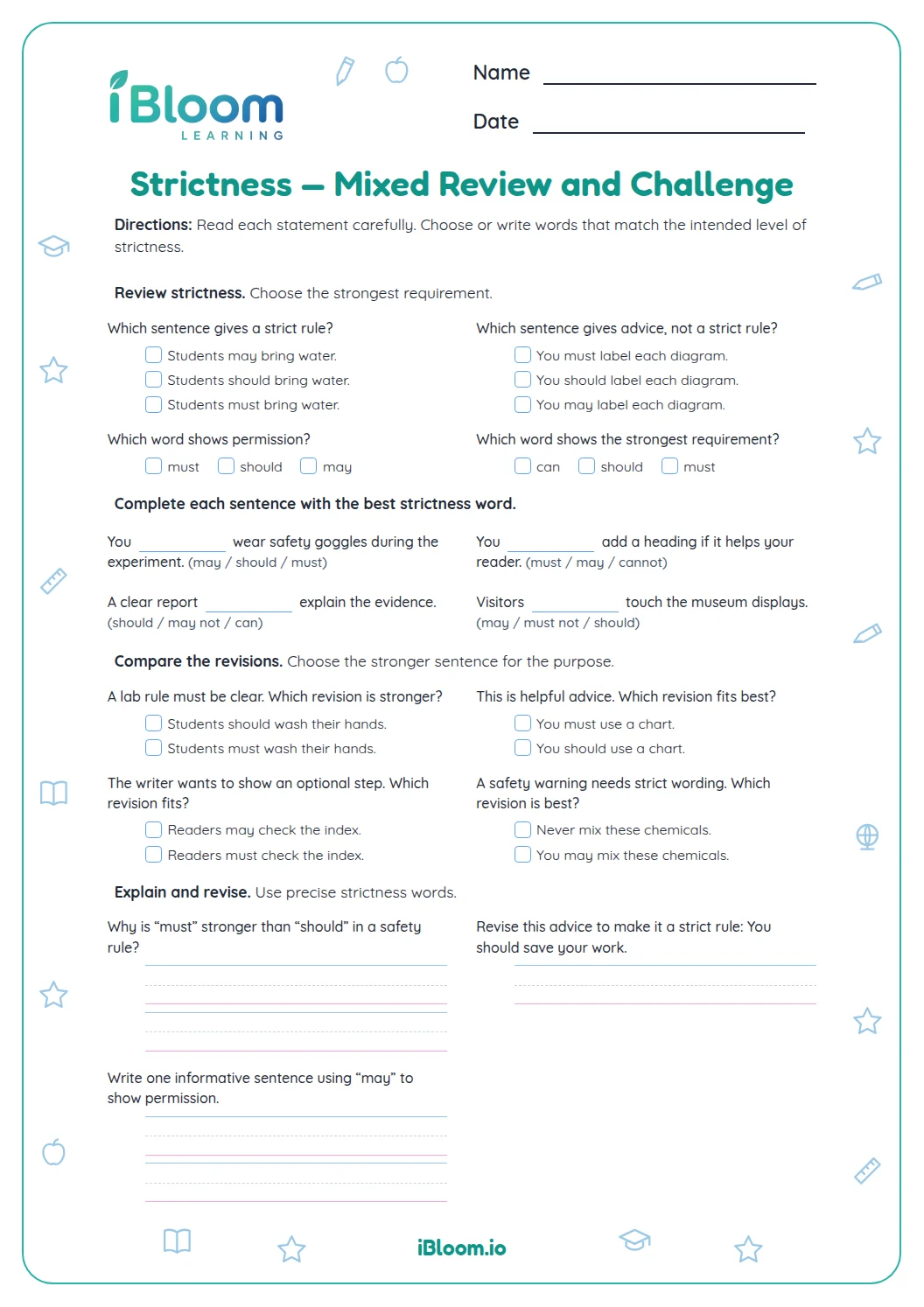
This Grade 5 sentence practice asks students to spot modal verbs and related phrases that express requirements, prohibitions, advice, and permission. Fourteen short examples use clear everyday rules and suggestions.
Aligned to L.5.1
Which words state a requirement?
Part A includes “Guests are required to wear name tags” and “You must return the library book by Friday.” Circle the word or phrase that makes each action required.
- Must and required signal an obligation in these examples.
How can you spot a prohibition?
Part B includes “Do not feed the animals,” “Riders may not enter,” and “Avoid running indoors.” Circle the words that make each action forbidden.
- Read the whole phrase; not changes the meaning of may.
Which phrases give advice?
Part C uses should, wise, recommend, and try to signal advice. These phrases suggest a helpful action without stating that it is required.
- Advice recommends an action.
When does a phrase give permission?
Part D includes “You may borrow one book” and “Students are allowed to choose.” Those phrases show that an action is permitted.
- May and allowed grant permission in these examples.
How to use this worksheet
- 1Read the full sentence for its meaning.
- 2Find the word or phrase that sets the rule’s force.
- 3Decide whether it states a requirement, prohibition, advice, or permission.
- 4Circle the complete phrase, including not when it changes the meaning.
- 5Use the key to check the target words.
Common mistakes and quick fixes
The mistake
Circling must but leaving out not.
The fix
Treat must not as a two-word prohibition phrase.
The mistake
Calling every modal a strict command.
The fix
Use sentence meaning: should advises and may gives permission here.
The mistake
Choosing by the modal word alone without reading the sentence.
The fix
Read the action and surrounding words to identify the intended force.
Curriculum alignment
Students examine how modal verbs shape meaning in complete sentences.
Recognize how word choices shape the meaning of complete sentences.
On this sheet: Students identify modal verbs and interpret how they shape requirements, prohibitions, advice, and permission.
Show the official wordingHide the official wording
Demonstrate command of the conventions of standard English grammar and usage when writing or speaking.
What to practice next
Make more practice
Further reading
Questions parents and teachers ask
What is a modal verb?
A modal verb works with another verb to show how an action is viewed. On this sheet, must and must not express requirements and prohibitions, should gives advice, and may grants permission. Students circle the modal word or phrase in each sentence.
Why is must not treated as one answer?
In this worksheet, “Do not” and “may not” show that an action is forbidden. Circle both words when the phrase has two parts. Question 7, “Riders may not enter,” shows how not changes the meaning of may. The full phrase makes the rule clear.
How is should different from must?
Must presents an action as required in these examples, while should recommends an action as advice. Question 1 asks students to find must in a requirement; question 9 uses should for advice. Read each sentence to identify its force.
Can may mean something other than permission?
Yes. May can express possibility elsewhere, but in this worksheet it gives permission. “You may borrow one book” is one example. The context shows that borrowing is allowed, rather than merely possible. Compare that with the prohibition phrase “may not” in Part B.
What should students circle in each sentence?
Circle the word or phrase that communicates the sentence’s force. Most items use one word; prohibitions include phrases such as “Do not” and “may not,” so circle both words. The key lists both words for each two-word phrase.