





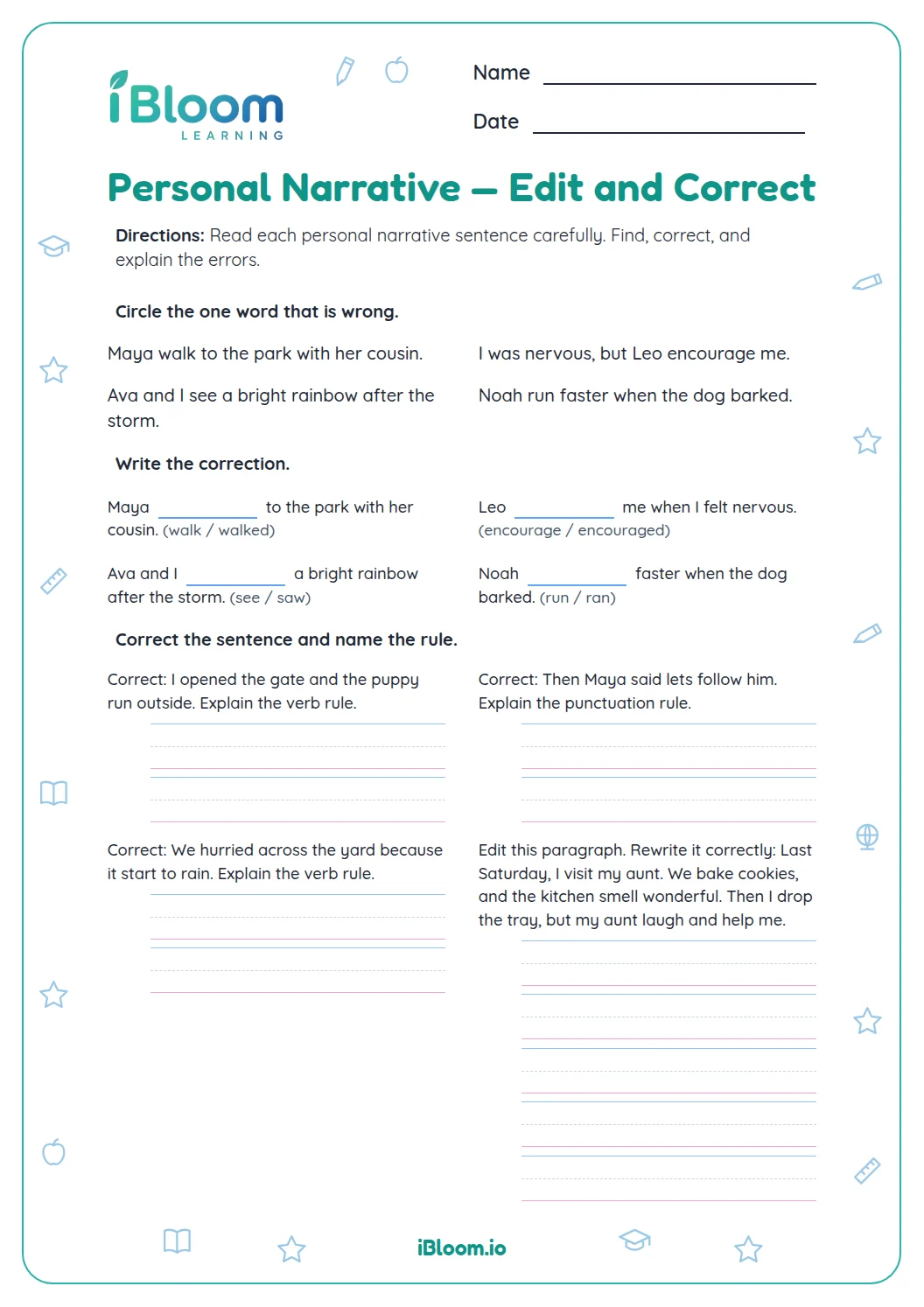
About this worksheet
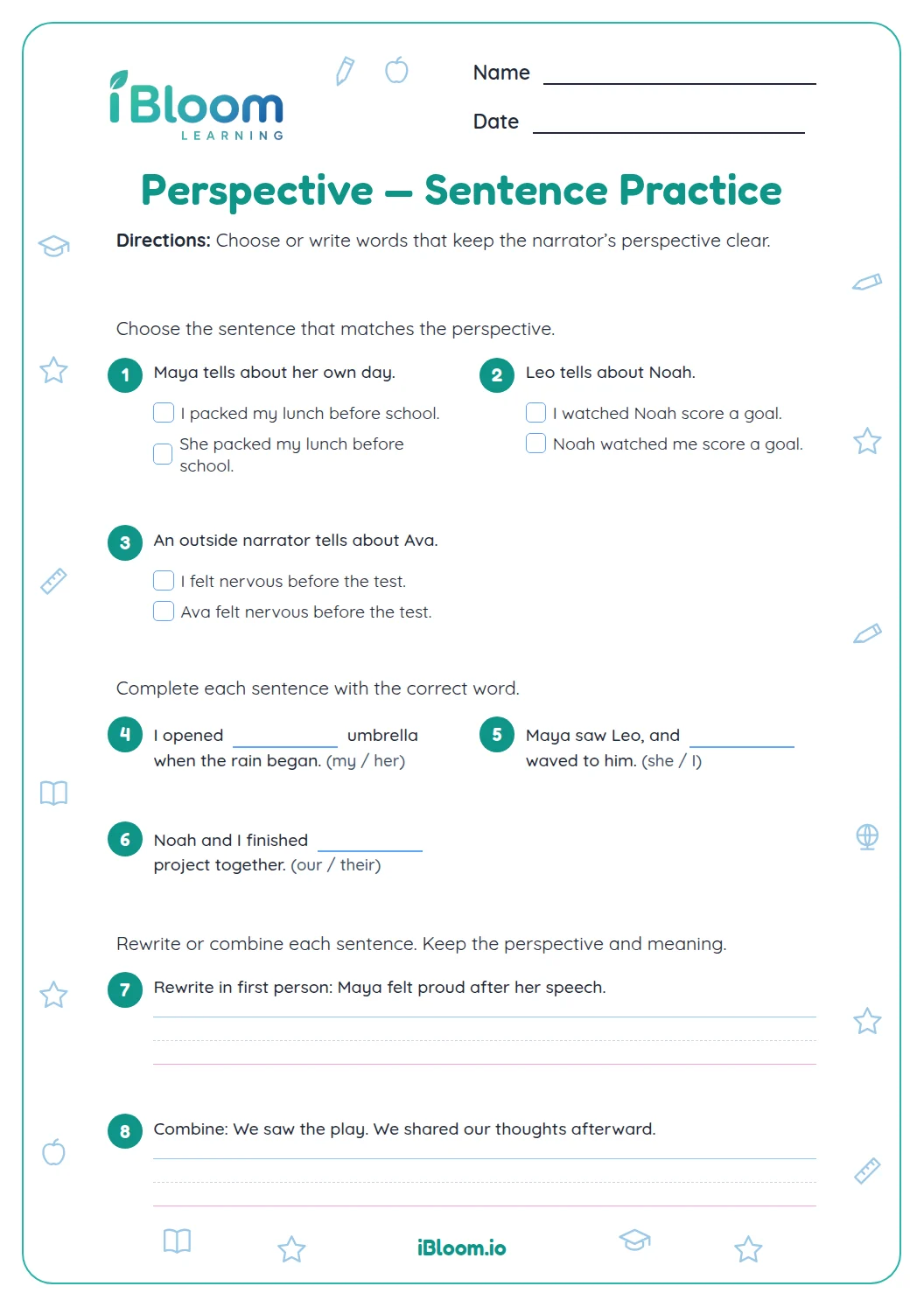
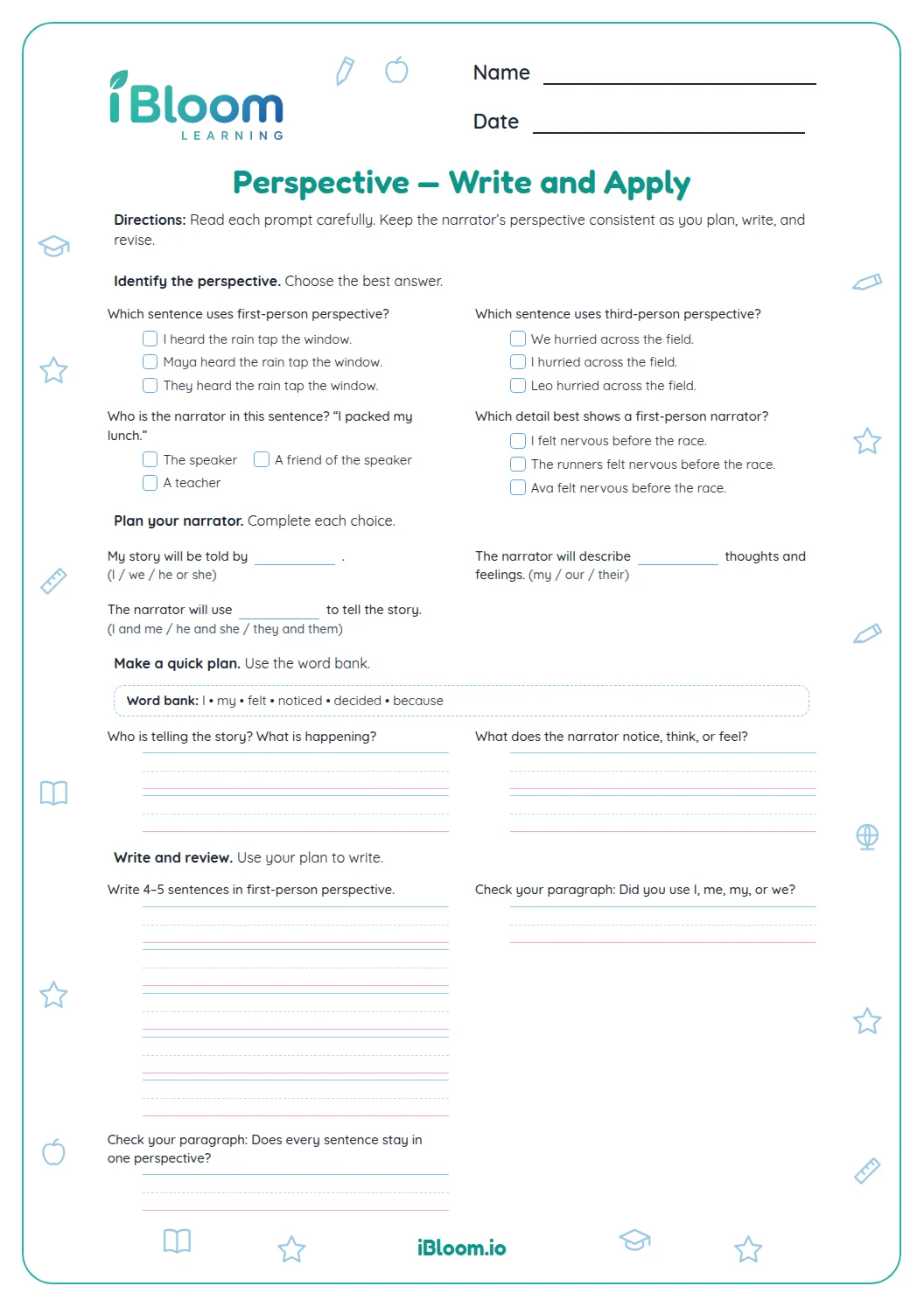
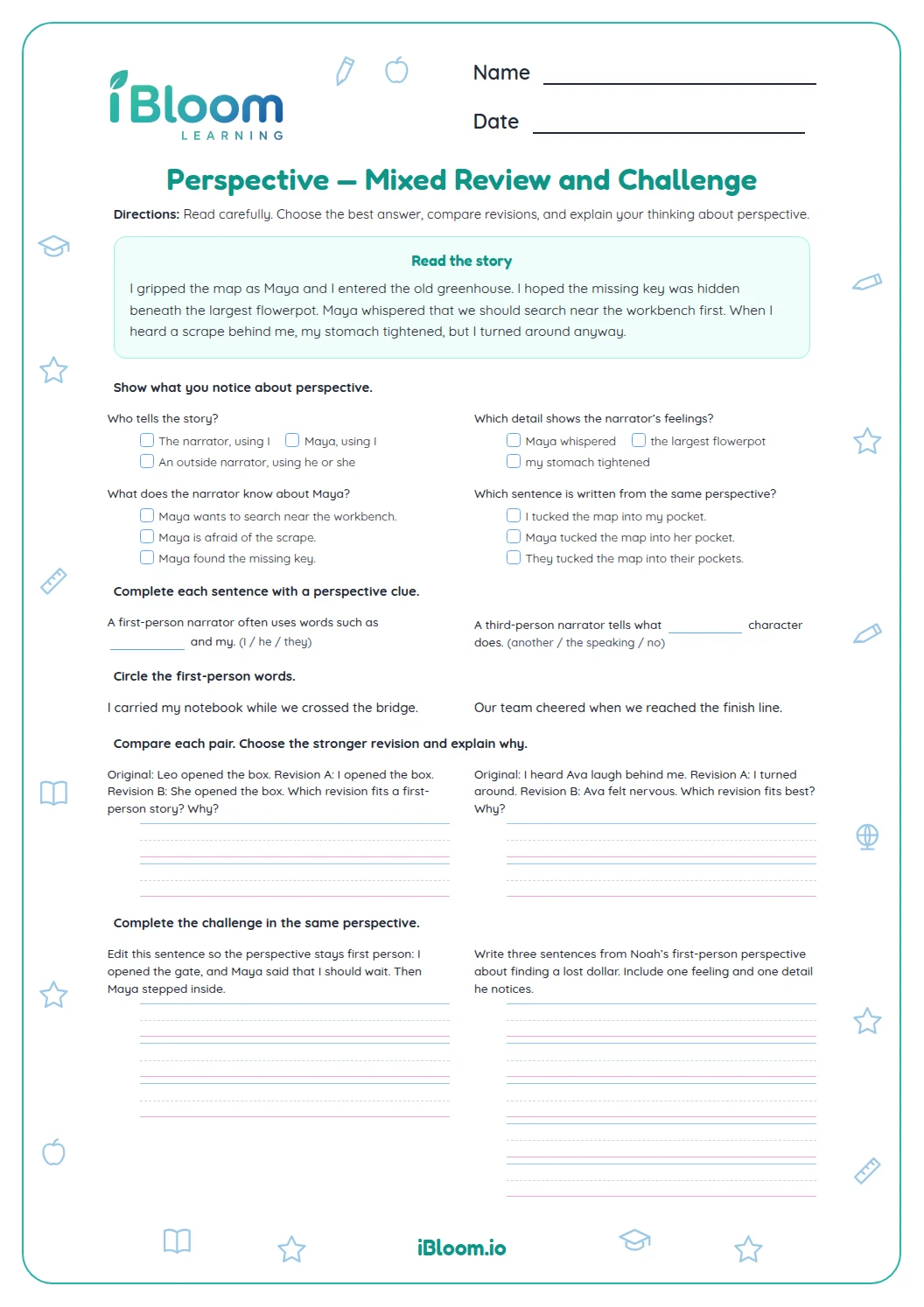
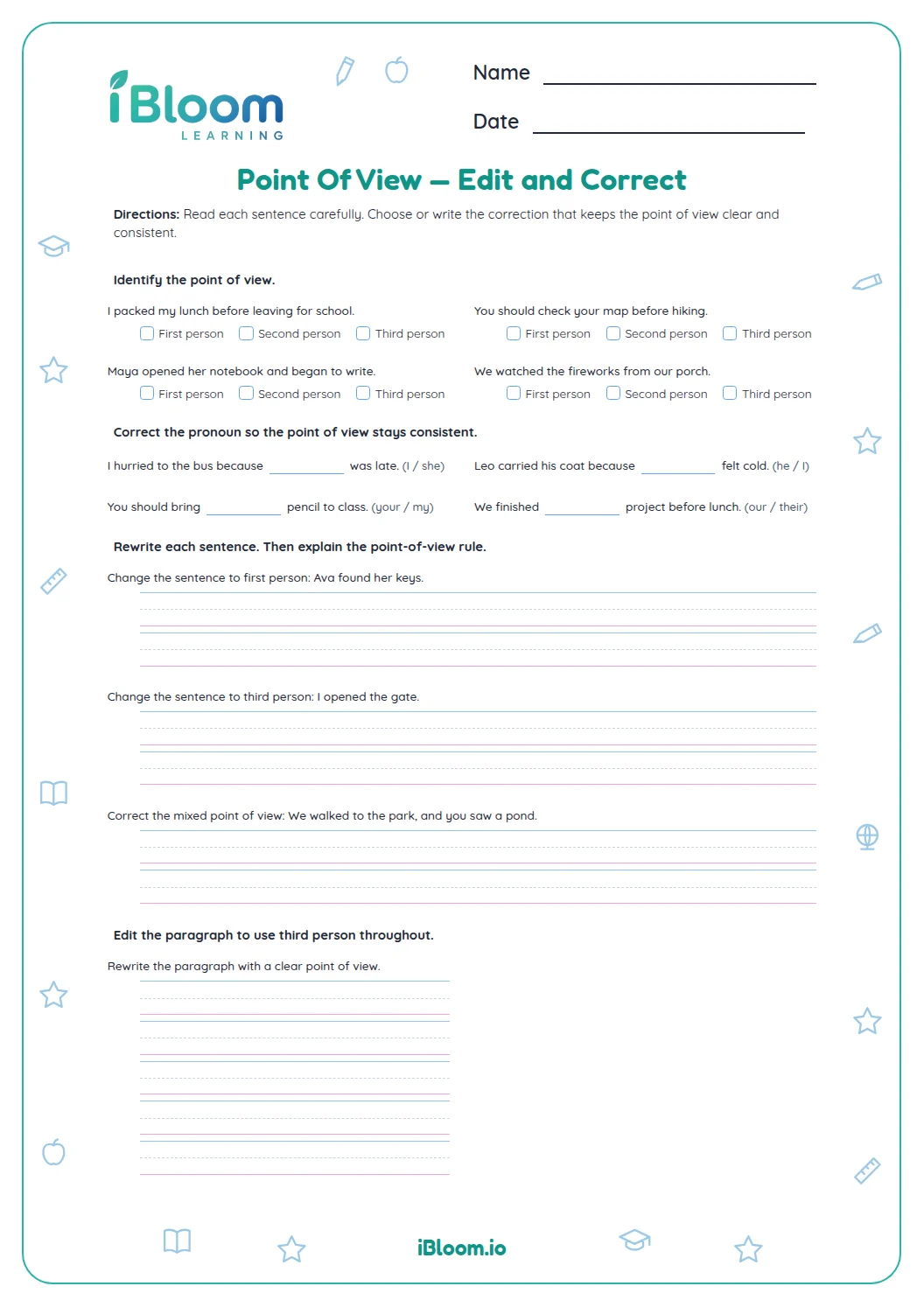
This guided worksheet moves from recognizing point of view to completing pronouns and rewriting sentences. The final prompts ask students to sustain a narrator through a short continuation, so practice goes beyond choosing “I” or “she.”
Aligned to W.5.3
What clues show the narrator’s viewpoint?
First-person narrators use I, me, we, or our to tell what they experience. Third-person narrators tell about characters by name or with pronouns such as he, she, and they. Part A asks students to identify these clues.
How do pronouns keep a viewpoint consistent?
Parts B and C ask students to supply pronouns and rewrite sentences. For example, “Omar stepped onto the trail” can become “I stepped onto the trail” in first person.
What should students check in a rewrite?
Read the whole sentence after changing the narrator. Make sure every pronoun fits the requested perspective and the sentence still makes sense. Open continuations have sample answers; other clear, consistent responses can also work.
How to use this worksheet
- 1Start by noticing the pronouns in each sentence.
- 2For the rewrite items, change the narrator and check every pronoun.
- 3For open continuations, use a point-of-view clue from the prompt.
- 4Read each completed sentence aloud to check that the viewpoint stays steady.
Common mistakes and quick fixes
The mistake
Changing “I” to a character’s name but leaving “my” in the sentence.
The fix
Read the whole sentence again and update every pronoun affected by the new narrator.
The mistake
Treating a character who says “I” in dialogue as proof the entire story is first person.
The fix
Use the narration outside quotation marks to identify the storyteller.
The mistake
Switching between I and he or she in one narration.
The fix
Choose the requested narrator, then scan every pronoun in the sentence.
Curriculum alignment
Grade 5 narrative writing uses effective techniques to develop experiences and events. This page practices maintaining a consistent narrator across sentences.
Write narratives with clear sequencing and effective technique.
On this sheet: Students practice maintaining a requested narrator while completing and rewriting narrative sentences.
Show the official wordingHide the official wording
Write narratives to develop real or imagined experiences or events using effective technique, descriptive details, and clear event sequences.
What to practice next
Further reading
Questions parents and teachers ask
What is first-person narration?
A first-person narrator tells a story from their own point of view, using words such as I, me, my, we, and our. In the worksheet, students identify these clues and use them to complete or rewrite sentences while keeping the narrator consistent.
What is third-person narration?
A third-person narrator tells about someone else, using names and pronouns such as he, she, they, him, her, and them. Students use these words as clues, then practice keeping the same outside narrator across a complete sentence or short continuation.
Can answers differ from the answer key?
Yes. The last continuation prompts have sample answers because students can continue a story in many sensible ways. Accept a different sentence if it responds to the prompt, reads clearly, and keeps the requested first-person or third-person viewpoint.
How can students check pronoun consistency?
Read the entire sentence aloud after filling in a pronoun or rewriting the line. Check that the narrator’s point of view does not switch partway through. In a third-person sentence, look for a character name or he, she, or they; in first person, look for I or we.
Can a different rewrite be correct?
Yes. Written answers can use different words if they follow the prompt and maintain its requested viewpoint. The answer key supplies sample responses for open-ended items, so check for clear sentences and consistent pronouns rather than matching every word.