






About this worksheet
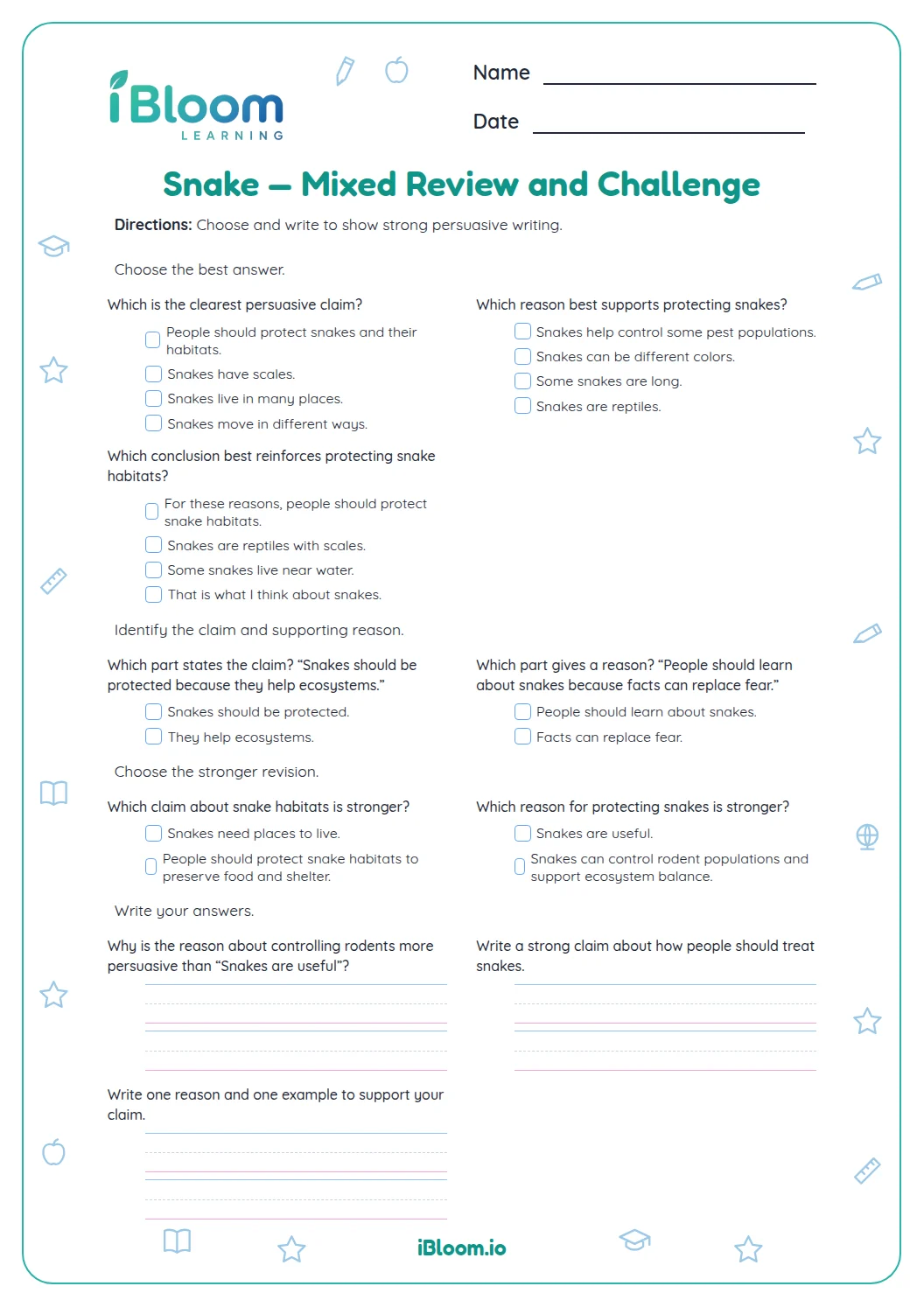
This free Grade 5 worksheet uses snake habitats and observation lessons to teach the parts of persuasive writing. Students label eight sentences as claims, reasons, examples, or conclusions, then answer four questions about relevant support. Two writing tasks ask for an opinion supported by a reason and detail, followed by a conclusion. The activities practice Common Core W.5.1b and W.5.1d. A separate answer key supplies the twelve fixed answers and two model responses.
Aligned to W.5.1b and W.5.1d
What are the four persuasive writing parts?
A claim tells readers what the writer thinks should happen. A reason explains why that choice makes sense. An example names a specific action or situation that illustrates the support. A conclusion returns to the opinion after the support.
Part A contains two sets of four sentences. One argues for protecting snake habitats; the other proposes lessons about observing snakes. Read each set in order before labeling the sentences.
How can a claim and a conclusion sound similar?
Both can express the same opinion, but they occur at different points in an argument. A claim introduces the position. A conclusion closes the discussion and may use a phrase such as “In closing” to point back to the support.
- 11: Our town should protect snake habitats. → C (claim)
- 23: For example, leave a patch of wild grass. → E (example)
- 34: In closing, our town should protect snake habitats. → F (final conclusion)
How do students decide whether a detail supports the claim?
Part B asks students to connect each choice to a stated purpose. Preserving homes supports protecting snake habitats. The color of a pencil does not explain why students should learn about observing snakes.
Two questions ask for useful support and two ask for an unrelated detail. Have students check which kind of answer is requested before choosing.
What belongs in the final two responses?
Question 13 asks students to choose either snake topic and state an opinion with a reason and a specific detail. Question 14 asks for a conclusion that returns to that opinion. Read the responses together as one short argument.
Students may disagree with the example claims. Accept a different position when the reason supports it, the detail explains the reason, and the conclusion follows from the same opinion.
How to use this worksheet
- 1Explain C = claim, R = reason, E = example, and F = final conclusion.
- 2Read each four-sentence set in Part A, then label each sentence by its job.
- 3In Part B, check whether the question asks for support or an unrelated detail.
- 4Choose one snake topic and write an opinion with a reason and a specific detail.
- 5Write a conclusion, then use the key to check labels and discuss how the written ideas connect.
Mistakes to discuss and fix
The mistake
Labeling the last sentence of each set as a claim because it states an opinion.
The fix
Look at its place after the support and its closing phrase, such as “In conclusion.” It wraps up the argument.
The mistake
Choosing “Our pencils are yellow” because it is a classroom detail.
The fix
Ask whether the detail explains why students should learn about observing snakes.
The mistake
Writing a conclusion that introduces a different snake topic.
The fix
Return to the opinion in question 13 and close that argument without starting a new one.
Common Core alignment
Support an opinion about snakes with a reason and a specific detail.
On this sheet: Students identify reasons and examples, select relevant support, and write a supported opinion.
Show the official wordingHide the official wording
Provide logically ordered reasons that are supported by facts and details.
Recognize and write a conclusion that returns to the opinion.
On this sheet: Part A identifies two conclusions; question 14 asks students to write a conclusion for their own opinion.
Show the official wordingHide the official wording
Provide a concluding statement or section related to the opinion presented.
What to practice next
Make more practice
Further reading
Questions parents and teachers ask
What are the snake topics on this worksheet?
The sheet uses two topics: protecting places where snakes live and teaching students about observing snakes. Part A presents a short argument for each topic. Part B checks whether details support the stated claims, and Part C lets students choose either topic for their own supported opinion and conclusion.
What do C, R, E, and F stand for?
C means claim, R means reason, E means example, and F means final conclusion. F gives the conclusion its own label because C already means claim. The letters appear in the Part A directions. Read each four-sentence set in order and decide what job each sentence does.
Do students need to research snakes before starting?
No; students can identify the writing parts from the sentences provided. The examples describe proposed habitat protection and observation lessons. For the final responses, students can use those ideas or propose another relevant detail. Check the connection between ideas instead of expecting a report of researched animal facts.
Can a student disagree with the sample opinions?
Yes; students may choose a different position on either snake topic in Part C. For example, someone might prefer a recorded observation lesson to an outdoor lesson. The reason should explain that preference, the detail should support the reason, and the conclusion should return to the same position.
What does the answer key provide?
The two-page key provides eight labels, four selected answers, and two sample written responses. Use the fixed answers for recognition and relevance questions. For the final pair, accept other responses when the opinion has connected support and the conclusion closes that argument without switching to a different topic.