
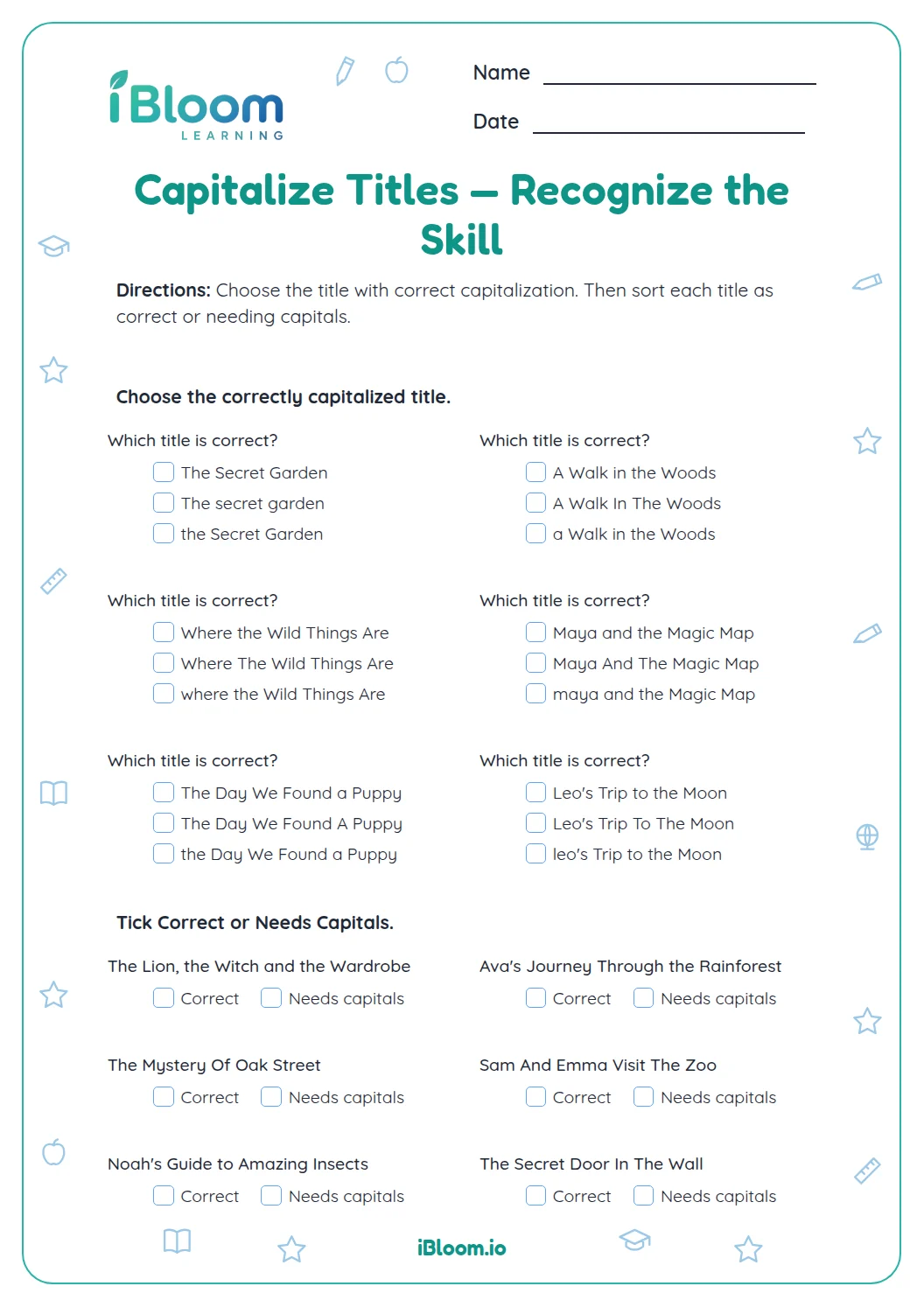

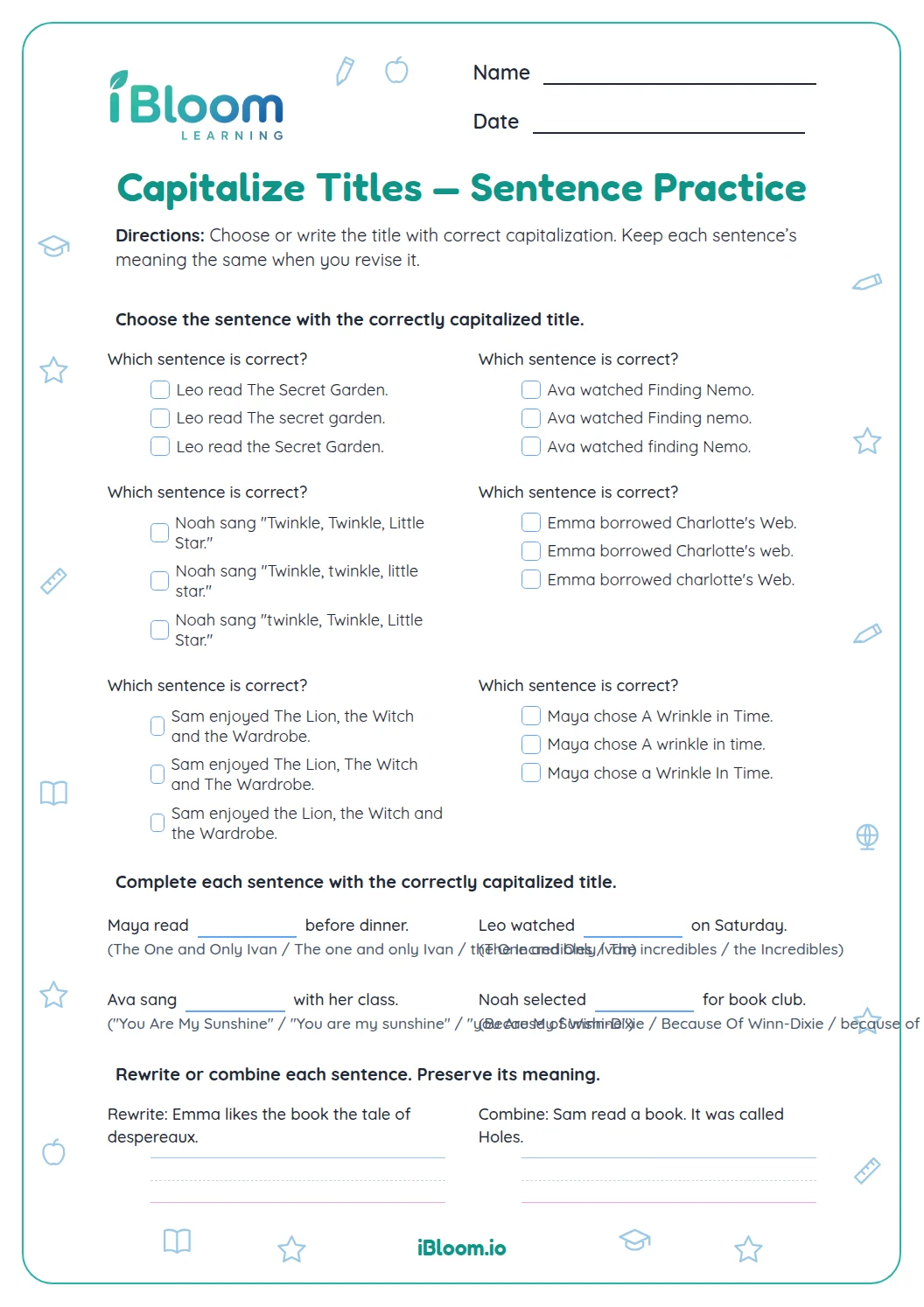

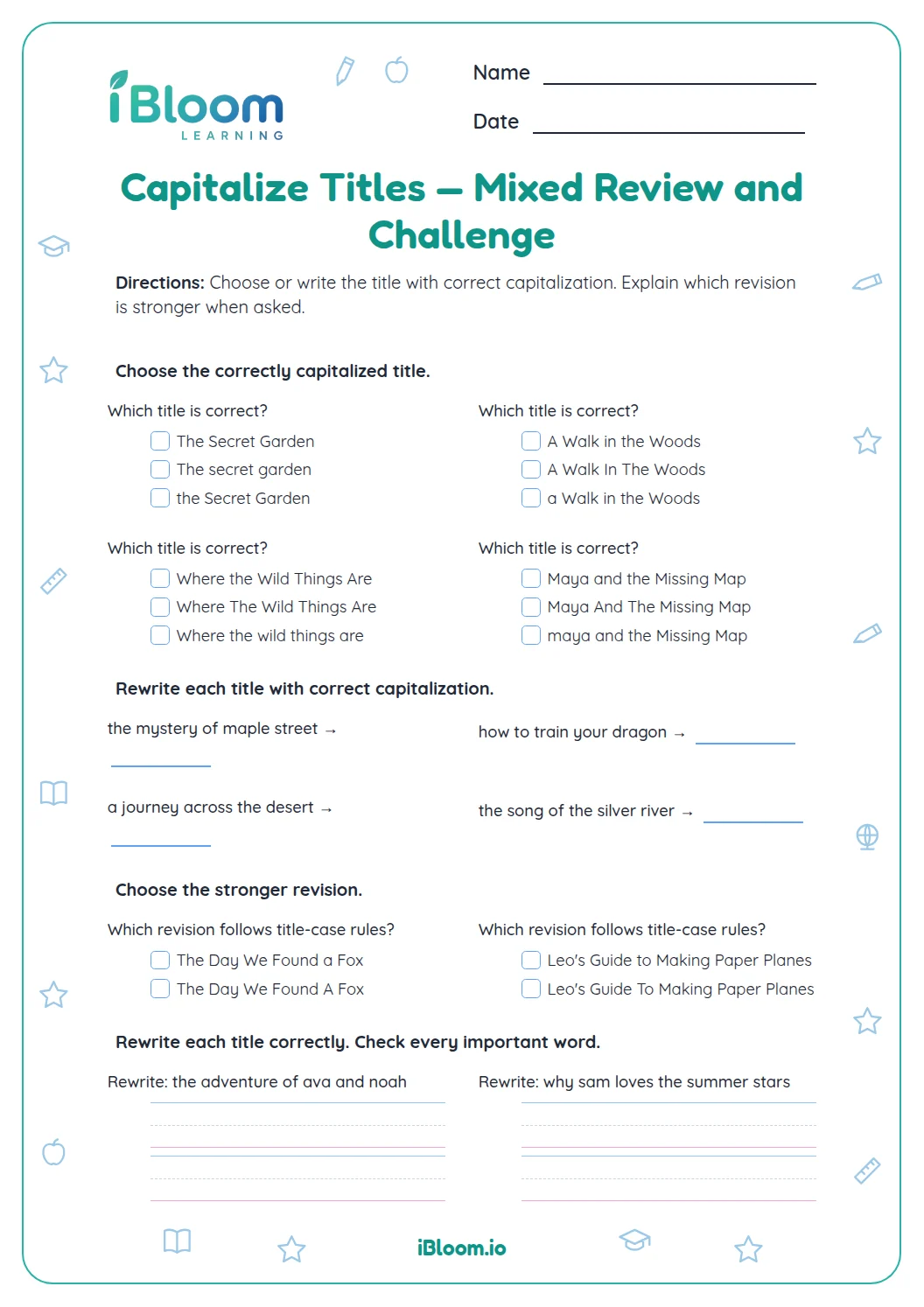


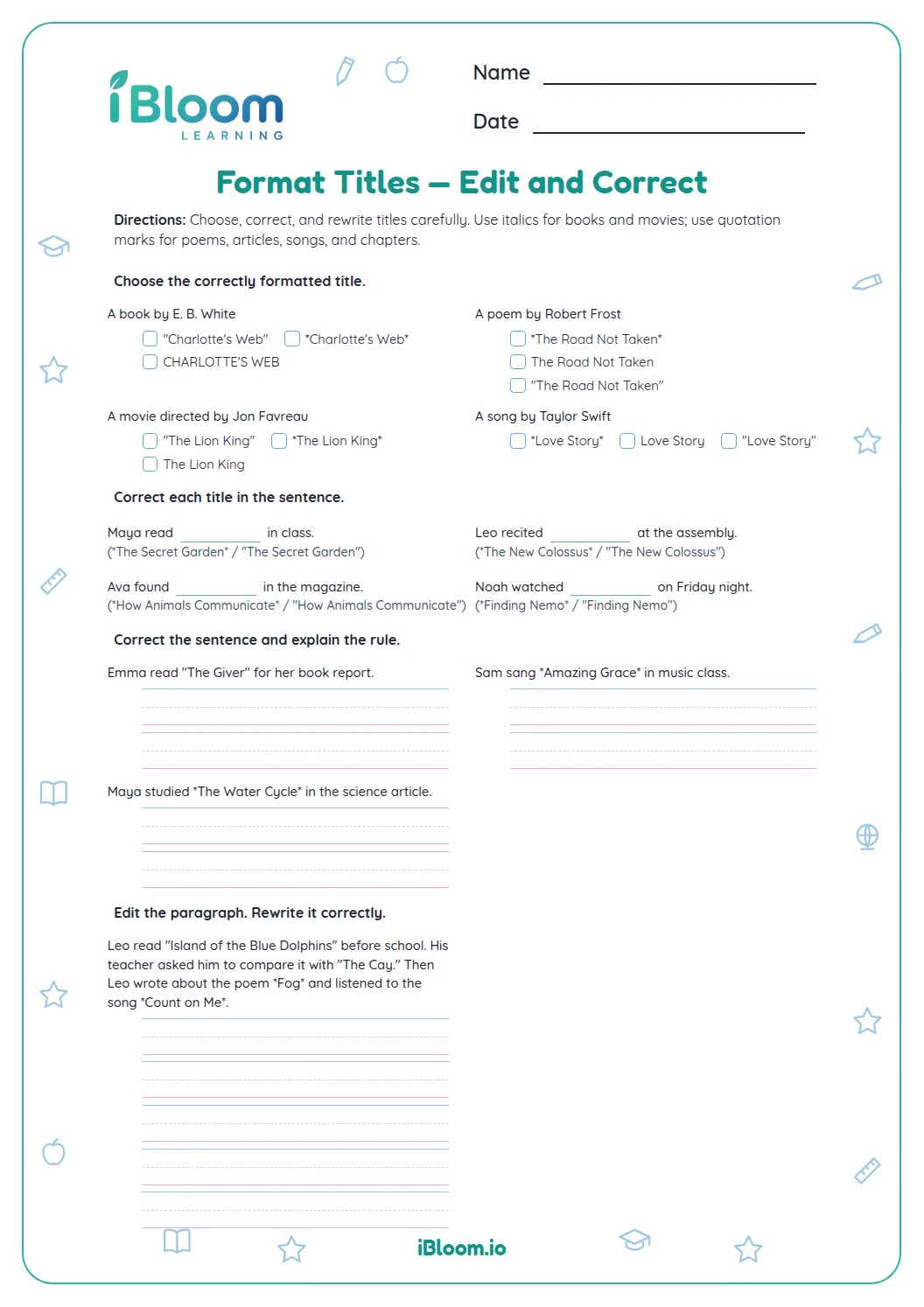



About this worksheet
This free Grade 5 worksheet gives students a reason to check every word in a title. Part A asks them to repair six titles, and Part B adds two more. Part C puts four titles inside sentences, and Part D asks for two original titles. Students practice Common Core L.5.2 by applying capitalization conventions in their writing. The answer key supplies corrected titles and sentences, plus samples for the creative tasks.
Aligned to L.5.2
Which capitalization rule does this sheet use?
Start with the first and last words, then check the words between them. Capitalize important words such as nouns, pronouns, verbs, adjectives, and adverbs. Keep short articles, conjunctions, and prepositions lowercase inside a title.
Short does not mean lowercase. Is is a verb, and I is a pronoun. Both receive capitals in the practice titles. Use this same convention when checking the child’s two original titles.
How do you repair a title word by word?
Question 1 gives a useful model because it has small words at the start and inside. Read the title aloud, then decide about each word.
- 1Original: the secret of the lake
- 2The starts the title. Secret and Lake are main words.
- 3Keep of and the lowercase inside the title.
- 4Correct title: The Secret of the Lake
How does the practice move into writing?
Part C keeps the surrounding sentence in ordinary sentence case while students capitalize the title within quotation marks. In question 12, In takes a capital because it is the title’s last word.
Part D asks for a lost-map title using of and an animal title using and. Check that the requested word occurs inside each title, then check capitals. The samples demonstrate the rule; students can invent different titles.
How to use this worksheet
- 1Read the printed rule together and name the first and last words in question 1.
- 2In Part C, locate the quoted title before changing any letters.
- 3Read each Part D prompt and plan a title that includes its required word.
- 4Read each Part C prompt and plan a title that includes its required word.
- 5Use the key to check fixed answers, then check the original titles against the rule.
Mistakes to notice and how to help
The mistake
Capitalizing every word, as in The Secret Of The Lake.
The fix
Keep of and the lowercase when they are inside this title.
The mistake
Leaving is lowercase because it has only two letters.
The fix
Identify its job: is is a verb, so it takes a capital in a title.
The mistake
Leaving the final in lowercase in A Place to Rest In.
The fix
Check the last word separately; the sheet’s rule capitalizes it.
Common Core alignment
Apply standard English capitalization conventions when writing titles.
On this sheet: Students correct and create titles by applying capitalization conventions.
Show the official wordingHide the official wording
Demonstrate command of the conventions of standard English capitalization, punctuation, and spelling when writing.
What to practice next
Make more practice
Further reading
Questions parents and teachers ask
Should students capitalize every word in a title?
No; this sheet keeps the listed small words lowercase when they occur inside a title. For example, The Secret of the Lake has lowercase of and the. Students should check first and last words separately, because their position gives them a capital even when they are small words.
Why is Is capitalized in question 5?
Is is a verb, so it is a main word under the rule used here. The repaired title is Is the Gate Open. Use this example to remind students to consider a word’s job rather than its length when deciding whether it needs a capital.
What should students change in Part B?
Students should correct the capitalization of the title inside each sentence. They copy the entire sentence so they can practice applying the rule in connected writing. The surrounding words and punctuation are already provided correctly, and the key shows a complete corrected sentence for each item.
How do I check the two original titles?
Check the topic, required word, and capitalization rather than matching the key exactly. Question 11 needs a lost-map title with of inside it; question 12 needs two animals and an internal and. The answer key labels its suggestions as samples because many different titles can satisfy those requirements.
What makes the final word In different in question 10?
In is capitalized because it ends the title A Place to Rest In. The printed rule gives first and last words capitals, even when those words would stay lowercase inside a title. Ask the student to compare that ending with the internal in in An Owl in the Attic.