







About this worksheet
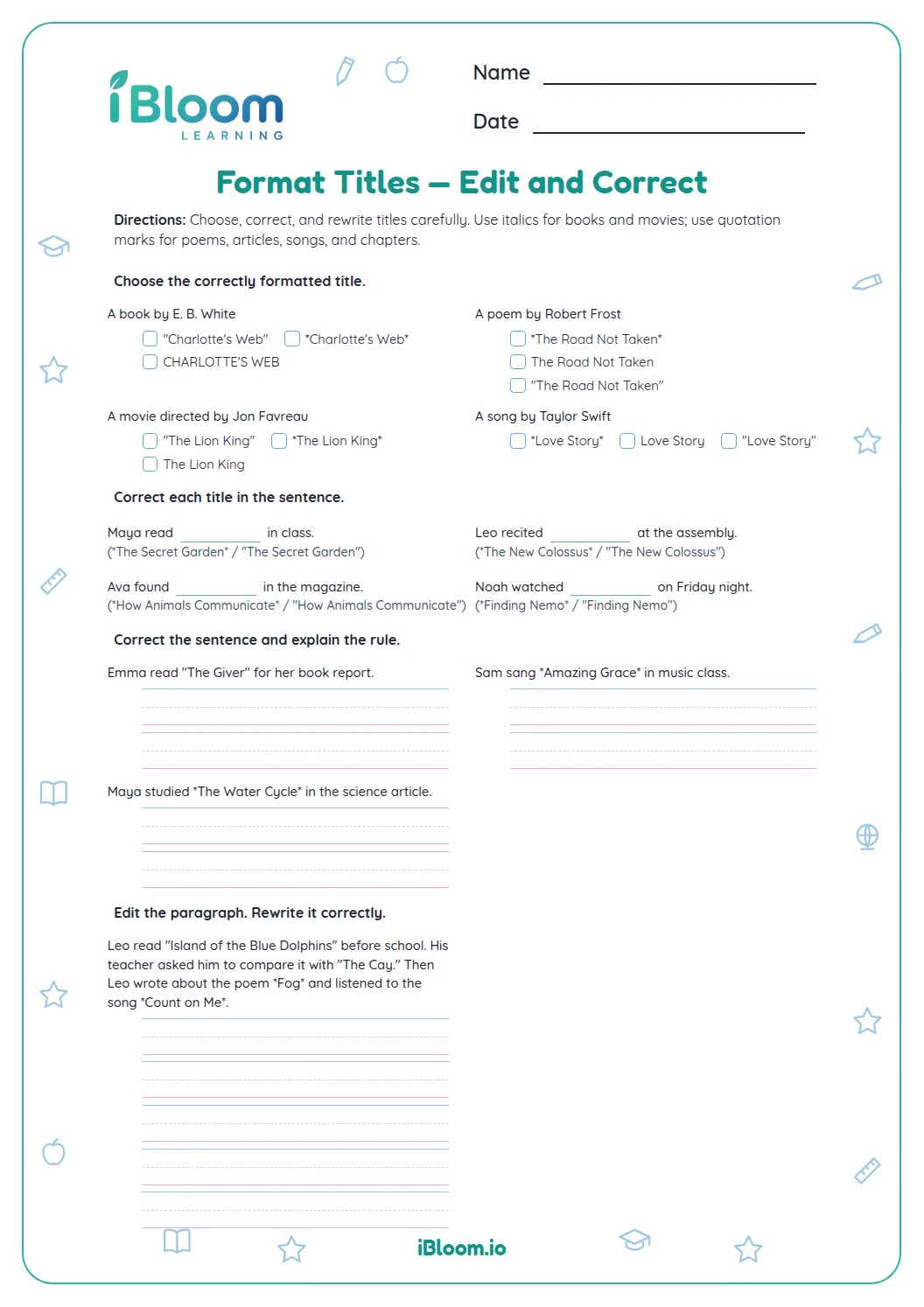
This free Grade 5 worksheet turns title-formatting rules into writing practice. Students underline book and movie titles and place poem and song titles in quotation marks. Part A asks them to copy six titles with the right marks. Part B gives four sentences to rewrite, and Part C asks for four original sentences using supplied titles. The 14 activities practice Common Core L.5.2d. These example titles require no knowledge of particular works. The answer key identifies titles to underline and gives models for the open responses.
Aligned to L.5.2d
Which titles get underlining or quotation marks?
For this handwriting activity, underline the full title of a book or movie. Put quotation marks around the full title of a poem or song. The prompts identify the kind of work so students can choose the convention from that information.
When typing, italics can take the place of underlining for book or movie titles. Keep the capital letters supplied on this sheet; the main decision here is how to mark the title.
How do you format a title inside a sentence?
First find the exact title. Mark those words, then check the punctuation that belongs to the complete sentence. A period or comma goes inside closing quotation marks in these US examples.
- 1Prompt: We sang the song Rain on the Roof.
- 2Rewrite: We sang the song “Rain on the Roof.”
- 3The quotation marks enclose the song title; the sentence period comes before the closing mark.
How do the final four questions apply the rule?
Part C supplies a book title, a poem title, a movie title, and a song title. Students create one sentence for each. Before writing, identify the kind of work and decide which marks its title needs.
Accept different ideas in the final sentences. Check that each is complete, uses the supplied title unchanged, and has the correct title marks.
How to use this worksheet
- 1Read the handwriting rule at the top and identify each work as a book or a short work.
- 2Copy the six Part A titles, keeping their capital letters.
- 3Rewrite each Part B sentence and mark only the title words.
- 4Write a complete sentence for each Part C title.
- 5Compare with the key, then check underlining and both quotation marks.
Mistakes to notice and fix
The mistake
Putting quotation marks around a book or movie title.
The fix
Use book or movie in the prompt as the cue to underline the entire title.
The mistake
Underlining the whole sentence.
The fix
Locate the first and last word of the title; underline only that span.
The mistake
Leaving off the closing quotation mark.
The fix
Point to the beginning and end of the short-work title and check for a pair of marks.
Common Core alignment
Mark book or movie titles with underlining and short-work titles with quotation marks.
On this sheet: Students format supplied titles, rewrite sentences, and use titles in their own sentences.
Show the official wordingHide the official wording
Use underlining, quotation marks, or italics to indicate titles of works.
What to practice next
Make more practice
Further reading
Questions parents and teachers ask
Do students need to know these books or movies?
No background reading or viewing is needed for these example titles. Each prompt tells students whether the title names a book, movie, poem, or song. That information determines the formatting. Students can focus on the marks without needing to recognize a title or describe its plot.
Should my child underline or use italics?
Use underlining on this handwritten worksheet. Italics serve the same purpose for book or movie titles in typed writing, so you can mention that connection while checking the work. For poems and songs on this sheet, students should use a pair of quotation marks instead.
How much original writing is included?
Four questions ask students to compose their own sentences, one each for a book, poem, movie, and song. The earlier ten questions supply either a title to copy or a sentence to rewrite. Students practice the marks first, then apply them while deciding what to write.
How should I check the answer key’s underlining notes?
Treat each underlining note as an instruction about the student’s handwriting. The key names the title that should have a line beneath it; students do not need to copy the note itself. For quotation-mark answers, check both marks and the placement of the sentence period.
What does CCSS L.5.2d mean for this sheet?
CCSS L.5.2d asks students to use underlining, quotation marks, or italics to indicate titles of works. Here, students practice that choice in handwritten responses. The supplied work types make the decision clear, and the final four sentences give them a chance to apply the convention independently.