




About this worksheet
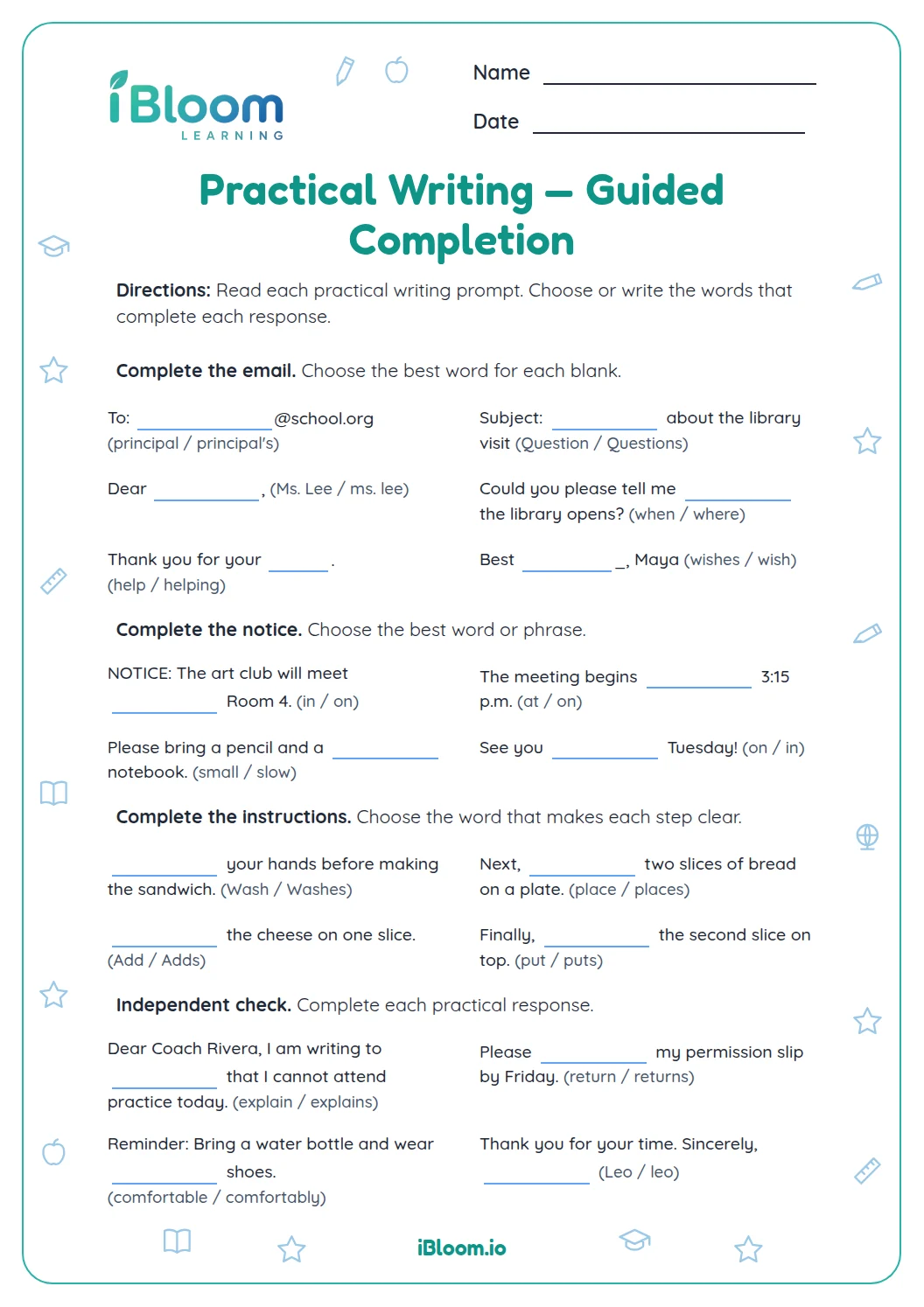
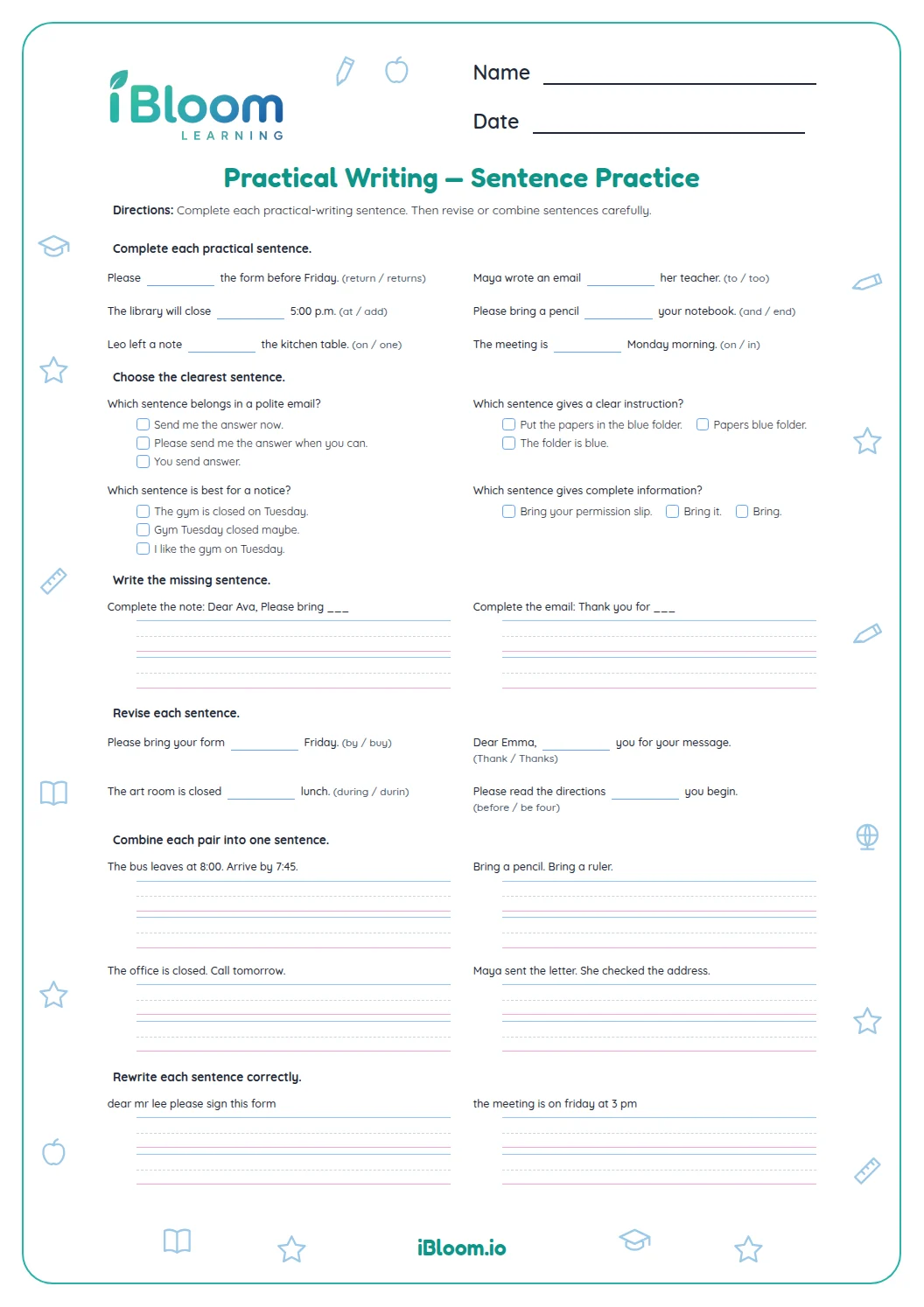
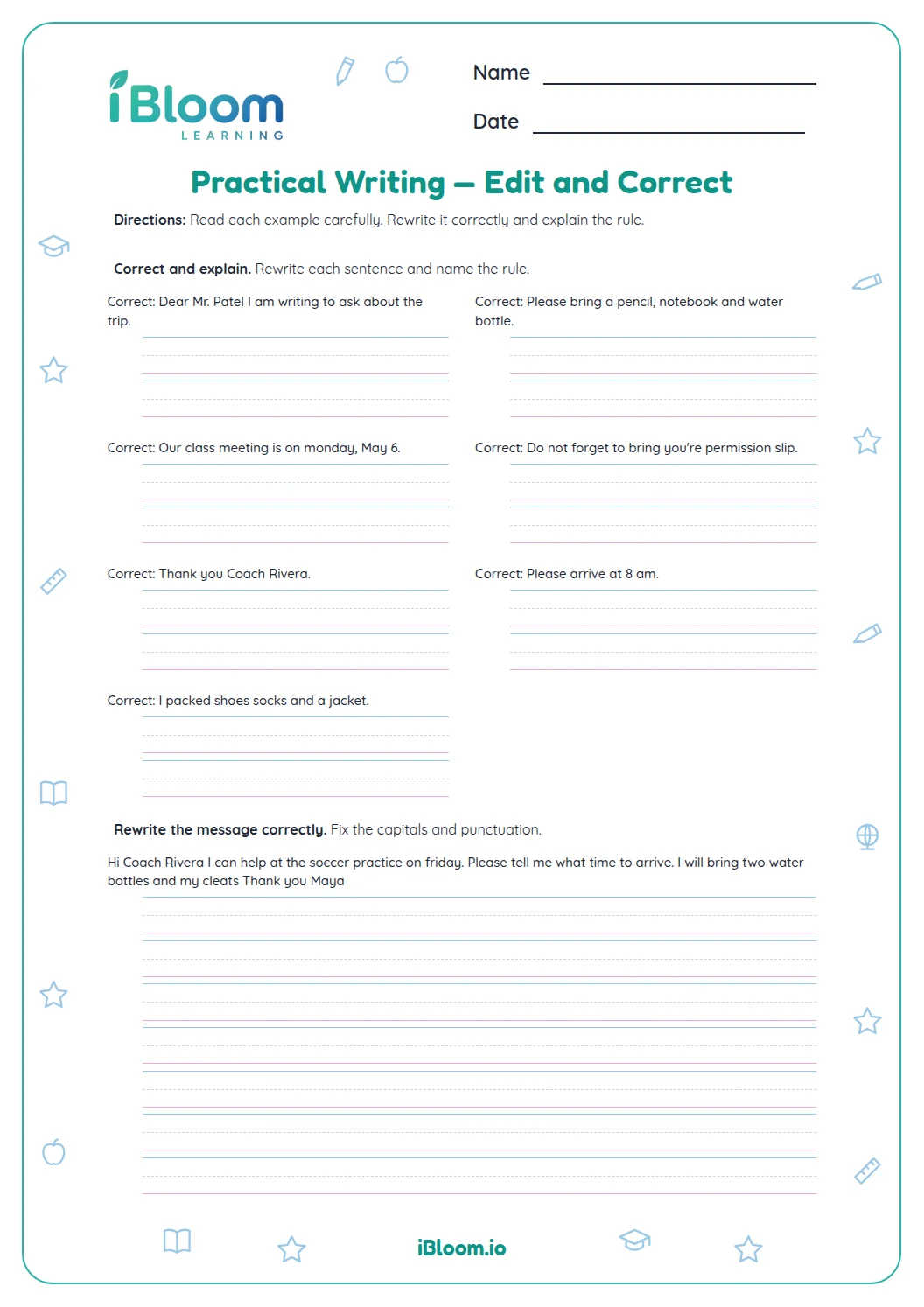
This free printable Grade 5 worksheet practices writing that helps someone act: a request, an invitation, a notice, or a short set of directions. Ten tasks move from choosing a suitable message to repairing details and writing two brief notes. Part A focuses on audience and purpose, Part B makes vague wording specific, and Part C combines a courteous tone with essential information. The work supports Common Core W.5.4, clear writing suited to a task, purpose, and audience. The separate key gives exact choices and sample wording for responses that can vary.
Aligned to W.5.4
What will children write?
Part A asks children to choose a useful format, a courteous request, a specific email subject, and the detail missing from an invitation. The four choices set up a simple question: what will help this reader?
Part B has four one-sentence repairs. The facts are supplied, so children can concentrate on replacing vague words, adding a place, ordering directions, and making a demand polite. Part C asks for a request to a librarian and a notice to classmates, each in one or two sentences.
How do you replace vague words with useful details?
Ask what the reader would have to guess. Words such as “it,” “then,” and “there” can work when both people already know the details. A standalone reminder needs those details stated.
Question 5 supplies the missing object and day. Children can change the wording, but both notebook and Friday must remain in the revised sentence.
- 1Draft: “Bring it then.”
- 2Facts: bring your notebook on Friday.
- 3Clear revision: “Bring your notebook on Friday.”
How can a child check a message before sending it?
Read the message as if you were receiving it for the first time. Can you tell what is being requested, when it matters, and where to go or what to bring? Check only the details relevant to that task.
For the librarian request, the message needs two animal books and a return date of Monday. For the club notice, it needs Friday at 3 p.m., Room 8, and a pencil. The key models a complete response; other clear, courteous versions can also work.
How to use this worksheet
- 1Read the Part A directions and let your child choose the four answers independently.
- 2Ask who would read each message and what that person needs to know.
- 3For Part B, underline the supplied facts before rewriting each sentence.
- 4Write the two Part C messages, keeping each to one or two sentences.
- 5Compare with the key for required details, then reread aloud to check tone and clarity.
Mistakes to watch for
The mistake
Leaving “it” or “there” in a message when the reader has no context.
The fix
Replace the vague word with the actual object or place, as in notebook or Room 8.
The mistake
Making a request polite but dropping the deadline.
The fix
Keep both the courteous wording and the needed time; question 8 still needs tomorrow.
The mistake
Adding friendly sentences while omitting an essential detail.
The fix
Check the supplied facts one by one before adding any extra wording.
Common Core alignment
Write clear messages with details and a tone suited to the reader and purpose.
On this sheet: Children choose message types, clarify instructions, and compose requests and notices for named readers.
Show the official wordingHide the official wording
Produce clear and coherent writing in which the development and organization are appropriate to task, purpose, and audience. (Grade-specific expectations for writing types are defined in standards 1-3 above.)
What to practice next
Make more practice
Further reading
Questions parents and teachers ask
What kinds of practical writing are included?
The worksheet includes requests, reminders, an invitation check, an email subject, directions, and a club notice. These short forms give children a reason to think about a reader. The final two tasks ask them to put details together in their own words, with model responses on the key.
How long should the final messages be?
Each final message should be one or two sentences. Question 9 needs a polite request for two animal books and a promise to return them Monday. Question 10 needs the club meeting day, time, room, and what to bring. A longer response is unnecessary when those details are clear.
Must children copy the sample answers exactly?
No, the sample answers show one workable way to write each response. Check whether the child preserves every supplied fact and writes clearly for the named reader. For example, “Please bring your notebook on Friday” works as well as “Bring your notebook on Friday” in question 5.
How can I help without writing the messages for my child?
Ask the child to name the reader and underline the facts first. Then use a specific question such as “When should this be returned?” or “Where will the club meet?” Let the child choose the sentence wording. Use the key afterward to check completeness and a suitable tone.
What makes the last part a challenge?
The last part combines decisions that earlier questions practice separately. Children must select a suitable tone, keep all the facts, and organize them into a usable message. The librarian request and club notice have different readers and purposes, so the same opening will not necessarily suit both tasks.